Another Way to Say “at The Same Time”: 30 Better Alternatives
“At the same time” is perfectly natural English, but it can become repetitive when you use it several times in an essay, report, email, or conversation. Finding another way to say “at the same time” depends on what you actually mean. You might be describing two actions happening together, two activities overlapping, or two contrasting ideas that are both true.
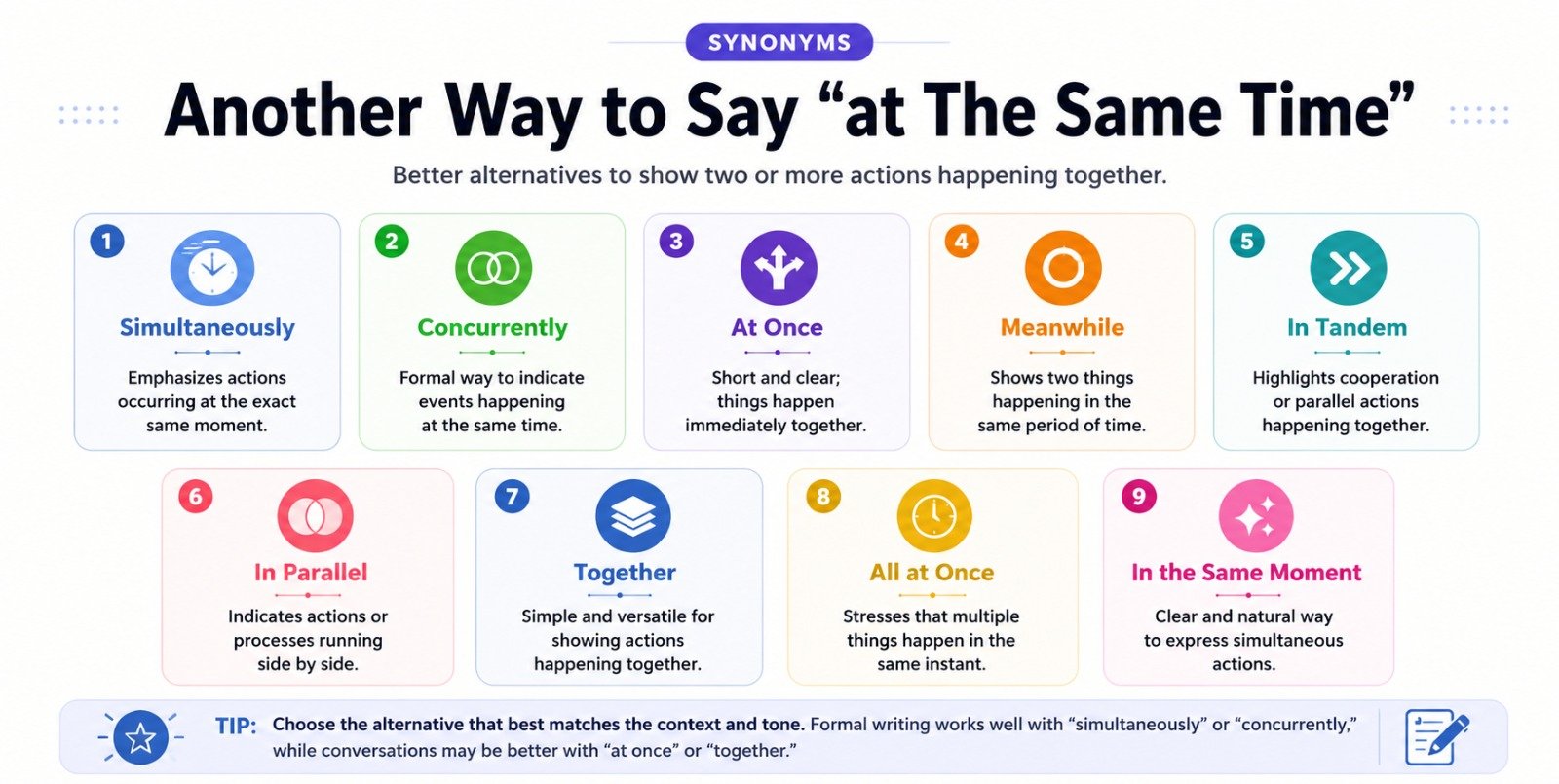
Useful alternatives include simultaneously, concurrently, meanwhile, at once, in parallel, in tandem, however, nevertheless, even so, still, and yet. They aren’t all interchangeable, though. “Simultaneously” relates mainly to timing, while “nevertheless” introduces contrast. Major dictionaries recognize both the simultaneous and contrasting senses of “at the same time.”
Another way to say “at the same time” is simultaneously when events happen together. Other useful choices include concurrently, meanwhile, at once, in parallel, and in tandem. When the phrase introduces a contrast rather than literal timing, use however, nevertheless, even so, still, or yet.
What Does “At the Same Time” Mean?
“At the same time” has two particularly important uses in English.
The first is literal. It describes people, events, actions, or conditions occurring together.
Example:
“The two runners crossed the finish line at the same time.”
The second introduces a contrasting or qualifying idea.
Example:
“The job is demanding, but at the same time, it is extremely rewarding.”
In the second sentence, no timing is being discussed. The speaker is saying that two apparently opposing qualities are true together. Dictionaries therefore give both “simultaneously” and contrast words such as “nevertheless” as possible equivalents, depending on context.
This distinction matters because replacing every occurrence with “simultaneously” can change or distort your meaning.
Best Alternatives to “At the Same Time”
| Alternative | Meaning / Function | Tone | Best Used For |
|---|---|---|---|
| Simultaneously | At exactly or nearly the same moment | Formal/neutral | Essays, reports, technical writing |
| Concurrently | During overlapping periods | Formal | Business, academic, legal contexts |
| Meanwhile | During another event or period | Neutral | Narratives, reports, explanations |
| At once | Together at one moment | Neutral/casual | Speech and general writing |
| In parallel | Separate processes progressing together | Professional | Projects, technology, business |
| In tandem | Two things working together | Professional | Teams, strategies, processes |
| In unison | Performing the same action together | Neutral | Speaking, singing, movement |
| Side by side | Existing or working alongside each other | Neutral | Cooperation and development |
| However | Introduces a contrasting point | Formal/neutral | Essays and professional writing |
| Nevertheless | Something remains true despite a contrast | Formal | Academic and formal writing |
| Nonetheless | Similar to “nevertheless” | Formal | Essays and reports |
| Even so | Despite what was just stated | Neutral | General and formal writing |
| Still | Introduces a qualification or contrast | Neutral | Conversation and writing |
| Yet | Concise contrast | Neutral/formal | Essays and compact sentences |
| That said | Qualifies a previous statement | Professional/neutral | Reports, discussion, emails |
When the Alternatives Are Not Interchangeable
A synonym list can be misleading if it suggests that every alternative can simply replace “at the same time.”
Compare these sentences:
“Both alarms rang at the same time.”
Here, simultaneously works:
“Both alarms rang simultaneously.”
But nevertheless doesn’t work because there is no contrast.
Now consider:
“The plan is expensive, but at the same time, it may save money in the long run.”
Here, “simultaneously” would sound unnatural. The sentence is presenting two contrasting facts, so however, nevertheless, even so, or that said may be more suitable.
Another important distinction exists between simultaneous and concurrent. “Simultaneous” emphasizes the same moment, while “concurrent” can describe activities that overlap over a period rather than occurring at precisely the same instant.
Other Ways to Say “At the Same Time” for Simultaneous Actions
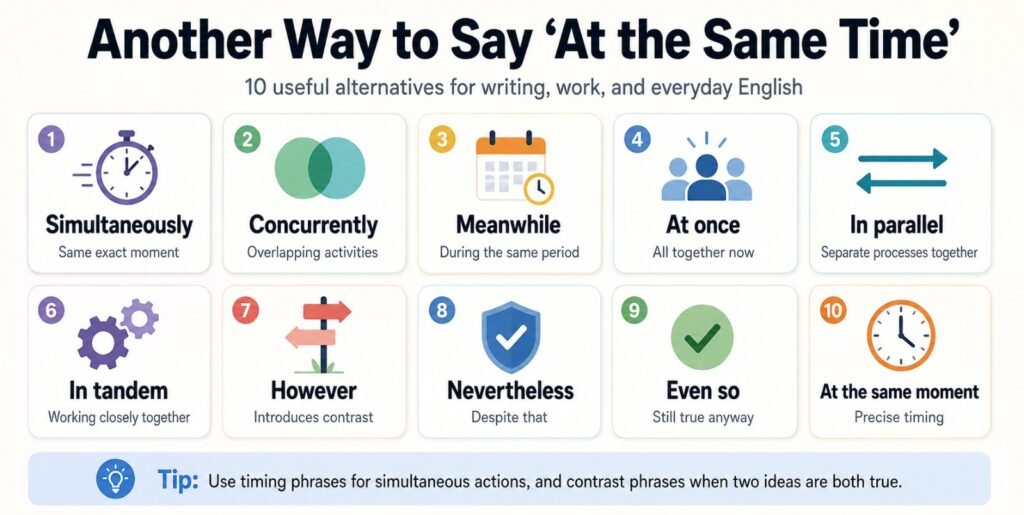
When your meaning is literally “happening together,” these options are the most useful.
1. Simultaneously
“Simultaneously” is probably the closest formal replacement when two actions or events happen at essentially the same moment. It is especially natural in academic, scientific, technical, and professional writing.
Example:
“The two systems were activated simultaneously.”
It sounds more precise than:
“The two systems were activated at the same time.”
Avoid it when “at the same time” is being used to introduce a contrasting opinion.
2. Concurrently
“Concurrently” works when two activities happen during overlapping periods.
Example:
“The company is developing three projects concurrently.”
It is common in professional, legal, technical, and academic contexts. Unlike “simultaneously,” it doesn’t always imply that everything begins at the exact same second.
3. Meanwhile
“Meanwhile” introduces something happening during the period in which another event is occurring. Cambridge includes it among words related to the simultaneous sense of “at the same time.”
Example:
“Emma prepared the presentation. Meanwhile, Daniel checked the figures.”
“Meanwhile” usually connects separate actions rather than emphasizing one precise moment.
4. At Once
“At once” is concise and natural when several things happen together.
Example:
“Everyone started talking at once.”
It works particularly well in everyday English.
Be aware that “at once” can also mean immediately:
“Come here at once.”
In that sentence, it doesn’t mean “at the same time.”
5. Together
“Together” is useful when people perform an action as a group.
Example:
“They lifted the box together.”
It emphasizes cooperation more than precise timing.
6. In Unison
“In unison” is ideal when people speak, sing, respond, or move together.
Example:
“The audience shouted the answer in unison.”
It is more specific than “at the same time,” so it isn’t appropriate for every simultaneous action.
Other Ways to Say “At the Same Time” Professionally
Professional writing often benefits from expressions that describe the relationship between tasks more precisely.
7. In Parallel
“In parallel” means that separate processes or activities are progressing alongside one another.
Example:
“Testing and development will continue in parallel.”
This works particularly well in project management, technology, engineering, and business communication.
8. In Tandem
“In tandem” suggests that two people, departments, ideas, or processes work together.
Example:
“The marketing and sales teams will work in tandem.”
It communicates cooperation as well as simultaneous activity.
9. Side by Side
“Side by side” can describe people or processes operating alongside each other.
Example:
“The two departments worked side by side during the transition.”
The expression feels less technical than “concurrently” or “in parallel.”
10. Alongside
“Alongside” is useful when one activity accompanies another.
Example:
“The company introduced new training alongside its updated safety procedures.”
It doesn’t necessarily mean both actions occurred at precisely the same instant.
11. In Concert
“In concert” means acting together or in a coordinated manner and is recognized as an alternative in thesaurus references.
Example:
“The agencies worked in concert to resolve the issue.”
It is more about coordination than literal timing.
12. Concurrent With
“Concurrent with” can be useful in formal reports when one event takes place during the same period as another.
Example:
“The expansion occurred concurrent with increased consumer demand.”
In ordinary prose, “at the same time as” may sound more natural, so don’t choose this form merely to make a sentence sound more sophisticated.
Another Way to Say “At the Same Time” in an Essay
In an essay, first decide whether you’re describing timing or contrast.
If two developments occur during the same period, consider:
- Simultaneously
- Concurrently
- Meanwhile
- During the same period
- In parallel
For example:
Original:
“Urban populations increased rapidly. At the same time, demand for public transportation grew.”
Alternative:
“Urban populations increased rapidly. Meanwhile, demand for public transportation grew.”
Or:
“Demand for public transportation grew concurrently with the expansion of urban populations.”
If you’re introducing a competing idea, however, a contrast transition is usually better.
Other Ways to Say “At the Same Time” in an Essay When Showing Contrast
13. However
“However” is one of the clearest choices when the second statement contrasts with the first.
Example:
“The policy could reduce costs. However, it may also limit access to services.”
Use it when you want a straightforward academic or professional transition.
14. Nevertheless
“Nevertheless” means that something remains true despite the information that came before it.
Example:
“The evidence was limited. Nevertheless, the findings were significant.”
Grammar resources and major thesauruses list it as a strong alternative when “at the same time” has a contrasting rather than chronological meaning.
15. Nonetheless
“Nonetheless” is very close to “nevertheless.”
Example:
“The approach has several weaknesses. Nonetheless, it offers a useful starting point.”
It fits formal essays, reports, and analytical writing.
16. Even So
“Even so” acknowledges what was just said before presenting something that remains true despite it.
Example:
“The deadline is ambitious. Even so, the team believes it can finish on schedule.”
This sounds natural without being overly formal.
17. Still
“Still” is shorter and slightly more conversational.
Example:
“The solution isn’t perfect. Still, it represents substantial progress.”
It works in essays, articles, and everyday writing.
18. Yet
“Yet” creates a concise contrast.
Example:
“The system is simple yet remarkably powerful.”
“Yet” is especially useful when both qualities can fit naturally into one sentence.
19. That Said
“That said” acknowledges a previous point before introducing a limitation, qualification, or different perspective.
Example:
“The early results are promising. That said, more research is needed.”
It’s common in professional and explanatory writing, although “however” or “nevertheless” may suit highly formal academic prose better.
20. On the Other Hand
Use “on the other hand” when you’re presenting another side of an argument.
Example:
“Remote work offers greater flexibility. On the other hand, it can make spontaneous collaboration more difficult.”
It is not a direct synonym for every use of “at the same time.” It specifically signals comparison or contrast.
Professional Ways to Say “At the Same Time”
If you’re writing an email, report, proposal, or workplace update, these choices tend to sound especially natural:
Simultaneously
“We will update both platforms simultaneously.”
Concurrently
“The two reviews will be conducted concurrently.”
In parallel
“Our teams will work on both stages in parallel.”
In tandem
“Finance and operations will work in tandem on the rollout.”
Meanwhile
“The technical team will handle the migration. Meanwhile, customer support will prepare guidance for users.”
However
“The proposal could reduce operating costs. However, implementation will require additional training.”
That said
“The timeline is challenging. That said, we believe it remains achievable.”
A professional way to say “at the same time” isn’t necessarily the most formal-looking word. The best choice is the one that states the relationship between the ideas clearly.
Other Ways to Say “At the Same Time” in Formal Writing
For more formal contexts, consider these options:
21. During the Same Period
This is useful when two developments overlap over days, months, or years rather than occurring at one precise moment.
Example:
“Industrial production increased during the same period.”
It is especially useful in historical, academic, and analytical writing.
22. At the Same Moment
This alternative emphasizes precise timing.
Example:
“Both signals disappeared at the same moment.”
It’s clearer than “concurrently” when the exact moment matters.
23. Concurrently With
This construction relates one event formally to another.
Example:
“Consumer spending rose concurrently with employment growth.”
It works best in reports and formal analysis.
24. While
Sometimes the simplest replacement is “while.”
Example:
“She worked full time while completing her degree.”
This is much more natural than:
“She worked full time and completed her degree at the same time.”
However, “while” can also introduce contrast:
“While the proposal has advantages, it also carries risks.”
Context determines its function.
25. As
“As” can show that two actions occur together.
Example:
“The lights dimmed as the music began.”
It is useful when events unfold at approximately the same moment rather than when two long-running processes merely overlap.
Other Natural Alternatives Worth Knowing
Several other expressions can fit specific situations.
26. All at Once
Use this when several things happen suddenly together.
Example:
“All the notifications appeared at once.”
It can imply suddenness, which the neutral phrase “at the same time” doesn’t necessarily convey.
27. At One and the Same Time
This emphatic expression stresses that two seemingly different things are true simultaneously.
Example:
“The experience was frightening and exciting at one and the same time.”
It is longer than the original phrase, so it is most useful when emphasis is intentional.
28. All the While
“All the while” means throughout the time that another situation continues.
Example:
“He appeared relaxed, all the while worrying about the result.”
It expresses duration rather than one exact shared moment.
29. In the Meantime
“In the meantime” refers to what happens during an interval before something else occurs or finishes.
Example:
“The repairs will take two hours. In the meantime, customers can use the second entrance.”
It is related to “meanwhile,” but it is not a general replacement for every occurrence of “at the same time.”
30. As This Happens
This phrase can help in explanations, instructions, and narratives.
Example:
“The liquid begins to cool. As this happens, the material gradually hardens.”
It works when the second process develops during the first.
Is “At the Same Time” Formal?
Yes. “At the same time” is acceptable in both formal and informal English. You don’t need to replace it simply because you’re writing an essay or professional document.
Compare:
Natural:
“The study found improved efficiency, but at the same time identified several risks.”
More concise:
“The study found improved efficiency but nevertheless identified several risks.”
The second isn’t automatically “better.” It simply creates a different rhythm and emphasizes the contrast more strongly.
For literal timing, “simultaneously” or “concurrently” can sound more precise in technical writing.
How to Use “At the Same Time” in a Sentence
The phrase can appear naturally in several grammatical patterns.
Two actions:
“She was studying and working at the same time.”
Two people:
“We both answered at the same time.”
Two qualities:
“The movie was funny and unsettling at the same time.”
Contrasting ideas:
“I understand why he made the decision, but at the same time, I disagree with it.”
Professional situation:
“We need to improve efficiency while at the same time maintaining service quality.”
Two events:
“The announcement came at the same time as the quarterly results.”
These examples also show why no single synonym can replace the phrase in every sentence.
Common Mistakes When Replacing “At the Same Time”
Using “Simultaneously” for a Contrast
Consider:
“The apartment is expensive, but at the same time, the location is excellent.”
Changing this to:
“The apartment is expensive, but simultaneously, the location is excellent.”
sounds awkward because the sentence isn’t really about time. “However,” “still,” or “that said” is more appropriate.
Using “Meanwhile” for an Exact Moment
“Meanwhile” normally describes something happening during another event or period. If two alarms sound at precisely the same moment, “simultaneously” is clearer.
Treating “Concurrently” and “Simultaneously” as Identical
They overlap, but “concurrently” is particularly useful for activities existing over the same period, while “simultaneously” more strongly emphasizes shared timing.
Making Simple Writing Unnecessarily Formal
“The children shouted together” may sound more natural than “the children vocalized concurrently.”
A good alternative should improve clarity, not merely replace a familiar phrase with a more complicated word.
How to Choose the Right Alternative
Ask what relationship you’re trying to express.
If two things happen at exactly the same moment, simultaneously is usually the strongest choice.
If two activities overlap over a period, try concurrently.
If separate actions are progressing alongside one another, consider in parallel.
If two teams or processes cooperate, in tandem may be more accurate.
If you’re moving from one event to another happening during the same period, meanwhile works naturally.
If you’re presenting a contrasting argument, choose however, nevertheless, even so, still, or yet.
And when “at the same time” already sounds natural and clear, there is no need to replace it.
Frequently Asked Questions
What Is Another Way to Say “At the Same Time”?
“Simultaneously” is one of the closest alternatives when you’re describing two actions happening together. Other possibilities include “concurrently,” “meanwhile,” “at once,” “in parallel,” and “in tandem.” If you’re expressing contrast, use words such as “however” or “nevertheless” instead.
What Is Another Way to Say “At the Same Time” in an Essay?
For timing, use simultaneously, concurrently, meanwhile, during the same period, or in parallel. When you mean “despite that” or are adding a contrasting point, however, nevertheless, nonetheless, even so, or yet may fit better.
How Do You Say “At the Same Time” Professionally?
Professional alternatives include simultaneously, concurrently, in parallel, in tandem, meanwhile, and alongside. The most appropriate expression depends on whether you’re discussing timing, overlapping projects, or coordinated work.
Is “At the Same Time” Formal?
Yes. “At the same time” can be used in formal and informal communication. Formal writing may sometimes benefit from a more precise term such as “simultaneously,” “concurrently,” or “nevertheless,” but the original expression isn’t inherently informal.
What Is the Difference Between “Simultaneously” and “Concurrently”?
“Simultaneously” strongly emphasizes things occurring at the same moment. “Concurrently” often describes activities that take place during overlapping periods. For example, two buttons may be pressed simultaneously, while two courses may run concurrently.
Can I Start a Sentence With “At the Same Time”?
Yes. It can introduce an additional or contrasting consideration:
“At the same time, we need to consider the cost.”
When used as an introductory expression in this way, it is normally followed by a comma.
Is “Meanwhile” Another Way to Say “At the Same Time”?
Sometimes. “Meanwhile” works when one event occurs during the same general period as another:
“Laura prepared dinner. Meanwhile, James set the table.”
It doesn’t work when “at the same time” means “however” or “nevertheless.”
Can “However” Replace “At the Same Time”?
Only when “at the same time” introduces a contrast.
For example:
“The plan is expensive. At the same time, it offers major long-term benefits.”
can become:
“The plan is expensive. However, it offers major long-term benefits.”
But “however” cannot replace the phrase in “They arrived at the same time.”
Conclusion
The best alternative to “at the same time” depends less on finding a synonym and more on identifying your intended meaning. Use simultaneously for precise shared timing, concurrently for overlapping activities, meanwhile for events occurring during the same period, and in parallel or in tandem for processes progressing together. When you’re balancing opposing ideas, choices such as however, nevertheless, even so, still, and yet are more accurate.
Your audience and level of formality matter too. A technical report may benefit from “concurrently,” while “at once” may sound more natural in conversation. In an essay, a carefully chosen transition can make the relationship between ideas clearer. Clarifyra focuses on these small differences in meaning and tone so you can choose wording that genuinely fits what you want to say.
You May Also Read | Other Ways to Say “Firstly, Secondly, Thirdly”: 30+ Better Alternatives for Writing