Other Ways to Say “This Shows” in an Essay: 25 Better Alternatives
“This shows” is useful when you’re explaining evidence, interpreting a quotation, or connecting an example to your argument. The problem is that it can quickly become repetitive, especially in essays where you may analyze several pieces of evidence in the same paragraph.
There are plenty of other ways to say this shows, but the best choice depends on what your evidence is actually doing. Sometimes it suggests an idea rather than proves it. In other cases, it reveals, illustrates, highlights, or supports a particular point.
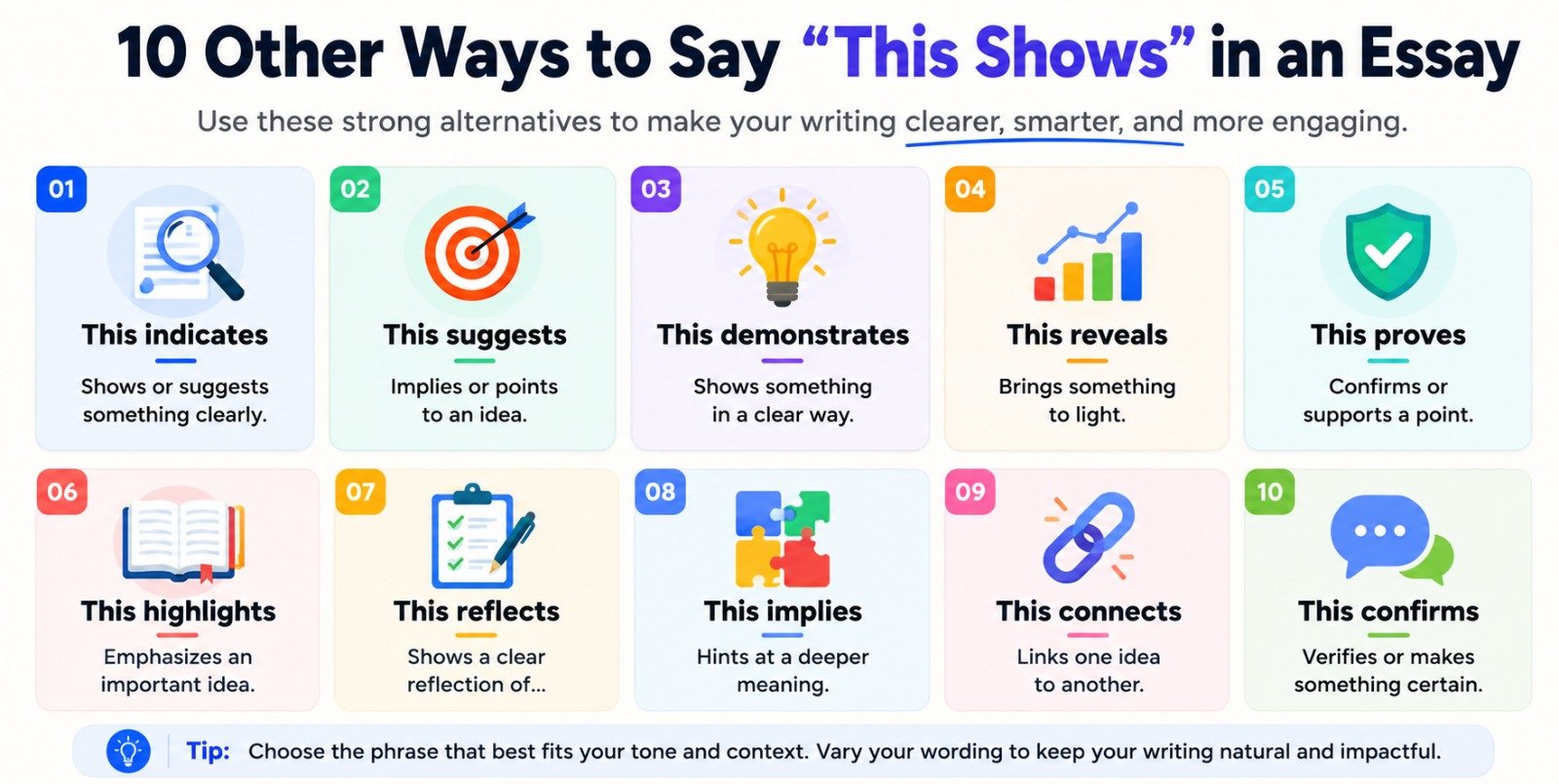
Better Ways to Say “This Shows” at a Glance
| Alternative | What It Does | Best Used For |
|---|---|---|
| This demonstrates | Presents strong evidence | Formal essays and arguments |
| This indicates | Points toward a conclusion | Research and analytical writing |
| This suggests | Offers a cautious interpretation | Literary and academic analysis |
| This reveals | Uncovers meaning or information | Character, theme, or motive analysis |
| This illustrates | Makes an idea clearer through an example | Explanatory writing |
| This highlights | Draws attention to something important | Key findings or themes |
| This reflects | Shows an attitude, condition, or wider pattern | Social, historical, or literary analysis |
| This implies | Communicates something indirectly | Interpretation |
| This reinforces | Strengthens an existing point | Argumentative essays |
| This confirms | Verifies an earlier idea | Evidence-based conclusions |
| This exemplifies | Serves as a clear example | Academic explanations |
| This underscores | Emphasizes importance | Formal analytical writing |
| This conveys | Communicates a feeling, message, or tone | Literary analysis |
| This portrays | Represents a person, situation, or idea | Literature and media analysis |
| This supports the argument that | Connects evidence directly to a claim | Argumentative essays |
These expressions overlap, but they are not interchangeable in every sentence. A phrase such as “this suggests” is deliberately cautious, while “this confirms” makes a much stronger claim.
You May Also Read | 30 Other Ways to Say “According To” in Essays, Writing and Everyday Use
What Does “This Shows” Mean in Writing?
In an essay, “this shows” usually connects evidence with interpretation.
For example:
The character refuses to speak to his family. This shows that he feels isolated.
The first sentence gives evidence. The second explains what that evidence means.
There is nothing grammatically wrong with “this shows.” The issue is repetition. If every paragraph contains “this shows that…,” your analysis can begin to sound basic or mechanical.
A better approach is to choose a more precise verb that describes the relationship between the evidence and your interpretation.
Other Ways to Say “This Shows” in an Essay
Academic writing benefits from precise language. The following alternatives are especially useful when explaining evidence or developing an argument.
Other Ways to Say “This Shows”: This Demonstrates
“This demonstrates” is one of the strongest and most natural formal alternatives. It works when the evidence clearly supports the point you are making.
Example:
“The decline in attendance demonstrates the need for a different approach.”
Compared with “shows,” demonstrates sounds slightly more formal and deliberate.
Other Ways to Say “This Shows”: This Indicates
Use “this indicates” when evidence points toward a conclusion without necessarily establishing it beyond doubt.
Example:
“The increase in repeat purchases indicates that customers are becoming more loyal to the brand.”
This wording is particularly useful in reports, research papers, and data-based essays.
Other Ways to Say “This Shows”: This Suggests
“This suggests” is ideal when your interpretation is reasonable but not completely certain.
Example:
“The character’s hesitation suggests that she is unsure about her decision.”
This is often better than “proves” in literary analysis because readers may interpret the same evidence differently.
Other Ways to Say “This Shows”: This Reveals
Use “this reveals” when something exposes a deeper idea, feeling, motive, or condition.
Example:
“His unwillingness to accept help reveals his fear of appearing vulnerable.”
It is particularly effective when analyzing characters, themes, attitudes, or hidden meanings.
Other Ways to Say “This Shows”: This Illustrates
“This illustrates” works when an example makes a broader point clearer.
Example:
“The disagreement between the two departments illustrates the communication problems within the organization.”
Think of illustrates as meaning “provides a clear example of.”
Other Ways to Say “This Shows”: This Highlights
Use “this highlights” when you want to draw attention to an important feature, problem, contrast, or finding.
Example:
“The difference between the two results highlights the importance of preparation.”
It emphasizes significance rather than merely stating that something exists.
Other Ways to Say “This Shows”: This Reflects
“This reflects” is useful when something mirrors a broader attitude, trend, emotion, belief, or social condition.
Example:
“The narrator’s frustration reflects the wider dissatisfaction felt by the community.”
It works especially well in literature, history, sociology, and cultural analysis.
Other Ways to Say “This Shows”: This Implies
Use “this implies” when the meaning is indirect rather than explicitly stated.
Example:
“Her refusal to answer implies that she may know more than she is willing to admit.”
Because implies involves interpretation, avoid using it when the evidence states the point directly.
Other Ways to Say “This Shows”: This Reinforces
“This reinforces” works when evidence strengthens an idea you have already introduced.
Example:
“The second survey produced similar results, reinforcing the argument that the policy has broad support.”
It is especially useful when building an argument across several examples.
Other Ways to Say “This Shows”: This Underscores
“This underscores” means that something emphasizes the importance or seriousness of a point.
Example:
“The rapid spread of the disease underscores the need for early intervention.”
It is formal and works well in reports, essays, and analytical writing.
Better Ways to Say “This Quote Shows”
Students often use “this quote shows” after inserting evidence from a text. While the phrase is understandable, repeating it can make literary analysis sound formulaic.
Instead, choose a phrase that tells the reader what the quotation actually does.
Useful alternatives include:
- This quote demonstrates…
- This quotation illustrates…
- This passage reveals…
- This line suggests…
- This excerpt indicates…
- This statement implies…
- This phrase highlights…
- This quotation reinforces…
- The author’s words emphasize…
- The passage conveys…
For example:
Basic:
“This quote shows that the character feels guilty.”
Better:
“This quotation reveals the character’s growing sense of guilt.”
More analytical:
“The repeated references to darkness reveal how deeply guilt has affected the character’s state of mind.”
The final version is usually stronger because it does not rely on a generic introductory phrase at all.
You Don’t Always Need to Say “This Shows”
One of the best ways to improve an essay is to stop treating “this shows” as something that must always be replaced with another two-word phrase.
Sometimes you can write the analysis directly.
Instead of:
“The author describes the street as empty and silent. This shows that the setting is lonely.”
Write:
“The empty, silent street creates a sense of isolation.”
Or instead of:
“Sales increased by 27%. This shows that the new strategy was successful.”
Write:
“The 27% increase in sales provides strong evidence that the new strategy was effective.”
This usually produces cleaner, more confident writing.
Alternatives for Different Types of Analysis
Different situations call for different verbs. Choosing according to function is more useful than simply picking a synonym at random.
When the Evidence Is Strong
Use:
- This demonstrates…
- This confirms…
- This establishes…
- This provides evidence that…
- This supports the conclusion that…
Example:
“Three independent trials produced nearly identical results, confirming that the effect was repeatable.”
When You Are Making an Interpretation
Use:
- This suggests…
- This indicates…
- This implies…
- This may reflect…
- This points to…
Example:
“The sudden change in tone suggests that the speaker is becoming increasingly uncomfortable.”
These phrases leave appropriate room for interpretation.
When You Are Explaining an Example
Use:
- This illustrates…
- This exemplifies…
- This is an example of…
- This demonstrates how…
Example:
“The company’s rapid expansion into smaller cities exemplifies its broader growth strategy.”
When You Want to Emphasize Importance
Use:
- This highlights…
- This underscores…
- This emphasizes…
- This draws attention to…
- This reinforces…
Example:
“The sharp rise in operating costs highlights the need for tighter financial controls.”
When Analyzing Literature or Language
Use:
- This reveals…
- This conveys…
- This portrays…
- This reflects…
- This suggests…
- This emphasizes…
Example:
“The fragmented sentences convey the narrator’s increasing panic.”
These verbs often produce more precise literary analysis than a generic “this shows.”
“This Shows” Alternatives Are Not All Interchangeable
Changing one verb for another can change the strength of your claim.
Consider these sentences:
“The evidence suggests that the policy is ineffective.”
This leaves some uncertainty.
“The evidence indicates that the policy is ineffective.”
This sounds somewhat stronger but still allows for further evidence.
“The evidence demonstrates that the policy is ineffective.”
This presents the evidence as convincing.
“The evidence proves that the policy is ineffective.”
This makes the strongest claim and may be too absolute in many essays.
The word “proves” deserves particular care. In mathematics or tightly controlled scientific contexts, proof may be appropriate. In literature, history, social sciences, and many argumentative essays, suggests, indicates, or supports is often more accurate.
Different Ways to Say “This Shows That”
If your sentence repeatedly follows the pattern “this shows that…”, you can vary the entire construction rather than only changing shows.
For example:
- This suggests that…
- This indicates that…
- This demonstrates that…
- This reveals that…
- This illustrates how…
- This highlights the fact that…
- This supports the argument that…
- This provides evidence that…
- This points to…
- This reinforces the idea that…
- From this, we can infer that…
- This can be interpreted as…
- This reflects…
- This is evidence of…
Example:
Instead of:
“The character avoids eye contact. This shows that he is nervous.”
Try:
“The character’s avoidance of eye contact suggests that he is nervous.”
The second version is more concise and integrates the evidence with the interpretation.
Common Mistakes When Replacing “This Shows”
Using “Proves” Too Easily
A quotation from a novel rarely proves an interpretation. It may support, suggest, demonstrate, or reinforce it.
Avoid:
“This quote proves that the character is selfish.”
Better:
“This quote suggests that the character is motivated by self-interest.”
Replacing Repetition With Different Repetition
Changing every instance of “this shows” to “this demonstrates” does not solve the problem.
Vary sentence structure as well as vocabulary.
Instead of repeatedly writing:
“This demonstrates that…”
try constructions such as:
“The contrast highlights…”
“The figures indicate…”
“The narrator’s response reveals…”
“Taken together, these examples support…”
Choosing a Word Because It Sounds More Academic
Longer or more formal words are not automatically better.
“This elucidates” may be grammatically possible in some contexts, but it can sound unnecessarily stiff when shows, illustrates, or explains would be clearer.
Good academic writing values precision more than complicated vocabulary.
Forgetting What “This” Refers To
Sometimes the problem is not the word shows but the vague pronoun this.
For example:
“The government increased taxes while reducing public spending. This shows…”
What exactly does this refer to: the tax increase, the spending reduction, or both?
A clearer version might be:
“The combination of higher taxes and lower public spending indicates a major shift in fiscal policy.”
Naming the evidence directly often makes your writing stronger.
How to Choose the Best Alternative
Before replacing “this shows,” ask what relationship exists between your evidence and your point.
If the evidence strongly establishes something, demonstrates or confirms may work.
If it points toward an interpretation, choose suggests or indicates.
If it uncovers meaning, use reveals.
If it provides an example, use illustrates or exemplifies.
If it draws attention to importance, choose highlights or underscores.
If it strengthens an existing argument, use reinforces or supports.
The right word isn’t simply a more sophisticated synonym. It tells the reader exactly how your evidence connects to your analysis.
Frequently Asked Questions
What are other ways to say “this shows” in an essay?
Natural alternatives include this demonstrates, this indicates, this suggests, this reveals, this illustrates, this highlights, this reflects, this implies, and this supports the argument that. The best choice depends on how strongly your evidence supports the point.
What is another way to say “this quote shows” in an essay?
You can write “this quotation reveals,” “this passage suggests,” “this line indicates,” “this quote demonstrates,” or “the author’s words highlight.” In stronger analysis, you can often remove the introductory phrase and discuss the quotation directly.
Is “this demonstrates” better than “this shows”?
It can be in formal writing, but not automatically. Demonstrates usually makes a stronger claim than shows, so it should be used when the evidence clearly supports your interpretation.
Can I use “this suggests” instead of “this shows”?
Yes, especially when your conclusion is interpretive rather than certain. Suggests is useful in literary analysis and academic writing because it avoids presenting an interpretation as an unquestionable fact.
What is a more academic way to say “this shows”?
Depending on the context, academic alternatives include “this demonstrates,” “this indicates,” “this illustrates,” “this provides evidence that,” “this supports the argument that,” and “this underscores.”
Should I avoid “this shows” completely in essays?
No. “This shows” is clear and grammatically correct. The goal is not to ban it but to avoid unnecessary repetition and choose more precise wording when the evidence calls for it.
What can I say instead of “this shows that”?
Try “this suggests that,” “this indicates that,” “this demonstrates that,” “this supports the idea that,” “this provides evidence that,” or restructure the sentence so the evidence becomes the subject.
Conclusion
The best other ways to say “this shows” depend on what your evidence is doing. Suggests suits cautious interpretations, demonstrates works for stronger evidence, reveals uncovers deeper meaning, and highlights emphasizes significance. Often, the strongest option is to remove “this shows” entirely and connect the evidence directly to your analysis. Clarifyra focuses on these small but meaningful wording differences so you can choose language that makes your writing clearer, more precise, and more natural.
You May Also Read | 50 Ways to Say Goodbye Lyrics: Spanish and Other Goodbye Phrases