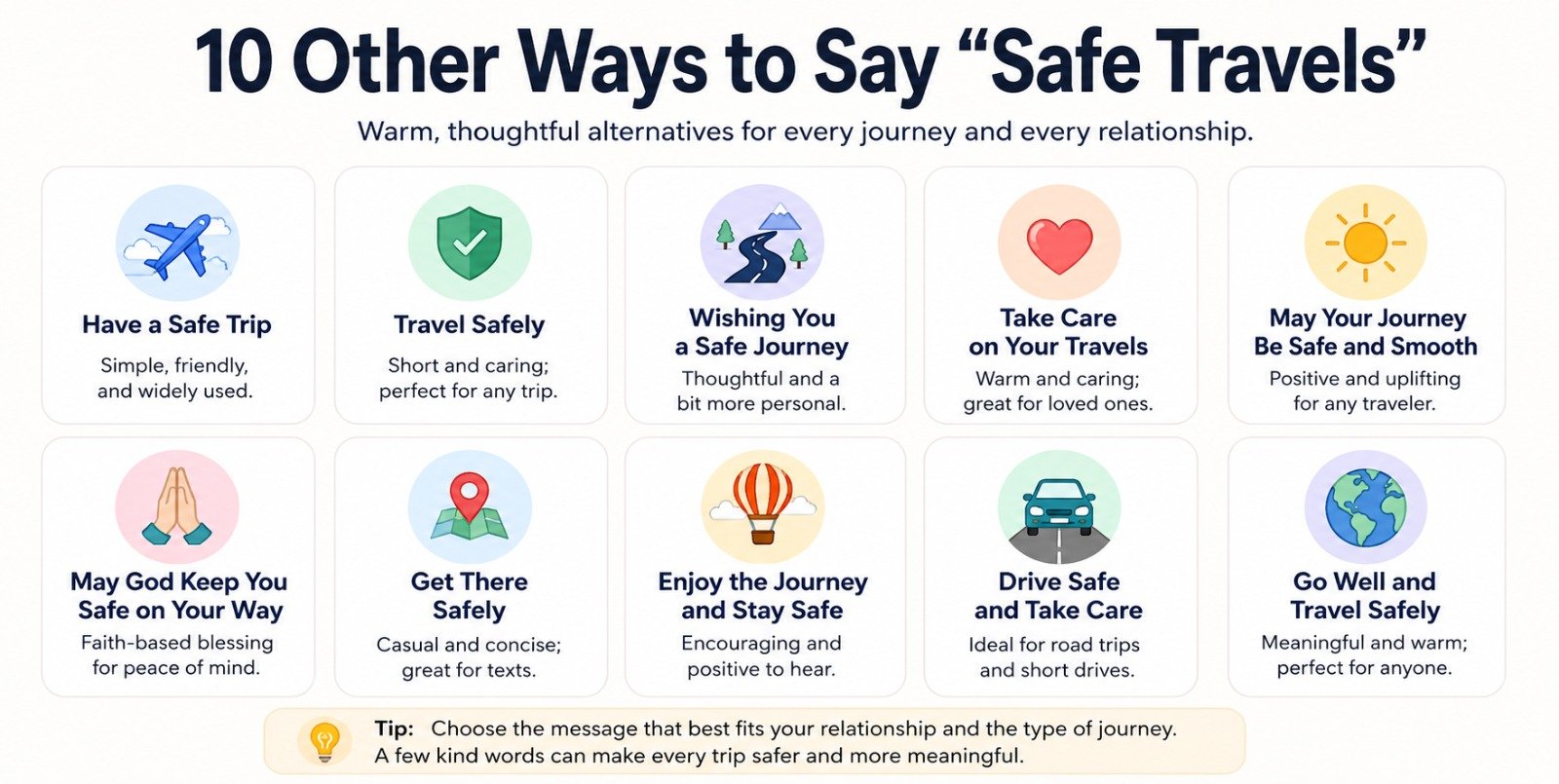
25 Other Ways to Say “Safe Travels”: Thoughtful Phrases for Any Trip
“Safe travels” is a warm, familiar way to wish someone well before they leave on a trip. It works for flights, road trips, vacations, business travel, and journeys home, but it isn’t the only natural option. Depending on your relationship with the traveler and the type of journey they’re taking, you might prefer something friendlier, more professional, more personal, or even faith-based.
Below, you’ll find natural other ways to say “safe travels”, along with guidance on which expressions fit different situations.
What Does “Safe Travels” Mean?
“Safe travels” is a farewell used to express the hope that someone completes their journey without danger, major problems, or unnecessary stress.
In everyday English, the phrase communicates more than physical safety. It can also suggest:
- I hope your journey goes smoothly.
- I hope you reach your destination safely.
- I care about how your trip goes.
- I wish you well while you’re away.
For example:
“It was great seeing you. Safe travels home!”
The speaker isn’t predicting danger. They’re simply offering a warm and considerate goodbye.
Safe Trip Meaning: Is It Different From “Safe Travels”?
The safe trip meaning is very close to the meaning of “safe travels,” but there is a slight difference in emphasis.
“Have a safe trip” usually refers to one particular journey, while “safe travels” can sound broader and may refer to the person’s overall travel experience.
| Expression | Tone | Best Used For | Example Situation |
|---|---|---|---|
| Safe travels | Warm, neutral | General travel | Vacation or business trip |
| Have a safe trip | Friendly | One specific trip | Leaving for another city |
| Have a safe journey | Polite, slightly formal | Longer journeys | International or long-distance travel |
| Have a safe flight | Friendly, specific | Air travel | Before someone boards a plane |
| Drive safe | Casual | Car travel | Friend driving home |
| Have a smooth journey | Polite | Travel where comfort matters | Work or international travel |
| Bon voyage | Cheerful | Vacations and departures | Friend leaving on a holiday |
| Enjoy your trip | Positive | Leisure travel | Vacation or weekend getaway |
These expressions overlap, but they aren’t perfectly interchangeable. Saying “have a safe flight,” for example, only makes sense when the person is actually flying.
Friendly Other Ways to Say “Safe Travels”
When you’re speaking to a friend, relative, or someone you know well, you can sound warmer and more personal.
Another Way to Say “Safe Travels”: Have a Safe Trip
“Have a safe trip” is probably the closest everyday alternative.
It sounds friendly without being overly emotional and works in almost any travel situation.
Example:
“Have a safe trip, and send me some pictures when you get there.”
Another Way to Say “Safe Travels”: Travel Safely
“Travel safely” is concise and slightly more direct.
It works well in both spoken and written communication.
Example:
“Travel safely and enjoy the weekend.”
Another Way to Say “Safe Travels”: Enjoy Your Trip
This expression shifts attention from safety to enjoyment.
It works particularly well when someone is leaving for a vacation, honeymoon, weekend break, or other leisure trip.
Example:
“Enjoy your trip to Rome. I hope you have an amazing time.”
Other Ways to Say “Safe Travels”: Have an Amazing Trip
This is enthusiastic and casual.
Use it with friends, family members, or coworkers you have a friendly relationship with.
Example:
“Have an amazing trip! I can’t wait to hear about it.”
Other Ways to Say “Safe Travels”: Have Fun and Stay Safe
This combines excitement with concern.
It’s especially natural when someone is going on an adventurous holiday, road trip, festival trip, or group vacation.
Example:
“Have fun and stay safe out there!”
Another Way to Say “Safe Travels”: Happy Travels
“Happy travels” sounds cheerful and relaxed.
It isn’t as common in everyday conversation as “safe travels,” but it works nicely in cards, captions, and friendly messages.
Example:
“Happy travels! Hope every stop is memorable.”
Professional Ways to Say “Safe Travels”
In professional communication, you usually want something polite and warm without sounding overly personal.
Other Ways to Say “Safe Travels” Professionally: Wishing You a Safe Journey
This is polished enough for clients, managers, colleagues, and business contacts.
Example:
“Wishing you a safe journey and a productive week in Singapore.”
Other Ways to Say “Safe Travels” Professionally: Have a Smooth Journey
“Smooth” emphasizes a journey without delays, complications, or inconvenience rather than only physical safety.
Example:
“Have a smooth journey, and I look forward to speaking with you when you return.”
Another Professional Way to Say “Safe Travels”: Wishing You Pleasant Travels
This is polite and slightly formal.
It fits emails and farewell messages, although it may sound more traditional than conversational.
Example:
“Wishing you pleasant travels and a successful conference.”
Other Ways to Say “Safe Travels”: Have a Comfortable Trip
This is useful when someone has a long journey ahead.
Example:
“Have a comfortable trip, and we’ll catch up next week.”
Other Ways to Say “Safe Travels” in an Email: Wishing You a Safe and Easy Journey
This wording combines warmth with professionalism.
Example:
“Thank you again for your time today. Wishing you a safe and easy journey home.”
Other Ways to Say “Safe Travels” Before a Flight
Air travel gives you several more specific options.
Other Ways to Say “Safe Travels”: Have a Safe Flight
This is the clearest choice when someone is about to fly.
Example:
“Have a safe flight. Let me know when you land.”
Another Way to Say “Safe Travels”: Have a Smooth Flight
This focuses more on comfort and an easy experience.
Example:
“Have a smooth flight and enjoy your time away.”
Other Ways to Say “Safe Travels”: Enjoy Your Flight
This is lighter than “have a safe flight.”
It works well when you don’t want your message to sound concerned or serious.
Example:
“Enjoy your flight! Hopefully you get some rest on the way.”
Other Ways to Say “Safe Travels”: Happy Landings
“Happy landings” is a traditional and somewhat playful wish associated with flying.
It can sound charming, but it’s less common in ordinary conversation than “have a safe flight.”
Example:
“Happy landings! See you next week.”
Other Ways to Say “Safe Travels”: Wishing You Clear Skies
This is more creative and expressive.
It works nicely in a card, social media caption, or personal message.
Example:
“Wishing you clear skies and an easy flight.”
Other Ways to Say “Safe Travels” for a Road Trip
A road journey calls for different wording than a flight.
Another Way to Say “Safe Travels”: Drive Safe
“Drive safe” is casual and common in everyday American English.
You’re most likely to use it with friends, relatives, or coworkers.
Example:
“Drive safe. The roads are pretty busy tonight.”
Other Ways to Say “Safe Travels”: Have a Safe Drive
This is slightly more neutral than “drive safe.”
Example:
“Have a safe drive back home.”
Other Ways to Say “Safe Travels”: Take Care on the Road
This sounds caring without being overly formal.
Example:
“Take care on the road, especially through the mountains.”
Other Ways to Say “Safe Travels”: Enjoy the Road Trip
Use this when the journey itself is part of the experience.
Example:
“Enjoy the road trip and take plenty of breaks along the way.”
Other Ways to Say “Safe Travels”: Text Me When You Get There
This doesn’t literally mean “safe travels,” but it often serves the same social purpose.
It shows personal concern and is especially natural between family members, partners, and close friends.
Example:
“Text me when you get there so I know you made it safely.”
Warm and Personal Safe Travels Alternatives
Sometimes you want your farewell to show more emotion than a simple “safe travels.”
Other Ways to Say “Safe Travels”: Come Back Safe and Sound
This expression emphasizes both reaching the destination safely and returning safely.
Example:
“Have an incredible adventure and come back safe and sound.”
Other Ways to Say “Safe Travels”: Take Good Care of Yourself
This is broader than a travel wish.
It expresses concern for the person during the entire time they’re away.
Example:
“Take good care of yourself while you’re traveling.”
Another Way to Say “Safe Travels”: Let Me Know When You Arrive Safely
This sounds caring and personal.
It works especially well for someone you’re close to.
Example:
“Let me know when you arrive safely. I’ll probably still be awake.”
Other Ways to Say “Safe Travels”: I Hope Everything Goes Smoothly
Use this when the traveler may have connecting flights, a complicated itinerary, immigration procedures, or a long journey.
Example:
“I hope everything goes smoothly with your connections tomorrow.”
Other Ways to Say “Safe Travels”: Have a Wonderful Journey
This is warm, polished, and flexible.
Example:
“Have a wonderful journey and enjoy every moment.”
Is “Bon Voyage” a Safe Travels Synonym?
Bon voyage is one of the best-known alternatives, but it isn’t an exact safe travels synonym.
It literally functions as a wish for someone to have a good journey. The focus is more on the overall trip than specifically on safety.
It works especially well when someone is:
- Going on vacation
- Leaving for a cruise
- Traveling internationally
- Starting a memorable journey
Example:
“Bon voyage! Have an incredible time in France.”
It may sound a little playful or celebratory in casual English, so it isn’t always the best choice for a serious business email.
Not Every Safe Travels Alternative Means Exactly the Same Thing
Choosing the right phrase depends on what you actually want to communicate.
For example:
“Enjoy your trip” focuses on enjoyment, not safety.
“Have a smooth journey” suggests avoiding delays or inconvenience.
“Text me when you arrive” expresses personal concern.
“Have a safe flight” only works for air travel.
“Drive safe” is appropriate for driving, not a train or plane journey.
“Bon voyage” sounds celebratory rather than concerned.
This is why the best alternative isn’t always the closest dictionary synonym. Natural English depends heavily on context.
Safe Travels Prayer
For someone who is religious, a safe travels prayer can express care in a more spiritual way.
A simple original prayer might be:
May God watch over you throughout your journey, guide you safely along the way, and bring you peacefully to your destination. May you be protected wherever you go and return home safely. Amen.
This type of message is most appropriate when you know that religious language is welcome.
For someone whose beliefs you don’t know, a neutral phrase such as “Have a safe journey” is usually the safer choice.
“Safe Travels, God Bless You” Meaning
“Safe travels, God bless you” combines a normal travel farewell with a religious blessing.
It essentially communicates:
“I hope you travel safely, and I pray that God protects and blesses you during your journey.”
Here are a few natural variations.
Other Ways to Say “Safe Travels, God Bless You”: May God Keep You Safe
Warm and direct.
Example:
“May God keep you safe throughout your journey.”
Other Ways to Say “Safe Travels, God Bless You”: May God Watch Over You
This sounds caring and prayerful.
Example:
“May God watch over you wherever your travels take you.”
Other Ways to Say “Safe Travels, God Bless You”: May God Guide Your Journey
This focuses on guidance as well as protection.
Example:
“May God guide your journey and bring you safely home.”
Other Ways to Say “Safe Travels, God Bless You”: God Bless You on Your Journey
A concise blessing suitable for a card, message, or farewell.
Example:
“God bless you on your journey. Have a wonderful trip.”
Short Safe Travels Messages for Texts
Sometimes you don’t need a full sentence.
These work naturally in text messages:
- Travel safe!
- Have a good trip!
- Safe journey!
- Enjoy the adventure!
- Have an amazing time!
- Take care out there!
- Have a smooth flight!
- Drive safe!
- Text me when you land.
- Let me know when you get there.
- Have fun and stay safe!
- Bon voyage!
For someone close to you, adding a personal detail usually feels warmer than sending a generic phrase.
Instead of:
“Safe travels!”
You could write:
“Have a safe flight tomorrow. Text me when you land!”
Safe Travels GIF Messages
A safe travels GIF is usually used as a visual farewell in a text, social post, group chat, or messaging app.
The GIF itself may feature airplanes, cars, suitcases, maps, clouds, roads, or animated travel scenes. A short caption usually works better than a long paragraph.
Good messages to pair with one include:
- Safe travels! ✈️
- Have an amazing trip!
- Bon voyage!
- Have a safe flight!
- Enjoy the adventure!
- See you when you’re back!
- Travel safe and have fun!
If you’re sending one professionally, choose a simple visual rather than an overly playful or romantic animation.
What About “Safe Travels USA Comprehensive”?
The phrase “safe travels USA comprehensive” doesn’t function as a normal English alternative to “safe travels.”
It may refer to a specific travel-related service, program, insurance product, brand, or navigational query rather than a phrase people use when wishing someone well.
For that reason, it shouldn’t be treated as a synonym or forced into a normal farewell sentence.
If your goal is to wish someone well while traveling in the United States, natural English would be:
“Have a safe trip around the U.S.”
or:
“Safe travels throughout the United States.”
How to Choose the Best Alternative
Start with the type of journey.
For a flight, “have a safe flight” is more natural than a general travel phrase.
For a road trip, “drive safe” or “have a safe drive” fits better.
For a coworker or client, choose something polished such as “wishing you a safe journey.”
For a close friend or family member, “text me when you get there” often sounds warmer because it shows genuine personal concern.
For a vacation, you might focus less on safety and say “have an amazing trip” or “enjoy every moment.”
And if faith is an important part of the relationship, a blessing such as “may God watch over you on your journey” can feel more meaningful than a neutral farewell.
Frequently Asked Questions
What is another way to say “safe travels”?
Natural alternatives include “have a safe trip,” “have a safe journey,” “travel safely,” “have a smooth trip,” “enjoy your journey,” and “bon voyage.” For a flight, “have a safe flight” is more specific, while “drive safe” works for road travel.
What does “safe travels” mean?
“Safe travels” means that you hope someone completes their journey safely and without serious problems. It’s usually said as a warm farewell before someone leaves.
Is it better to say “safe travel” or “safe travels”?
“Safe travels” is the established farewell expression. “Safe travel” can be grammatically correct in other constructions, such as discussing “safe travel practices,” but it sounds unnatural as a standalone goodbye.
Is “have a safe trip” the same as “safe travels”?
They communicate almost the same idea. “Have a safe trip” usually refers to one specific journey, while “safe travels” can sound broader and slightly more general.
What can I say instead of “safe travels” professionally?
Good professional alternatives include “wishing you a safe journey,” “have a smooth trip,” “wishing you pleasant travels,” and “have a comfortable journey.”
What should I say to someone before a flight?
“Have a safe flight,” “have a smooth flight,” “enjoy your flight,” and “wishing you an easy journey” are all natural choices.
How do you wish someone safe travels with God?
If religious wording suits the relationship, you can say “may God keep you safe on your journey,” “may God watch over you while you travel,” or “God bless you and bring you safely home.”
Final Thoughts
The best alternative to “safe travels” depends less on finding a perfect synonym and more on choosing wording that fits the journey and your relationship with the traveler. “Have a safe journey” works almost anywhere, “drive safe” suits an informal road trip, and “text me when you arrive” adds a much more personal touch.
Small wording choices can make a farewell feel warmer, more professional, or more meaningful. Clarifyra helps you notice those differences so you can say what you mean in a way that feels natural for the person and the moment.
You May Also Read | 100 Different Ways to Say Hello: Creative, Casual and Stylish Greetings