Nickle or Nickel: Which Is Correct?
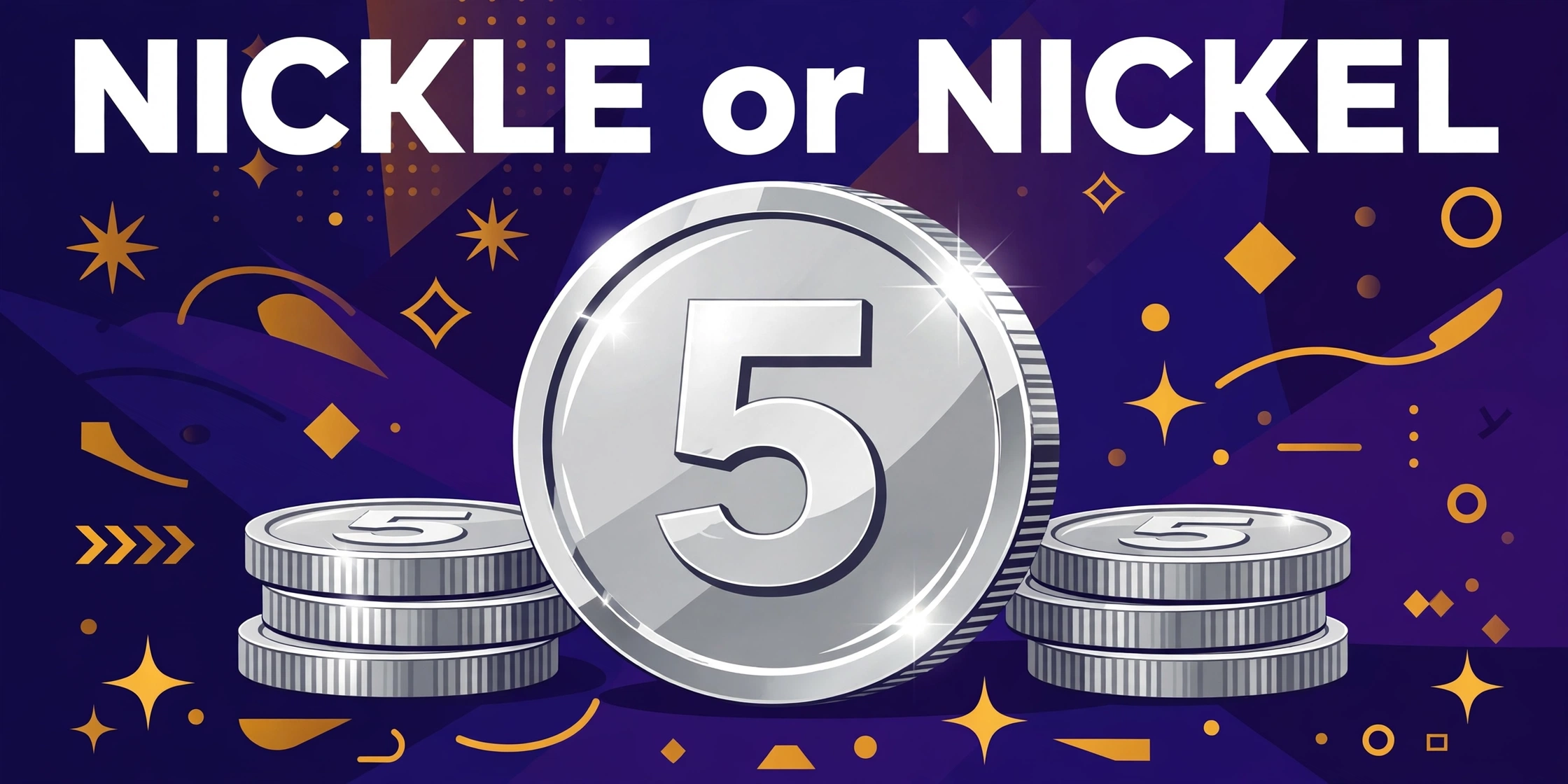
Nickel is the correct spelling. Nickle is a misspelling — or, to be precise, a spelling that some dictionaries have recorded as a rare alternative, but which no style guide accepts and which looks like a typo to every reader. The standard spelling, in British and American English alike, is N-I-C-K-E-L, ending in -el, not -le. The confusion is understandable: the word ends in the sound /əl/, and English has hundreds of words that spell that sound -le — table, little, apple, kettle. Nickel is not one of them. It belongs to the smaller family of words that spell the sound -el, like label, model, and travel, and the only way to be sure is to learn it.
Quick Answer: Always write nickel — “The coin is made of nickel and copper.” Nickle is a common misspelling and is not accepted as standard English, even though a few dictionaries record it as a rare variant. Nickel is pronounced /ˈnɪk.əl/ in both British and American English. As a noun it names a silvery-white metal and, in the United States and Canada, the five-cent coin; as a verb it means to coat something with nickel.
What the Dictionaries Say
Merriam-Webster defines nickel as a noun in five senses: a silver-white, hard, malleable, ductile metallic element, capable of a high polish and resistant to corrosion, used chiefly in alloys and as a catalyst; the United States five-cent piece, regularly containing 25 percent nickel and 75 percent copper, and the Canadian five-cent piece; five cents; and, in slang, a packet containing five dollars’ worth of an illicit drug, also called a nickel bag. A fifth sense, American football, is a pass defence employing five defensive backs. The dictionary dates the first known use of the word to 1755.
Dictionary.com gives the American pronunciation as /ˈnɪk.əl/ and the British as /ˈnɪkəl/, and lists the same senses: the metallic element, with the chemical symbol Ni, atomic number 28, and atomic weight 58.71; the American and Canadian five-cent coins; and, as a verb, “to cover or coat with nickel,” with the forms nickeled or nickelled and nickeling or nickelling. Collins gives the same picture, with the verb forms listed as -els, -elling, and -elled in British English and -els, -eling, and -eled in American English.
What about nickle? The picture is more nuanced than a simple “not a word.” Merriam-Webster’s website redirects a search for “nickle” to its nickel entry, and Washington State University’s Common Errors in English Usage notes that “although some dictionaries list ‘nickle’ as an alternative spelling, by far the more common and more widely accepted spelling is ‘nickel.’” Wiktionary records the spelling in quotations from 1919 and 1922, which shows that it has appeared in print. But none of that makes it standard. Every major dictionary gives nickel as the headword, and every style guide prescribes nickel. In modern writing, “nickle” reads as a mistake, and it should be corrected wherever it appears.
Nickel the Metal
Nickel is a chemical element, a hard, silvery-white metal that resists corrosion and takes a high polish. It is almost never used on its own. Its value lies in what it does to other metals: added to steel, it makes stainless steel, the metal of cutlery, sinks, and surgical instruments; added to other alloys, it makes the hard-wearing metals used in coins, batteries, and jet engines. It is also used as a catalyst in chemical processes, and as a coating — nickel plating — that protects other metals from rust and wear. The metal’s symbol is Ni, its atomic number is 28, and its atomic weight is about 58.69.
The name has a story that explains the spelling. It comes from the German Kupfernickel, literally “copper demon” or “false copper,” the name miners gave to a reddish ore that looked like copper ore but yielded no copper. The Nickel in the German word was a mischievous goblin or demon, a pet form of Nikolaus, blamed for tricking the miners. Swedish mineralogist Axel Fredrik Cronstedt shortened the German word in the 1750s when he identified the new metal, and English took the shortened form.
Nickel the Coin
For most people, a nickel is not a metal but a coin. In the United States, the nickel is the five-cent piece, worth one twentieth of a dollar. It was introduced in 1866, during the coin shortage that followed the American Civil War, and it took its name from the metal, even though the coin has always been mostly copper: a modern American nickel is 75 percent copper and 25 percent nickel. The Canadian five-cent piece is also called a nickel, and it has the same value. In both countries, the coin’s name is the metal’s name, and the spelling is the same.
The coin has given English several idioms. “Not worth a nickel” means worthless. “Nickel-and-dime” means to deal in trivially small amounts of money, or to charge for every little thing: “The airline nickel-and-dimed us for bags, seats, and snacks.” “Don’t take any wooden nickels” is an old American warning not to be cheated. None of these phrases is ever spelled with “nickle,” and seeing the misspelling in one of them is a sure sign of a typo.
Nickel as a Verb
Nickel is also a verb, meaning to coat or plate something with nickel: “The fittings were nickeled to protect them from rust.” It is a technical word, used in manufacturing and metalwork rather than in everyday conversation, but it follows the ordinary rules. In American English the past tense is nickeled and the -ing form is nickeling. In British English the past tense is nickelled and the -ing form is nickelling, with a doubled l. The difference is the same doubling rule that gives American traveled and British travelled: in British English, a final l doubles before a vowel suffix, and in American English it usually does not.
Why People Write “Nickle”
The misspelling has one main cause, and it is a strong one: the sound. “Nickel” ends in the unstressed syllable /əl/, and English spells that syllable in two ways. Words like table, little, apple, kettle, and bottle use -le, and they are far more common than words like nickel, label, and model that use -el. A writer spelling by ear will reach for -le first, and most of the time that instinct is right. With nickel, it is wrong.
The remedy is a short list of words to learn as a group. Nickel, label, model, travel, cancel — all of them end in -el, and all of them are spelled that way for historical reasons that have nothing to do with pronunciation. Learn them together, and the -le habit stops producing errors. A second trick is the element itself: the chemical symbol is Ni, and the word ends in -el, not -le, because the metal’s name came from German, where the ending was -el from the start.
Correct vs Incorrect
| Incorrect | Correct | Why |
|---|---|---|
| The coin is made of nickle. | The coin is made of nickel. | The metal and the coin are both spelled nickel, ending in -el. |
| I found a nickle on the pavement. | I found a nickel on the pavement. | The five-cent coin is a nickel, in American and British English alike. |
| Stainless steel contains nickle. | Stainless steel contains nickel. | The element’s name is nickel, symbol Ni, atomic number 28. |
| The fittings were nickled to stop rust. | The fittings were nickelled (British) or nickeled (American) to stop rust. | The verb keeps the -el ending of the noun; British English doubles the l. |
| That advice isn’t worth a nickle. | That advice isn’t worth a nickel. | The idiom uses the coin’s name, spelled nickel. |
| She paid a nickle for the song. | She paid a nickel for the song. | Five cents is a nickel, whether in a jukebox or a shop. |
Common Mistakes to Avoid
1. Spelling the word “nickle”
The most common mistake is the simplest: writing “nickle” instead of “nickel.” The fix is to learn the ending as a fact, not as a guess. The word ends in -el, like label and model, and it is spelled the same way in British and American English. There is no regional variation to hide behind.
2. Treating “nickle” as an accepted variant
A few dictionaries record “nickle” as a rare alternative spelling, and that fact is sometimes quoted as permission to use it. It is not permission. A spelling can be recorded and still be wrong for practical purposes: it will look like a typo to readers, it will be flagged by spellcheckers, and it will be marked wrong in exams and in professional writing. Use nickel every time.
3. Doubling the “l” in the American verb forms
In American English, the verb forms are nickeled and nickeling, with a single l. In British English they are nickelled and nickelling, with a double l. Mixing the two — writing “nickelled” in an American document or “nickeled” in a British one — is a smaller error than misspelling the base word, but it is still an error. Pick the variety you are writing in and stay with it.
Frequently Asked Questions
Is “nickle” ever correct?
Not in standard modern English. Some dictionaries record it as a rare alternative spelling, and it appears in print from the early twentieth century, but every major dictionary gives nickel as the headword, and every style guide prescribes nickel. In practice, “nickle” reads as a misspelling and should be corrected.
How do you pronounce “nickel”?
It is pronounced /ˈnɪk.əl/ — “NICK-əl” — in both British and American English, with the stress on the first syllable. The final syllable is an unstressed schwa followed by l, which is why the spelling is so easy to get wrong.
Is there a spelling difference between British and American English?
No. Nickel is spelled the same way on both sides of the Atlantic, for the metal and for the coin. The only difference is in the verb forms: British English writes nickelled and nickelling, while American English writes nickeled and nickeling.
What is a nickel worth?
A nickel is the United States and Canadian five-cent coin, worth one twentieth of a dollar. The coin is mostly copper — a modern American nickel is 75 percent copper and 25 percent nickel — but it took its name from the metal when it was introduced in 1866.
The Takeaway
The answer is simple: nickel, ending in -el, is correct in every variety of English, and nickle is a misspelling that should be corrected. The word names a silvery-white metal, atomic number 28, and the five-cent coin that took the metal’s name, and it is pronounced “NICK-əl” on both sides of the Atlantic. Remember that the ending is -el, like label and model, and it will stay put.
Sources: Merriam-Webster (nickel, noun senses, first known use 1755, etymology from Swedish nickel and German Kupfernickel); Dictionary.com (nickel, American /ˈnɪk.əl/, British /ˈnɪkəl/, verb forms nickeled/nickelled); Collins (nickel, verb forms -elled/-eling); Washington State University, Common Errors in English Usage (note that some dictionaries list “nickle” as an alternative spelling); Wiktionary (historical quotations for “nickle,” 1919 and 1922).