DUI or DWI: What’s the Difference and Which Is Worse?
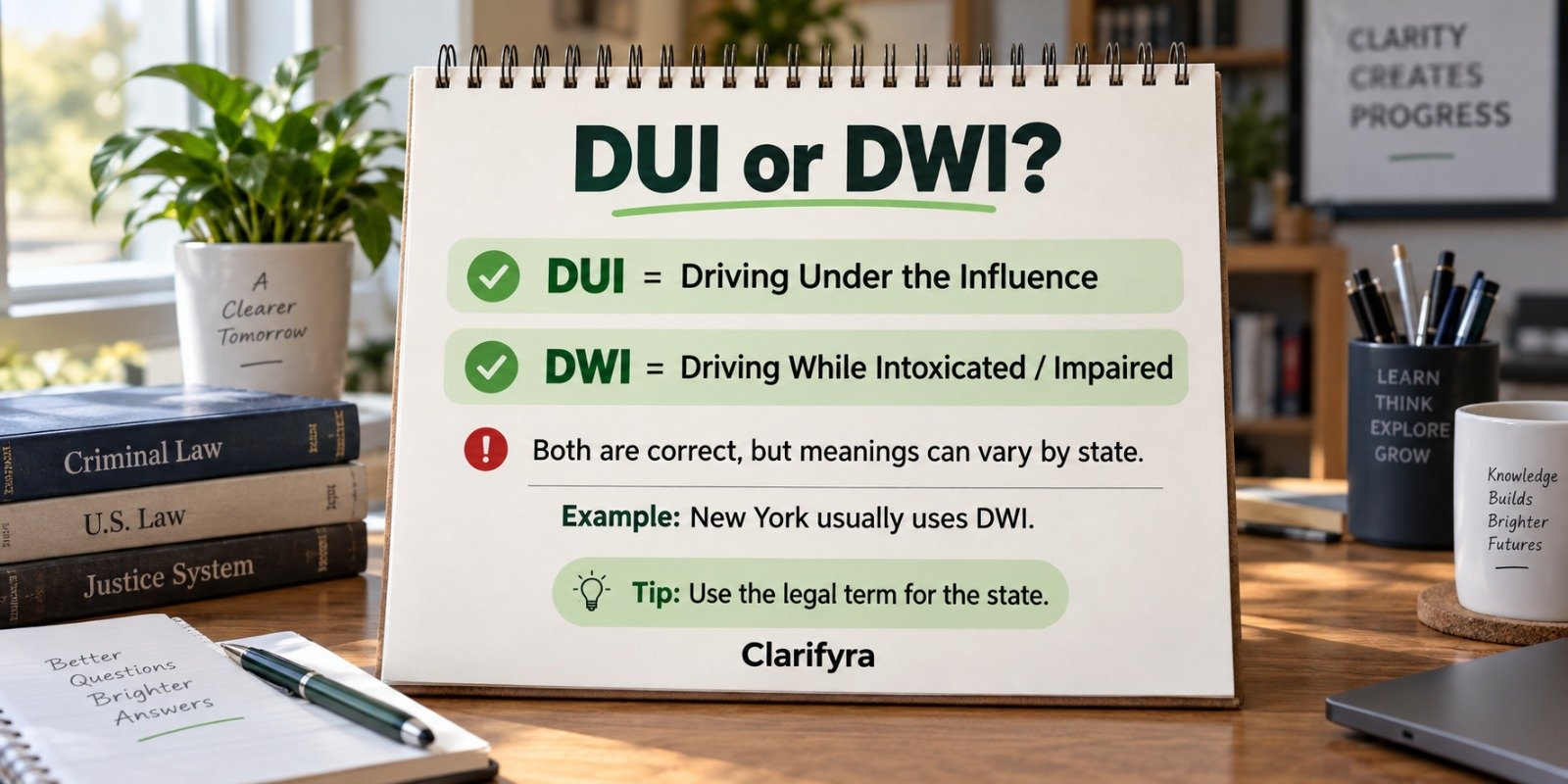
DUI and DWI are both terms connected with impaired driving, but they do not have one universal meaning across the United States. DUI usually means Driving Under the Influence, while DWI can mean Driving While Intoxicated or Driving While Impaired. In some states, the terms describe essentially the same type of offense. In others, the law treats them differently.
That means the answer to “Which is worse, DUI or DWI?” depends largely on where the offense occurs and the circumstances involved.
DUI stands for Driving Under the Influence, while DWI usually means Driving While Intoxicated or Driving While Impaired. Neither term is automatically more serious nationwide because states use and define them differently. The applicable state law determines the official charge and its severity.
DUI vs. DWI at a Glance
| Feature | DUI | DWI |
|---|---|---|
| Full form | Driving Under the Influence | Driving While Intoxicated or Driving While Impaired |
| General meaning | Driving under the influence of alcohol, drugs, or another impairing substance | Driving while intoxicated or impaired |
| Correct term? | Yes | Yes |
| Used nationwide in exactly the same way? | No | No |
| Can involve drugs? | Yes | Yes, depending on state law |
| More serious? | Depends on jurisdiction | Depends on jurisdiction |
The biggest point to remember is that DUI and DWI are legal terms, not simply two interchangeable English abbreviations with fixed nationwide definitions.
Similar word comparisons include: Caliber or Calibre: Which Spelling Is Correct?
What Does DUI Mean?
DUI means “Driving Under the Influence.”
It generally refers to operating a vehicle while alcohol, drugs, or another substance affects a person’s ability to drive safely.
For example:
- He was arrested on suspicion of DUI.
- The driver faced a DUI charge after the traffic stop.
- Driving under the influence of certain drugs can result in a DUI charge.
- State DUI laws can differ considerably.
The word influence is important. DUI is not necessarily limited to alcohol. Depending on the state’s law, impairment involving illegal drugs, prescription medication, cannabis, or other substances may also fall under an impaired-driving offense.
NHTSA uses impaired-driving terminology for both alcohol and drugs and warns that drugs—including some prescription and over-the-counter medicines—can affect the skills needed for safe driving.
What Does DWI Mean?
DWI most commonly means “Driving While Intoxicated,” but in some jurisdictions it means “Driving While Impaired.”
That difference in wording is one reason the term can be confusing.
Examples include:
- She was charged with DWI after being stopped by police.
- The state’s DWI laws apply to intoxicated drivers.
- A previous DWI conviction may affect how a later offense is handled.
- He contacted an attorney after receiving a DWI charge.
The exact definition should always be checked under the law of the relevant state.
What Is the Difference Between DUI and DWI?
There is no single DUI-or-DWI difference that applies throughout the entire United States.
States generally follow one of several approaches:
- A state may primarily use DUI.
- A state may primarily use DWI.
- A state may use both terms for different offenses or levels of impairment.
- A jurisdiction may use another abbreviation entirely, such as OUI.
FindLaw notes that DUI, DWI, and similar terms all relate to impaired driving, but their exact legal meanings and how states apply them can differ.
So, in everyday conversation, someone may loosely say that a person “got a DUI” even when the state’s official offense is called DWI. In legal writing, however, it is important to use the terminology recognized by that particular jurisdiction.
Which Is Worse: DUI or DWI?
Neither DUI nor DWI is automatically worse nationwide.
This is probably the most important distinction to understand. The acronym alone does not tell you how serious an offense is.
In some states, DUI and DWI are simply different labels for broadly similar impaired-driving offenses. In other states, both terms may exist but represent different levels or circumstances of impairment.
The seriousness of a particular case can also depend on factors such as:
- The driver’s blood alcohol concentration (BAC)
- Previous impaired-driving offenses
- Whether alcohol, drugs, or both were involved
- Whether a collision occurred
- Whether anyone was injured
- The age of the driver
- The presence of passengers
- Other aggravating circumstances under state law
Because these rules vary, statements such as “DWI is always worse than DUI” or “DUI is always the more serious charge” are inaccurate when applied to the entire United States.
Is DWI or DUI Worse in Different States?
This is where much of the confusion comes from.
Some states that use both terms may assign different legal meanings to them. One state might treat DWI as the more serious designation, while another jurisdiction can use its terminology differently.
For that reason, you should not take a DUI-vs-DWI comparison from one state and assume the same rule applies somewhere else.
A useful way to remember it is:
The letters tell you the name of the offense; state law tells you what that offense actually means.
This is also why legal documents, official court records, and state government resources should use the exact statutory term rather than a more familiar abbreviation from another state.
Is It DUI or DWI?
Both DUI and DWI are correct terms. Which one should be used depends on context.
In ordinary English, you may hear:
“He got a DUI.”
or:
“She was arrested for DWI.”
Both sentences are grammatically natural.
However, if you are referring to a specific legal charge, use the terminology recognized in that jurisdiction.
For example, if a state officially calls the offense Driving While Intoxicated, writing DWI is more precise than automatically replacing it with DUI.
Also, the abbreviations are normally written in capital letters:
Correct: DUI
Correct: DWI
Forms such as Dui and Dwi may appear in casual typing, but DUI and DWI are the standard written forms.
Which Is Worse: DUI or DWI in NY?
In New York, the official terminology includes DWI, meaning Driving While Intoxicated, and DWAI, meaning Driving While Ability Impaired.
New York’s Division of Criminal Justice Services specifically explains that DUI is an acronym used in other states, while New York uses DWI and DWAI terminology.
So asking whether a DUI or DWI is worse in New York is not quite the right comparison. DWI is the relevant New York legal term, rather than DUI being a separate competing New York offense.
New York also distinguishes among several alcohol- and drug-related driving offenses. The state’s driver’s manual lists DWI, aggravated DWI, DWAI involving alcohol, DWAI involving drugs, and offenses involving combined alcohol and drug influence.
Under New York law, a BAC of 0.08% or higher can support a DWI offense, while the state also recognizes impairment-related offenses below that level in certain circumstances.
Does DUI or DWI Always Mean Drunk Driving?
No.
Although the terms are often associated with alcohol, impaired-driving offenses can also involve drugs.
Depending on the jurisdiction, this may include:
- Illegal drugs
- Cannabis
- Prescription medicines
- Certain over-the-counter medicines
- Alcohol combined with drugs
That is why “drunk driving” and “impaired driving” are related but not always identical expressions.
A person does not necessarily need to have consumed alcohol for an impaired-driving law to apply.
How Does BAC Relate to DUI and DWI?
BAC stands for blood alcohol concentration.
For most drivers in the United States, a BAC of 0.08% or higher reaches the standard per se alcohol limit. Utah is the major exception, with a 0.05% per se BAC limit.
However, a common mistake is assuming that being below 0.08 automatically means a person is safe to drive or cannot face an impaired-driving offense.
NHTSA notes that alcohol can begin affecting driving-related abilities at levels below 0.08, and certain states have additional impairment provisions.
The exact legal consequences therefore depend on factors beyond simply knowing the abbreviation DUI or DWI.
Examples of DUI and DWI in Sentences
Here are some natural examples showing how the terms are used:
DUI:
The driver was arrested on suspicion of DUI.
DWI:
She was charged with DWI after the traffic stop.
General comparison:
DUI and DWI laws differ from state to state.
As a question:
Is the offense officially called DUI or DWI in this state?
Discussing severity:
Whether a DUI or DWI is more serious depends on the jurisdiction and circumstances.
Drug-related impairment:
An impaired-driving charge can sometimes involve drugs rather than alcohol.
These examples also show why DUI and DWI should not be treated like a simple correct-versus-incorrect spelling pair. Both are valid abbreviations, but their legal use varies.
Common Mistakes to Avoid
One frequent mistake is assuming that DWI always means a more serious form of DUI. That may be true under certain state systems, but it is not a nationwide rule.
Another is believing that DUI applies only to alcohol. Depending on local law, driving under the influence of drugs can also result in an impaired-driving charge.
It is also inaccurate to assume that every state officially calls the offense DUI. New York, for example, uses DWI and DWAI terminology.
Finally, avoid treating a BAC below 0.08 as a universal guarantee that driving is lawful or unimpaired. State rules and the circumstances of a particular case can matter.
Easy Way to Remember the Difference
Remember the full forms:
DUI = Driving Under the Influence
DWI = Driving While Intoxicated or Impaired
Then remember one extra rule:
The state determines the legal difference.
That is more reliable than trying to memorize one acronym as automatically “worse” than the other.
The Bottom Line
DUI and DWI are both valid abbreviations connected with impaired driving. DUI means Driving Under the Influence, while DWI generally means Driving While Intoxicated or Driving While Impaired. Which term applies—and whether one offense is more serious than another—depends on the jurisdiction rather than the abbreviation alone.
When discussing a real charge, use the official terminology of the relevant state and consult qualified legal guidance for individual circumstances. For everyday English usage, the key distinction is simple: both terms are correct, but they are not defined identically everywhere—a distinction worth making clearly on Clarifyra.
Frequently Asked Questions
What does DUI mean?
DUI stands for Driving Under the Influence. It generally describes driving while alcohol, drugs, medication, or another impairing substance affects a person’s ability to operate a vehicle safely. The precise legal definition varies by jurisdiction.
What does DWI mean?
DWI usually means Driving While Intoxicated or Driving While Impaired. Which expansion and legal definition applies depends on the state. Some jurisdictions use DWI as their main term for impaired-driving offenses.
Are DUI and DWI the same thing?
Sometimes they are used for essentially the same type of offense, but not always. States choose their own terminology and may define DUI and DWI differently. If both terms exist in one jurisdiction, they may represent different offenses or circumstances.
Is DWI worse than DUI?
Not universally. Some states may treat DWI as the more serious offense, while other jurisdictions use different terminology or may treat DUI differently. You need to check the law of the state involved rather than relying on the acronym alone.
Is it DUI or DWI in New York?
New York primarily uses DWI, meaning Driving While Intoxicated, along with DWAI, meaning Driving While Ability Impaired. New York officials describe DUI as terminology used in other states.
Can DUI or DWI involve drugs?
Yes. Impaired-driving offenses are not necessarily limited to alcohol. Depending on state law, driving while affected by illegal drugs, cannabis, prescription medication, or other impairing substances can result in an impaired-driving charge.
You May Also Read | Peaked or Piqued: What’s the Difference?