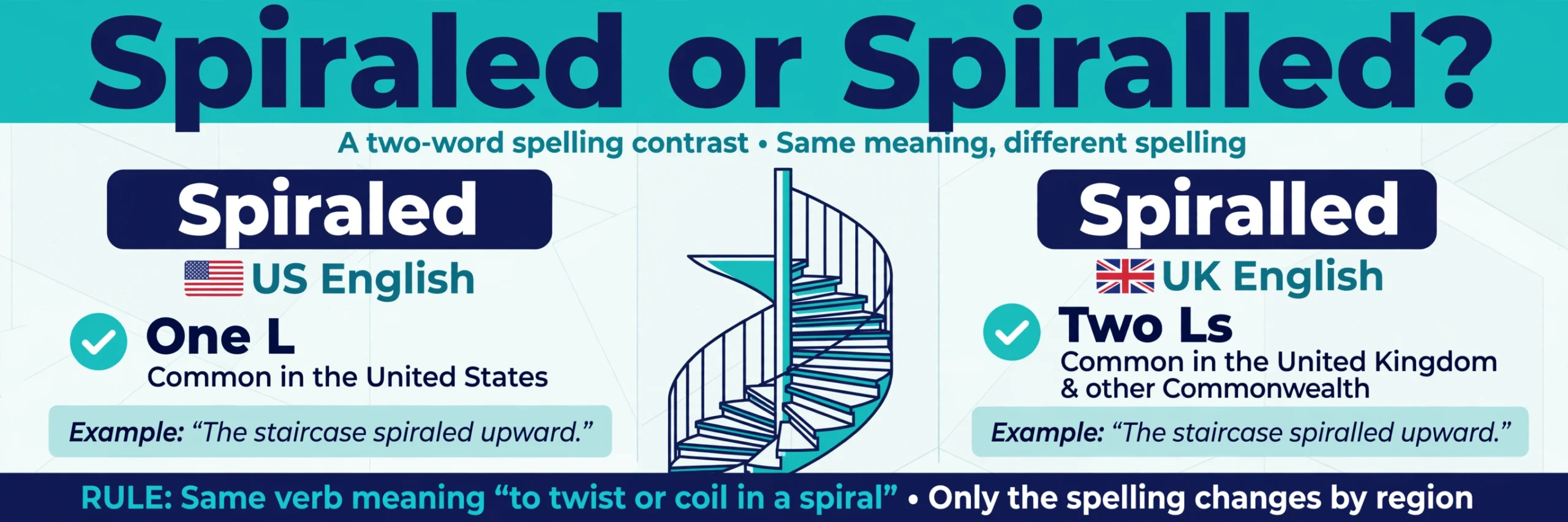
Spiraled or Spiralled: Which Spelling Is Correct?
Few spelling pairs cause as much quiet hesitation as spiraled and spiralled. You type “energy bills spiralled last winter” in London, “energy bills spiraled last winter” in New York, and both sentences mean exactly the same thing. Unlike pairs where one form is a genuine error, this is a true regional spelling split, and the correct choice depends on where your readers are. In British English, the standard past tense and past participle of spiral is spiralled, with a double l, and the present participle is spiralling. In American English, the standard forms are spiraled and spiraling, with a single l. If you write for Clarifyra’s British audience, spiralled is the form to use; if your audience is American, spiraled will look natural. Neither is a mistake — but mixing them in one article is.
Quick Answer
Use spiralled (double l) in British English and spiraled (single l) in American English — for both the past tense and past participle; the same split gives spiralling (UK) and spiraling (US). Collins records the British verb forms as “-ralling, -ralled” and the US forms as “-raling, -raled”, and its learner’s dictionary notes: “in AM, use spiraling, spiraled”. The verb means to move in a spiral, or to increase (or fall) rapidly: “House prices spiralled during the boom.” Choose one system and keep it consistent.
What the dictionaries record
Because this pair turns on a spelling convention rather than on meaning, the dictionary evidence is unusually clear — provided you read the British and American entries separately instead of assuming one global answer.
Collins English Dictionary, in its British English entry for spiral, gives the verb forms as “-rals, -ralling, -ralled” and then marks the American alternatives explicitly: “US -rals, -raling, -raled”. Collins COBUILD, aimed at learners, states the distribution even more plainly: the headword forms are given with spiralling and spiralled, followed by the regional note “in AM, use spiraling, spiraled”. Webster’s New World College Dictionary, representing American usage, lists “spiraled or spiralled, spiraling or spiralling”, acknowledging that the double-l forms are understood in the United States without treating them as the home default.
Cambridge’s example sentences follow the same geography in practice: British-oriented examples favour “spiralling out of control”, while American-oriented material uses single-l forms. Merriam-Webster’s American entry lists the verb without forcing the issue in the headword line, which is typical of US dictionaries: the single-l spelling is the expected domestic choice, and the double-l spelling is a recognised British variant rather than an error.
Two conclusions follow. First, there is no meaning difference to exploit: spiralled and spiraled are the same verb form of the same verb, pronounced the same way relative to each dialect (British /ˈspaɪərəl/ for the base word, American /ˈspaɪrəl/). Second, this is not a free variation where either spelling is equally at home everywhere. Each spelling belongs to a spelling system, and readers notice when a text drifts between systems — in this word and in neighbours such as travelled/traveled and labelled/labeled.
The rule behind the double l
The pattern governing spiralled is one of the most useful spelling generalisations in English, and learning it will settle dozens of words at once. When a verb ends in a single vowel plus l, British English normally doubles the l before a vowel-initial ending such as -ed or -ing, even when the final syllable is unstressed. Hence spiral → spiralled, spiralling; travel → travelled, travelling; label → labelled; model → modelled; cancel → cancelled.
American English applies a narrower version of the rule. It doubles the final consonant mainly when the last syllable carries the stress (as in compel → compelled) and otherwise keeps a single letter: spiral → spiraled, spiraling; travel → traveled; model → modeled. The stress in spiral falls on the first syllable — SPY-ral — so American spelling sees no reason to double the l, while British spelling doubles it anyway. Neither system is more logical in the abstract; they are different settlements of the same historical question, and each is internally consistent.
Editors check word families together. A British text with spiralled will also use travelled, cancelled, and labelled; an American text uses the matching single-l set. “The scheme was cancelled” in one paragraph and “costs spiraled” in the next registers as inconsistency, even for readers who cannot name the rule.
Canadian, Australian, and New Zealand English generally follow the British pattern, so spiralled suits those audiences too. A publication style guide outranks geography: consistency with house style is the professional standard.
Meaning and use of the verb spiral
Spelling settled, the verb itself deserves attention, because choosing spiralled over spiraled is only half the writer’s task. As a verb, spiral covers two related ideas. The literal sense is movement along a spiral path: smoke spiralling from a chimney, a hawk spiralling upward, a staircase that spirals around a central column. The figurative sense — now the commoner one in news writing — is rapid, self-reinforcing change, usually increase: prices spiral, debts spiral, violence spirals out of control. It can also describe rapid decrease, as in “the market spiralled downward”, but the upward, inflationary use dominates.
This figurative sense is why the past tense fills financial reporting. “Costs have spiralled since 2021” presents the rise as a continuing, accelerating process, not a single jump. The word carries built-in drama — momentum and loss of control — stronger than rose and far stronger than edged up. Using it for a modest, stable increase is exaggeration careful readers notice.
The verb works both transitively and intransitively. Intransitively: “The plane spiralled toward the ground” (British spelling) / “The plane spiraled toward the ground” (American). Transitively, less commonly: “The pilot spiralled the aircraft down through the cloud.” In both patterns the -ed/-ing choice follows the same regional rule, and the rest of the sentence remains identical.
Spiralled vs. spiraled at a glance
| Feature | British English | American English |
|---|---|---|
| Past tense | spiralled | spiraled |
| Past participle | spiralled (“has spiralled”) | spiraled (“has spiraled”) |
| Present participle / -ing form | spiralling | spiraling |
| Dictionary evidence | Collins British entry: “-ralling, -ralled” | Collins: “US -raling, -raled”; COBUILD note “in AM, use spiraling, spiraled” |
| Underlying rule | Double final l after a single vowel before -ed/-ing, stressed or not | Double mainly when the final syllable is stressed; otherwise single l |
| Base-word pronunciation | spiral /ˈspaɪərəl/ | spiral /ˈspaɪrəl/ |
Canadian, Australian, and New Zealand usage generally aligns with the British column for this word. International publications should name their chosen standard in a style guide rather than deciding word by word.
Correct vs. incorrect examples
Note that “incorrect” here usually means “wrong system for the stated audience”, not “wrong English”.
Correct (British): “House prices will continue to spiral downwards, analysts warned, after a year in which borrowing costs spiralled.”
Correct (British): “By 1988 the monetary indicators were spiralling out of control.”
Correct (American): “Production costs began to spiral, and executives pointed to spiraling healthcare costs.”
Correct (American): “Vines spiraled upward toward the roof.”
Incorrect for a British article: “Debts spiraled while wages were frozen.” Every other spelling may be British, but this single-l form imports the American system for one word.
Incorrect for an American article: “The aircraft began spiralling out of control over Ohio.” American readers will not misunderstand, but editors will flag the inconsistency.
Always incorrect: “The costs have spiralled/spiraled” with a slash in finished prose, or “spiralied” / “spirralling” — doubled consonants that no dictionary records.
Common mistakes
Treating spiraled as a misspelling
British writers sometimes “correct” American texts by changing spiraled to spiralled. That is not correction; it is conversion. Spiraled is the standard American past tense, recorded as such in US dictionaries. Only convert when you are deliberately re-setting a whole text to British conventions — and then convert the full set of related spellings, not just this word.
Doubling the wrong letter, or doubling twice
The choice is between one l and two; there is never a doubled r or a triple letter. Forms such as *spirralling* and *spirallled* appear in rushed drafts and are wrong in both systems. A quick visual check — spi-ra-l(l)ed — prevents them.
Applying the British rule where stress changes the answer
Some l-final verbs behave differently because stress shifts: compare spiral (stress on the first syllable; US single l, UK double l) with compel (stress on the second syllable; both double l: compelled). Writers who half-remember the rule sometimes produce American “compelled” as *compeled*, which is wrong in both dialects. The safe test for American spelling is stress; British spelling doubles regardless, with a small set of exceptions (for example, parallel → paralleled in both systems).
Using spiral for any increase
Because spiralled is a vivid word, it gets overused. A two-percent rise that then stabilises has not spiralled in any meaningful sense. Reserve the verb for rapid, escalating movement, and prefer rose, increased, or climbed for ordinary changes. Precision here is a meaning issue, not a spelling issue — and it is the kind readers reward.
Confusing the noun phrase “downward spiral”
In “a downward spiral”, spiral is a noun and needs no -ed form. Errors arise when writers blend the patterns (“a spiraling downward of prices”) where simpler phrasing (“prices spiralled downward”) is available. Choose either the verb or the noun construction, not a hybrid.
FAQs
Is spiralled or spiraled correct?
Both are correct, in different spelling systems. Spiralled is British (and generally Australian, New Zealand, and Canadian) usage; spiraled is American usage. Match your audience and remain consistent.
What is the present participle: spiralling or spiraling?
It follows the same split: spiralling in British English, spiraling in American English. Collins’ learner’s dictionary makes this explicit with the note “in AM, use spiraling, spiraled”.
Why does British English double the l if the stress is on the first syllable?
British spelling applies the doubling rule to verbs ending in a single vowel plus l before -ed and -ing endings regardless of stress (travelled, labelled, spiralled). American spelling generally doubles only when the final syllable is stressed. The difference is a convention settled differently by the two spelling reforms, not a difference in pronunciation.
Can I use spiraled in a British article if my spellchecker accepts it?
You can, but you should not if the rest of the article follows British conventions. Spellcheckers accept forms from the dictionary they are given; they do not enforce consistency across a document. Set the checker to the target dialect and choose the British form throughout.
Does spiral only mean prices going up?
No. Its literal sense is movement in a spiral shape, and even in the figurative sense it can describe rapid falls (“the shares spiralled downward”). The rapid-rise use is simply the most frequent in news reporting.
Takeaway
Decide by audience, not by instinct: spiralled and spiralling for British readers, spiraled and spiraling for American readers, with Canada, Australia, and New Zealand generally sitting in the British column. Both spellings represent the same verb, the same pronunciation pattern, and the same dramatic meaning of rapid, escalating change. The only real error is inconsistency — so pick your system, apply it to the whole word family (travel, label, cancel, and their kin), and let the spelling disappear beneath the writing, which is where it belongs.