Siting or Citing: What’s the Difference?
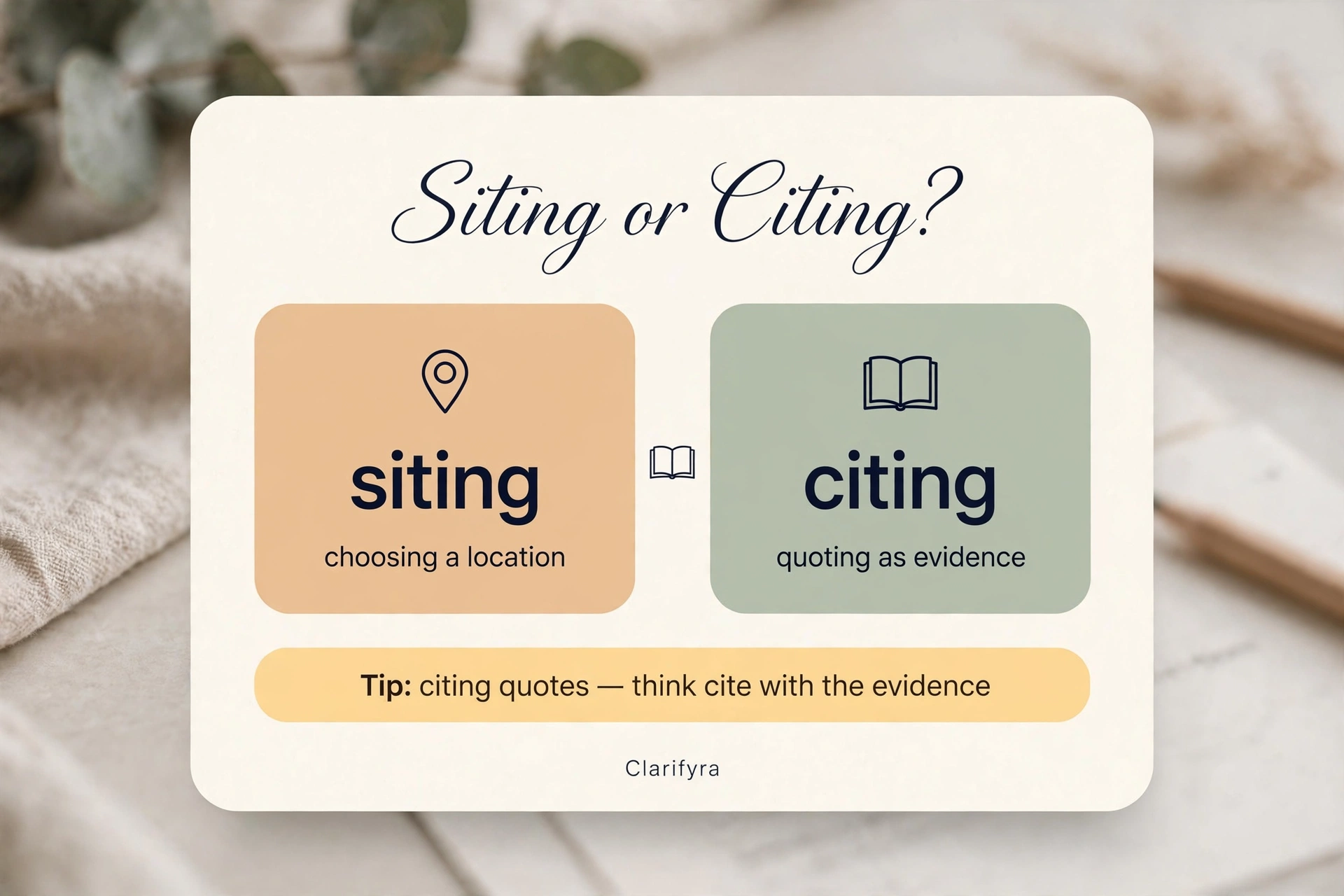
Citing is about pointing to evidence: quoting or referring to a source, an authority, or an example. Siting is about placing things: choosing where something goes. Both are pronounced “SYE-ting” (/ˈsaɪtɪŋ/) — which is exactly why they get swapped. A student is citing sources in an essay (referring to evidence); a planning committee debates the siting of a new school (where to put it). If your sentence is about sources, quotes, or legal summonses, it’s citing. If it’s about location, it’s siting.
Quick Answer
Citing is the -ing form of the verb cite — “to quote or refer to (a passage, book, or author) in substantiation as an authority, proof, or example” (Collins), or “to summon to appear before a court of law.” It’s what you do with evidence: “the report, citing three independent studies.” Siting is the -ing form of the verb site — the act of choosing or assigning a location: “the siting of the new school.” Both are pronounced /ˈsaɪtɪŋ/, so only meaning tells them apart.
What “Citing” Means: Pointing to Evidence
Citing comes from the verb cite, and its core job is pointing at something as support. Collins’ British English entry defines cite as “to quote or refer to (a passage, book, or author) in substantiation as an authority, proof, or example,” and its American (Webster’s New World) entry lists the verb forms as cited, citing. The word entered English in the 15th century from Old French citer, “to summon,” from Latin citāre — and that summoning root survives in its second main sense.
The dictionaries record three working senses of the verb:
- Quoting or referring to as evidence. “She cited a famous author in her essay”; “citing new polling data, the analyst revised the forecast.” This is the academic and journalistic heart of the word.
- Summoning before a court. Collins lists “to summon to appear before a court of law” as a full sense — the officer’s “the driver was cited for speeding” is this meaning, not a typo.
- Mentioning as an example, proof, or precedent. Webster’s New World gives “to refer to or mention as by way of example, proof, or precedent” — “he cited the king’s virtues,” or a paper cited as precedent in a legal argument.
There’s also a noun lurking in the family: American dictionaries record cite as a noun meaning “a short note recognizing a source of information” — in other words, a citation. So “add a cite after every quotation” is legitimate usage, even though it sounds odd to ears trained only on the verb.
Pronunciation is the same on both sides of the Atlantic: Collins gives cite as /saɪt/ in British and American English alike, and citing follows the regular pattern — /ˈsaɪtɪŋ/, “SYE-ting,” identical to siting and sighting.
A Quick Recap: What “Siting” Means
Siting belongs to an entirely different world from citing: it’s the -ing form of the verb site, “to build or place something in a particular position” (Oxford). It means the act of choosing or assigning a location — “the siting of the new school,” “siting permits,” “siting decisions.” It lives in planning documents, architecture, environmental reports, and business strategy: permits, councils, and zoning hearings. A useful way to hold the two apart: siting never involves quoting anything; it’s always about where.
For the full siting-vs-sighting side of this confusion (the “where” word versus the “seeing” word), see Siting or Sighting: What’s the Difference? — this article focuses on citing.
The Site, Sight, and Cite Trio
Siting and citing collide because their parent words, site and cite, are homophones — both pronounced /saɪt/ — and they share a third identical-sounding partner, sight. Oxford groups all three together as homophones, and Merriam-Webster devotes a usage note to the trio, warning that “homophones — words that sound alike but are distinct — are easily confused.” The -ing forms inherit their parents’ spellings: siting keeps site (no h), citing keeps cite (with the c-that-sounds-like-s). If you can keep the three parents straight — site = a place, sight = seeing, cite = to quote or summon — the -ing forms follow without effort.
Siting vs Citing at a Glance
| Word | Comes from | Part of speech | Core meaning | Example |
|---|---|---|---|---|
| citing | verb cite | verb form | quoting or referring to as evidence; summoning | “the report, citing three studies” |
| siting | verb site | verb form / noun | choosing or assigning a location | “the siting of the new school” |
Correct vs Incorrect
The test for every sentence: is this about pointing to evidence, or about choosing a place?
- ✗ “The paper is siting three peer-reviewed studies.” → ✓ “The paper is citing three peer-reviewed studies.” (Referring to evidence — from cite.)
- ✗ “The council debated the citing of the wind farm.” → ✓ “The council debated the siting of the wind farm.” (Choosing a location — from site.)
- ✗ “Please include your sitings at the end of the essay.” → ✓ “Please include your citations at the end of the essay.” (References to sources; sitings is not a standard word.)
- ✗ “They were citing the new headquarters near the river.” → ✓ “They were siting the new headquarters near the river.” (Placing the building — verb form of site.)
- ✓ “The lawyer spent the morning citing precedents to the judge.” (Referring to authority — from cite.)
- ✓ “Citing the report’s findings, she argued for reform.” (The -ing participle introducing quoted evidence.)
- ✓ “The siting of the data centre followed two years of consultation.” (A location decision.)
Common Mistakes
1. Writing “siting” when you mean referencing a source. ✗ “the author is siting Smith (2021)” → ✓ “the author is citing Smith (2021).” Students typing fast reach for siting because it sounds right — but there is no source involved in siting, only places.
2. Writing “citing” for a planning or location decision. ✗ “the proposed citing of the factory” → ✓ “the proposed siting of the factory.” A factory’s position is a site decision; no quotation is happening.
3. Inventing “sitings.” The plural-looking sitings isn’t a standard word in any major dictionary. If you need the plural of a reference note, the word is citations; if you need the plural of a location decision, rephrase — “siting decisions,” “siting permits.”
4. Assuming “citing” only means quoting. The summon sense is real dictionary territory: “he was cited for contempt” means summoned before the court, not quoted. In legal and news contexts, citing often carries this official-action meaning — “the report cited the company for violations.”
5. Confusing “cite” with “quote” and “reference.” They overlap but aren’t identical. Cite is the act of pointing to the source (“she cited the study”); quote is repeating its exact words (“she quoted the study’s conclusion”); reference is the full bibliographic entry. You can cite without quoting, and quote while citing.
6. Relying on the spellchecker. Both siting and citing are real, recorded words, so neither gets flagged. This is a meaning error, not a spelling error — only knowing which meaning you intend will save you.
Frequently Asked Questions
How is “cite” pronounced?
/saɪt/ — “SYTE” — in both UK and US English (Collins records the same pronunciation for both). It rhymes with site and sight, which is why the three are classic homophones. Citing is /ˈsaɪtɪŋ/ (“SYE-ting”), pronounced identically to siting and sighting.
What’s the difference between “cited” and “sited”?
Cited is the past tense of cite: “the study was widely cited” (quoted or referred to). Sited is the past tense of site: “the castle is magnificently sited on a cliff” (placed there). Same pronunciation (/ˈsaɪtɪd/), same trap, same fix: evidence versus location.
Do I need to cite sources in an essay, and how?
Yes — citing sources is how academic writing shows its work: every quotation, paraphrase, and borrowed idea points back to where it came from, usually in a “Works Cited” or reference list. The exact format (APA, MLA, Chicago) depends on your discipline and instructor, so check the course requirements rather than trusting memory. The key point for this article’s purposes: whenever the act is referring to evidence, the word is citing, never siting.
Is “citing” ever a noun?
Not as a headword — citing is the present participle of the verb cite. The noun for the act or note of referring to a source is citation. American dictionaries do record the bare verb cite itself as a noun (“a short note recognizing a source of information”), but “citing” as a noun isn’t standard usage.
What’s the difference between “cite,” “quote,” and “reference”?
Cite means to point to a source as authority or evidence (“the paper cites three studies”). Quote means to repeat exact words (“the paper quotes the study’s conclusion”). Reference is the full bibliographic entry that lets a reader find the source. A good citation often does all three jobs at once, but the words describe different actions.
Can “siting” ever involve quoting?
No. Siting is the -ing form of the verb site, “to build or place something in a particular position” (Oxford) — it only ever concerns location. Any quoting, referring, or summoning belongs to citing. The two share a pronunciation and nothing else.
The Takeaway
Citing points; siting places. The essay is citing its sources; the committee is debating the siting of the school. They’re homophones with unrelated jobs — cite’s world is evidence, quotations, and summonses; site’s world is maps, permits, and construction. When in doubt, ask which parent you need: if the word you’re reaching for ends in cite, it’s citing; if it ends in site, it’s siting.