Ways to Say Hello in Different Languages: 50+ Greetings Around the World
A simple “hello” can open a conversation almost anywhere, but the words you use change from language to language—and sometimes according to the time of day, the person you’re speaking to, or how formal the situation is.
Learning a few ways to say hello in different languages is useful for travel, meeting international friends, learning a new language, or simply understanding how people greet one another around the world. Below, you’ll find common greetings from more than 50 languages, followed by a closer look at Spanish and Japanese, where one English “hello” can have several natural equivalents.
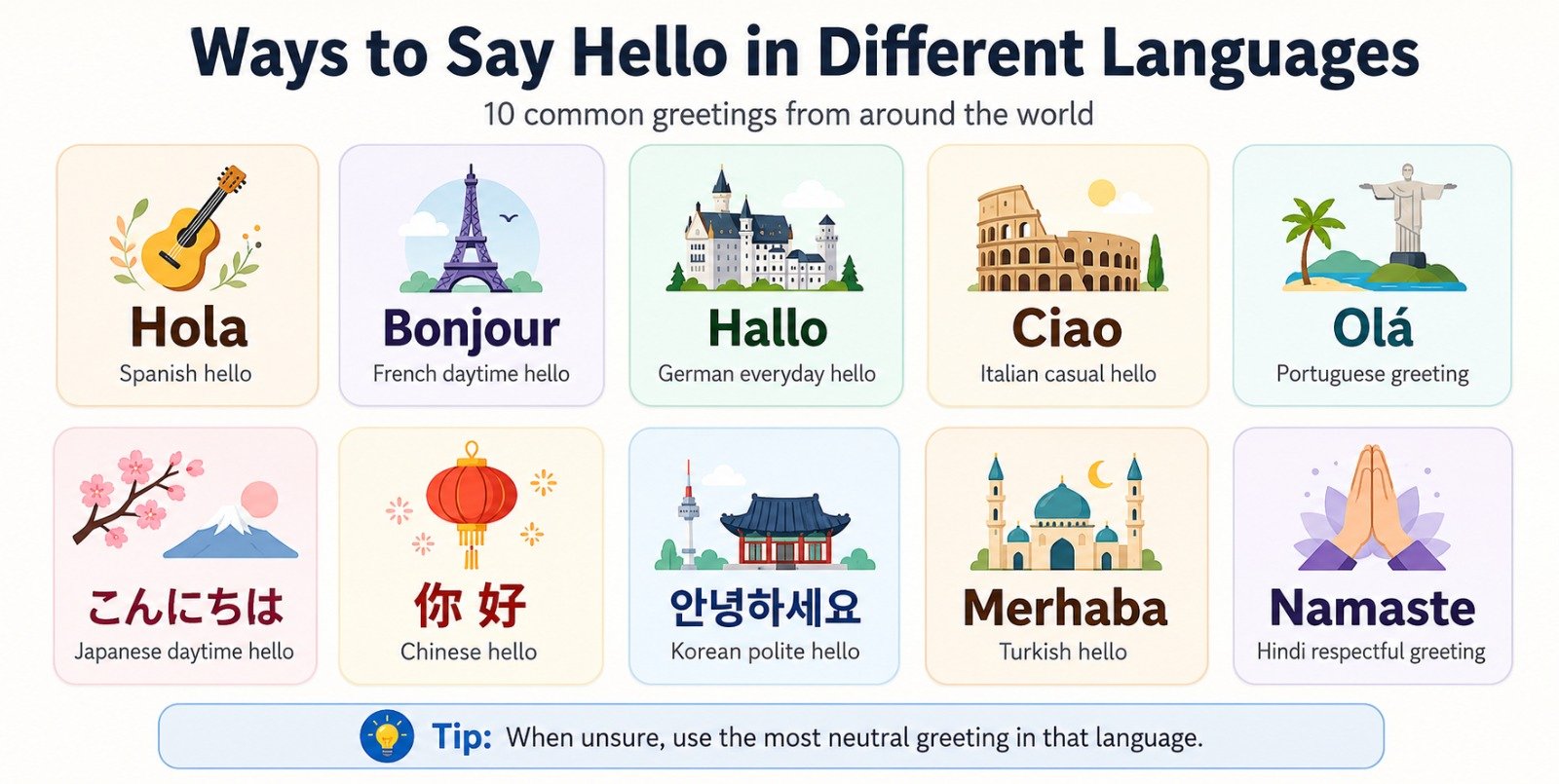
<div style=”background:#f3f5ff;border:1px solid #cbd1f7;border-left:4px solid #4C60DC;border-radius:10px;padding:18px 20px;margin:22px 0;”> <div style=”font-size:12px;font-weight:700;text-transform:uppercase;letter-spacing:0.8px;color:#4C60DC;margin-bottom:7px;”>At a Glance</div> <div style=”font-size:16px;line-height:1.65;color:#222;”>Some familiar greetings around the world are <strong>Hola</strong> in Spanish, <strong>Bonjour</strong> in French, <strong>Hallo</strong> in German, <strong>Ciao</strong> in Italian, <strong>Olá</strong> in Portuguese, <strong>Konnichiwa (こんにちは)</strong> in Japanese, <strong>Nǐ hǎo (你好)</strong> in Mandarin Chinese, and <strong>Annyeonghaseyo (안녕하세요)</strong> in Korean. The best greeting depends on the language, situation, and level of formality.</div> </div>
50+ Different Ways to Say Hello in Different Languages
There isn’t always a perfect one-to-one translation of the English word “hello.” Some languages use different greetings for strangers and friends, while others change their greeting depending on the time of day.
The table below focuses on widely recognized or useful greetings rather than pretending there is one universal “hello” for every language.
| Language | Common Greeting | Meaning or Best Use |
|---|---|---|
| Spanish | Hola | Hello; suitable in most everyday situations |
| French | Bonjour | Hello/good day; polite daytime greeting |
| German | Hallo | Hello; common everyday greeting |
| Italian | Ciao | Hi; casual and friendly |
| Portuguese | Olá | Hello; widely useful |
| Japanese | こんにちは (Konnichiwa) | Hello/good afternoon; mainly daytime |
| Korean | 안녕하세요 (Annyeonghaseyo) | Polite everyday hello |
| Mandarin Chinese | 你好 (Nǐ hǎo) | Hello |
| Cantonese | 你好 (Néih hóu) | Hello |
| Arabic | مرحبًا (Marhaban) | Hello/welcome |
| Hindi | नमस्ते (Namaste) | Respectful greeting |
| Urdu | السلام علیکم (Assalam-o-alaikum) | Peace be upon you; very common greeting |
| Bengali | নমস্কার (Nomoshkar) | Respectful greeting |
| Russian | Привет (Privet) | Hi; informal |
| Ukrainian | Привіт (Pryvit) | Hi; informal |
| Polish | Cześć | Hi; informal |
| Czech | Ahoj | Hi; informal |
| Slovak | Ahoj | Hi; informal |
| Dutch | Hallo | Hello |
| Swedish | Hej | Hi/hello |
| Danish | Hej | Hi/hello |
| Norwegian | Hei | Hi/hello |
| Finnish | Hei | Hi/hello |
| Icelandic | Halló | Hello |
| Greek | Γεια σου (Yia sou) | Hello; generally informal singular |
| Turkish | Merhaba | Hello |
| Romanian | Bună | Hi/hello |
| Hungarian | Szia | Hi; informal |
| Croatian | Bok | Hi; informal |
| Serbian | Zdravo | Hello |
| Slovenian | Živjo | Hi; informal |
| Bulgarian | Здравей (Zdravey) | Hello; informal singular |
| Lithuanian | Labas | Hello; informal |
| Latvian | Sveiki | Hello |
| Estonian | Tere | Hello |
| Albanian | Përshëndetje | Hello/greetings |
| Georgian | გამარჯობა (Gamarjoba) | Hello |
| Armenian | Բարև (Barev) | Hello |
| Hebrew | שלום (Shalom) | Hello/peace |
| Persian | سلام (Salam) | Hello |
| Swahili | Jambo | Hello; widely recognized greeting |
| Afrikaans | Hallo | Hello |
| Zulu | Sawubona | Hello, traditionally to one person |
| Xhosa | Molo | Hello, traditionally to one person |
| Filipino/Tagalog | Kumusta? | Hello/how are you? |
| Indonesian | Halo | Hello |
| Malay | Hai | Hi |
| Vietnamese | Xin chào | Hello |
| Thai | สวัสดี (Sawasdee) | Polite hello |
| Khmer | សួស្តី (Suostei) | Hello |
| Nepali | नमस्ते (Namaste) | Respectful greeting |
| Sinhala | ආයුබෝවන් (Ayubowan) | Traditional respectful greeting |
| Māori | Kia ora | Hello/greetings |
| Hawaiian | Aloha | Hello; also used when saying goodbye |
| Irish | Dia dhuit | Traditional greeting, literally invoking God |
| Welsh | Helo | Hello |
| Basque | Kaixo | Hello |
| Catalan | Hola | Hello |
| Haitian Creole | Bonjou | Good morning/day; common daytime greeting |
| Esperanto | Saluton | Hello/greetings |
These forms reflect the important difference between simply translating “hello” and choosing a greeting people actually use. Language-learning resources also distinguish formal from informal greetings in many languages rather than presenting every greeting as interchangeable.
Also Check | 100 Different Ways to Say Hello: Creative, Casual and Stylish Greetings
Why “Hello” Doesn’t Translate the Same Way Everywhere
English makes things relatively easy. You can say “hello” at 8 a.m., 2 p.m., or 8 p.m. without changing the word.
Other languages often make finer distinctions.
A greeting may depend on:
- Time of day: morning, afternoon, or evening
- Formality: speaking to a friend versus a stranger or senior
- Region: expressions can vary between countries that share a language
- Setting: face-to-face conversation, phone calls, shops, or workplaces
- Number of people: some languages change forms according to whom you’re addressing
That means a phrase can be a perfectly good greeting without being appropriate in every situation.
For example, Russian distinguishes the informal Привет (Privet) from the much more formal Здравствуйте (Zdravstvuyte). City Lit specifically notes that the formal form is appropriate with strangers, older people, and in professional settings.
So when learning different ways to say hello in different languages, context matters just as much as vocabulary.
Popular European Greetings
European languages provide several greetings that English speakers may already recognize.
In French, bonjour is the standard polite daytime greeting, while salut is more relaxed and suits friends or informal situations. In German, Hallo is common in everyday conversation, while Guten Tag gives you a more formal “good day.” Italian ciao is famously friendly and casual, while salve can be more neutral.
These differences matter when you’re traveling. Saying the technically correct word with the wrong level of familiarity can sound odd, even when your meaning is understood.
For example:
French, polite: “Bonjour, Madame.”
French, casual: “Salut, Marc!”
German, neutral/formal: “Guten Tag.”
German, casual: “Hallo!”
Babbel and Berlitz both distinguish greetings according to formality and regional usage in European languages.
Ways to Say Hello in Spanish
The easiest answer to “How do you say hello in Spanish?” is hola.
Hola works in an enormous range of everyday situations. You can use it with friends, colleagues, shop staff, or someone you’ve just met. It is therefore the safest first greeting for a beginner.
But there are plenty of different ways to say hello in Spanish, especially when you consider time of day and casual conversation.
Common Spanish Greetings
| Spanish Greeting | English Sense | Best Used For |
| Hola | Hello/hi | Almost any everyday situation |
| Buenos días | Good morning | Morning; polite or neutral |
| Buenas tardes | Good afternoon | Afternoon |
| Buenas noches | Good evening/night | Evening or nighttime |
| Buenas | Hi/good day | Casual greeting in many regions |
| ¿Qué tal? | How’s it going? | Friendly everyday conversation |
| ¿Cómo estás? | How are you? | Informal singular conversation |
| ¿Cómo está? | How are you? | More formal singular address |
| ¿Qué pasa? | What’s up? | Informal conversation |
| ¿Qué onda? | What’s up? | Informal; especially associated with Mexico and some other regions |
Berlitz identifies hola as the standard Spanish hello and distinguishes it from time-based forms such as buenos días, buenas tardes, and buenas noches. It also notes considerable regional variation in casual Spanish greetings.
Hola: The Safest Everyday Choice
If you know only one Spanish greeting, make it hola.
It’s straightforward and doesn’t require you to decide whether a conversation is highly formal or casual.
For example:
“Hola, Ana. ¿Cómo estás?”
“Hi, Ana. How are you?”
“Hola, mucho gusto.”
“Hello, nice to meet you.”
The h in hola is silent, so the word sounds roughly like OH-lah.
Buenos Días, Buenas Tardes, and Buenas Noches
Spanish often uses a greeting based on the time of day.
Buenos días is the natural choice in the morning.
Buenas tardes takes over later in the day.
Buenas noches is used in the evening and at night.
These phrases generally sound a little more courteous than simply walking in with an informal “¿Qué pasa?”
A customer entering a café in the morning, for instance, might naturally say:
“Buenos días.”
Casual Spanish Greetings
With friends, you have more freedom.
¿Qué tal? is a useful conversational greeting that is closer to “How’s it going?” than a literal replacement for “hello.”
¿Qué pasa? has a “What’s up?” feel.
¿Qué onda? is particularly associated with casual Mexican Spanish, so it shouldn’t be presented as the default greeting throughout the entire Spanish-speaking world. Regional vocabulary is one reason learning Spanish greetings from a single translation list can be misleading.
Ways to Say Hello in Japanese
Japanese shows especially clearly why there isn’t always one word that works everywhere.
The expression most English speakers know is こんにちは (konnichiwa). It is useful, but Japanese speakers also choose greetings based on the time of day, social relationship, and situation.
Useful Japanese Greetings
| Japanese | Romanization | Natural English Sense | Typical Context |
| おはよう | Ohayou | Morning! | Casual morning greeting |
| おはようございます | Ohayou gozaimasu | Good morning | Polite morning greeting |
| こんにちは | Konnichiwa | Hello/good afternoon | Daytime greeting |
| こんばんは | Konbanwa | Good evening | Evening |
| もしもし | Moshi moshi | Hello? | Telephone conversations |
| やあ | Yaa | Hi/hey | Very casual |
| 久しぶり | Hisashiburi | Long time no see | Someone you already know |
Konnichiwa: The Famous Japanese “Hello”
こんにちは (konnichiwa) is usually taught as Japanese for “hello.” That’s a useful beginner translation, but its real-world use is more specific than English “hello.”
It is primarily a daytime greeting, rather than something you’d naturally use first thing in the morning or late at night.
A simple exchange could be:
A: こんにちは。
Konnichiwa.
B: こんにちは。
Konnichiwa.
For an English-speaking learner, a rough pronunciation is kon-nee-chee-wah.
Saying Good Morning in Japanese
In the morning, Japanese speakers commonly use:
おはよう (ohayou) — casual
おはようございます (ohayou gozaimasu) — polite
The longer version is appropriate when you want to show more politeness, such as in many workplace or less familiar social situations.
Saying Good Evening in Japanese
Later in the day, use:
こんばんは (konbanwa) — “Good evening.”
So, rather than relying on konnichiwa from morning until night, learning these three greetings gives you a more natural foundation:
Morning: おはようございます
Daytime: こんにちは
Evening: こんばんは
Moshi Moshi Is for the Phone
One of the most useful distinctions for learners is もしもし (moshi moshi).
It is strongly associated with telephone conversations. It isn’t simply another casual phrase you should substitute for konnichiwa whenever you meet someone face to face.
For example, when calling a friend:
“もしもし、元気?”
“Moshi moshi, how are you?”
Japanese learning resources distinguish ohayou gozaimasu, konnichiwa, konbanwa, and moshi moshi according to their situations rather than treating them as identical greetings.
Formal and Casual Greetings Aren’t Always Interchangeable
One of the easiest mistakes to make with international greetings is assuming that every translation listed under “hello” can be swapped freely.
They can’t.
Consider these pairs:
| Language | More Neutral/Formal | More Casual |
| French | Bonjour | Salut |
| German | Guten Tag | Hallo / Hi |
| Italian | Salve / Buongiorno | Ciao |
| Russian | Здравствуйте (Zdravstvuyte) | Привет (Privet) |
| Japanese | おはようございます | おはよう |
| Spanish | Buenos días | ¿Qué pasa? |
Babbel’s multilingual greeting guide similarly separates formal and informal forms across a range of languages.
The distinction is similar to choosing between “Good morning, Mr. Harris” and “Hey, what’s up?” in English. Both can begin a conversation, but the social effect is very different.
When speaking to a stranger and you’re uncertain, the polite or neutral greeting is usually the more useful one to learn first.
Greetings That Mean More Than “Hello”
Some international greetings carry meanings that don’t line up perfectly with the English word hello.
Shalom in Hebrew is associated with peace and can function as a greeting.
Aloha in Hawaiian is used as both a greeting and a farewell and has cultural meaning beyond a simple English “hi.”
Kia ora in Māori is widely used as a greeting, while its meaning and cultural associations extend beyond a literal “hello.”
Namaste, used in South Asian contexts, is a respectful greeting rather than merely an alternative pronunciation of the English word.
This is why translations should be understood as functional equivalents, not always word-for-word matches.
How to Choose the Right International Greeting
If you’re learning a greeting for travel or conversation, don’t try to memorize dozens of expressions from one language at once. Start with three things:
1. Learn the safest general greeting.
Start with hola, bonjour, merhaba, nǐ hǎo, or the equivalent neutral greeting in your target language.
2. Learn whether it changes by time of day.
French, Spanish, Japanese, German, and many other languages have useful morning or evening forms.
3. Learn one polite and one casual option.
This keeps you from greeting your friend’s grandmother, a hotel receptionist, and your closest friend in exactly the same way.
It is also worth listening to native audio when pronunciation matters. An English spelling approximation can help you remember a new word, but it can’t represent every sound or accent accurately.
What About Ways to Say Hello in All Languages?
It isn’t practical to list ways to say hello in all languages in a single useful article. The world has thousands of living languages, and many contain dialects, levels of formality, and regional greeting traditions of their own.
Even broad multilingual greeting resources make a selection rather than literally covering every language; for example, Berlitz’s international greeting collection covers 113 real and fictional languages.
A better approach is to learn common greetings from languages that are relevant to where you’re traveling, who you’re speaking with, or what you’re studying.
That also leaves room to learn how the greeting is actually used instead of memorizing hundreds of disconnected words.
A Few Useful Greeting Situations
Knowing the translation is only the first step. Here’s how the choice can change with the situation.
Meeting Someone for the First Time
Prefer a neutral or polite greeting.
Spanish: Buenos días / Hola
French: Bonjour
Japanese: こんにちは
German: Guten Tag
Greeting a Friend
Casual alternatives become more natural.
Spanish: Hola / ¿Qué tal?
French: Salut
Italian: Ciao
Russian: Привет (Privet)
Answering the Phone
Telephone greetings can follow different conventions. Italian commonly uses Pronto?, French uses Allô ?, and Japanese is well known for もしもし (moshi moshi) in informal phone conversations. Babbel’s guide to answering the phone across languages highlights how phone greetings differ from ordinary face-to-face hellos.
That’s another reason a simple translation dictionary doesn’t always tell the full story.
Frequently Asked Questions
What are 10 easy ways to say hello in different languages?
Ten useful examples are Hola (Spanish), Bonjour (French), Hallo (German), Ciao (Italian), Olá (Portuguese), Konnichiwa (Japanese), Nǐ hǎo (Mandarin Chinese), Annyeonghaseyo (Korean), Merhaba (Turkish), and Salam (Persian).
What is the Spanish word for hello?
The standard Spanish word for hello is hola. It works in most everyday situations. Depending on the time of day, you can also use buenos días, buenas tardes, or buenas noches.
What are some different ways to say hello in Spanish?
Besides hola, common Spanish greetings include buenos días, buenas tardes, buenas noches, ¿qué tal?, and the more casual ¿qué pasa?. Some informal expressions are regional, so what sounds natural in Mexico may not be the usual choice in Spain, Argentina, or another Spanish-speaking country.
How do you say hello in Japanese?
こんにちは (konnichiwa) is the best-known Japanese equivalent of “hello” and is mainly a daytime greeting. In the morning, use おはよう (ohayou) or the more polite おはようございます (ohayou gozaimasu). In the evening, use こんばんは (konbanwa).
Is konnichiwa used all day in Japan?
Not usually. Konnichiwa is mainly associated with daytime. Morning and evening have their own conventional greetings, which is why translating it simply as an all-purpose English “hello” can miss an important usage distinction.
How do you say hello on the phone in Japanese?
もしもし (moshi moshi) is a familiar Japanese telephone greeting, particularly in informal calls. It shouldn’t be treated as a general replacement for konnichiwa in face-to-face conversation.
Are formal and informal greetings different in other languages?
Yes. Many languages distinguish between greetings for friends and those used with strangers, older people, customers, or professional contacts. Russian Privet versus Zdravstvuyte is a clear example, and European languages such as French, German, and Italian also offer more formal and more casual choices.
Choosing the Best Way to Say Hello
Learning greetings around the world is more useful when you learn a little context with each word. Hola, bonjour, konnichiwa, and ciao may all serve the basic purpose of starting a conversation, but their tone and appropriate setting aren’t always identical.
Begin with a common neutral greeting, then learn how the language handles friends, strangers, morning, evening, and more formal situations. That small amount of context can make even a beginner’s greeting sound more natural and considerate.
At Clarifyra, we focus on those differences in meaning and usage so you can go beyond memorizing words and choose the expression that genuinely fits the person, place, and conversation.
Also Read | 100 Funny Ways to Say Hello: Silly, Weird and Playful Greetings