Christmases or Christmas’s: Which Is Correct?
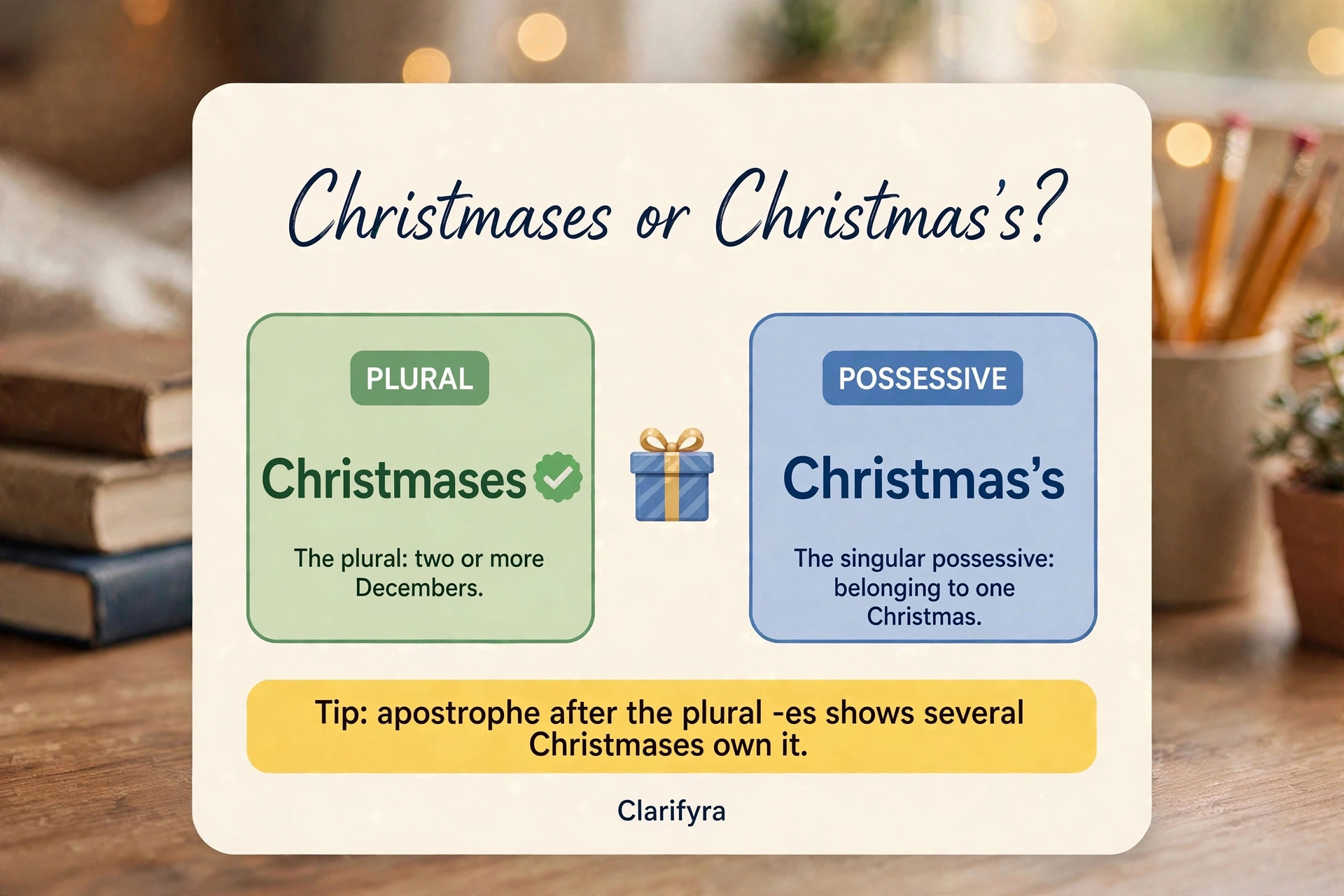
Christmases is the plural — it means more than one Christmas, as in “We’ve had three wonderful Christmases here.” Christmas’s is the singular possessive, used when something belongs to or is part of one Christmas. The spelling Christmass (with a double s) is not a modern English word. Here is how to keep the three real forms straight.
Quick Answer
Christmases = plural (more than one Christmas). Christmas’s = singular possessive (belonging to one Christmas). Christmases’ = plural possessive (belonging to several Christmases). Christmass with a double s is not a word in modern English.
The Verdict: Three Forms, Three Jobs
Christmas ends in an s, which makes people hesitate — and that hesitation is exactly where the mistakes creep in. There are three correct forms, and each does a different job:
| Form | What it means | Example |
|---|---|---|
| Christmases | Plural: more than one Christmas | Our last three Christmases were spent in Norway. |
| Christmas’s | Singular possessive: belonging to one Christmas | Christmas’s biggest attraction for the kids is the tree. |
| Christmases’ | Plural possessive: belonging to several Christmases | The Christmases’ traditions varied from year to year. |
Notice that all three start from the same base word, Christmas, and none of them doubles the final s. If you ever catch yourself typing “Christmass” or “Christmasses”, stop — those are not words.
Why the Plural Takes -es
Nouns that end in a hissing sound — spelled s, ss, sh, ch, x, or z — form their plurals by adding -es, not just -s. The extra vowel gives you a syllable to pronounce, which is why we say bus–buses, watch–watches, and box–boxes. Christmas follows the same rule: the plural is Christmases.
Collins records this plural explicitly in its entry, listing “Word forms: plural Christmases”, and Oxford Learner’s Dictionaries classifies Christmas as both countable and uncountable — which means it can be pluralized. So writing “Christmases” is not a guess; it is the documented plural form.
The same -es pattern turns up in other words that trip people up, like how coaches takes -es. Once you see the rule, the spelling stops looking odd: Christmas + es = Christmases. One s from the base word, plus es — never a doubled ss before the ending.
Singular vs Plural Possessives
This is where the apostrophe comes in, and it is simpler than it looks. Decide first whether you mean one Christmas or several.
One Christmas: add ‘s
To make a singular noun possessive, add ‘s, even when the noun already ends in s. So:
- Christmas’s busiest week is the one before the 25th.
- What was Christmas’s gift to you this year?
You will occasionally see Christmas’ (apostrophe only, no extra s). Some writers and style conventions drop the final s on singular nouns that already end in one, and neither spelling will be misunderstood. There is no single rule everyone follows for this case, so pick one form and stay consistent. Christmas’s is the safer default in ordinary writing.
Several Christmases: add the apostrophe after the -es
If you are talking about more than one Christmas, form the plural first (Christmases), then add just an apostrophe, because the plural already ends in s:
- The Christmases’ celebrations got grander each year.
- Looking back, the past decade’s Christmases’ best moments were the quiet ones.
The difference is one letter: Christmas’s (singular owner) vs Christmases’ (plural owners). Reading the sentence aloud helps — if you hear “Christmases” (plural), the apostrophe goes after the s. The same apostrophe logic sits behind the confusion between nobodies vs nobody’s: plural and possessive look similar, but the apostrophe always tells you which one you meant.
Why “Christmass” Isn’t a Word
The double-s spelling is tempting because the word ends in a stressed “s” sound and your fingers want to double the consonant. But Christmass has no entry in the Cambridge, Merriam-Webster, or Collins dictionaries I checked — it is not a recognized modern English word.
There is a historical footnote: the only dictionary trace of the spelling is as an obsolete variant. A Wiktionary-based entry records Christmass as an obsolete form of Christmas, citing a 1687 quotation. Obsolete means nobody is expected to use it now. In modern writing, Christmass is simply a typo — the same kind of error as writing “busess” instead of “buses”.
The word’s actual history points the other way. Merriam-Webster traces Christmas to Middle English Christemasse, from Old English Cristes mæsse — literally “Christ’s mass” — and Oxford Learner’s gives the same Old English origin. The single s at the end has been there all along.
Pronunciation: UK vs US
Good news: Christmas is pronounced the same on both sides of the Atlantic. Cambridge gives /ˈkrɪs.məs/ for both UK and US, and Oxford Learner’s and Collins agree, listing the same pronunciation for British and American English. The t is silent — say KRISS-muss, never KRIST-muss.
The plural Christmases adds an extra syllable for the -es: KRISS-muh-siz. That extra “iz” sound is exactly why the -es ending exists — it gives the hiss somewhere to land. None of the dictionaries I checked lists a separate IPA entry for the plural, but the pronunciation follows the standard pattern of es plurals like buses and watches.
Common Mistakes
1. Using the singular possessive when you mean the plural
✗ We spent the last three Christmas’s in Norway.
✓ We spent the last three Christmases in Norway.
Three separate holidays means a plural, not a possessive. No apostrophe.
2. Writing “Christmass” with a double s
✗ Happy Christmass!
✓ Happy Christmas!
The base word has one final s. Double-check your fingers at the end of the word.
3. Writing “Christmasses” for the plural
✗ I loved all our Christmasses together.
✓ I loved all our Christmases together.
You add -es to the existing single s; doubling the s before the ending gives you a word that doesn’t exist.
4. Using a plural verb with Christmas
✗ Christmas are my favourite time of year.
✓ Christmas is my favourite time of year.
Despite the final s, Christmas is singular — it takes singular verbs and this/that (“this Christmas”, not “these Christmas”).
5. Dropping the apostrophe in the singular possessive
✗ Christmas busiest week starts tomorrow.
✓ Christmas’s busiest week starts tomorrow.
If the week belongs to Christmas, it needs the possessive ‘s.
Memory Tricks
The “before or after” test: look at where the apostrophe sits. If the apostrophe comes before the final s (Christmas’s), you own something with one Christmas. If it comes after a plural (Christmases’), you’re talking about several.
The “say it out loud” test: plurals and singular possessives sound different. Christmases has four syllables (KRISS-muh-siz); Christmas’s has three (KRISS-muh-siz sounds identical to the plural — so check your meaning, not your ears). The point: if your sentence is about more than one holiday, spell the plural.
The “one s” rule: Christmas ends in one s. The plural adds es (one s + es), and the possessive adds ‘s (one s + ‘s). You never need two s’s in a row anywhere in these forms.
Frequently Asked Questions
Is it “Christmases” or “Christmas’s”?
It depends on your meaning. Christmases (no apostrophe) is the plural: “We’ve celebrated ten Christmases together.” Christmas’s (apostrophe before the s) is the singular possessive: “Christmas’s meaning goes beyond the presents.” More than one holiday — no apostrophe. One holiday owning something — apostrophe.
Is Christmas singular or plural?
Singular. Even though it ends in s, Christmas is a singular noun, so it takes singular verbs and determiners: “Christmas is…”, “this Christmas”, “that Christmas” — never “Christmas are” or “these Christmas”. The plural only appears when you are explicitly talking about multiple years’ holidays.
What about “Christmas'” — apostrophe with no s?
This is the singular possessive with the final s dropped: Christmas’ busiest week. Some style conventions prefer it for singular nouns ending in s, but there is no universal rule — dictionaries and grammar references describe both as accepted in different style traditions. In everyday writing, Christmas’s is the more standard choice. Whichever you pick, use it consistently.
Is “Christmasses” ever correct?
No. The plural is Christmases — one s from the base word plus -es. “Christmasses” doubles the s for no reason and isn’t a word in any of the dictionaries checked.
Can you use Christmas as a possessive at all?
Yes, though it’s less common in conversation than in writing. You might write “Christmas’s true meaning” or “Christmas’s busiest shopping day”. It’s perfectly grammatical — you just don’t need it as often as the plural or the plain singular.
Final Takeaway
Three forms, three jobs: Christmases for more than one Christmas, Christmas’s when one Christmas owns or contains something, and Christmases’ for the rare case of several Christmases owning something. Everything else — Christmass, Christmasses — is a spelling error. Remember the one-s rule, pronounce the t as silent, and the apostrophe will fall into place.