CCing or CC’ing: Which Is Correct?
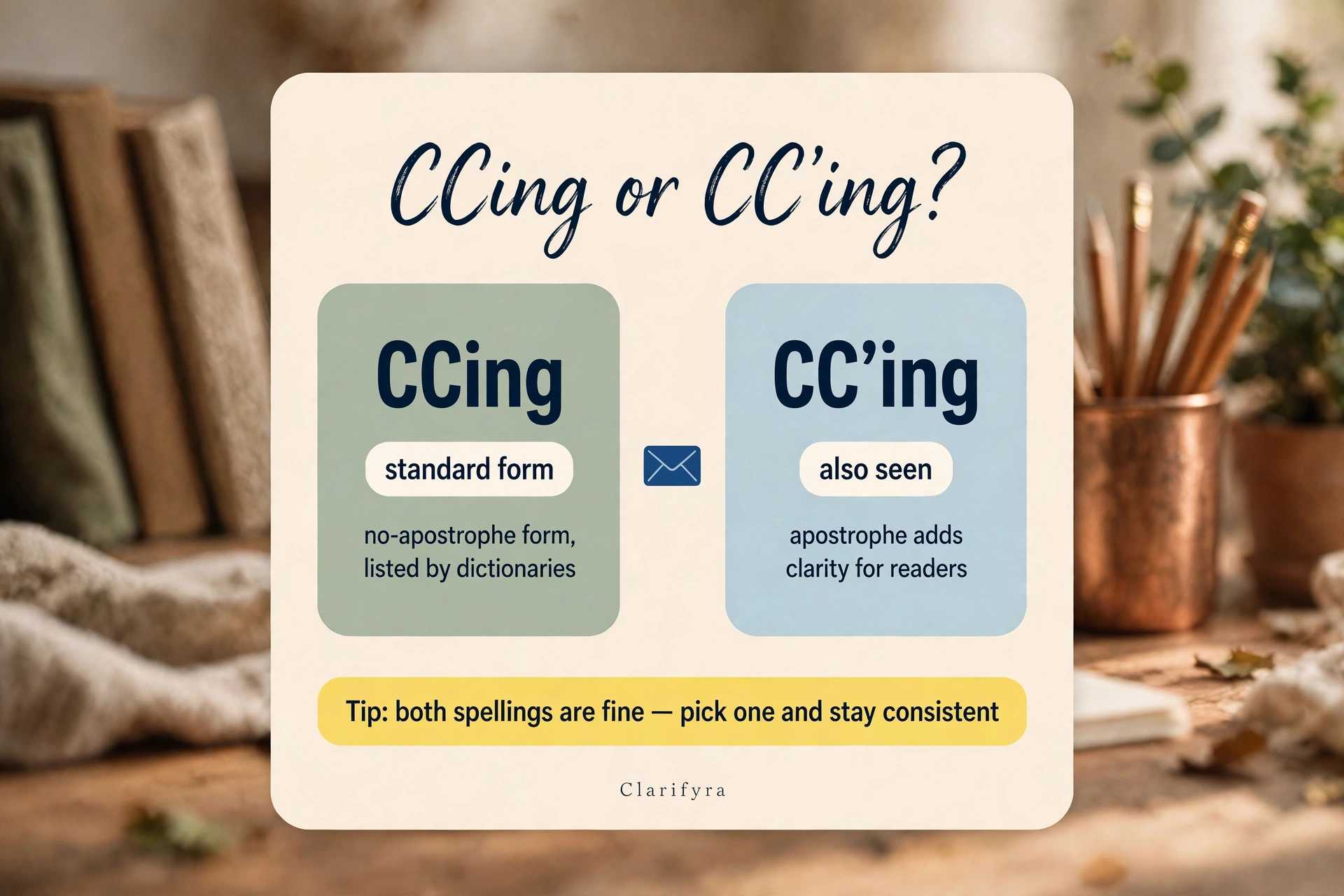
If you’ve typed “cc’ing” and then wondered whether the apostrophe belongs there, you’re in good company — this spelling is genuinely unsettled. The short answer: both “ccing” and “cc’ing” are acceptable. The no-apostrophe form ccing is the one dictionaries list as the present participle (Collins records “ccing,” “cced”), while the apostrophe form cc’ing is extremely widespread and appears even in Merriam-Webster’s own example sentence (“He cc’d me on his reply”). Neither will be marked wrong; the only real mistake is switching between them in the same document.
Quick Answer
Ccing and cc’ing are both acceptable — Collins lists “ccing” (present participle) and “cced” (past) as word forms, while the apostrophe forms cc’ing and cc’d are used by Merriam-Webster and some style guides. Pick one spelling, keep the apostrophe usage consistent, and in formal writing consider rephrasing with “copied.”
“CC” as a Verb: What It Means
Before the spelling question comes the word itself. CC is an initialism from carbon copy — the copy of a typed document made with carbon paper. When email arrived, “cc” was recycled as the field for additional recipients, and then the noun quietly became a verb: “to send someone a copy of (an email, letter, or memo),” as Merriam-Webster defines it. It’s a transitive verb — you cc someone on something:
“Please cc me on the follow-up email.”
“She cc’d her manager on the complaint.”
“Are you ccing the whole team on this?”
Merriam-Webster traces the verb to 1983, from CC (carbon copy) — a young verb by English standards, which explains why its spelling hasn’t finished settling. (Many people now read it as “courtesy copy,” which describes the social meaning better than carbon paper ever did, but “carbon copy” remains the origin the dictionaries record.)
What the Dictionaries Actually Record
Here’s the full landscape, because no single dictionary covers every variant — and the differences between them are the whole story:
- Collins COBUILD (the learner’s dictionary): word forms listed as ccs (third-person singular), ccing (present participle), cced (past tense and past participle). No apostrophes anywhere. Its example sentence: “she is also cced here.”
- Collins English Dictionary (British): verb word forms given as cc’s, cc’ing, cc’d or cc’ed. All apostrophe forms, with two past-tense variants.
- Merriam-Webster (American): doesn’t print a full word-form table in the entry shown here, but its own example sentence uses the apostrophe: “He cc’d me on his reply.”
So two reference traditions from the same publisher (Collins) split the difference: one prints the bare forms, the other prints the apostrophe forms. Merriam-Webster’s usage sits on the apostrophe side. If you’re looking for one dictionary to declare a winner, you’ll be disappointed — the honest reading is that the inflection of “cc” is genuinely in flux, and both families of spelling have serious dictionary credentials.
Why There’s No Single “Correct” Spelling
The uncertainty isn’t laziness — it’s structural. When an initialism becomes a verb, English has no settled rule for attaching endings to it. Ordinary verbs follow one pattern (“walk” → “walking”), but an initialism isn’t a word root in the usual sense, so writers face a judgment call:
- No apostrophe (“ccing,” “cced”): treats “cc” as a fully naturalized word and inflects it like any other. This is the tidy, dictionary-recorded option.
- Apostrophe (“cc’ing,” “cc’d,” “cc’ed”): uses the apostrophe as a readability device, separating the two capital letters from the ending so readers don’t stumble. “Cced” can look like a typo; “cc’d” reads instantly.
- Hyphen (“cc-ing,” “cc-ed”): occasionally appears in informal writing, but no dictionary lists it. Skip it.
The apostrophe here is doing the same job it does in RSVP’d — the apostrophe isn’t marking possession or a contraction; it’s simply keeping the abbreviation visually separate from its ending. Initialisms from other languages go through the identical growing pains, and RSVPed or RSVP’d faces exactly the same choice. It’s a useful sanity check: if you wouldn’t flag “RSVP’d” as an error, “cc’d” shouldn’t bother you either.
One verified house-style example shows how institutional writers land on this: the University of Arkansas’s style guide specifies cc as the verb, cc’d as the past, and cc’ing as the present participle. Other house styles go the Collins COBUILD route. The point isn’t which one is right — it’s that both choices are defensible and neither is a sign of ignorance.
The Full Set of Forms at a Glance
| Form | No-apostrophe spelling | Apostrophe spelling | Example |
|---|---|---|---|
| Base verb | cc | — | “Please cc me on that.” |
| Present participle | ccing (Collins COBUILD) | cc’ing (widespread) | “She’s ccing the legal team.” |
| Past tense / participle | cced (Collins COBUILD) | cc’d (Merriam-Webster, Collins), cc’ed | “He cc’d me on his reply.” |
| Third-person singular | ccs (Collins COBUILD) | cc’s (Collins English Dictionary) | “She ccs her manager on everything.” |
A note on pronunciation: it’s pronounced “see-see” (/siː siː/ — Collins’s phonetic spelling) with the endings spoken as usual: “ccing” is “see-see-ing,” “cc’d” is “see-see’d.” Nobody pronounces the apostrophe; it’s purely a visual aid.
Practical Guidance: What to Actually Write
Since there’s no universal rule, here’s how to make a defensible choice:
- In formal or professional writing, prefer the no-apostrophe forms: ccing, cced, ccs. These are the forms a dictionary lists, which matters if your writing might be judged by someone who checks.
- In informal writing (emails, Slack, internal notes), cc’ing and cc’d are perfectly fine — and in many workplaces they’re what everyone already writes. Merriam-Webster’s own example sentence should settle any worry that they’re sloppy.
- Be consistent within a document. Don’t write “cc’ing” in paragraph one and “ccing” in paragraph three. Consistency is the one requirement no dictionary disagrees on.
- Match your house style if one exists. If your employer or publication specifies one form (as the University of Arkansas style guide does with cc’d/cc’ing), follow it — that’s what house styles are for.
- When in doubt, rephrase. The cleanest escape in formal prose is to avoid the inflected form entirely: “I copied Maria on the email,” “I’ve added James to the cc line,” or “I’m keeping the team in the loop.” The verb “copy” has a fully settled past tense, which is why so many professional writers quietly use it instead.
- Capitalization: lowercase cc/ccing/cc’d is common when the word is functioning as a verb mid-sentence; follow your house style. CC remains the noun — the field label (“add her to the CC field”). Don’t capitalize the verb just because the noun is capitalized.
Common Mistakes
1. Writing “ccd.” ✗ “He ccd me on the reply.” → ✓ “He cc’d me on the reply.” Bare “ccd” reads as an initialism of its own (and no dictionary lists it). Add either an apostrophe or the e.
2. Mixing forms in one document. ✗ “I’m cc’ing Priya… I cced Priya earlier.” → Pick cc’ing or ccing and stay with it throughout.
3. Using the hyphenated forms. ✗ “cc-ing,” “cc-ed” → Hyphenated versions appear in casual writing, but the major references checked did not list them. Use the apostrophe or nothing.
4. Capitalizing the verb mid-sentence. ✗ “I’m CCing the team.” → ✓ “I’m ccing the team.” The capital letters belong to the noun (the CC field), not the verb.
5. Thinking the apostrophe is grammatically “wrong.” The apostrophe in “cc’ing” isn’t a possessive or a contraction — it’s the same readability device as the apostrophe in “RSVP’d.” Calling it an error is a misapplication of the apostrophe rules, which are aimed at ordinary words.
6. Writing “ccs” when you mean the plural of the field. Minor but common: “I put her in the ccs” should be “in the cc field.” “Ccs” is only the third-person verb form (“he ccs everyone”).
How to Remember It
Think of the apostrophe as a seam between the abbreviation and the ending: cc | ‘ing. It’s not a grammar mistake — it’s a little flag that says “this part is the initialism, that part is the verb ending.” If you’d rather skip the flag, write ccing and let the dictionary spelling do the work. Either way, the test is simple: would a reader stumble? If yes, add the apostrophe; if not, leave it out.
Frequently Asked Questions
Is it “ccing” or “cc’ing”?
Both are acceptable. Ccing is the present participle recorded in Collins COBUILD (alongside “cced” and “ccs”), while cc’ing is the equally widespread apostrophe form. Choose one and use it consistently.
Is it “cc’d” or “cced” or “cc’ed”?
All three appear in dictionaries or major publications. Cc’d is the most widely used and appears in Merriam-Webster’s own example sentence (“He cc’d me on his reply”); cc’ed is listed by Collins English Dictionary as an alternative; cced is the no-apostrophe form in Collins COBUILD. Avoid bare “ccd.”
What does “cc” mean in an email?
It stands for carbon copy, recycled from the age of typewriters and carbon paper. In email, cc’ing someone sends them a copy of a message addressed primarily to someone else — typically to keep them informed without requiring a reply.
Why does the apostrophe form exist at all?
Because “cced” and “ccing” can be hard to read — strings of repeated consonants followed by endings look like typos. The apostrophe keeps the initialism visually separate from the ending. It’s a readability aid, not an error, and the same device appears in other verbified initialisms (like “RSVP’d”).
Should I capitalize it — “CCing” or “ccing”?
As a verb in the middle of a sentence, lowercase is common: ccing / cc’ing. Capitals are reserved for the noun: the CC field, “add her to CC.” At the start of a sentence you’d capitalize normally, but sentences rarely begin with this verb.
Does the same apply to “bcc”?
Yes — “bcc” (blind carbon copy) is verbified the same way, and the same spelling families appear: bccing/bcc’ing, bcc’d/bcced. The guidance is identical: pick one form and be consistent.
Do any style guides prescribe a spelling?
House styles vary, and no single universally recognized prescription exists. Some institutional style guides (e.g., the University of Arkansas’s) specify cc’d and cc’ing; dictionaries split between the no-apostrophe forms (Collins COBUILD: ccing, cced) and the apostrophe forms (Collins English Dictionary: cc’ing, cc’d/cc’ed). If your workplace has a style guide, follow it.
Final Takeaway
Ccing or cc’ing? The dictionaries have weighed in on both sides — Collins COBUILD lists “ccing” and “cced,” Collins English Dictionary lists “cc’ing” and “cc’d”/”cc’ed,” and Merriam-Webster itself writes “He cc’d me on his reply.” This isn’t a right/wrong question; it’s a young verb that English hasn’t finished spelling. Choose the no-apostrophe forms for maximum dictionary alignment, the apostrophe forms for maximum readability, rephrase with “copied” in formal prose if you want to sidestep the whole question — and above all, stay consistent.