Inclosed or Enclosed: Which Is Correct?
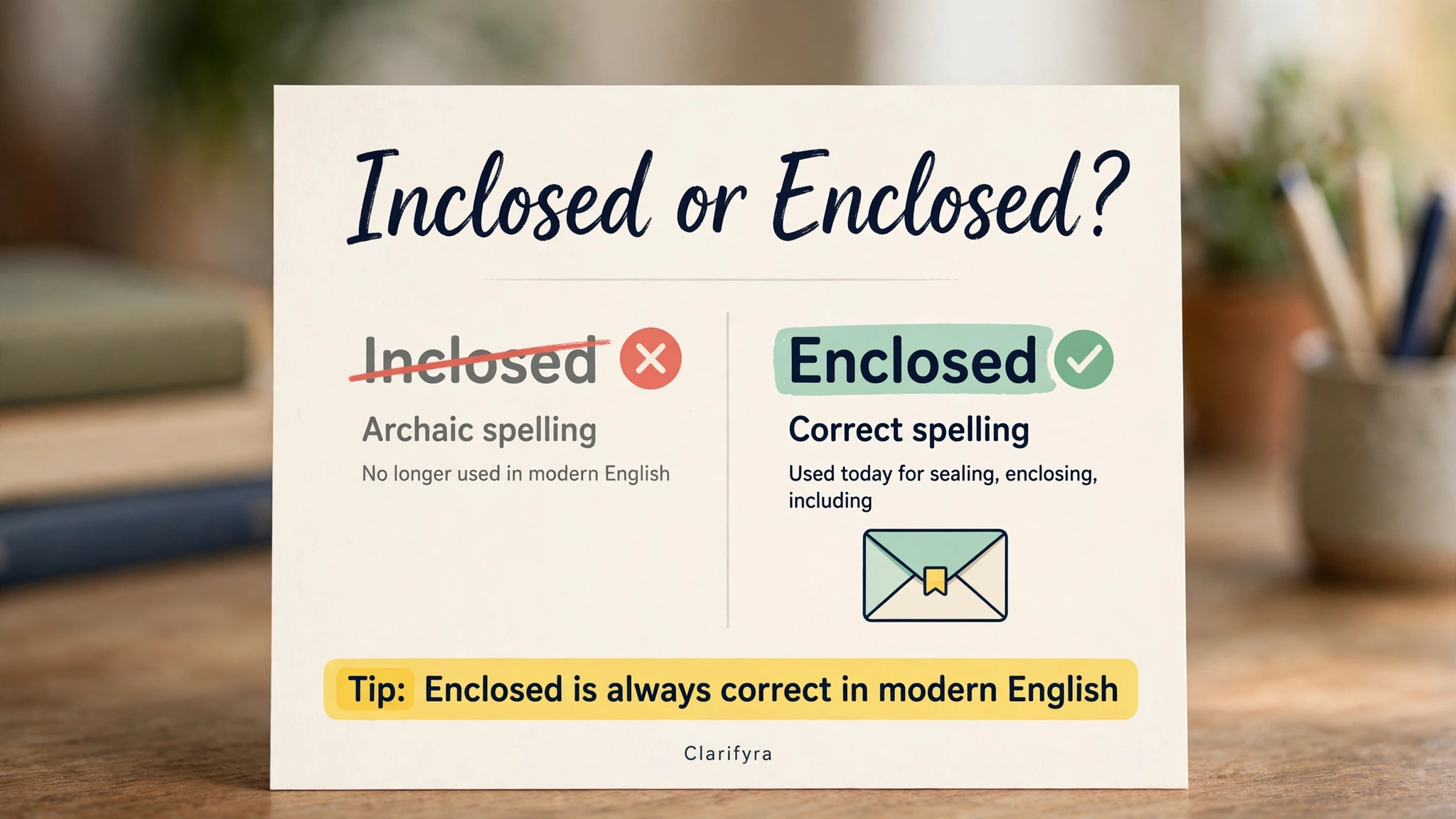
If you’re choosing between inclosed and enclosed, the practical answer is straightforward: write enclosed. It is the overwhelmingly standard spelling in contemporary English — in letters, emails, and descriptions of shut-in spaces alike. But the full story is more interesting than a simple right/wrong verdict: inclose isn’t a modern invention or a mere typo. Major dictionaries — Collins, Merriam-Webster, and American Heritage — all record it as a less common variant of enclose, and it was the normal spelling in many historical documents. It’s just that in today’s writing, almost nobody uses it, so readers will take it for a mistake. Enclosed is the safe, conventional choice; inclosed is a real but rare historical variant.
Quick Answer
Enclosed is the standard modern spelling — use it in all contemporary writing. Inclosed is recorded in major dictionaries as a less common variant with genuine historical usage, but it is rare today and will look like an error to most readers. When in doubt, enclosed is never wrong.
What the Dictionaries Actually Say
This is where precision matters, because the confident claim “no dictionary lists ‘inclose'” turns out to be wrong. Here’s what the major references actually record:
- Collins English Dictionary (British): “inclose” — a less common spelling of enclose, with derived forms inclosable, incloser, and inclosure.
- Merriam-Webster (American): “inclose, inclosure” — less common variants of enclose, enclosure.
- American Heritage Dictionary: “inclose” — a less common spelling of enclose.
So “inclose” has a legitimate dictionary presence — as a variant, explicitly marked less common. That’s an important distinction in how dictionaries work: recording a spelling is not the same as recommending it. Dictionaries are descriptive; they document forms people have used. The label “less common variant” is the lexicographers’ way of telling you it exists but isn’t the norm.
A note on accuracy: an earlier version of this page overstated the case by suggesting no current dictionary lists “inclose.” That was incorrect, and it’s been fixed. The guidance is unchanged — use “enclosed” — but the facts deserve precision.
How “Enclosed” Became the Standard
For centuries, both spellings circulated. English never fully tidied up its en-/in- pairs — we still have ensure/insure and enquire/inquire living side by side — but for this particular verb, the “en-” form won decisively as spelling standardized through the 18th and 19th centuries. By the 1900s, “enclose” was the undisputed standard in print, and “inclose” survived mainly in legal and historical contexts where old documents kept it alive.
This is the normal life cycle of spelling variants: they coexist, one pulls ahead, and the other fades into the archives. It’s the same story as anual vs annual — two spellings enter, one spelling leaves, and modern writers are expected to know which one survived.
Where You’ll Still Meet “Inclosed”
The variant isn’t just a dictionary curiosity — it left real footprints. The most prominent are the British parliamentary acts that reorganized common land: the Inclosure Act 1773 and the Inclosure (Consolidation) Act 1801 (also called the General Inclosure Act) carry the “in-” spelling in their official short titles to this day. Archival guides note the split explicitly: historical sources spell it “inclosure,” while modern historians write “enclosure.”
Beyond Parliament, you’ll find “inclosed” in pre-1900 books, old property deeds (“inclosed lands”), and digitized texts where optical character recognition has faithfully reproduced the original spelling. So if you encounter “inclosed” in the wild, it’s almost always one of two things: a genuinely old document, or a modern writer reproducing (or accidentally echoing) an old spelling.
What “Enclosed” Means Today
Enclosed — the past tense, past participle, and adjective form of enclose — carries two everyday senses, both still very much alive:
1. Shut in or surrounded on all sides
“The children played in an enclosed courtyard.”
“Smoking is prohibited in enclosed public spaces.”
“They’ve enclosed the balcony with glass panels.”
2. Included with a letter or parcel
“Please find enclosed a copy of your tenancy agreement.”
“I’ve enclosed two copies of the contract for signature.”
“The samples are enclosed with this letter.”
In the second sense, “enclosed” is a compact passive: “please find [the form] enclosed” means “please find [the form, which is] enclosed [with this letter].” It’s one of the most durable phrases in business English — and one of the places the “inclosed” misspelling most often appears, since people write the phrase from memory rather than checking it.
“Enclosed” vs “Attached”: A Distinction Worth Knowing
Here’s a genuinely useful related point. Enclosed belongs to physical mail — something inside the same envelope or parcel. For email, the word you want is attached:
- Posting a contract? “Please find enclosed…”
- Emailing a contract? “Please find attached…”
Writing “enclosed” in an email (“please find enclosed the report”) isn’t exactly wrong — readers understand it — but it’s a leftover from the paper era. “Attached” is the natural modern choice for files, and using it marks you as someone who writes for the medium you’re actually in.
In Business Correspondence
“Please find enclosed” remains standard in formal letters, especially legal, administrative, and official contexts. A few usage notes for getting it right:
- “Enclosed herewith” is legal-formal; in ordinary business writing, plain “enclosed” is enough.
- Pair it with the right preposition: “enclosed with this letter,” “enclosed in the package.”
- Don’t stack formalities: “Please find inclosed herewith the documents” combines the wrong spelling with needless stiffness. “I’ve enclosed the documents” does the same job in half the words.
British vs American English: Any Difference?
None worth noting. This is one of the cleaner findings in the research: the American authority (Merriam-Webster) and the British authority (Collins) describe “inclose” in identical terms — a less common variant — and “enclosed” is the standard spelling on both sides of the Atlantic. If you’re writing for an international audience, “enclosed” is safe everywhere.
Why “Inclosed” Looks Wrong to Modern Readers
Even though dictionaries record it, writing “inclosed” in a contemporary document will cause problems in practice:
- Spellcheckers flag it. Every major spellchecker treats “inclosed” as an error, so your document will show red underlines — or autocorrect it mid-sentence.
- Readers read it as a typo. Almost no living reader has seen “inclosed” in modern prose. They won’t think “ah, a historical variant” — they’ll think you can’t spell “enclosed.”
- Style guides don’t recognize it. No current style guide lists it as acceptable; house styles will “correct” it.
The lesson generalizes: a dictionary recording a variant doesn’t make it advisable. As with collum vs column, appearing in old books is not the same as being correct today — language standardizes, and professional writing follows the standard.
Common Mistakes
1. Writing “inclosed” in modern documents. However legitimate its history, in anything written today it functions as an error. The dictionary entry won’t save you with a reader, an editor, or a spellchecker.
2. Using “enclosed” for email attachments. “Please find enclosed the spreadsheet” in an email is a paper-era holdover — write “attached” for files.
3. Confusing “enclosed” with “included.” They overlap but aren’t identical: “enclosed” means physically shut in or sent along with something; “included” means forming part of a whole. A gift can be enclosed in a box and included in the price.
4. Treating a dictionary variant as a recommendation. Dictionaries document the language people have used; they don’t bless every entry equally. “Less common variant” means exactly what it says — less common. Follow the common one.
5. Overcomplicating the phrase. “Please find enclosed herewith attached the documents” — pick one register and commit. In a letter: “Please find enclosed…”. In an email: “I’ve attached…”.
How to Remember the Spelling
Think of an envelope: something enclosed goes inside an envelope. The “en-” opening is your anchor — enclose, enclosed, enclosure. If your spelling starts with “in-“, you’re reaching for the 18th century.
Frequently Asked Questions
Is “inclosed” a real word?
It’s a real recorded variant rather than a standard word: Collins, Merriam-Webster, and American Heritage all list “inclose” as a less common spelling of “enclose,” and it appears in genuine historical documents. But it’s vanishingly rare in contemporary writing, so in practice, treat it as an error and write “enclosed.”
Do any modern dictionaries list “inclose”?
Yes — Collins (“a less common spelling of enclose”), Merriam-Webster (“less common variants of enclose, enclosure”), and American Heritage (“a less common spelling of enclose”) all include it. The listing confirms it exists; the “less common” label confirms you shouldn’t use it.
Is “inclosed” just a typo?
In anything written today, treat it as one. Historically it was an accepted spelling — you’ll find it in the Inclosure Acts and 18th-century books — but that was centuries ago.
Which is correct: “please find inclosed” or “please find enclosed”?
“Please find enclosed” — always, in modern writing. This is the single most common context for the misspelling, because people reproduce the phrase from memory.
Should I write “enclosed” or “attached” in an email?
“Attached.” Reserve “enclosed” for physical mail — something inside the envelope or parcel. For files sent electronically, “attached” is the natural choice.
Do British and American English differ on this spelling?
No. “Enclosed” is standard in both; “inclosed” is a rare variant in both. The major dictionaries on each side describe it identically.
Why do old legal documents say “inclosed”?
Because that was an accepted spelling when they were written. Acts of Parliament like the Inclosure Act 1773 retain the historical spelling in their official titles, and old deeds refer to “inclosed lands.” When quoting or discussing such documents, keep the original spelling; everywhere else, modernize it.
What does “enclosed” mean in a letter?
It tells the reader the mentioned item is in the same envelope or package: “Please find enclosed your policy documents” means the documents are inside with the letter.
Final Takeaway
Enclosed is the spelling for the modern world — standard in every dictionary’s main entry, correct in every contemporary context, safe in every register. Inclosed deserves respect as a genuine piece of the language’s history, recorded in dictionaries and preserved in Acts of Parliament — and that’s exactly where it should stay: in discussions of history, not in your writing. When in doubt, enclosed is never wrong.