Ignitor or Igniter: Which Spelling Is Correct?
If you have ever written the word for a device that starts a flame or combustion process, you may have paused over ignitor or igniter. Both spellings appear in English, particularly in product descriptions, technical material, and everyday writing. That can make it difficult to know whether one is a mistake or whether both are legitimate forms.
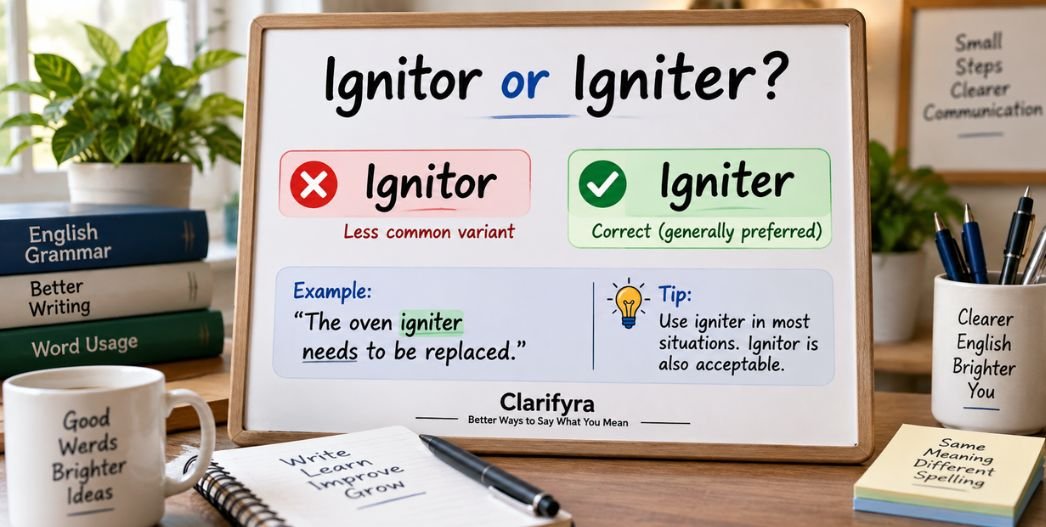
The good news is that both “igniter” and “ignitor” are recognized English words. They generally have the same meaning: something that initiates ignition. However, igniter is the more familiar and generally preferred spelling in modern general English, while ignitor remains an accepted variant and can appear in technical or industry-specific terminology. Merriam-Webster’s Scrabble Dictionary, for example, lists ignitor as a noun and points to igniter.
Both igniter and ignitor are accepted spellings for something that initiates ignition. Igniter is generally the safer choice for modern general English and is widely used in contemporary technical writing. Ignitor is a recognized variant, so it should not automatically be treated as a misspelling.
Igniter vs. Ignitor: A Quick Comparison
| Feature | Igniter | Ignitor |
|---|---|---|
| Correct word? | Yes | Yes |
| Part of speech | Noun | Noun |
| Basic meaning | Something that initiates ignition | Something that initiates ignition |
| General usage | More common/preferred | Less common variant |
| Meaning difference | None in ordinary use | None in ordinary use |
| Best choice for general writing | Yes | Acceptable, depending on context |
The central point is simple: the two forms generally refer to the same thing. The distinction is primarily one of spelling and usage preference, rather than meaning.
What Does “Igniter” Mean?
Igniter is a noun for a device, component, or other thing that starts ignition.
Depending on the context, an igniter may produce a spark, heat, flame, or another ignition source. You might encounter the word when discussing household appliances, engines, industrial equipment, or other combustion systems.
For example:
- The oven’s igniter needs to be replaced.
- The gas stove has an electronic igniter.
- The technician tested the furnace igniter.
- The grill’s igniter stopped working.
The word comes naturally from the verb ignite, meaning to cause something to begin burning.
Is “Igniter” a noun?
Yes. Igniter is a noun.
It names the thing that performs the action of initiating ignition.
Compare:
- Ignite — verb: to cause something to burn.
- Igniter — noun: something that causes ignition.
- Ignition — noun: the act or process of starting combustion.
For example:
The device ignites the fuel.
The device is an igniter.
These words are related, but they have different grammatical functions.
What Does “Ignitor” Mean?
Ignitor is also used as a noun for something that initiates ignition. It is not necessary to invent a separate definition for it: in ordinary usage, it has essentially the same meaning as igniter.
For example:
- The technician inspected the furnace ignitor.
- The replacement ignitor arrived this morning.
- The equipment uses an electronic ignitor.
- The old manual refers to the component as an ignitor.
Merriam-Webster’s Scrabble Dictionary specifically lists ignitor as a playable noun and identifies igniter as the equivalent form.
That is an important distinction from articles that simply label ignitor as an incorrect spelling. Some English comparison websites do make that claim, but the dictionary evidence shows that ignitor is an established word, so calling it universally incorrect would be misleading.
So, Is It “Ignitor or Igniter”?
If you are asking which spelling should you normally use, choose igniter.
It is the clearer default for general English, particularly when you are writing an article, instruction, explanation, or other contemporary text for a broad audience.
However, if you encounter ignitor in a technical document, product name, manual, or established terminology, there is no need to assume that it is simply a typo.
Several English usage articles similarly describe igniter as the more common or preferred modern form while recognizing ignitor as an alternative.
A practical rule
Writing your own sentence? → Use “igniter.”
Quoting or following an existing product/manual terminology? → Keep “ignitor” if that is the established spelling.
This approach gives you both accuracy and consistency.
Why Are the Two Spellings Confused?
The confusion is understandable because the words look and sound almost identical.
Both are formed around the verb ignite, and both describe an object or component associated with ignition. The only visible difference is the ending:
- igniter
- ignitor
English contains many nouns ending in -er and -or, and the choice between these endings is not always predictable from a simple universal rule.
For this reason, seeing ignitor in a manual or product description does not necessarily mean that someone has made a spelling mistake.
The existence of both forms is also reflected in English usage resources.
Is “Ignitor” a Misspelling?
Not necessarily.
This is one of the most important points to understand about the ignitor or igniter spelling question.
If you are writing standard contemporary English and want the most widely familiar form, igniter is usually the better choice. But ignitor is a recognized variant, so it should not be presented as though it has no legitimate use.
For example:
Preferred for general writing:
The oven igniter is not working.
Also acceptable:
The oven ignitor is not working.
The second sentence may be less familiar to some readers, but the spelling itself does not automatically make the sentence incorrect.
Correct Usage Examples
Here are some natural examples showing how the word works in sentences.
With “igniter”
The technician replaced the faulty igniter.
The gas burner uses an electronic igniter.
Check the igniter if the appliance fails to start.
The furnace igniter glows before the burner lights.
With “ignitor”
The technician replaced the faulty ignitor.
The equipment manual calls the component an ignitor.
The replacement ignitor was installed yesterday.
In these examples, the basic meaning remains the same.
Igniter, Ignition, and Ignite: Don’t Mix Them Up
Although they are closely related, ignite, igniter, and ignition have different grammatical roles.
| Word | Part of speech | Meaning | Example |
|---|---|---|---|
| Ignite | Verb | To start burning | The spark will ignite the fuel. |
| Igniter | Noun | Something that initiates ignition | The igniter is faulty. |
| Ignitor | Noun | Variant of igniter | The ignitor needs replacement. |
| Ignition | Noun | The process of starting combustion | The ignition system failed. |
A common mistake is to treat igniter as though it were another form of ignite. It is not. Ignite describes an action, whereas igniter names something that performs or initiates that action.
Does “Igniter” Have a Different Meaning From “Ignitor”?
In normal usage, no significant meaning difference exists.
Both forms can describe something that starts ignition. The distinction is mainly related to spelling preference and usage.
For example:
The stove’s igniter creates the spark.
and
The stove’s ignitor creates the spark.
Both communicate essentially the same idea.
That is why it is more useful to think of these as alternative spellings of the same noun rather than two completely different vocabulary words.
What About American and British English?
It is tempting to classify igniter and ignitor as a straightforward American-versus-British spelling difference, but that would oversimplify the evidence.
Some usage sources associate igniter more strongly with modern American and general technical writing, while ignitor continues to appear in other contexts.
Unlike a clear pair such as color/colour or center/centre, there is not a simple rule saying that one spelling belongs exclusively to American English and the other exclusively to British English.
Therefore, avoid writing:
“Igniter is American English and ignitor is British English.”
That statement is too absolute.
A better approach is to say that igniter is generally the preferred modern form, while ignitor remains an accepted variant whose use can depend on terminology, industry, or the source being followed.
Which Spelling Should You Use in Formal Writing?
For most formal or general-purpose writing, igniter is the safest choice.
This is especially true if you are:
- Writing an English-language article
- Explaining a word to general readers
- Preparing instructional material
- Writing product-related content without a mandated terminology
- Creating your own technical explanation
However, consistency matters. If a manufacturer officially calls a particular component an ignitor, changing the spelling throughout a discussion of that product may make the terminology less precise.
In other words, follow established terminology when necessary; otherwise, “igniter” is a sensible default.
Easy Way to Remember the Preferred Form
A simple memory trick is:
Ignite → igniter
Think of other familiar nouns ending in -er that describe something performing an action:
- write → writer
- drive → driver
- start → starter
- ignite → igniter
This does not prove that ignitor is invalid—it simply gives you an easy way to remember which form to choose when you are writing your own sentence.
Common Mistakes to Avoid
1. Calling “ignitor” universally wrong
This is too strong. Dictionary evidence recognizes ignitor, so it is better described as an accepted variant rather than automatically as a misspelling.
2. Treating the two forms as different devices
In ordinary usage, igniter and ignitor have the same basic meaning. The spelling does not normally indicate two different types of ignition equipment.
3. Confusing “igniter” with “ignite”
Remember the grammatical difference:
The igniter starts the process.
The spark can ignite the fuel.
4. Assuming the spelling is strictly regional
Unlike color/colour, the distinction is not neatly divided between American and British English.
5. Changing an established product name
If a manufacturer, manual, or technical specification deliberately uses ignitor, retaining that terminology may be more appropriate than automatically changing it to igniter.
FAQs
Is “igniter” the correct spelling?
Yes. Igniter is a correct English noun and is generally the preferred spelling for modern general writing. It refers to something that initiates ignition.
Is “ignitor” also correct?
Yes. Ignitor is a recognized variant. Merriam-Webster’s Scrabble Dictionary lists it as a noun and points to igniter.
Which is more common: igniter or ignitor?
Igniter is generally the more familiar and preferred form in contemporary general English. Ignitor still appears in technical terminology, product documentation, and other contexts.
Is ignitor a misspelling of igniter?
Not automatically. Although igniter is usually the better default for modern writing, ignitor is an established variant, so it should not always be corrected as a spelling error.
Are igniter and ignitor interchangeable?
Generally, yes. Both words refer to something that initiates ignition. When a specific manufacturer or technical standard uses one spelling, however, it is sensible to preserve that established terminology.
How do you spell the word for a device that starts ignition?
The safest general spelling is igniter. The alternative ignitor is also recognized, so you may encounter both forms.
The Bottom Line
Both igniter and ignitor are legitimate forms, but they are not equally useful as a default. Igniter is generally the better choice for modern general English because it is the more familiar and widely preferred spelling. Ignitor remains a valid variant and may be appropriate when following established technical, product, or industry terminology. For clear everyday writing, choose igniter and stay consistent. For more English usage explanations like this, Clarifyra helps readers choose clearer and more accurate ways to say what they mean.