Would or Will: Meaning, Difference, Rules, and Examples
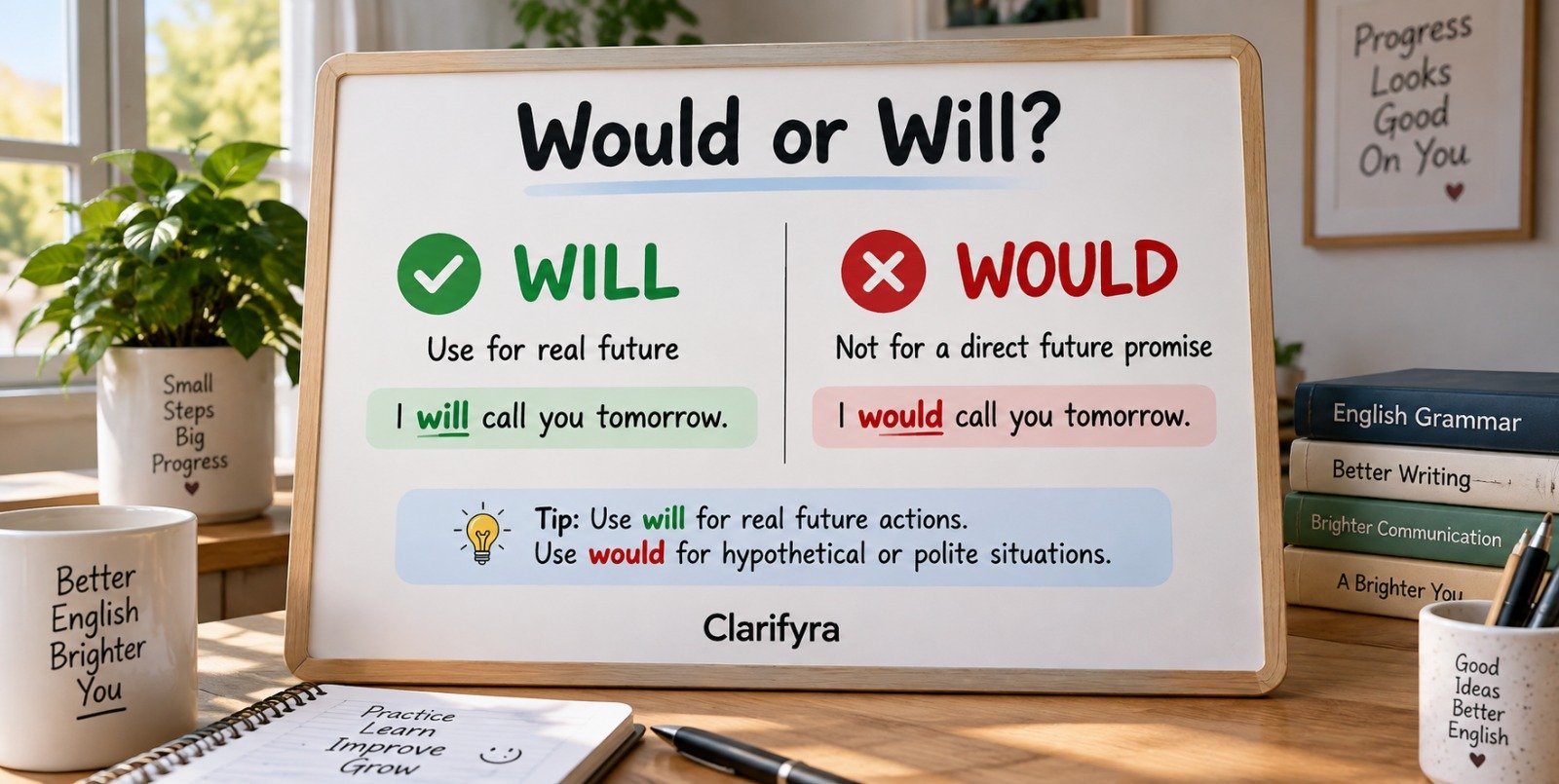
“Will” and “would” are both common modal verbs, but they are not interchangeable in every sentence. Will is usually used for real or expected future situations, promises, decisions, and predictions. Would is more often used for hypothetical situations, polite requests, future events viewed from the past, and repeated past actions.
The difference becomes much easier once you look at the speaker’s point of view: will usually sounds more direct and certain, while would often introduces distance, politeness, imagination, or a past perspective.
Will is generally used for real or expected future events, promises, decisions, and predictions. Would is commonly used for hypothetical or conditional situations, polite requests, future events viewed from the past, and repeated past actions. Both are correct, but the right choice depends on meaning and context.
What Is the Difference Between Will and Would?
The simplest difference is that will usually refers to something presented as real, expected, intended, or likely, while would often refers to something imagined, conditional, polite, or seen from a past point of view.
| Feature | Will | Would |
|---|---|---|
| Word type | Modal verb | Modal verb |
| Common use | Real or expected future | Hypothetical or conditional situation |
| Prediction | It will rain later. | It would rain if the weather changed. |
| Request | Will you help me? | Would you help me? |
| Reported speech | “I will call.” | She said she would call. |
| Past habit | Usually not used this way | We would play outside every evening. |
| Tone | More direct | Often softer or more polite |
A useful rule is:
Will = expected or real future.
Would = imagined, conditional, polite, or future viewed from the past.
Similar word comparisons include: Either or Ither: Which Is Correct and Why?
What Does “Will” Mean?
Will is a modal verb used before the base form of another verb.
The basic pattern is:
will + base verb
Examples:
- I will call you tomorrow.
- She will arrive at six.
- We will finish the work soon.
- He will understand eventually.
Will commonly expresses future actions, predictions, willingness, promises, and decisions.
Future actions
Use will when talking about something expected to happen in the future.
- I will visit my parents next weekend.
- The meeting will begin at 10 a.m.
Predictions
- I think it will rain tonight.
- She will probably win the competition.
Promises and decisions
- I will help you.
- I will never forget this.
- Don’t worry. We will fix the problem.
The negative form is:
will not = won’t
Example:
- He won’t come tonight.
What Does “Would” Mean?
Would is also a modal verb and is followed by the base form of a verb.
The pattern is:
would + base verb
Examples:
- I would go if I had enough time.
- She would help if you asked her.
- Would you open the window?
- He said he would call later.
The negative form is:
would not = wouldn’t
Example:
- I wouldn’t do that without asking first.
Would has several important uses, including hypothetical situations, polite questions, reported speech, future-in-the-past meanings, preferences, and repeated past actions.
When to Use Will or Would
Use will when the speaker presents something as a real or expected future event.
- I will see you tomorrow.
- They will be here soon.
- I think the plan will work.
- She will call after lunch.
Use would when the situation depends on a condition, is imagined rather than certain, or is being described from a past perspective.
- I would travel more if I had the money.
- She would buy the house if it were cheaper.
- He said he would visit us.
- I knew the task would be difficult.
Compare:
I will buy the car.
The speaker presents this as a real future decision.
I would buy the car if it were cheaper.
The purchase depends on a condition.
Would or Will Be: Which Should You Use?
Both will be and would be are correct.
Use will be when talking about a real or expected future situation.
- She will be at work tomorrow.
- The test will be difficult.
- Dinner will be ready soon.
Use would be when the situation is hypothetical, conditional, polite, or viewed from the past.
- It would be easier if you helped me.
- That would be wonderful.
- He said the meeting would be on Friday.
Compare:
It will be expensive.
This is a prediction about the real situation.
It would be expensive.
This usually suggests an imagined or conditional situation.
Will or Would for the Future?
For a straightforward future action or prediction, will is normally the better choice.
- I will call you tomorrow.
- She will arrive next week.
- They will finish the project soon.
Would can also refer to the future, but usually when that future is viewed from a point in the past.
For example:
- She said she would call the next day.
- I thought he would arrive early.
- We knew the journey would take several hours.
This is sometimes called the future in the past.
Present viewpoint:
She will call later.
Past viewpoint:
She said she would call later.
Is Would the Past Tense of Will?
Would can act as the past form of will, but that is only one of its uses.
Consider this direct statement:
- He said, “I will help you.”
In reported speech:
- He said he would help me.
Here, would represents the past form of will.
However, would is also used for meanings that are not simply past tense:
- Would you help me? — polite request
- I would travel more if I could. — hypothetical situation
- We would visit them every summer. — repeated past action
- I would rather stay home. — preference
So it is more accurate to say that would can be the past form of will in certain contexts, rather than saying it is always the past tense of will.
Will and Would in Reported Speech
In reported speech, will often changes to would when the reporting verb is in the past.
Direct speech:
“I will call you tonight.”
Reported speech:
She said she would call me that night.
Another example:
Direct:
“There will be a delay.”
Reported:
He said there would be a delay.
This change reflects the speaker’s shift from a present point of view to a past one.
Does Shall Change to Would or Will in Reported Speech?
The answer depends on how shall is being used.
In a statement, shall can become would in reported speech.
Direct:
“I shall need more time.”
Reported:
She said she would need more time.
However, in questions involving suggestions or offers, shall often changes to should instead.
Direct:
“Shall I open the window?”
Reported:
She asked whether she should open the window.
So shall does not always change to will or would. The meaning of the original sentence determines the correct reported form.
Will or Would in a Question?
Both forms can appear in questions, but the tone is often different.
Will you…?
Will usually sounds more direct.
- Will you help me?
- Will you close the door?
- Will you come with us?
Would you…?
Would often sounds softer or more polite.
- Would you help me?
- Would you close the door?
- Would you come with us?
Compare:
Will you send me the file?
Direct and normal.
Would you send me the file?
More polite or less direct.
Some expressions normally use would:
- Would you like some coffee?
- Would you mind waiting?
- Would you rather stay here?
Will and Would in Conditional Sentences
Conditional sentences are one of the clearest places to see the difference.
Real or possible condition
Use will in the result when the condition is considered genuinely possible.
- If it rains, we will stay home.
- If she calls, I will answer.
- If they arrive early, we will start immediately.
Hypothetical condition
Use would when imagining an unreal or less likely situation.
- If I had more money, I would travel more.
- If she lived nearby, we would visit her often.
- If the weather improved, we would go to the beach.
A common mistake is putting would directly in the normal if-clause:
Incorrect: If I would have more time, I would help.
Correct: If I had more time, I would help.
Common Uses of Would With Examples
Would has several important grammatical uses.
1. Hypothetical situations
- I would move abroad if I found the right job.
- She would buy it if the price were lower.
2. Polite requests
- Would you help me with this box?
- Would you mind waiting outside?
3. Reported speech
- He said he would call.
- They promised they would return.
4. Future in the past
- I knew the exam would be difficult.
- She thought the journey would take two hours.
5. Repeated past actions
- Every summer, we would visit our grandparents.
- After dinner, my father would read the newspaper.
Would works well for repeated past actions, but used to is usually better when describing past states.
For example:
Natural: I used to live in London.
6. Preferences
- I would rather stay home.
- She would prefer to wait until tomorrow.
Should You Say “I Hope He Would” or “I Hope He Will”?
For a present hope about a real future situation, will is normally better.
- I hope he will come.
- I hope he will understand.
In many cases, the simple present sounds even more natural:
- I hope he comes.
- I hope he understands.
Use would when the hope itself is in the past.
- I hoped he would come.
- She hoped he would understand.
So:
Present hope: I hope he will come.
Past hope: I hoped he would come.
“I Hope You Would” or “I Hope You Will”?
For a present hope about the future, use:
- I hope you will help me.
- I hope you will enjoy the trip.
Often, English speakers may use another structure instead:
- I hope you can help me.
- I hope you enjoy the trip.
For a hope held in the past:
- I hoped you would help me.
- I hoped you would understand.
Using I hope you would as a general replacement for I hope you will often sounds unnatural unless there is a specific hypothetical context.
“I Hope It Would” or “I Hope It Will”?
Use will when expressing a current hope about something in the future.
- I hope it will work.
- I hope it will be enough.
You can also say:
- I hope it works.
- I hope it is enough.
Use would when talking about a past hope:
- I hoped it would work.
- We hoped it would be enough.
“I Hope That You Would” or “Will”?
The presence of that does not change the basic rule.
For a present hope:
- I hope that you will understand.
- I hope that you will reconsider.
For a past hope:
- I hoped that you would understand.
- I hoped that you would reconsider.
The simple present is also natural in many present-tense examples:
- I hope that you understand.
“I Hope I Would” or “I Hope I Will”?
Use will for a realistic future hope.
- I hope I will be able to attend.
- I hope I will get another chance.
In everyday English, these may also be expressed more naturally as:
- I hope I can attend.
- I hope I get another chance.
Would is possible when the sentence itself is hypothetical.
For example:
- I hope I would have the courage to help if that ever happened.
Here, would belongs to the imagined situation rather than simply following the word hope.
Will vs Would Examples With Answers
Choose will or would.
- I think it ___ rain tomorrow.
Answer: will - If I had more money, I ___ travel more.
Answer: would - She said she ___ call later.
Answer: would - ___ you please close the window?
Answer: would
“Will” is possible, but “would” is more polite. - Don’t worry. I ___ help you.
Answer: will - When we were children, we ___ play outside until dark.
Answer: would - I hope she ___ recover soon.
Answer: will
“I hope she recovers soon” is also natural. - If the weather improves, we ___ go to the beach.
Answer: will - If the weather improved, we ___ go to the beach.
Answer: would - He promised that he ___ never do it again.
Answer: would
Common Mistakes With Will and Would
Adding -s after a modal
Incorrect: She will goes tomorrow.
Correct: She will go tomorrow.
Incorrect: He would calls me.
Correct: He would call me.
Modal verbs are followed by the base form of the main verb.
Using “do” before would
Incorrect: Do you would help me?
Correct: Would you help me?
Would already functions as the auxiliary verb.
Using “don’t” with would
Incorrect: I don’t would do that.
Correct: I wouldn’t do that.
Using would in the wrong conditional clause
Incorrect: If I would have enough money, I would buy it.
Correct: If I had enough money, I would buy it.
Using would automatically after hope
Less natural: I hope you would recover soon.
Natural: I hope you recover soon.
Natural: I hope you will recover soon.
An Easy Way to Remember the Difference
Think of will as the more direct form:
Will = real, expected, or intended.
Think of would as adding distance:
Would = imagined, conditional, polite, or viewed from the past.
Compare:
- I will go tomorrow. — real future plan
- I would go if I could. — conditional
- Will you help? — direct request
- Would you help? — more polite request
- She says she will call. — present viewpoint
- She said she would call. — past viewpoint
The Bottom Line
Both will and would are correct English modal verbs, but they express different relationships to time, certainty, condition, and politeness. Use will for real or expected future events, promises, decisions, and predictions. Use would for hypothetical situations, polite requests, future events viewed from the past, reported speech, preferences, and repeated past actions.
Once you remember that will is generally more direct and would often adds distance or condition, choosing between them becomes much easier. That practical distinction fits Clarifyra’s goal of helping readers find better ways to say exactly what they mean.
Frequently Asked Questions
Is would always the past tense of will?
No. Would can act as the past form of will in reported speech and future-in-the-past constructions, but it also has independent uses for hypothetical situations, polite requests, preferences, and repeated past actions.
Which is more polite, will or would?
Would is usually more polite in requests. For example, “Would you help me?” sounds softer than “Will you help me?” Both can be correct, but would creates more distance and politeness.
Can will and would be used in the same sentence?
Yes. For example: “I think he will come, but I would be surprised if he arrived early.” Each modal has a different function within the sentence.
Should I say “I hope he will come” or “I hope he would come”?
“I hope he will come” is the usual choice for a current hope about the future. “I hoped he would come” is appropriate when describing a hope you had in the past.
Is “would” correct for future events?
Yes, especially when the future is viewed from a past point of view. For example, “She said she would call later.” For a direct future statement from the present, use “will”: “She will call later.”
Can would describe past habits?
Yes. Would can describe repeated past actions, as in “Every summer, we would visit our grandparents.” For past states, however, “used to” is generally more natural, as in “I used to live in London.”
You May Also Read | Palette or Pallet: What’s the Difference?