Bailer or Baler: What’s the Difference?
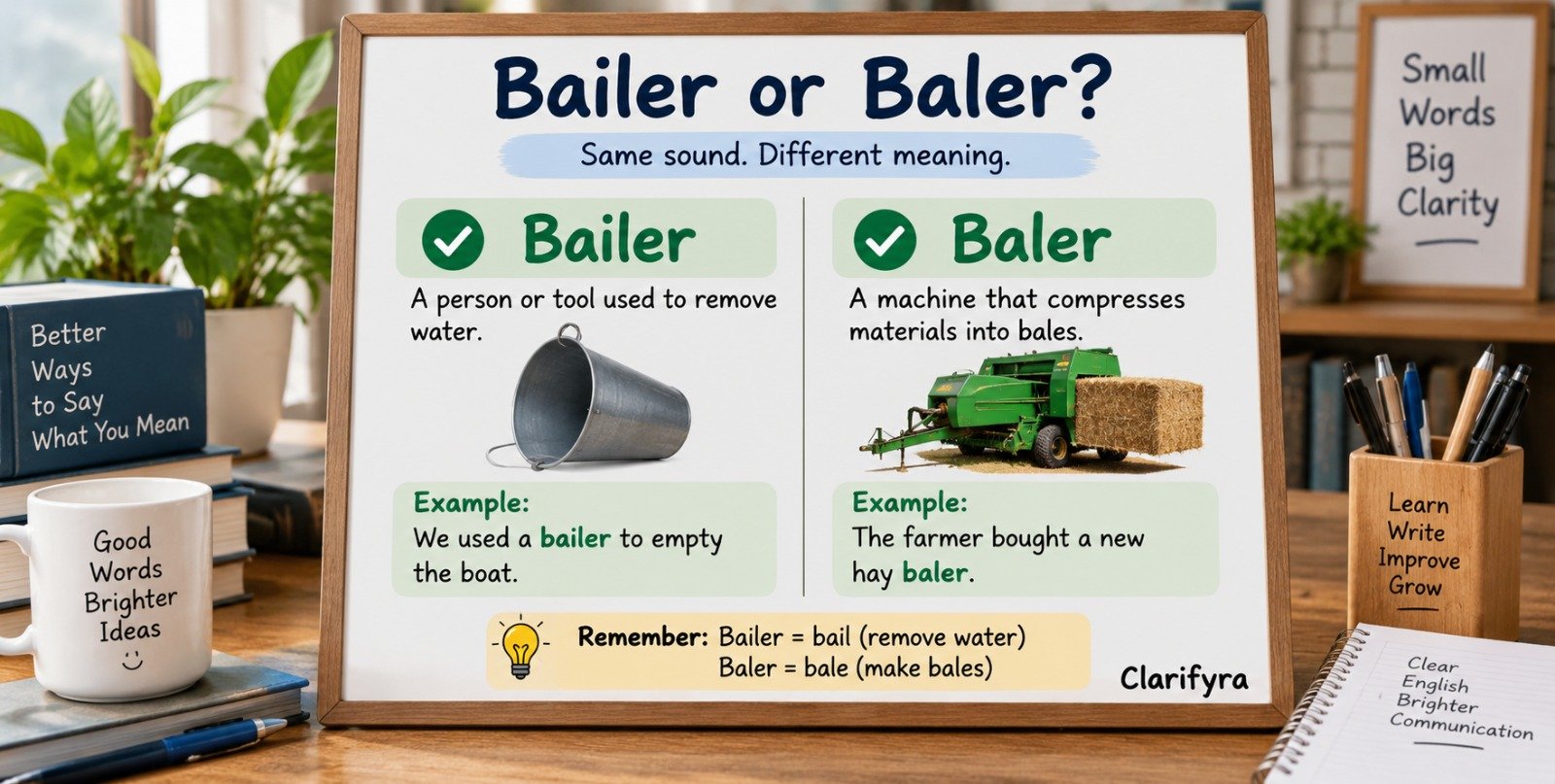
Bailer and baler sound almost identical, so it is easy to mix them up in writing. However, they usually refer to very different things. A bailer is associated with bailing, especially removing water from a boat or another place, while a baler is a machine or person that forms materials into bales. That means the correct spelling depends entirely on what you are describing.
Both bailer and baler are real words. Use bailer for a person, tool, or device used to bail out water or liquid. Use baler for a machine that compresses hay, cardboard, paper, or other materials into bales.
Bailer vs Baler: The Key Difference
The easiest way to understand the difference is to look at the base words:
- Bail → bailer
- Bale → baler
A bailer performs the action of bailing, particularly removing water.
A baler creates bales.
| Feature | Bailer | Baler |
|---|---|---|
| Correct word? | Yes | Yes |
| Part of speech | Noun | Noun |
| Main meaning | A person or device used for bailing | A person or machine that makes bales |
| Common context | Boats, water removal | Farming, recycling, cardboard |
| Example | We used a bailer to empty the canoe. | The farmer repaired the hay baler. |
Because the words are pronounced similarly, context is usually the best way to determine which spelling you need.
Many English learners mix up similar-looking words such as Either or Ither: Which Is Correct and Why?
What Is Bailer?
A bailer is a noun formed from the verb bail. In one of its common meanings, bail means to remove water from a boat or another container.
A bailer can therefore be a person who bails water or a container, tool, or device used to remove it.
Examples:
- The small boat had a plastic bailer under the seat.
- We used a bailer to remove rainwater from the canoe.
- The crew grabbed the bailer when water began entering the boat.
- Every dinghy should have suitable equipment for bailing water.
The word can also appear in specialized technical contexts for equipment that removes or collects liquids.
Is “Bailer” a Real Word?
Yes. Bailer is a legitimate English word.
The mistake occurs when it is used for equipment that makes bundles of hay, cardboard, or other materials. In those cases, the correct word is usually baler.
For example:
Correct: The sailor picked up the bailer.
Incorrect for farming equipment: The farmer bought a new hay bailer.
For the farm machine, write hay baler.
What Is Baler?
A baler is a noun referring to something or someone that bales material.
Most commonly, it refers to a machine that compresses loose material into tightly packed bundles called bales.
Standard dictionary examples include machines used with materials such as:
- Hay
- Straw
- Cotton
- Paper
- Cardboard
A baler may be used on a farm, in a warehouse, or at a recycling facility.
Examples:
- The farmer connected the baler to the tractor.
- Workers put the cardboard into the baler.
- The recycling center uses a large baler for paper.
- The old straw baler needed repairs.
Bailer or Baler for Cardboard?
If you are talking about equipment that compresses cardboard, the correct term is:
cardboard baler
A cardboard baler presses loose cardboard into compact bales, making the material easier to handle, store, and transport.
For example:
Correct: Our warehouse uses a cardboard baler.
Incorrect: Our warehouse uses a cardboard bailer.
The spelling becomes easier to remember when you focus on the finished product: the machine makes a bale, so it is a baler.
The same rule applies to paper and many other recyclable materials.
You may therefore see phrases such as:
- Cardboard baler
- Paper baler
- Recycling baler
- Waste baler
Bailer or Baler for Hay?
For agricultural equipment, the correct spelling is also baler.
A hay baler is a machine that collects or compresses cut hay and forms it into bales. Depending on the equipment, these bales may be round or rectangular.
Correct examples include:
- hay baler
- round baler
- square baler
- straw baler
For example:
Correct: The tractor pulled the hay baler across the field.
Incorrect: The tractor pulled the hay bailer across the field.
Again, the machine creates bales, which explains the spelling baler.
What Is a Baler Machine?
A baler machine is equipment used to compress loose material into compact bales.
In agriculture, a baler may work with hay, straw, cotton, or similar crops.
In recycling and commercial settings, balers can be used for materials such as cardboard, paper, plastics, and other compressible waste.
For example:
- The farm invested in a new round baler machine.
- The warehouse installed a baler machine for waste cardboard.
- Employees received training before operating the industrial baler.
Although baler machine is understandable, simply saying baler is often enough because the word itself commonly refers to the machine.
How Do You Pronounce Bailer?
Bailer is pronounced approximately:
BAY-ler
Baler has essentially the same pronunciation in normal English:
BAY-ler
For baler, standard dictionary pronunciations include approximately /ˈbeɪ.lər/ in American English and /ˈbeɪ.lə(r)/ in British English.
Because the two words sound alike, pronunciation usually does not help you choose the correct spelling.
Instead, ask:
Is it removing water or making a bale?
If it removes water, use bailer.
If it creates bales, use baler.
Why Are These Words So Easy to Confuse?
The confusion mainly comes from their spelling and pronunciation.
Only one letter separates them:
- bailer
- baler
They are also pronounced alike for most speakers.
However, the words come from different base forms:
Bail + -er = bailer
Bale + -er = baler
The ending -er commonly describes someone or something that performs an action. Understanding the verb behind each word makes the distinction much clearer.
Correct Usage in Sentences
Here are some side-by-side examples.
Using Bailer
- I kept a small bailer in the boat.
- The canoe started taking on water, so she reached for the bailer.
- A simple container can sometimes serve as an emergency bailer.
Using Baler
- The farmer purchased a new hay baler.
- The cardboard baler reduced the amount of storage space needed.
- Workers loaded loose paper into the industrial baler.
- The round baler moved slowly across the field.
The meaning of the sentence should tell you which spelling belongs there.
Easy Way to Remember the Difference
A simple memory trick is to look for bale inside baler:
BALE + R = BALER
If something produces a bale, it is a baler.
Think:
hay bale → hay baler
cardboard bale → cardboard baler
For the other word, remember:
BAIL + ER = BAILER
If you bail water out, you can use a bailer.
Common Mistakes to Avoid
One common mistake is writing bailer whenever the word refers to a large machine.
The size or type of machine does not determine the spelling. Its function does.
If it compresses material into bales, write baler.
Another mistake is assuming that bailer is simply an alternative spelling of baler. It is not. Both words exist independently and have different meanings.
Also avoid using pronunciation as your only guide. Since the words sound alike, you need to consider what the object or person actually does.
Final Verdict: Bailer or Baler?
Use bailer when referring to someone or something involved in bailing, especially removing water.
Use baler when referring to someone or a machine that forms material into bales.
So, for hay and cardboard, baler is the correct choice. For a tool used to remove water from a boat, bailer is appropriate. Remembering the base words bail and bale makes the distinction simple, which is exactly the kind of everyday English clarification we aim to provide at Clarifyra.
Frequently Asked Questions
Is it a cardboard bailer or baler?
The correct term is cardboard baler. The machine compresses cardboard into bales, so the spelling comes from the word bale.
Is it a hay bailer or hay baler?
Use hay baler. A hay baler is agricultural machinery that forms hay into bales. Hay bailer is generally incorrect when referring to this machine.
Are bailer and baler both correct words?
Yes. Both are legitimate English words, but they usually have different meanings. A bailer is associated with bailing, while a baler is associated with making bales.
What does a baler machine do?
A baler machine compresses loose materials into compact bales. Depending on the type, it may process hay, straw, cardboard, paper, plastic, or other materials.
How is bailer pronounced?
Bailer is pronounced approximately BAY-ler. It sounds essentially the same as baler, so context is more useful than pronunciation when choosing the spelling.
Can I use bailer instead of baler?
Not when you mean a machine that produces bales. In that context, use baler. Bailer has its own meaning and is not simply an alternative spelling of baler.
You May Also Read | Peaked or Piqued: What’s the Difference?