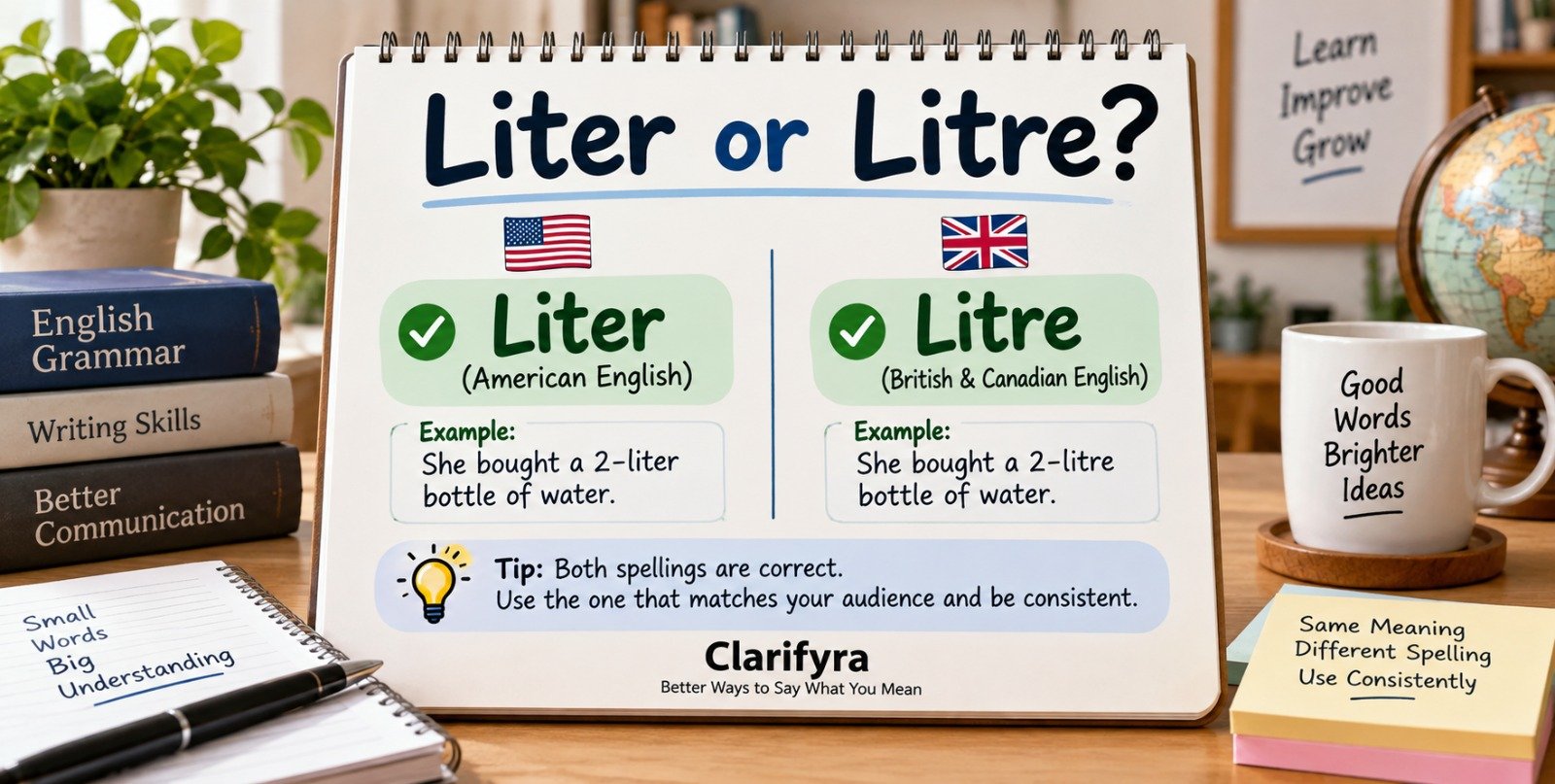
Liter or Litre: Which Spelling Is Correct?
If you are unsure whether to write liter or litre, the good news is that neither spelling is wrong. Both words refer to the same metric unit of volume, but their use depends mainly on the variety of English you are writing. Liter is standard in American English, while litre is the usual spelling in British English and is also preferred in Canadian English. Choosing the right form is therefore less about meaning and more about matching your audience and keeping your spelling consistent.
Both liter and litre are correct. Liter is the standard American English spelling, while litre is preferred in British English, Canadian English, and many other varieties influenced by British usage. They have exactly the same meaning.
Liter or Litre: What’s the Difference?
The difference is purely one of regional spelling. A liter and a litre are not different measurements.
Both refer to a metric unit of volume equal to:
- 1,000 milliliters or millilitres
- 1 cubic decimeter
- 1,000 cubic centimeters
The spelling you choose should depend on the English style you are following.
| Feature | Liter | Litre |
|---|---|---|
| Correct spelling? | Yes | Yes |
| Meaning | Metric unit of volume | Metric unit of volume |
| Common in | American English | British and Canadian English |
| Symbol | L | L |
| Example | a 2-liter bottle | a 2-litre bottle |
The measurement itself remains identical regardless of spelling.
Many English learners mix up similar-looking words such as Metre or Meter: Which Spelling Is Correct?
What Does “Liter” Mean?
A liter is a unit used to measure volume, especially the volume of liquids such as water, milk, fuel, or soft drinks.
The spelling liter is standard in American English.
Examples:
- She drank a liter of water after the race.
- The container holds three liters.
- We bought a two-liter bottle of soda.
- The tank can store 50 liters of fuel.
In American writing, liter and its plural liters are the expected forms.
What Does “Litre” Mean?
A litre means exactly the same thing as a liter. The difference is simply that litre follows British-style spelling.
Examples:
- Please buy a litre of milk.
- The tank holds 60 litres.
- She drinks about two litres of water each day.
- We need a five-litre container.
This spelling is standard in the United Kingdom and commonly used in countries that follow British English conventions.
Is It Liter or Litre in American English?
In American English, use liter.
For example:
Correct in American English:
The bottle contains two liters of water.
Less typical in American English:
The bottle contains two litres of water.
The second sentence is not wrong in meaning, but litre looks distinctly British to an American reader.
American English shows a similar spelling pattern with several other words:
| American English | British English |
|---|---|
| liter | litre |
| meter | metre |
| center | centre |
| theater | theatre |
If the rest of your writing follows American spelling, liter is the natural choice.
Liter or Litre in the UK?
In the UK, litre is the standard spelling.
British English examples include:
- a litre of petrol
- two litres of water
- a five-litre container
- 20 litres of paint
You may occasionally encounter liter, especially in American material, imported content, or writing intended for an international audience. However, when following standard British spelling conventions, litre is the appropriate form.
Liter or Litre in Canada?
Canadian English generally uses litre.
For example:
- The vehicle used 40 litres of fuel.
- She bought a litre of milk.
- The container has a capacity of ten litres.
Although Canadian English shares some vocabulary and spelling patterns with American English, litre follows the British-style spelling convention.
So, if you are wondering whether to use liter or litre in Canada, choose litre in standard Canadian writing.
Is It Spelled Liter or Litre?
Both spellings are legitimate.
Which one you should use depends on your audience:
- Choose liter for American English.
- Choose litre for British English.
- Choose litre for standard Canadian English.
- Follow the preferred spelling of your publication, school, employer, or style guide when one is provided.
The most important point is consistency. Avoid switching between the two spellings within the same piece of writing unless you are quoting another source.
For example:
Consistent American style:
The small tank holds 10 liters, while the larger one holds 30 liters.
Consistent British style:
The small tank holds 10 litres, while the larger one holds 30 litres.
Mixing liters and litres unnecessarily can make otherwise correct writing look inconsistent.
What Is the Symbol for Liter and Litre?
Both spellings use the same unit symbol:
L
Examples:
- 1 L
- 2 L
- 500 mL
- 20 L
The symbol does not change according to whether you write liter or litre.
For example:
- American English: 2 liters = 2 L
- British English: 2 litres = 2 L
An uppercase L is especially clear because a lowercase l can sometimes be mistaken for the number 1.
Examples in American and British English
Seeing both forms in context makes the distinction easier to remember.
American English
- This jug holds one liter of water.
- The engine has a two-liter capacity.
- We bought five liters of juice.
- How many liters can this tank hold?
British English
- This jug holds one litre of water.
- The engine has a two-litre capacity.
- We bought five litres of juice.
- How many litres can this tank hold?
Notice that the meaning does not change. Only the spelling does.
Common Mistakes to Avoid
Treating One Spelling as Universally Wrong
Neither form is a misspelling. Calling litre incorrect because you normally use American English, or calling liter incorrect because you use British English, would be misleading.
Both are accepted regional forms.
Mixing the Spellings
Avoid writing something like:
Inconsistent:
The bottle holds one litre, and the tank holds 20 liters.
Instead, choose one spelling system:
American:
The bottle holds one liter, and the tank holds 20 liters.
British:
The bottle holds one litre, and the tank holds 20 litres.
Changing the Unit Symbol
The spelling changes, but the symbol does not. Both forms use L.
You do not need separate symbols for American and British English.
Easy Way to Remember the Difference
Think of litre as part of the British -re spelling pattern.
British English often uses:
- litre
- metre
- centre
- theatre
American English commonly reverses the final letters:
- liter
- meter
- center
- theater
This pattern is not a universal rule for every English word, but it is a useful way to remember the difference in this case.
Final Verdict: Which One Should You Use?
Both spellings are correct and refer to exactly the same unit of volume. Use liter when writing in American English and litre when writing in British or Canadian English. Whichever form suits your audience, use it consistently throughout the text.
At Clarifyra, the simplest rule to remember is: American English uses “liter,” while British and Canadian English usually use “litre.”
Frequently Asked Questions
Which is correct, liter or litre?
Both are correct. Liter is the standard American spelling, while litre is the standard British spelling and is also preferred in Canadian English.
Do liter and litre mean the same thing?
Yes. They refer to exactly the same metric unit of volume. One liter or litre equals 1,000 milliliters.
Is it liter or litre in Canada?
The standard Canadian spelling is litre. Although Canadian English has some similarities with American English, it uses the British-style spelling for this word.
Is “liter” acceptable in the UK?
It will be understood, but litre is the standard spelling in British English. Use litre when following normal UK spelling conventions.
How do Americans spell litre?
Americans normally spell it liter. For example, American writing would typically use “a two-liter bottle” rather than “a two-litre bottle.”
What is the abbreviation for liter or litre?
The unit symbol is L for both spellings. For example, “2 liters,” “2 litres,” and “2 L” all describe the same volume.
You May Also Read | Mum or Mom: Which Is Correct in English?