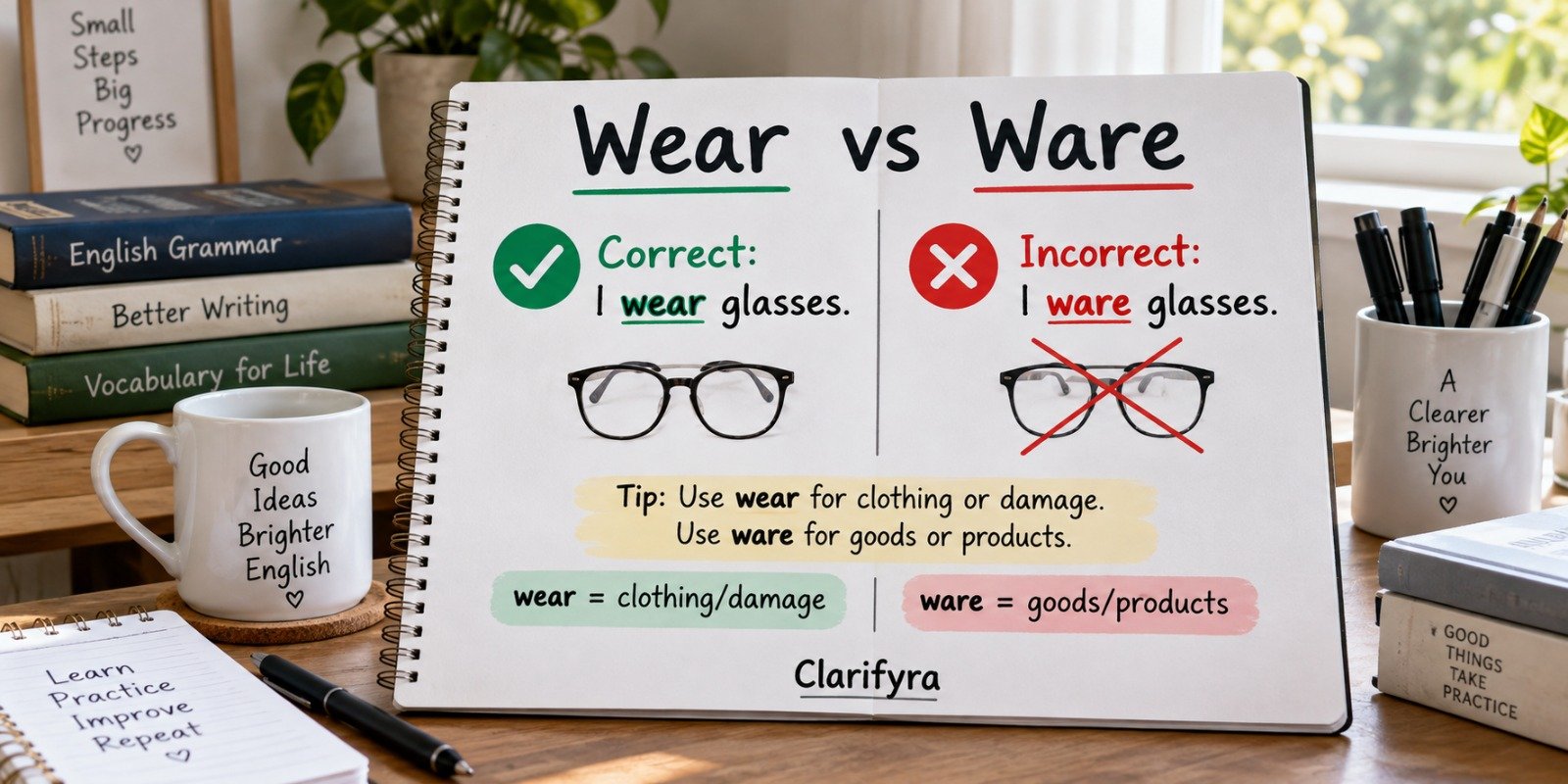
Wear vs Ware: Meaning, Difference, and Correct Usage
Wear and ware sound the same, which makes them easy to confuse in writing, but they have very different meanings. Wear is the word used for clothing, accessories, and damage caused by repeated use. Ware, on the other hand, refers to goods or products and often appears in words such as software, hardware, and kitchenware. Understanding the difference is simple once you connect each spelling with its usual purpose.
Both wear and ware are correct English words, but they are used differently. Use wear for clothing, accessories, or damage from use, and use ware for goods or manufactured products.
Wear vs Ware: What’s the Difference?
The main difference is meaning.
Wear is commonly used as a verb meaning to have clothing or another item on your body. It can also describe something becoming damaged gradually through use. As a noun, it can refer to clothing or to deterioration.
Ware is a noun connected with goods, merchandise, or products. In modern English, it is especially common as part of compound words.
Here is a quick comparison:
| Feature | Wear | Ware |
|---|---|---|
| Correct English word? | Yes | Yes |
| Common word type | Verb and noun | Noun |
| Main meaning | Clothing or damage through use | Goods or products |
| Example | She wears glasses. | The shop sells handmade wares. |
| Common compounds | footwear, sportswear | software, hardware, kitchenware |
A simple rule is:
You wear clothes, but a seller may offer wares.
You May Also Read | Is It Colab or Collab? Learn the Correct Usage
What Is Wear?
Wear has several related meanings, so the correct interpretation depends on the sentence.
Wear as a Verb
The most familiar meaning is to have clothing, jewelry, glasses, or another item on your body.
Examples:
- She likes to wear bright colors.
- I usually wear a jacket in winter.
- He wears glasses while reading.
- They were wearing matching shirts.
The main verb forms are:
| Form | Example |
|---|---|
| Wear | I wear boots to work. |
| Wears | She wears a watch. |
| Wore | He wore a suit yesterday. |
| Worn | These shoes have been worn many times. |
| Wearing | She is wearing a blue coat. |
Wear Meaning Damage or Deterioration
Wear can also mean to become damaged, thinner, weaker, or less effective because of repeated use.
For example:
- The carpet will eventually wear near the doorway.
- These tires are beginning to wear unevenly.
- Constant friction can wear the surface down.
As a noun, wear can refer directly to that damage:
- The sofa shows signs of wear.
- The tires have uneven wear.
- This material is resistant to everyday wear.
Wear as a Clothing Noun
The word can also refer to a type or category of clothing.
Common examples include:
- sportswear
- footwear
- evening wear
- casual wear
- outerwear
So, depending on context, wear can describe what you put on your body or what happens to something after repeated use.
What Is Ware?
Ware is mainly a noun referring to goods, products, or manufactured items.
It is less common by itself in everyday conversation than wear, but it appears frequently in compound words.
Examples include:
- hardware
- software
- kitchenware
- glassware
- tableware
- cookware
The plural form wares can describe products or merchandise offered for sale.
Examples:
- The market vendors displayed their wares.
- Local artists sold handmade wares at the festival.
- The merchant arranged his wares on the table.
You would not normally use ware to describe clothing that someone has on.
Incorrect: She likes to ware dresses.
Correct: She likes to wear dresses.
Where vs Wear vs Ware
Another source of confusion is where vs wear vs ware because all three can sound alike in normal speech.
Their meanings, however, are completely different.
Where
Where refers to a place, position, or situation.
- Where is my phone?
- Do you know where he lives?
- This is the café where we met.
Wear
Use wear for clothing, accessories, or deterioration.
- I wear glasses.
- These shoes are starting to wear out.
Ware
Use ware for goods or products.
- The store sells ceramic ware.
- Vendors displayed their wares outside.
A useful way to remember the three is:
Where = place
Wear = clothing or damage
Ware = products
Wear or Ware Out: Which Is Correct?
The correct expression is wear out.
Ware out is incorrect when you mean that something becomes damaged, unusable, or exhausted through repeated use.
Examples:
- These running shoes will eventually wear out.
- Cheap fabric may wear out quickly.
- The long journey completely wore me out.
The phrase can refer to objects or people.
When an object wears out, it becomes damaged or less useful.
The old tires finally wore out.
When a person is worn out, that person is extremely tired.
After working all day, I was worn out.
Wore Out vs Worn Out
These forms are related but grammatically different.
Wore out is the simple past:
- She wore out her favorite shoes.
Worn out is the past participle or an adjective:
- She has worn out two pairs of shoes.
- Those shoes are completely worn out.
Ware or Wear for Damage?
When talking about damage caused by regular use, the correct word is wear.
Correct expressions include:
- normal wear
- excessive wear
- surface wear
- tire wear
- signs of wear
- wear and tear
For example:
Correct: The chair shows noticeable wear on the arms.
Incorrect: The chair shows noticeable ware on the arms.
The expression wear and tear also refers to ordinary damage that develops through regular use.
Example:
A few scratches are expected after years of normal wear and tear.
This meaning has nothing to do with ware, which refers to products or goods.
Correct Examples of Wear and Ware
Seeing the two words in different situations can make the distinction clearer.
Wear Examples
- You should wear comfortable shoes for the walk.
- She always wears a necklace from her grandmother.
- He wore a dark jacket to dinner.
- The carpet is beginning to wear near the stairs.
- The machine shows very little wear after several years.
- These gloves are designed for everyday wear.
Ware Examples
- The shop sells decorative ceramic ware.
- New kitchenware can make cooking easier.
- The computer requires updated software.
- We replaced some damaged hardware.
- Traders displayed their wares along the street.
- The restaurant ordered new tableware.
Common Mistakes to Avoid
Because the words sound alike, writers sometimes choose the correct sound but the wrong spelling.
Using Ware for Clothing
Incorrect: I ware glasses.
Correct: I wear glasses.
If something is on your body, wear is usually the correct choice.
Writing Ware Out
Incorrect: These shoes will ware out soon.
Correct: These shoes will wear out soon.
Deterioration is associated with wear, not ware.
Using Ware for Physical Damage
Incorrect: The floor has a lot of ware.
Correct: The floor has a lot of wear.
Confusing Wares With Wears
Compare:
She wears a blue coat.
Here, wears is a verb.
The merchant sells handmade wares.
Here, wares is a plural noun meaning goods.
The pronunciation is similar, but the meanings and grammatical roles are different.
Wear vs Ware Synonyms
The best synonym depends on which meaning you intend.
Synonyms and Related Words for Wear
For clothing or what someone has on:
- dress
- put on
- don
- sport
- clothing
- apparel
- attire
For damage or deterioration:
- deteriorate
- erode
- weaken
- abrade
- become worn
For wear out when referring to tiredness:
- exhaust
- tire
- fatigue
Synonyms and Related Words for Ware
Depending on context:
- goods
- products
- merchandise
- articles
- commodities
- stock
Remember that these are not always interchangeable word-for-word. For example, software cannot normally be replaced with soft goods without changing the meaning.
Easy Way to Remember the Difference
A simple memory trick is to associate each spelling with a familiar idea.
WEAR = What You Put On
Think:
I WEAR it.
You wear:
- shoes
- glasses
- clothes
- jewelry
- a hat
Also remember that things can wear out after being used repeatedly.
WARE = Products
Think about familiar product words ending in -ware:
- software
- hardware
- kitchenware
- glassware
If the meaning involves goods, merchandise, or a product category, ware may be the word you need.
WHERE = Place
For the third homophone, remember:
WHERE contains HERE.
Both relate naturally to location.
What About “Wear vs Ware Reddit”?
Informal discussions sometimes contain conflicting spellings because the two words sound identical, but standard usage follows the same distinction regardless of platform or conversational style.
Use wear when talking about clothing or deterioration:
My shoes are starting to wear out.
Use ware when talking about goods or product-related terms:
The shop displayed its handmade wares.
For formal or casual writing, context—not pronunciation—determines the correct spelling.
Final Verdict: Wear or Ware?
Both words are valid, but they are not interchangeable. Choose wear when you mean clothing, having something on your body, or damage caused by use. Choose ware when referring to goods, merchandise, or product categories such as hardware and kitchenware. If you remember wear = clothing/damage and ware = products, the distinction becomes easy to apply. That straightforward approach reflects Clarifyra goal of helping readers find better ways to say what they mean.
Frequently Asked Questions
Is it wear or ware?
Both are correct words. Use wear for clothing, accessories, or deterioration caused by use. Use ware for goods, merchandise, or product-related words such as software and kitchenware.
Is ware a real English word?
Yes. Ware is a real noun associated with manufactured goods or merchandise. It is especially common in compound words such as hardware, glassware, cookware, and tableware.
Is it wear out or ware out?
Wear out is correct. It means to become damaged through repeated use or, when referring to a person, to become extremely tired. Ware out is not the correct expression for this meaning.
Is damage called wear or ware?
Use wear for damage caused by regular use, friction, or age. Expressions such as normal wear, tire wear, signs of wear, and wear and tear are correct.
What is the difference between where, wear, and ware?
Where refers to a place, wear relates to clothing or deterioration, and ware refers to goods or products. Although they may sound alike, their meanings and functions are different.
Can wear be both a noun and a verb?
Yes. As a verb, wear can mean having clothing or accessories on your body or becoming damaged through use. As a noun, it can refer to clothing or to deterioration, as in casual wear and signs of wear.
You May Also Read | Is It Hidding or Hiding? Correct Spelling Explained