PPS or PSS: Which Is Correct After P.S.?
You finish a letter, add a P.S., and then remember one more thing. Should the next note be PPS or PSS? The two forms look similar, which makes the choice easy to second-guess. In standard letter and email usage, however, there is a clear convention.
A second postscript is written as PPS or P.P.S. Cambridge defines PPS as a short message added after a first postscript, so PSS is not the standard form when you mean a second postscript.
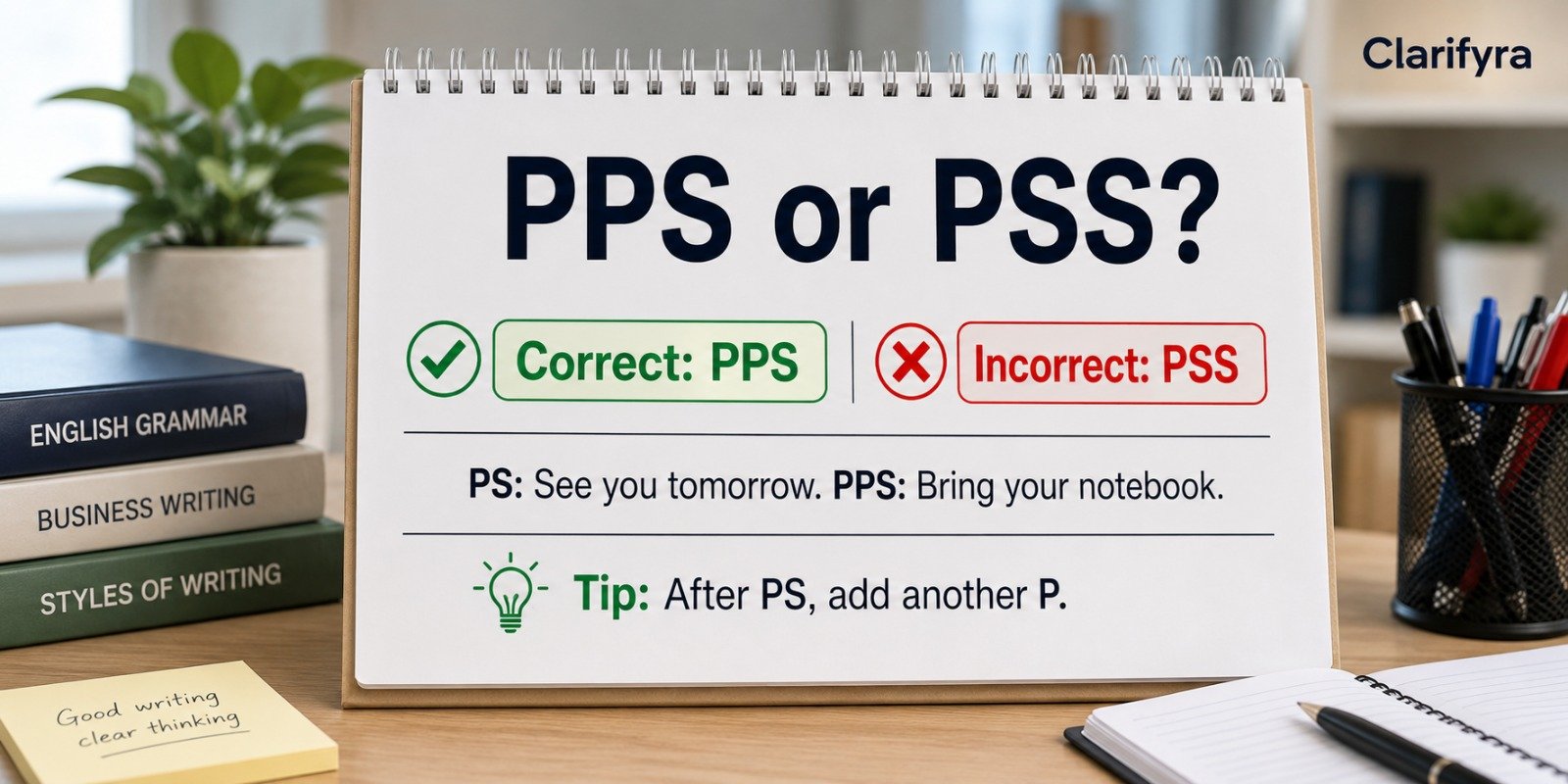
PPS is the correct form after PS. It means a second or additional postscript. PSS is not the standard abbreviation for another postscript at the end of a letter or email.
PPS or PSS: Which Is Correct?
When you want to add another note after an existing PS, use PPS.
The normal sequence is:
PS → PPS → PPPS
Not:
PS → PSS
A PS introduces the first postscript. A PPS introduces an additional postscript after that one.
For example:
PS: Remember to bring the tickets.
PPS: The doors open at 6:30.
Here, PPS is correct because the second note comes after an existing postscript.
Quick Comparison
| Form | Meaning in a Letter | Correct for a Second Postscript? |
|---|---|---|
| PS / P.S. | Postscript | No, this is the first postscript |
| PPS / P.P.S. | Second or additional postscript | Yes |
| PSS / P.S.S. | Not the standard second-postscript form | No |
| PPPS | A third postscript | Possible, but rarely needed |
What Is PS?
PS stands for postscript.
A postscript is a short additional message placed at the end of a letter after the main message has been completed. Cambridge describes a postscript as a remark or message added at the bottom of a letter, traditionally after the writer has signed their name.
For example:
Dear Mia,
Thanks for helping me with the presentation. I’ll send you the revised slides tomorrow.
Best,
Daniel
PS: I found the notes you were looking for.
The PS adds a separate thought that was not included in the body of the letter.
In modern emails, writers can easily edit the original text before sending it, but PS is still useful when you want a final note to stand out.
What Is PPS?
PPS is the standard abbreviation used for a second or additional postscript.
Cambridge defines it as a short message added after a message has already been added at the end of a letter, while Dictionary.com identifies P.P.S. as a second or additional postscript.
A simple example is:
PS: I’ll bring the documents tomorrow.
PPS: Please remind me to bring the keys too.
The first extra note is the PS. The additional note after it becomes the PPS.
PPS Meaning in a Letter
When someone uses PPS at the end of a letter or email, it essentially means:
“Here is one more note after my first postscript.”
It is commonly understood as post-postscript.
You may see it written in either of these forms:
PPS
or
P.P.S.
Both are recognizable. The version without periods is especially common in modern informal writing.
What Is PSS?
PSS is not the standard abbreviation for a second postscript.
This is where much of the confusion comes from.
A writer may look at PS and assume that a second note should add another S, resulting in PSS. However, the established English convention does not work that way.
Instead, another P is added:
PS → PPS
PSS can appear as an abbreviation for unrelated terms in specialized contexts, so it is not accurate to say that the letters PSS can never form a valid abbreviation. But when the question is specifically about a postscript at the end of a letter, PPS is the appropriate form.
What Comes After PS: PPS or PSS?
After PS comes PPS.
The pattern is easiest to understand by looking at each stage:
PS — first postscript
PPS — second postscript
PPPS — third postscript
For example:
PS: Dinner starts at seven.
PPS: You don’t need to bring anything.
PPPS: Actually, bring your appetite.
A third postscript can technically be written as PPPS, but once you have several additional notes, it may be clearer to revise the original message instead.
P.S., PPS, or PSS: How the Pattern Works
The abbreviation PS comes from postscript, which refers to something written after the main message.
If you add another postscript after the first one, the conventional form is PPS.
Think of it as:
post + postscript = PPS
That is why another P appears rather than another S.
The structure is therefore:
PS + another postscript → PPS
This also explains why phrases such as “p.s. pps or pss” and “what is after P.S. PPS or PSS” have the same simple answer: use PPS.
PPS or PSS at the End of a Letter
At the end of a letter, use PPS when you have already written a PS and need another separate note.
Here is a complete example:
Dear Olivia,
Thank you for coming to dinner on Saturday. It was great catching up with you, and I hope we can do it again soon.
Best wishes,
Emma
PS: I think you left your umbrella here.
PPS: It is next to the front door.
The second additional note correctly uses PPS.
Correct
PS: Call me when you arrive.
PPS: I may be in a meeting, so leave a message.
Incorrect for a Second Postscript
PS: Call me when you arrive.
PSS: I may be in a meeting, so leave a message.
In the second example, PSS should be changed to PPS.
What Does “Post Scriptum” Have to Do With It?
The term postscript is historically connected with the Latin expression post scriptum, referring to something written afterward.
In English, PS became the familiar abbreviation for a note placed after the main letter.
A further addition is conventionally called a post-postscript, which gives us PPS or P.P.S.
That is why PPS or PSS post scriptum can seem confusing at first. The second abbreviation is not created by adding another S. English usage instead adds another P.
Dictionary.com also records P.P.S. for a second or additional postscript and notes its connection with Latin post postscrīptum.
Can You Write P.P.S. Instead of PPS?
Yes.
Both of these forms are understandable:
PPS
P.P.S.
The same applies to:
PS
and
P.S.
Modern writing often drops the periods from abbreviations, especially in emails and casual messages.
The important distinction is the order of the letters, not whether periods are included.
So:
PPS — correct
P.P.S. — correct
PSS — not standard for a second postscript
Examples of PPS in Sentences and Messages
Seeing the pattern in context makes it easier to remember.
Friendly Letter
PS: Give Max a hug for me.
PPS: I left his birthday present on the kitchen table.
PS: Friday’s meeting has been moved to 10 a.m.
PPS: I’ll send the updated agenda this afternoon.
Birthday Card
PS: Hope you save me a piece of cake!
PPS: Chocolate, preferably.
Informal Message
PS: Don’t forget your charger.
PPS: And remind me not to forget mine.
These examples all use PPS because another short note follows an existing PS.
Funny PPS Examples
PPS can also be used for comic timing because the second note can change or undermine the first one.
For example:
PS: I definitely did not eat the last cookie.
PPS: Please ignore the crumbs on my shirt.
Or:
PS: This is my final reminder.
PPS: Seriously, this time.
Another:
PS: The dog behaved perfectly today.
PPS: We may need a new cushion.
These PPS funny examples work because the additional postscript acts like a final punchline.
Why Do People Confuse PPS and PSS?
The confusion is mostly visual.
Someone sees:
P + S
and may assume that a second postscript should simply become:
P + S + S
That feels logical at first glance, but it does not reflect the conventional abbreviation.
The established pattern adds another P instead:
PS → PPS
Another reason for confusion is that PSS may appear online as an abbreviation for completely different terms. Seeing those letters elsewhere can make PSS look like a possible alternative in letter writing.
For a postscript, however, PPS is the standard choice.
An Easy Way to Remember the Difference
Use this simple rule:
Another postscript means another P.
Start with:
PS
Need another note?
Add another P:
PPS
Need another one after that?
Add another P again:
PPPS
This is much easier to remember than trying to decode the abbreviation every time you write one.
Common Mistakes to Avoid
Writing PSS for the Second Note
Incorrect:
PS: See you tomorrow.
PSS: Bring your notebook.
Correct:
PS: See you tomorrow.
PPS: Bring your notebook.
Adding Too Many Postscripts
A PPS is perfectly understandable, but several postscripts can make an email difficult to read.
Instead of:
PS
PPS
PPPS
PPPPS
consider moving some of the information into the main message.
Assuming PPS Must Always Have Periods
You do not have to write P.P.S. every time.
PPS is also widely understood.
The same principle applies to PS and P.S.
Should You Use PPS in Formal Writing?
PPS is acceptable when the format of the message allows a postscript, but it is usually more natural in personal letters, informal emails, cards, newsletters, and conversational correspondence.
In a formal report, application, proposal, or carefully edited business letter, it is often better to place important information in the main text.
A PPS should feel like an intentional additional note, not information that the reader needed earlier in the message.
Other Ways to Say “PPS” in an Email
You do not always need a formal postscript structure.
If you want to add another point naturally, you could use phrases such as:
Other Ways to Say “One More Thing”
- One more thing:
- By the way:
- I almost forgot:
- One last note:
- Another quick reminder:
- Before I forget:
More Formal Alternatives
- One final point:
- Additionally:
- As an additional note:
- I would also like to mention:
- One further detail:
- A final reminder:
These alternatives can make a professional email feel smoother than adding several postscripts.
Final Verdict: PPS or PSS?
If you are adding a second postscript after PS, write PPS or P.P.S.
PSS is not the standard form for that purpose.
Remember the sequence:
PS → PPS → PPPS
The easiest rule is simply to add another P whenever another postscript is added.
Frequently Asked Questions
Is It PPS or PSS?
Use PPS for a second postscript. It appears after a PS when you want to add one more short note. PSS is not the conventional abbreviation for this meaning.
What Comes After PS?
PPS comes after PS. For example, you might write a PS containing one reminder and then a PPS containing another separate reminder.
What Does PPS Mean?
In letters and emails, PPS means a second or additional postscript. Cambridge describes it as a message added after a first postscript.
Is PPS the Same as P.P.S.?
Yes. PPS and P.P.S. communicate the same idea. The difference is simply whether periods are used between the letters.
What Comes After PPS?
If another postscript is absolutely necessary, PPPS can follow PPS. In most situations, however, having several postscripts is a sign that the message would be clearer if edited.
Is PSS Ever Correct?
PSS can be a valid abbreviation for unrelated terms in other fields, but it is not the standard way to label a second postscript in a letter or email.
When deciding between these two forms, remember that a second postscript takes another P, giving you PPS, not PSS. Keeping small usage distinctions like this clear makes written communication easier to understand, which is also the kind of practical language distinction readers can explore through Clarifyra.
You May Also Read | Vice vs Vise? Which Spelling Should You Use?