25 Better Other Ways to Say “In Conclusion” in Essays and Professional Writing
“In conclusion” is clear, correct, and widely understood, but it isn’t always the most natural way to end a piece of Writing. In an essay, report, presentation, or professional document, repeating the same closing phrase can make your writing feel formulaic. Choosing from other ways to say in conclusion can help you sound more precise, polished, and appropriate for the situation.
The important thing is not simply finding a synonym. “Ultimately,” “in summary,” “on balance,” and “finally” do different jobs. Some summarize, some express a final judgment, and others merely introduce the last point. The best choice depends on what you want your conclusion to accomplish.
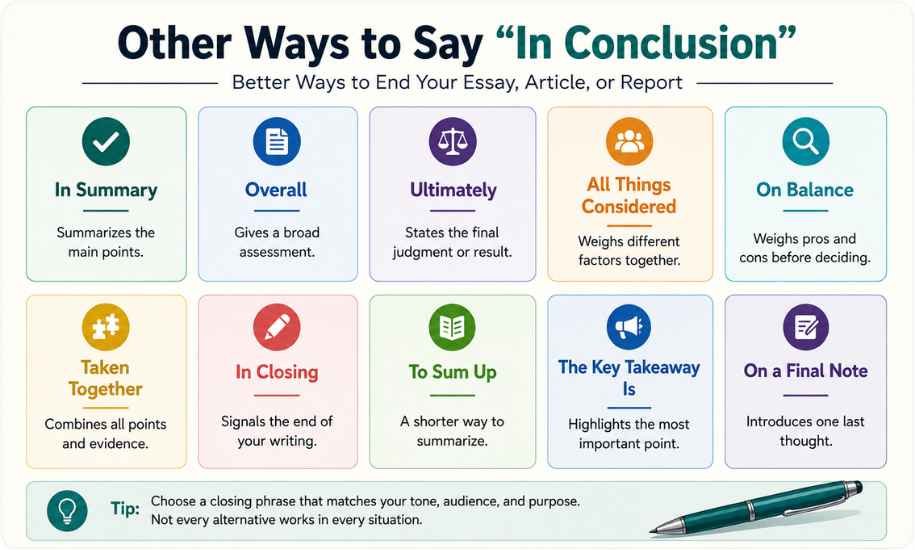
Some of the best other ways to say “in conclusion” are in summary, overall, ultimately, to sum up, all things considered, on balance, taken together, and in closing. For essays, phrases like “taken together” and “considering the evidence” often sound more natural, while professional writing may work better with “the key takeaway is” or “based on these findings.”
In professional writing, “based on these findings,” “the key takeaway is,” and “on balance” may sound more natural.
Choosing the Right Alternative
Not every closing expression is interchangeable. This table shows the most useful distinctions.
| Phrase | Tone | Best Used For | What It Does |
|---|---|---|---|
| In summary | Formal/neutral | Essays, reports | Summarizes main points |
| To summarize | Formal/neutral | Academic and professional writing | Restates key information |
| To sum up | Neutral | Essays, talks | Gives a concise recap |
| Overall | Neutral/professional | Reports, reviews, essays | Gives a broad assessment |
| Ultimately | Analytical | Arguments, recommendations | States a final judgment |
| All things considered | Thoughtful | Essays, comparisons | Weighs several factors |
| On balance | Formal/analytical | Evaluations, reports | Weighs pros and cons |
| Taken together | Academic | Research and analytical essays | Combines evidence |
| In closing | Formal | Speeches, letters | Signals a deliberate ending |
| In brief | Formal/concise | Reports and summaries | Condenses information |
| Based on these findings | Professional/academic | Research, reports | Draws a conclusion from evidence |
| The key takeaway is | Professional | Presentations, business writing | Highlights the main lesson |
| On a final note | Neutral | Articles, talks | Introduces one last thought |
| In the final analysis | Formal | Analytical writing | Gives a considered final judgment |
| To wrap things up | Casual | Blogs, conversations | Signals an informal ending |
Also Check | 75 Cute Ways to Say “I Love You”: Sweet, Romantic, Poetic and Funny Ideas
Better Ways to Say “In Conclusion” in an Essay
When looking for other ways to say in conclusion in an essay, focus on what your final paragraph is doing rather than simply replacing one phrase with another.
In Summary
“In summary” works well when your conclusion briefly revisits the central points of an essay.
Example:
“In summary, access to affordable education benefits both individuals and the wider economy.”
It is straightforward and formal enough for most academic writing.
Taken Together
“Taken together” is especially useful when your conclusion brings several pieces of evidence into one final interpretation.
Example:
“Taken together, these findings suggest that flexible working arrangements can improve productivity without reducing collaboration.”
This sounds more analytical than “in conclusion” because it explicitly connects the final claim to the evidence.
Ultimately
“Ultimately” is a good choice when you are reaching a final judgment rather than simply summarizing.
Example:
“Ultimately, the success of the policy will depend on how consistently it is implemented.”
This is one of the better ways to say in conclusion in an essay when your last paragraph needs to deliver a clear position.
All Things Considered
This phrase works well in argumentative or compare-and-contrast essays because it signals that you have considered multiple sides.
Example:
“All things considered, public transportation remains the more sustainable long-term option.”
Overall
“Overall” is simple but effective. It works particularly well in analytical essays, reviews, and evaluations.
Example:
“Overall, the novel presents ambition as both a source of progress and a cause of personal conflict.”
Professional Ways to Say “In Conclusion”
Professional writing often benefits from language that is direct and purposeful. Instead of announcing that you are concluding, you can signal the practical meaning of your discussion.
Based on These Findings
This phrase is useful in reports, research summaries, proposals, and workplace documents.
Example:
“Based on these findings, expanding the pilot program would be a reasonable next step.”
It works best when the conclusion genuinely follows from data, observations, or analysis.
The Key Takeaway Is
This is more conversational than traditional academic language, but it works very well in presentations, executive summaries, internal reports, and business communication.
Example:
“The key takeaway is that improving response times should be the team’s first priority.”
On Balance
“On balance” suggests that you have weighed competing advantages and disadvantages before reaching a conclusion.
Example:
“On balance, the benefits of the proposed system outweigh the short-term implementation costs.”
The Bottom Line Is
This expression is clear and decisive.
Example:
“The bottom line is that the current process cannot support the company’s expected growth.”
It is useful in business communication, but it can sound too conversational for formal academic writing.
In Closing
“In closing” is best suited to speeches, presentations, formal letters, and statements.
Example:
“In closing, I would like to thank everyone who contributed to the project.”
It signals that you are ending, but it does not necessarily summarize an argument.
Fancy Ways to Say “In Conclusion”
Sometimes you may want a more polished or sophisticated transition. The best fancy ways to say in conclusion still need to sound natural in context.
Useful options include:
- In the final analysis
- Taking all factors into consideration
- Viewed as a whole
- Drawing these points together
- Bringing these ideas together
- Considering the broader implications
- With these considerations in mind
- In light of the evidence presented
- Reflecting on the discussion as a whole
- When all factors are considered
For example:
“In the final analysis, lasting improvements will require both policy reform and sustained public support.”
Or:
“Drawing these points together, the evidence suggests that small behavioral changes can have a meaningful cumulative effect.”
More elaborate wording should add clarity, not simply make the sentence sound more impressive.
Longer Ways to Say “In Conclusion”
Some conclusions need a fuller transition, particularly when the argument is complex. Longer ways to say in conclusion can create a smoother bridge between your analysis and final judgment.
Consider:
- Taking all of these factors into consideration
- When the available evidence is considered as a whole
- Looking at the issue from a broader perspective
- Bringing all of these arguments together
- Based on the points discussed above
- When these findings are viewed collectively
- After weighing the advantages and disadvantages
- Considering the wider implications of these results
- With all of these observations in mind
Example:
“Taking all of these factors into consideration, improving urban air quality will require a combination of cleaner transportation, stricter emissions standards, and long-term infrastructure planning.”
These phrases work best when the sentence that follows genuinely draws together several parts of the discussion.
Smart Ways to End Without Saying “In Conclusion”
Some of the smart ways to say in conclusion do not use a conclusion phrase at all.
Compare:
Weak:
“In conclusion, remote work has advantages and disadvantages.”
Stronger:
“Remote work is therefore most effective when flexibility is supported by clear expectations, reliable communication, and measurable goals.”
The stronger version moves directly to the final insight.
Another example:
Predictable:
“In conclusion, artificial intelligence will change many jobs.”
Stronger:
“The central question is no longer whether artificial intelligence will affect the workplace, but how organizations will prepare people to work alongside it.”
A conclusion often becomes stronger when the final claim itself signals closure.
Creative Ways to Say “In Conclusion”
Blog posts, personal essays, speeches, and less formal articles allow more flexibility. Some creative ways to say in conclusion include:
- Here is the bigger picture
- If there is one thing to remember, it is this
- That brings us to the most important point
- One final thought is worth considering
- Where does that leave us?
- What matters most is
- The larger lesson is
- Looking beyond the details
- Before leaving the subject
- The story ultimately comes down to this
Example:
“If there is one thing to remember, it is this: clear communication is usually more effective than complicated wording.”
These alternatives are useful when you want the ending to feel natural and engaging rather than academic.
“Finally” Is Not Always Another Way to Say “In Conclusion”
This distinction matters.
“Finally” usually means the last item in a sequence.
Example:
“First, review the data. Next, identify the major trends. Finally, prepare the report.”
Here, “finally” does not mean “in conclusion.” It simply introduces the final step.
The same applies to “lastly.”
Example:
“Lastly, we should consider how the changes will affect new employees.”
This introduces one more point. It does not necessarily summarize everything that came before.
“Therefore” Is Also Different
“Therefore” expresses a result or logical consequence.
Example:
“The roads were covered in ice; therefore, the school remained closed.”
You could use “therefore” in a concluding paragraph, but it should not be treated as a direct synonym for “in conclusion.”
Similarly, “as a result,” “consequently,” and “thus” show cause-and-effect relationships rather than simply signaling the end of a discussion.
What About “In Essence”?
“In essence” means something closer to “essentially” or “at its core.”
Example:
“In essence, the proposal asks employees to trade greater flexibility for increased accountability.”
It can appear near the end of a discussion, but its main function is to reduce an idea to its essential meaning.
That is why it should not automatically replace “in conclusion.”
How to Choose the Best Closing Phrase
A good alternative should match both your purpose and your audience.
If you are summarizing, try:
- In summary
- To summarize
- To sum up
- In brief
If you are giving a final judgment, try:
- Ultimately
- Overall
- In the final analysis
- All things considered
If you are weighing competing arguments, try:
- On balance
- Taking everything into account
- All things considered
If you are drawing a conclusion from evidence, try:
- Taken together
- Based on these findings
- The evidence suggests
- Considering the evidence
If you are ending professionally, try:
- The key takeaway is
- Based on these findings
- Overall
- In closing
If you are ending conversationally or creatively, try:
- To wrap things up
- On a final note
- What matters most is
- Here is the bigger picture
Common Mistakes to Avoid
One of the biggest mistakes is choosing an alternative simply because it sounds sophisticated.
For example, “in the final analysis” may sound unnecessarily heavy in a short workplace email, while “to wrap things up” may feel too casual in a university dissertation.
Another mistake is using a transition that does not match the relationship between ideas.
“Therefore” requires a logical result. “Finally” usually introduces the last item. “In essence” simplifies an idea. “Ultimately” emphasizes a final outcome or judgment.
The most natural phrase is the one that accurately describes what your final sentence is doing.
Frequently Asked Questions
What are other ways to say “in conclusion”?
Common alternatives include “in summary,” “overall,” “ultimately,” “to sum up,” “all things considered,” “on balance,” “taken together,” and “in closing.” The best option depends on whether you are summarizing, evaluating, or giving a final judgment.
What is another way to say “in conclusion” in an essay?
Good essay alternatives include “taken together,” “overall,” “ultimately,” “in summary,” “considering the evidence,” and “all things considered.” You can also begin directly with your final interpretation without using an explicit conclusion phrase.
What are the best professional ways to say “in conclusion”?
For professional writing, useful choices include “based on these findings,” “overall,” “the key takeaway is,” “on balance,” and “ultimately.” “The bottom line is” can also work when a direct, businesslike tone is appropriate.
Is “in conclusion” bad academic writing?
No. “In conclusion” is grammatically correct and acceptable in academic writing. It may simply feel predictable if it appears repeatedly or if the structure already makes it obvious that the final paragraph is the conclusion.
Can I use “finally” instead of “in conclusion”?
Sometimes, but not always. “Finally” normally introduces the last point or step in a sequence, while “in conclusion” signals that you are drawing the entire discussion to a close.
Is “ultimately” the same as “in conclusion”?
Not exactly. “Ultimately” usually introduces a final result, judgment, or underlying point. It works well in many conclusions, but it is not a direct replacement in every sentence.
What is a fancy way to say “in conclusion”?
Depending on the context, you could use “in the final analysis,” “drawing these points together,” “considering the broader implications,” or “taking all factors into consideration.” Use these only when their level of formality fits the writing.
Conclusion
There is no single alternative that works in every situation. The best ending depends on whether you need to summarize information, weigh evidence, state a judgment, highlight a takeaway, or simply leave the reader with one final thought. A short phrase such as “overall” may be stronger than a more elaborate expression when clarity matters, while “taken together” or “based on these findings” can add useful precision in analytical writing.
At Clarifyra, the goal is to make these small but meaningful differences in English easier to recognize, so your final wording sounds appropriate for the audience, purpose, and tone rather than merely different for the sake of variety.
Also Read | 100 Ways to Say “I Love You”: Unique, Creative and Romantic Ideas