Another Way to Say “Due To”: Better Alternatives for Every Context
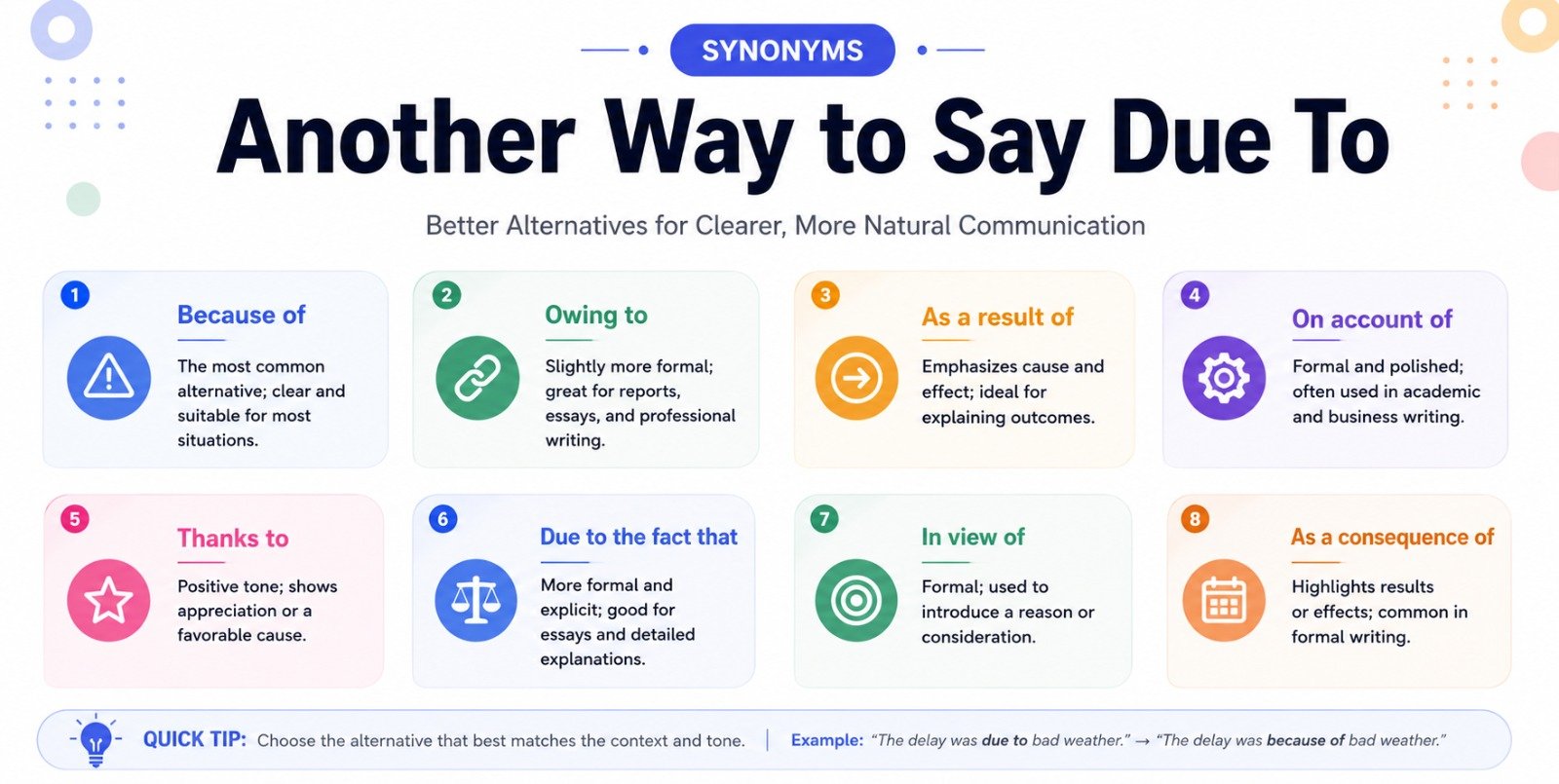
“Due to” is a perfectly normal way to explain a reason or cause, but repeating it can make your writing sound flat or predictable. Depending on the situation, another way to say due to might be because of, owing to, as a result of, caused by, attributable to, thanks to, or in light of.
The best choice depends on what you’re writing. A phrase that sounds natural in conversation may feel too casual in research, while an academic alternative may sound unnecessarily formal in an email.
Cambridge defines due to as meaning “because of something,” and Merriam-Webster recognizes its prepositional use as standard English. So there’s no need to remove “due to” from your writing entirely; alternatives are most useful when you want variety or greater precision.
Best Alternatives to “Due To” at a Glance
| Alternative | Tone | Best For | Example |
|---|---|---|---|
| Because of | Neutral | Everyday writing | The game was canceled because of rain. |
| Owing to | Formal | Notices and reports | Owing to maintenance, the office will close early. |
| As a result of | Neutral/Formal | Cause and effect | Sales rose as a result of higher demand. |
| Caused by | Direct | Clear causes | The outage was caused by a technical fault. |
| Attributable to | Formal/Academic | Research and analysis | The increase was attributable to stronger demand. |
| Stemming from | Formal | Underlying causes | The issue stems from outdated procedures. |
| Arising from | Formal | Problems and consequences | Costs arising from the delay were significant. |
| Thanks to | Positive | Positive outcomes | Thanks to your help, we finished early. |
| In light of | Professional | Decisions and updates | In light of recent changes, we revised the plan. |
| On account of | Formal | Explanations | The event was postponed on account of bad weather. |
Merriam-Webster also lists because of, owing to, on account of, and through among alternatives associated with “due to.”
Other Ways to Say “Due To” in Everyday Sentences
For normal speech and general writing, you usually don’t need an overly formal synonym. These options sound natural and clear.
Because Of
Because of is probably the easiest direct alternative to “due to.”
Due to:
The match was postponed due to heavy rain.
Better alternative:
The match was postponed because of heavy rain.
It works well in conversations, articles, workplace communication, and most general writing.
As a Result Of
Use as a result of when you want to make the cause-and-effect relationship more noticeable.
Example:
The company hired more staff as a result of increased demand.
This expression is slightly longer than “due to,” so it works best when emphasizing the outcome matters.
On Account Of
On account of means because of something, but it sounds more formal or slightly old-fashioned in some contexts.
Example:
The outdoor event was canceled on account of the weather.
It can work in formal explanations, though because of is usually more natural in everyday English.
Through
In certain sentences, through can identify the cause or means by which something happened.
Example:
The error occurred through a misunderstanding between the two teams.
It is not interchangeable with “due to” in every sentence, so use it only when the meaning fits.
Other Ways to Say “Due To” in an Email
Professional emails often use “due to” when explaining delays, changes, cancellations, or decisions. You can make your message sound more natural by choosing an alternative that matches the reason.
In Light Of
In light of works especially well when new information or circumstances lead to a decision.
Example:
In light of the recent schedule changes, we have moved the meeting to Thursday.
It sounds professional without being stiff.
Owing To
Owing to is a close formal alternative.
Example:
Owing to unexpected maintenance, our office will open at noon.
This fits formal announcements and business correspondence better than casual messages.
Because Of
Professional writing doesn’t always need formal vocabulary. Because of is often clearer.
Example:
Because of a scheduling conflict, I’ll need to move our call to Friday.
That sounds natural and professional at the same time.
Following
Following can work when one event leads to a later action or decision.
Example:
Following recent changes to the project timeline, we have updated the delivery schedule.
Notice that following means “after” rather than literally “because of,” so only use it when the sequence itself makes the causal relationship clear.
In Response To
Use in response to when an action happens because of a request, message, complaint, event, or development.
Example:
In response to your request, we’ve updated the invoice.
This is much more precise than writing “due to your request.”
Other Ways to Say “Due To” in an Essay
Essay writing often benefits from more precise causal language. Instead of repeating “due to,” choose expressions that show exactly how one idea relates to another.
As a Result Of
This is one of the strongest choices for explaining cause and consequence.
Example:
Urban populations expanded rapidly as a result of industrial development.
As a Consequence Of
As a consequence of is slightly more formal and gives greater emphasis to the outcome.
Example:
Many communities experienced economic decline as a consequence of factory closures.
Attributable To
Use attributable to when a result can reasonably be linked to a particular cause.
Example:
The improvement in literacy rates may be attributable to increased access to education.
This phrasing is especially useful in analytical writing.
Stemming From
Stemming from highlights the source or underlying origin of something.
Example:
Many of the disagreements stemmed from differences in political priorities.
It often works particularly well when discussing problems, disputes, or long-term causes.
Arising From
Arising from is another formal option for something developing because of a circumstance.
Example:
The report examines challenges arising from rapid population growth.
It commonly appears in formal, legal, academic, and professional writing.
Other Ways to Say “Due To” in Research
Research writing requires extra care because not every relationship is necessarily causal.
Attributable To
Use this when evidence reasonably supports connecting an outcome to a cause.
Example:
The observed improvement may be attributable to changes in treatment.
Resulting From
This is useful when describing a consequence produced by a particular event or condition.
Example:
Damage resulting from prolonged exposure was recorded.
Explained By
Use explained by when analyzing why a pattern or difference may exist.
Example:
The variation may be partly explained by differences in sample size.
Driven By
Driven by is common in business, economic, demographic, and analytical research.
Example:
The increase in demand was largely driven by population growth.
Associated With
Associated with requires special care.
Example:
Higher stress levels were associated with reduced sleep duration.
This does not necessarily mean that one factor caused the other. In research, association and causation should not be treated as identical.
Positive Ways to Say “Due To”
When something good happens, due to can sound emotionally neutral. A warmer alternative may fit better.
Thanks To
Thanks to is the clearest positive alternative.
Example:
Thanks to your support, the campaign exceeded its target.
With the Help Of
Use this when a person, group, tool, or resource contributed to success.
Example:
With the help of the design team, we completed the project ahead of schedule.
Through
Through can highlight effort or a method that produced a positive result.
Example:
She built a successful career through years of consistent work.
As a Result Of
This remains neutral but works perfectly well with positive outcomes.
Example:
Customer satisfaction improved as a result of faster response times.
“Thanks to” carries positive or appreciative coloring, while “as a result of” simply describes cause and effect. They aren’t always interchangeable.
Other Ways to Say “Due To” a Job or Work Commitment
When someone says they can’t do something “due to a job,” the phrase often sounds unnatural. Usually, because of work or a more specific explanation sounds better.
Because of Work
Example:
I couldn’t attend because of work.
Simple, natural, and conversational.
Because of Work Commitments
Example:
I won’t be able to join because of work commitments.
This sounds slightly more polished.
Because of My Work Schedule
Example:
I had to decline because of my work schedule.
Use this when timing is the real issue.
Professional Obligations
Example:
I’ll be unavailable that afternoon because of professional obligations.
This is more formal and works well when you don’t want to give unnecessary details.
Scheduling Conflict
Example:
I won’t be able to attend because of a scheduling conflict.
This is useful when the specific reason is another appointment or work responsibility.
Another Way to Say “Due to the Fact That”
“Due to the fact that” is grammatically possible, but it is often much longer than necessary.
The University of Wisconsin–Madison Writing Center recommends replacing wordy phrases such as “due to the fact that” with shorter choices including because or since.
Because
This is usually the best replacement.
Wordy:
The event was canceled due to the fact that the venue was unavailable.
Cleaner:
The event was canceled because the venue was unavailable.
Since
Use since when the causal meaning is clear.
Example:
Since the venue was unavailable, we moved the event online.
As
As can introduce a reason, especially in more formal writing.
Example:
As demand had fallen, the company reduced production.
However, “as” can sometimes indicate time rather than cause, so because may be clearer where ambiguity is possible.
Given That
Given that works when the reason is treated as an established circumstance.
Example:
Given that the deadline has passed, further applications cannot be accepted.
Considering That
This phrase works when a decision takes a circumstance into account.
Example:
Considering that the roads were closed, canceling the trip was sensible.
Other Ways to Say “Due to This”
When “due to this” refers back to a previously mentioned situation, transition words can often make the writing smoother.
As a Result
Example:
Demand fell sharply. As a result, production was reduced.
This is one of the most natural replacements.
Consequently
Example:
Several suppliers missed their deadlines. Consequently, production slowed.
“Consequently” sounds more formal than “as a result.”
Therefore
Example:
The required documents were missing. Therefore, the application could not be approved.
Use it when the second statement follows logically from the first.
For This Reason
Example:
The road remains unsafe. For this reason, access is temporarily restricted.
This is clear and reader-friendly.
Accordingly
Example:
The figures were incomplete. Accordingly, the report was revised.
“Accordingly” is especially useful in formal and professional writing.
Other Ways to Say “Due To” for Formal Writing
When the tone needs to be formal, several options work better than conversational phrases.
Owing To
Example:
Owing to unforeseen circumstances, the hearing has been postponed.
Attributable To
Example:
The decline was largely attributable to reduced investment.
Arising From
Example:
Any costs arising from the change will be reviewed separately.
By Virtue Of
This phrase means that something happens because of a particular status, quality, authority, or circumstance.
Example:
She qualified for the position by virtue of her professional experience.
It is not a general replacement for every use of “due to.”
In View Of
Example:
In view of the latest information, the committee postponed its decision.
This is particularly suitable when circumstances influence a judgment or action.
Other Ways to Say “Due To” for Cause and Effect
When the point of your sentence is the relationship between a cause and its outcome, these expressions are especially useful.
Caused By
Example:
The interruption was caused by a network failure.
This is direct and strong. Use it when causation is established.
Resulting From
Example:
Several delays resulting from the outage affected delivery times.
Brought About By
Example:
The transformation was brought about by years of economic reform.
This often suggests a process rather than one immediate cause.
Triggered By
Example:
The alarm was triggered by smoke in the kitchen.
“Triggered by” works best when one event sets another event in motion.
Prompted By
Example:
The review was prompted by several customer complaints.
This is particularly useful when the cause motivates an action or decision.
Not Every Alternative Is Interchangeable
Choosing another way to say “due to” isn’t simply a matter of swapping one phrase for another.
Consider these differences:
Thanks to suggests a positive cause.
Thanks to your advice, I avoided the mistake.
Using it for something negative can sound sarcastic:
Thanks to the traffic, I missed my flight.
Associated with suggests a relationship but does not automatically establish causation.
Following describes something happening afterward and does not always mean that the earlier event directly caused it.
In light of often describes a decision made after considering circumstances rather than a simple physical cause.
Triggered by implies that something set an event in motion, while attributable to is more analytical.
Good writing depends on choosing the phrase that expresses the relationship accurately, not simply the phrase that sounds different.
Another Word for “Due Date”
“Due date” is a separate meaning of due. Here, it refers to the time by which something should be completed, submitted, paid, or delivered.
Deadline
Best for assignments, applications, tasks, and projects.
Example:
The deadline for applications is May 15.
Submission Date
Useful for assignments, reports, forms, and applications.
Example:
The submission date for the essay is Friday.
Payment Deadline
Best for invoices, fees, and bills.
Example:
The payment deadline is the end of the month.
Target Date
Common in project management and planning.
Example:
Our target date for completion is October 1.
Completion Date
Use when a project or task must be finished by a particular date.
Example:
The expected completion date is June 30.
Cutoff Date
Useful when submissions, registrations, or requests will no longer be accepted after a certain point.
Example:
The cutoff date for registration is Monday.
Maturity Date
This has a specific financial meaning and is used for certain loans, bonds, deposits, or other financial instruments.
It should not be treated as a general synonym for every “due date.”
How to Choose the Right Alternative
A simple way to choose is to focus on what you want the sentence to do.
Use because of when you want plain, natural English.
Use owing to when the context is noticeably formal.
Use as a result of when you want to emphasize cause and effect.
Use attributable to when you’re analyzing the likely source of a result.
Use caused by when the causal connection is direct and established.
Use thanks to when the outcome is positive.
Use in light of when circumstances have influenced a decision.
Use because instead of “due to the fact that” when a full clause follows.
The clearest expression is usually better than the most sophisticated one.
Frequently Asked Questions
What is the best another way to say “due to”?
Because of is the most useful general alternative. For example, “The event was canceled because of bad weather” sounds natural in most forms of English.
Is “due to” grammatically correct?
Yes. Modern dictionaries recognize prepositional “due to” as standard English. Merriam-Webster notes that it has long been used by reputable writers and says there is no solid grammatical reason to avoid it.
What is a formal way to say “due to”?
Good formal choices include owing to, attributable to, arising from, in view of, and as a result of. The right choice depends on whether you’re describing a cause, analysis, or decision.
What can I say instead of “due to” in an email?
Try because of for a natural tone, owing to for a formal notice, in light of for a decision based on circumstances, or in response to when reacting to a request or development.
What is another word for “due to” in an essay?
Useful essay alternatives include as a result of, attributable to, stemming from, arising from, owing to, and because of.
What is a good “due to” synonym in research?
Attributable to, resulting from, explained by, stemming from, and driven by are useful choices. Use associated with carefully because association does not automatically establish cause.
What is a positive synonym for “due to”?
Thanks to is often the best choice for a positive outcome.
Example:
Thanks to the team’s hard work, the launch was successful.
What should I use instead of “due to the fact that”?
Usually, simply use because.
Instead of:
The meeting was delayed due to the fact that the manager was unavailable.
Write:
The meeting was delayed because the manager was unavailable.
What can I say instead of “due to this”?
Natural alternatives include as a result, because of this, consequently, therefore, for this reason, and accordingly.
Is “owing to” more formal than “due to”?
Usually, yes. Both can express cause, but owing to often feels more formal and is particularly common in notices and polished written communication.
Final Thoughts
There’s no reason to avoid “due to” completely. It’s standard, familiar, and useful. The real improvement comes from choosing more precise wording when your sentence needs a different tone or type of causal relationship.
For everyday writing, because of is often enough. For essays and research, phrases such as attributable to, resulting from, and as a result of can add precision. For positive situations, thanks to may sound warmer, while professional communication may call for in light of or owing to.
Small choices like these can make sentences clearer without making them complicated. That’s the kind of distinction Clarifyra aims to make easier, helping you find wording that genuinely fits what you mean.
You May Also Read | Other Ways to Say Because: 35 Natural Alternatives for Writing and Conversation