50+ Different Ways to Say “Bro”: Funny, Cool and Creative Alternatives
“Bro” is short, friendly, and incredibly flexible. You can use it to greet a close friend, encourage someone, react to something ridiculous, or simply get a buddy’s attention. But using the same word constantly can get repetitive. The best different ways to say “bro” depend on the relationship, mood, and kind of conversation you’re having. You might choose something natural like “dude,” warmer like “brother,” internet-friendly like “bruh,” or intentionally ridiculous like “Brotato Chip.”
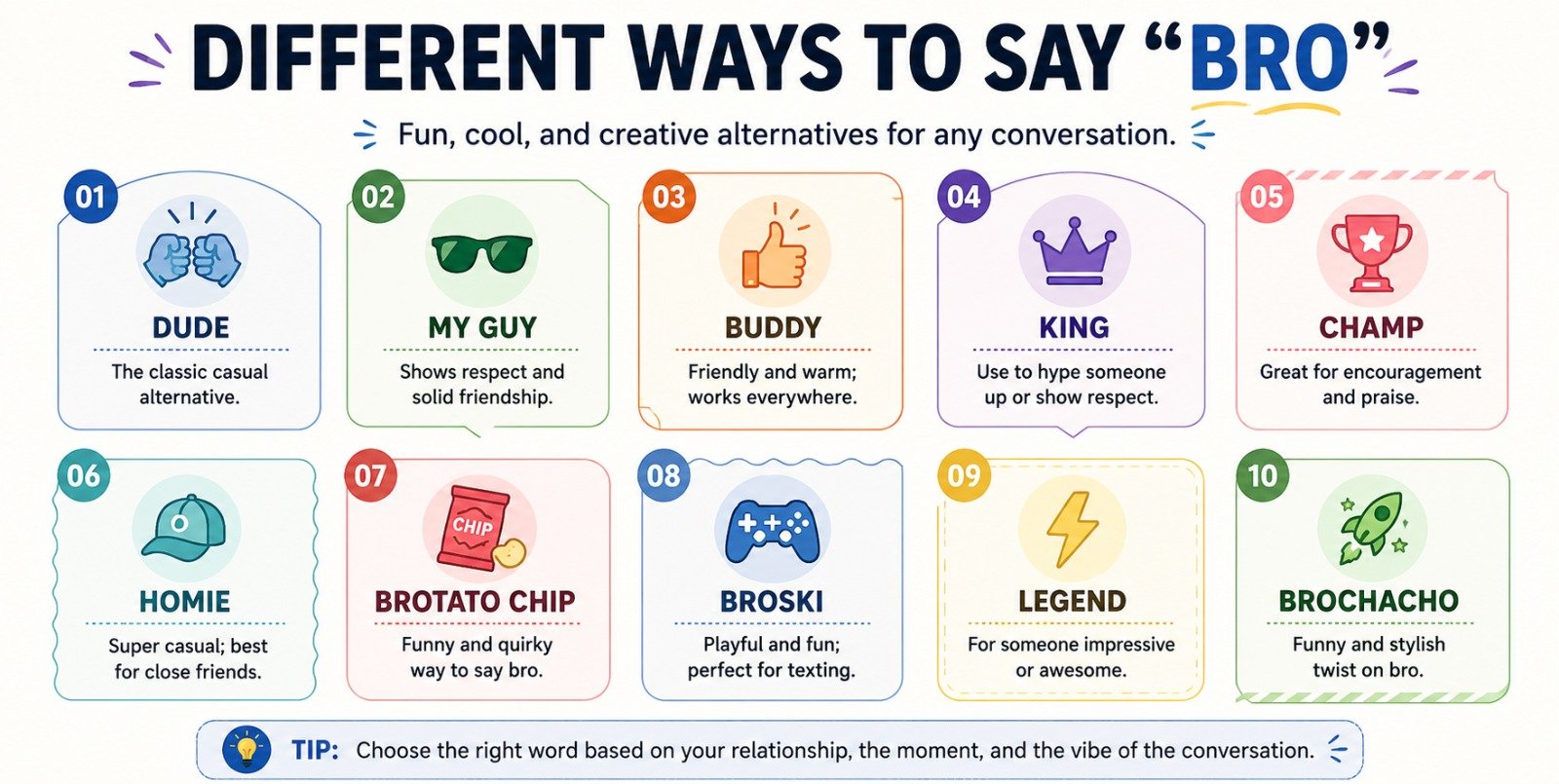
Different Ways to Say “Bro” at a Glance
Not every alternative carries the same feeling. Some work in almost any relaxed conversation, while others make sense mainly between close friends or as jokes.
| Expression | Tone | Best Used For |
|---|---|---|
| Dude | Relaxed | Everyday conversations |
| Buddy | Friendly | Friends and acquaintances |
| Mate | Casual | British, Australian, and friendly informal speech |
| Man | Conversational | Friends, reactions, encouragement |
| My Guy | Modern, friendly | Friends and casual greetings |
| Brother | Warm, sincere | Close friendships and support |
| Homie | Very casual | Close friends |
| Fam | Familiar | Close social circles and texting |
| Bruh | Reaction-based | Surprise, disbelief, annoyance |
| Broski | Playful | Texting, gaming, close friends |
| Broseph | Funny | Joking with friends |
| Brochacho | Silly | Inside jokes and playful conversations |
| Brotato Chip | Absurdly funny | Memes and joking texts |
| King | Encouraging | Praise and support |
| Legend | Complimentary | Thanking or praising someone |
Also Read | Different Ways to Say Yes: 80+ Natural, Funny, Fancy & Creative Alternatives
Everyday Alternatives to “Bro”
Some substitutions sound natural enough to use regularly without making the conversation feel forced.
Other Ways to Say “Bro” Casually
Dude
“Dude” is probably one of the closest everyday alternatives. It can express friendship, excitement, surprise, or even disbelief.
Example:
“Dude, you have to see this.”
Buddy
“Buddy” sounds friendly without being heavily slang-based. It works well with friends and people you know casually.
Example:
“Thanks for helping me move, buddy.”
Be aware that tone matters. A sharp “Listen, buddy” can sound confrontational rather than friendly.
Man
“Man” is especially natural when encouraging someone or reacting emotionally.
Example:
“Come on, man. You’ve got this.”
Pal
“Pal” has a slightly more traditional feel than “bro,” but it still works for friendly informal conversations.
Example:
“Good to see you again, pal.”
Like “buddy,” it can sound sarcastic when delivered with the wrong tone.
Mate
“Mate” is particularly natural in varieties of English where it is commonly used as an everyday form of friendly address.
Example:
“Nice one, mate.”
It may sound less natural if you deliberately adopt it in a friend group where nobody normally talks that way.
Other Ways to Say “Bro” to a Close Friend
For someone you’re genuinely close to, you can use words that suggest a stronger personal bond.
Brother
Using “brother” instead of “bro” feels more sincere and emotionally meaningful.
Example:
“I’ll always have your back, brother.”
It can also carry family, community, cultural, or religious associations depending on the speaker and situation.
My Guy
“My guy” is relaxed and upbeat.
Example:
“My guy! Where have you been?”
It works especially well as an enthusiastic greeting.
My Man
“My man” can express approval, affection, or excitement.
Example:
“You remembered the tickets. My man!”
Homie
“Homie” suggests familiarity and a close social connection.
Example:
“What’s good, homie?”
Because it has stronger slang associations than “buddy” or “dude,” it sounds most natural when it already fits your usual way of speaking.
Fam
“Fam” comes from “family,” but in casual slang it can also refer to close friends or members of your trusted social circle.
Example:
“Don’t worry, fam. I’ve got you.”
Cool Ways to Say “Bro”
Sometimes you want something with a little more personality than “buddy” or “pal.”
Other Ways to Say “Bro” That Sound Cool
G
A short, very informal form of address that can signal respect or familiarity.
Example:
“Appreciate it, G.”
Chief
“Chief” can sound confident and playful.
Example:
“What’s the plan, chief?”
It can also sound sarcastic, so delivery makes a difference.
Boss
Friends sometimes use “boss” as a playful sign of respect.
Example:
“You got it, boss.”
This is not a literal claim that the other person is your supervisor.
Ace
“Ace” can work as a friendly nickname, particularly when praising somebody competent.
Example:
“Nice job, ace.”
King
“King” is often used as an encouraging or complimentary form of address.
Example:
“Keep your head up, king.”
It has a noticeably more supportive tone than plain “bro.”
Legend
Calling someone a “legend” usually praises them rather than simply identifying them as a friend.
Example:
“You brought coffee for everyone? You’re a legend.”
That makes it useful in certain “bro” situations, but it is not a direct substitute in every sentence.
Funny Ways to Say “Bro”
Humorous variations are where the word really gets creative. Instead of replacing “bro,” these expressions stretch it into deliberately silly nicknames.
Other Ways to Say “Bro” for a Laugh
Try:
- Broski
- Broseph
- Broham
- Brochacho
- Brotato
- Brotato Chip
- Broseidon
- Brozilla
- Brofessor
- Brohemian
- Brohemian Rhapsody
- Brotein Shake
- Bro Montana
- Brobi-Wan Kenobi
- Brodo Baggins
- Broba Fett
- Sherlock Bromes
Most of these are humorous wordplay rather than ordinary synonyms. You probably wouldn’t introduce someone as your “Broseidon” in a serious setting. Between friends, though, their exaggerated silliness is the whole point.
Funny Ways to Say Bro Like “Brotato Chip”
“Brotato Chip” works because it takes the already silly “Brotato” and pushes the joke even further.
Here are similar ideas:
Brotato
“Brotato, are we ordering pizza or what?”
Brotato Chip
“Brotato Chip, explain what happened to my controller.”
Brotein Shake
A particularly fitting joke for a gym-loving friend.
“Looking huge today, Brotein Shake.”
Broccoli
An intentionally ridiculous food-related nickname.
“What’s happening, Broccoli?”
Broissant
A playful combination of “bro” and “croissant.”
“Good morning, Broissant.”
Burritbro
A deliberately absurd food pun that works as an inside joke.
“Where are we eating, Burritbro?”
These aren’t established substitutes you need to memorize. The fun comes from inventing your own “bro” combinations.
Funny Ways to Say Bro Like “Brochacho”
“Brochacho” has a different kind of comic effect. It sounds exaggerated, cheerful, and knowingly ridiculous.
Other Ways to Say “Bro” Like Brochacho
Broseph
“Broseph, what did you just do?”
A playful expansion of “bro” that sounds deliberately overdramatic.
Broski
“Broski, we’re leaving in five minutes.”
This one is playful but still natural enough to appear regularly in texts and gaming conversations.
Broham
“Easy there, Broham.”
It has the feel of an invented friendly nickname rather than an ordinary synonym.
Broseidon
“Calm down, Broseidon.”
A joke built around Poseidon that works particularly well when someone is acting dramatic or powerful.
Brofessor
“All right, Brofessor, explain your theory.”
Perfect for the friend who always has an explanation.
Brozilla
“Brozilla has entered the group chat.”
Good for joking about someone who is being loud, intense, or dramatic.
The more unusual these expressions become, the more important your relationship with the other person is. A close friend may find “Brochacho” hilarious; a stranger may simply find it confusing.
Creative Ways to Say “Bro”
You don’t have to build every nickname around the letters “bro.” Another approach is choosing an expression that reflects your relationship or the other person’s personality.
Other Ways to Say “Bro” Creatively
Captain
Use this jokingly for the person who always takes charge.
“Where are we headed, captain?”
Champ
Works naturally when encouraging or congratulating someone.
“You handled that perfectly, champ.”
Partner
Useful when you and the other person regularly do something together.
“Ready to go, partner?”
Amigo
A recognizable Spanish word meaning “friend” that English speakers sometimes use playfully in casual conversation.
“See you tomorrow, amigo.”
Home Slice
A deliberately playful slang expression for a friend.
“What’s up, home slice?”
Homeskillet
Even sillier than “home slice,” making it useful when humor is the goal.
“Looking good, homeskillet.”
Big Man
Can be friendly, teasing, respectful, or sarcastic depending on delivery.
“What are you having, big man?”
Hero
This works best when someone has helped you.
“You fixed my laptop? You’re a hero.”
Again, “hero” is not a direct synonym for “bro.” It replaces it naturally only when praise is part of the message.
Fun Ways to Say “Bro” in Text Messages
Texts and group chats give you much more freedom to exaggerate slang because the relationship and conversation are usually informal.
Other Ways to Say “Bro” in a Text
Instead of:
“Bro, look at this.”
You could write:
“Bruh, look at this.”
“Dude, look at this.”
“Broski, you need to see this.”
“My guy, explain this.”
“Fam, what is happening?”
“Brochacho, we have a problem.”
“Brotato Chip, answer your phone.”
For a normal message, “dude,” “my guy,” or “broski” will usually feel more natural. “Brochacho” and “Brotato Chip” deliberately turn the message into a joke.
Different Ways to Say “Bro” in Memes
Meme language often relies on exaggeration, absurdity, or deliberately over-serious wording.
Useful meme-style forms include:
- Bruh
- Broski
- Broseph
- Brochacho
- Brotato
- Bro really…
- My guy
- My brother
- My brother in Christ
- Bro thought…
- Bro said…
For example:
“Bro really thought nobody would notice.”
“Bruh, what am I looking at?”
“Broski made one mistake and deleted the whole project.”
“My brother in Christ, you chose the password.”
Some expressions, especially “my brother in Christ,” carry religious wording even when used as a meme. Consider your audience before using them casually.
“Bro” vs. “Bruh”: They Aren’t Always Interchangeable
“Bruh” is closely related to “bro,” but modern conversational use often gives it another function.
“Bro” commonly addresses someone directly:
“Bro, can you help me with this?”
“Bruh” frequently works as a reaction:
“Bruh… you deleted the file?”
It can communicate disbelief, annoyance, disappointment, or amusement all by itself.
That means replacing “bruh” with “buddy” may change the entire feeling:
“Bruh…” expresses a reaction.
“Buddy…” sounds like you’re addressing someone.
This is exactly why lists of alternatives should be treated as context-dependent rather than as perfectly interchangeable synonyms.
Not Every Alternative to “Bro” Means the Same Thing
The word “bro” can perform several jobs in conversation. It can identify a friend, get someone’s attention, express affection, show solidarity, or react to something unbelievable.
Different alternatives preserve different parts of that meaning.
Consider:
“You got this, bro.”
“You got this, champ” works because the sentence is encouraging.
“Bro, what did you do?”
“Bruh, what did you do?” works because disbelief is involved.
“Thanks, bro.”
“Thanks, legend” works if you’re praising the person.
“He’s my bro.”
“He’s my legend” does not communicate the same relationship.
Similarly:
- Brother can sound deeper and more sincere than bro.
- Buddy can sound friendlier but less slang-heavy.
- Mate may reflect regional speech.
- Bruh can function more like a reaction.
- King adds praise or encouragement.
- Brochacho adds obvious humor.
- Colleague describes a workplace relationship rather than closeness.
The right replacement depends on what “bro” is doing in the original sentence.
What Can You Say Instead of “Bro” at Work?
In genuinely professional communication, you usually don’t need another nickname.
Instead of:
“Bro, could you send the updated file?”
Write:
“Could you send the updated file?”
Or address the person by name.
With coworkers you know well, informal expressions may be completely normal in private conversation, but they can sound out of place in client emails, formal meetings, applications, or messages to senior colleagues.
Words such as colleague, teammate, and partner describe particular relationships, but they are not formal synonyms for “bro.”
For example:
“David is my colleague.”
does not mean the same thing as:
“David is my bro.”
The first describes a professional connection. The second suggests personal familiarity.
Can You Call a Woman “Bro”?
In some friend groups, yes.
Words such as “bro,” “dude,” and “bruh” are sometimes used casually without strict reference to gender. However, that doesn’t mean everyone likes being addressed that way.
Your relationship matters more than any supposed universal rule. If someone regularly uses “bro” with you, responding the same way may feel completely natural. If you don’t know the person well, their name or another neutral form of address is safer.
How to Choose the Right Way to Say “Bro”
Think about what you actually want your wording to communicate.
For a simple everyday friend, try:
Dude, buddy, mate, pal, man
For a close friendship, try:
Brother, my guy, my man, homie, fam
For an online or youthful casual tone, try:
Bruh, broski, fam, my guy
For encouragement or praise, try:
King, champ, legend, ace
For obvious humor, try:
Broseph, Brochacho, Brotato Chip, Broseidon, Brofessor
For a professional situation, skip the nickname and use the person’s name or wording appropriate to the actual relationship.
The most natural choice is usually the one that already sounds believable coming from you.
Frequently Asked Questions
What are the best other ways to say “bro”?
Dude, buddy, mate, man, my guy, brother, homie, fam, my man, and pal are among the easiest alternatives to use naturally. The best choice depends on how close you are to the person and how casual you want to sound.
What are some funny ways to say “bro”?
Funny options include Broseph, Broski, Brochacho, Brotato, Brotato Chip, Broseidon, Brozilla, Brofessor, Broham, and Brotein Shake. These are better treated as jokes or nicknames than standard synonyms.
What is another funny word like “Brotato Chip”?
Try Broccoli, Broissant, Brotein Shake, Broseidon, Brofessor, or invent your own combination. The humor comes from attaching “bro” to an unexpected word or name.
What are funny ways to say “bro” like “Brochacho”?
Broseph, Broski, Broham, Broseidon, Brozilla, and Brofessor have a similar exaggerated feel. “Broski” sounds relatively normal in casual speech, while the others are more obviously comedic.
Is “bruh” the same as “bro”?
Not exactly. Both are closely related, but “bruh” is commonly used as a reaction to something surprising, annoying, awkward, or unbelievable. “Bro” more often functions as a direct friendly form of address.
What is a cool alternative to “bro”?
“My guy,” “homie,” “fam,” “G,” “my man,” and “dude” can all create a relaxed, confident tone. Which one sounds coolest depends heavily on your own speech style and social group.
What should I call my best friend instead of “bro”?
For a close friend, you could use “brother,” “my guy,” “my man,” “homie,” or a personal nickname. “Brother” usually carries more emotional weight, while “my guy” and “homie” stay relaxed.
Can “bro” be used sarcastically?
Yes. Tone can completely change it. “Nice one, bro” could express genuine praise or obvious sarcasm depending on delivery and context. The same applies to alternatives such as “buddy,” “chief,” and “boss.”
Conclusion
There isn’t one perfect substitute for “bro.” Dude and buddy work well for ordinary casual conversation, brother adds warmth, bruh works particularly well for reactions, and king or legend can add encouragement and praise. If the conversation is intentionally silly, expressions like Brochacho, Broseph, Broseidon, and Brotato Chip give you much more room to play.
The best choice ultimately comes down to context, audience, tone, relationship, and formality. A nickname that sounds hilarious between lifelong friends could sound awkward with someone you’ve just met, while professional situations may not need a substitute at all. Clarifyra helps make those small differences in everyday language clearer, so you can choose wording that actually fits the person and the moment.
You May Also Read | Different Ways to Say Yes: 80+ Natural, Funny, Fancy & Creative Alternatives