Weave Meaning: Definition, Examples and How to Use It
To weave is, at its simplest, to make cloth by crossing threads over and under each other — but the word rarely stops at the loom. We weave stories out of scattered facts, weave our way through crowds and traffic, and describe ideas as woven into the fabric of our lives. Few English verbs travel so far from their literal starting point while keeping the same picture in view: separate strands, crossed and locked together, becoming something stronger than any one thread alone.
That journey also makes weave a verb with a split personality in its past tense. Is it wove or weaved? Is the finished cloth woven or weaved? The dictionaries give a clear answer, but it differs between British and American English — and getting it wrong is one of the most common slips with this word.
What the Dictionaries Say About “Weave”
| Dictionary | Definition of weave |
|---|---|
| Cambridge Advanced Learner’s Dictionary | “To twist long objects together, or to make something by doing this” — and, figuratively, “to form something from several different things or to combine several different things, in a complicated or skilled way.” |
| Cambridge Academic Content Dictionary | Verb (MAKE CLOTH): to make cloth by interlacing threads; verb (MOVE): to move in a winding course; noun: “the way in which cloth has been woven.” |
| Dictionary.com | “To interlace (threads, yarns, strips, fibrous material, etc.) so as to form a fabric or material“; “to form by combining various elements or details into a connected whole”; “to direct or move along in a winding or zigzag course.” |
Three pictures run through every definition: the craft (threads crossing on a loom), the combination (separate elements joined into a whole), and the movement (a path that bends from side to side). Keep those three pictures in mind and almost every use of weave falls into place.
How to Pronounce “Weave”: UK and US
Here the two varieties of English agree. Cambridge gives UK /wiːv/ and US /wiːv/, and Dictionary.com gives American [weev] and British /wiːv/ — in plain terms, it rhymes with leave and believe. The spelling is the only trap: the ea sounds like “ee”, never like the ea in bread.
- UK: /wiːv/ — weev
- US: /wiːv/ — weev
The related forms follow the same vowel: weaving /ˈwiː.vɪŋ/, wove (UK /wəʊv/, US /woʊv/), woven (US /ˈwoʊ.vən/). Note the vowel change in the past forms — wove rhymes with stove, not with weave.
Wove or Weaved? Woven or Weaved?
This is where British and American usage genuinely split, and Cambridge records the split explicitly: the past tense is wove, or in the US also weaved; the past participle is woven, or in the US also weaved. In practice:
| Form | Standard everywhere | Also accepted (mainly US) |
|---|---|---|
| Past tense | wove — “She wove the scarf by hand.” | weaved — “She weaved through traffic.” |
| Past participle | woven — “a tightly woven fabric” | weaved — less common, mostly for the movement sense |
Two working rules will keep you safe. First, for cloth, always prefer wove/woven: “woven cotton”, “hand-woven baskets”. Second, for the movement sense — dodging through traffic or a crowd — both wove and weaved appear, and weaved is especially common in American writing (“He weaved in and out of the cars”). What sounds wrong is mixing the two jobs: “a weaved basket” reads as unidiomatic to most readers, and “she wove through traffic” is fine but slightly more formal than “weaved”.
The Three Main Senses of “Weave”
1. Making cloth (the literal sense)
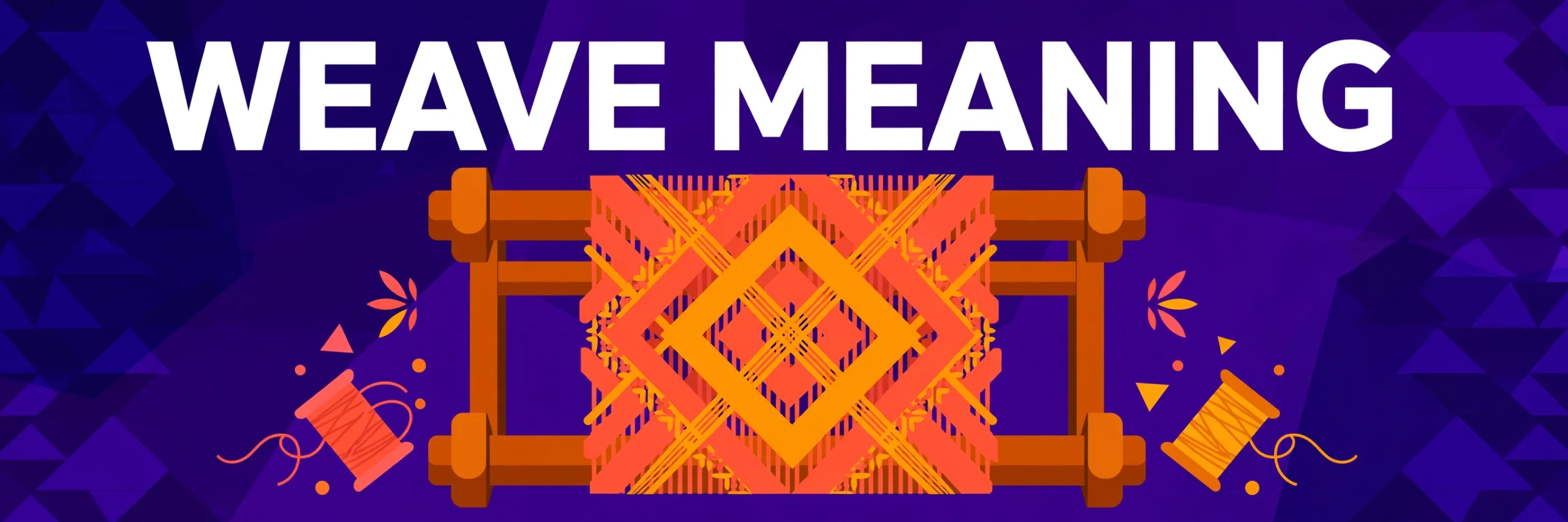
This is the original and still the central meaning: to form fabric by passing threads over and under each other, usually on a loom. The threads running lengthwise are the warp; the thread passed across them is the weft. Different ways of crossing them produce different weaves — plain weave, twill weave, satin weave — which is where the noun sense comes from: the weave of a fabric is its structure, the pattern made by its interlaced threads. A “loose weave” lets light through; a “tight weave” keeps wind out.
The craft sense extends naturally to anything made by the same crossing action: baskets woven from reeds, chair seats woven from cane, hair woven into braids. Cambridge also records a modern noun sense for hair: a weave can mean lengths of human or artificial hair woven or sewn into a person’s own hair to add length or fullness.
2. Combining elements into a whole (the figurative sense)
From cloth-making comes the most productive figurative use: to weave things together is to combine separate elements — facts, themes, characters, memories — into a single connected whole, skilfully. A novelist weaves plot threads together; a speaker weaves anecdotes into an argument; a good essay weaves evidence into its reasoning. Cambridge marks this sense as literary when the object is abstract, but in practice it is everyday English: “She wove her own experience into the talk.”
The fixed phrases matter here. To weave something into a story, speech, or design means to introduce it as one element of the whole. To be woven into the fabric of something — a city, a family, a life — means to be so deeply part of it that it cannot be separated out. Both phrases borrow the cloth image directly: the element is a thread, and the whole is the fabric.
3. Moving in a winding course (the movement sense)
To weave through a crowd, through traffic, or between trees is to move forward by constantly changing direction, dodging obstacles as you go. A cyclist weaves between parked cars; a skier weaves down the slope; a drunk person is said to weave along the pavement (a less kind use of the same picture). The related phrasal sense appears in sport and driving: to weave in and out of something is to alternate between passing through it and going around it.
Examples of “Weave” in Sentences
- Artisans in the village still weave their own cloth on wooden looms.
- She wove the willow branches into a basket while we talked.
- The author weaves three separate storylines into a single gripping narrative.
- He managed to weave a joke about the weather into an otherwise solemn speech.
- The cyclist weaved in and out of the slow-moving traffic.
- These traditions are woven into the fabric of daily life here.
- That shirt is a loose weave — perfect for hot weather, useless against the wind.
- She got a new weave fitted before the wedding.
Correct vs Incorrect: “Weave” in Use
| Correct | Incorrect / unidiomatic | Why |
|---|---|---|
| “She wove the rug herself.” | “She weaved the rug herself.” (in British English) | For cloth, wove is the standard past tense; weaved for cloth reads as American or non-standard in the UK. |
| “a tightly woven fabric” | “a tightly weaved fabric” | Woven is the established past participle for the cloth sense on both sides of the Atlantic. |
| “He weaved through the crowd.” (US) | “He wove through the crowd.” — also correct, just more formal | Both occur for the movement sense; weaved is the more common American choice here. |
| “She weaves humour into her lectures.” | “She weaves humour onto her lectures.” | The collocation is weave into, not onto — the element becomes part of the whole. |
| “The plot threads are woven together.” | “The plot threads are weaved together.” | For the figurative “combined into a whole” sense, woven is the idiomatic participle. |
Common Mistakes with “Weave”
- Using weaved for cloth. “Hand-weaved baskets” is the single most frequent error; “hand-woven” is the idiomatic form.
- Pronouncing it to rhyme with bread. It is weev, rhyming with leave.
- Confusing weave with wave. They sound similar in fast speech but are unrelated: you wave a hand; you weave cloth (or your way through a crowd).
- Forgetting the noun sense. “What weave is that shirt?” — asking about the fabric’s structure — is a perfectly normal question in sewing and textile contexts.
- Overusing the figurative sense. “Weaving” elements into everything quickly becomes a cliché in business writing. If you mean simply “including” or “adding”, say so.
FAQs About “Weave”
What is the past tense of weave?
Wove — “She wove the blanket last winter.” In American English, weaved is also accepted, especially for the movement sense (“He weaved through traffic”). For cloth, wove is standard everywhere.
What is the past participle of weave?
Woven — “a finely woven silk”. In American English, weaved is also recorded as a past participle, but woven remains the idiomatic choice for fabric and for the figurative “combined” sense.
What does “weave” mean as a noun?
Two main things: the pattern or structure of woven cloth (“a loose weave”, “a twill weave”), and, in modern US usage, hair extensions woven or sewn into a person’s hair.
What does “weave through traffic” mean?
To drive, cycle, or walk through traffic by constantly changing lanes or direction to pass slower vehicles or obstacles — moving in a winding, zigzag course rather than a straight line.
Is “weave” related to “web”?
Yes. Both come from Old English wefan (to weave), and a spider’s web is, in origin, something woven. The shared root is why “web” still carries the sense of an interlaced structure.
Takeaway
Weave starts at the loom and ends up everywhere: cloth woven from thread, stories woven from facts, paths woven through crowds. Say it weev, remember wove and woven for cloth (with weaved as the American alternative, especially for movement), and keep the cloth picture in mind — separate strands, crossed and locked together into something stronger than any one of them alone.
Source for the dictionary senses quoted above: Cambridge Dictionary’s entry for “weave”.