Leech Meaning: Definition, Examples and How to Use It
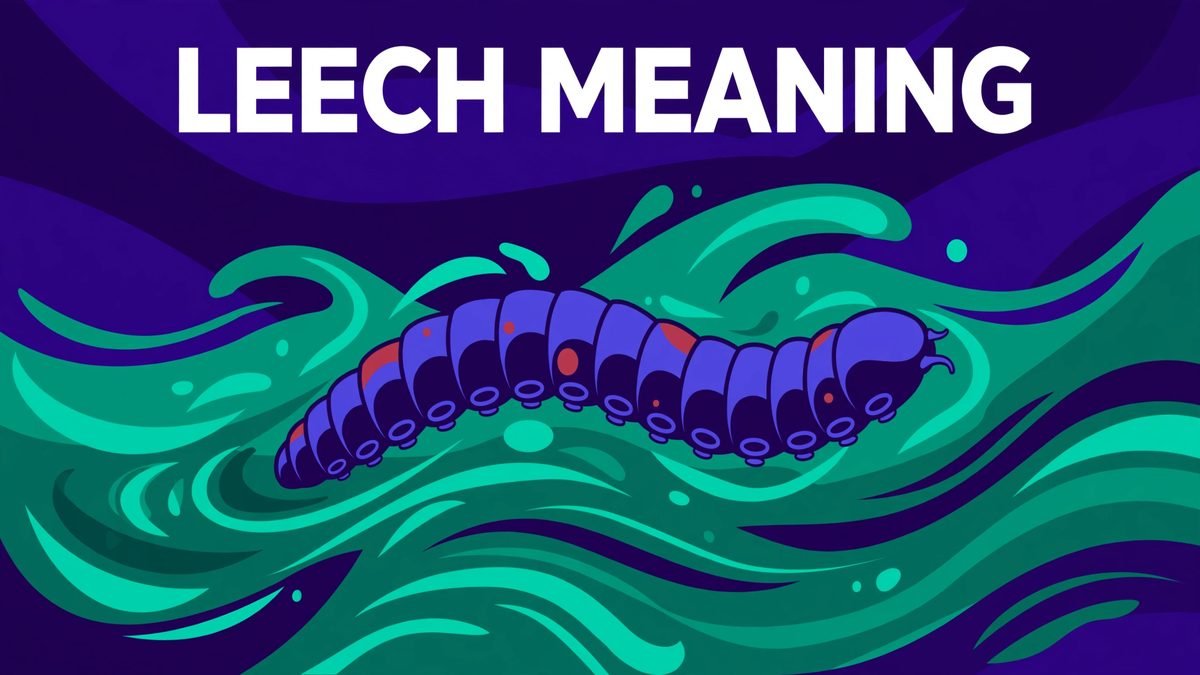
Leech is a word with two lives. In its first life, it is a small worm-like animal that lives in water and feeds by attaching itself to other animals and sucking their blood (Collins). In its second life, it is a person — and not a compliment: Collins marks this sense [disapproval], defining it as someone who “deliberately depend[s] on other people, often making money out of them.” The same creature that drains blood gives English its perfect metaphor for someone who drains resources.
The word is also a spelling trap. Leech (the worm, the person) sounds exactly like leach (a verb about liquids filtering through soil) — and spell-checkers will happily let you use the wrong one. Add in the word’s long medical history and its starring role in classic literature, and leech turns out to be far more interesting than its unpleasant reputation suggests. Every claim below was checked against the dictionaries first.
What Does “Leech” Mean? The Dictionary Definitions
Collins gives the two senses plainly, and Random House adds the scientific precision:
| Dictionary | Definition of leech |
|---|---|
| Collins (sense 1) | “A leech is a small animal which looks like a worm and lives in water. Leeches feed by attaching themselves to other animals and sucking their blood.” |
| Collins (sense 2) | “If you describe someone as a leech, you disapprove of them because they deliberately depend on other people, often making money out of them.” [disapproval] |
| Random House | “Any bloodsucking annelid worm of the class Hirudinea, as the European Hirudo medicinalis, once used widely for bloodletting.” / “A person who clings to another for personal gain, esp. without giving anything in return; parasite.” |
Two things to notice. First, the animal sense is the primary meaning — the human sense is a metaphor built on it, and dictionaries list the worm first. Second, the human sense is explicitly marked disapproval by Collins: calling someone a leech is an insult, not a neutral description. It accuses them of deliberate exploitation — taking without giving back.
How to Pronounce “Leech”: UK and US
Good news: there is no difference. Collins transcribes both British and American as /liːtʃ/ — leech, rhyming with beach, peach, and teach. One syllable, long “ee” sound, ending in the “ch” of church. The trouble is not pronunciation but spelling, because the identical-sounding leach is a different word entirely — see the homophone warning below.
Sense 1: The Animal
Leeches are segmented worms (annelids, the same large group as earthworms), most of them aquatic. Random House specifies the class Hirudinea and names the most famous species, the European medicinal leech, Hirudo medicinalis. They feed with suckers at each end of the body, attaching to a host and drawing blood — painlessly, as it happens, because their saliva contains a natural anaesthetic along with an anticoagulant that keeps the blood flowing.
Not all leeches drink blood, by the way — some are predators of small invertebrates — but the blood-feeding habit is what made the word famous, and it is the only habit the dictionaries bother to record. The word itself is ancient: Random House traces it to before 900 AD, from Middle English leche and Old English lǣce.
The medical history: leeches as doctors’ tools
Random House’s definition includes a striking detail: the medicinal leech was “once used widely for bloodletting.” For centuries, doctors believed that draining “bad blood” could cure everything from headaches to fevers, and leeches were the instrument of choice — gentler and more controllable than opening a vein. Demand was so enormous in the 19th century that wild leech populations in parts of Europe were harvested nearly to exhaustion.
Modern medicine has not entirely abandoned the leech. Medicinal leeches are still used in reconstructive and plastic surgery, where their talent for drawing blood helps relieve congestion in reattached tissue — a finger sewn back on, for example, can swell with blood that has no vein to drain through, and a leech provides the drainage while new vessels form. In the United States, the FDA cleared medicinal leeches as a medical device in 2004. From ancient remedy to surgical assistant: the leech’s medical career spans millennia.
A literary leech
Readers of classic literature may know the word’s most famous figurative use: in Nathaniel Hawthorne’s The Scarlet Letter (1850), two consecutive chapters are titled “The Leech” and “The Leech and His Patient.” The “leech” is Roger Chillingworth — and Hawthorne means it in both senses at once. Chillingworth is literally a physician (an archaic meaning of leech was “doctor” or “healer” — Random House still lists it), and figuratively he attaches himself to the Reverend Dimmesdale, draining him psychologically in pursuit of revenge. It is the dictionary’s two senses, weaponised as a chapter title.
Sense 2: The Person (Disapproving)
The figurative sense works because the metaphor is so exact: just as the worm attaches and takes blood without giving anything back, the human leech attaches to a generous host — a friend, a relative, an employer, a state — and takes money, favours, or effort without reciprocating. Collins’s definition stresses deliberateness: the leech chooses to depend on others.
The verb form extends the metaphor. Random House records to leech as a verb meaning “to cling to and feed upon or drain, as a leech does,” and modern usage has settled on the phrasal verb leech off (or leech onto):
- “He spent his twenties leeching off his parents.” (taking their money, giving nothing back)
- “The company was accused of leeching off government subsidies.” (Collins’s own example pattern)
- “She leeched onto him at the conference and wouldn’t leave.” (clinging for advantage)
- “Stop being such a leech — buy your own lunch for once.”
A usage caution: because Collins marks this sense [disapproval], deploying it against a real person is genuinely insulting — it accuses them of parasitism. It is common in journalism and politics (“welfare leeches,” “corporate leeches”), but in personal life it will end friendships. Use it about behaviour you want to condemn, and expect it to sting.
Leech vs. Leach: The Homophone Warning
This is the mistake the whole article has been building toward. Leech and leach are pronounced identically (/liːtʃ/) but are completely different words:
| Leech | Leach | |
|---|---|---|
| Part of speech | Noun (and verb) | Verb (mainly) |
| Meaning | Bloodsucking worm; exploitative person | To remove (or be removed) from a substance by a percolating liquid (Collins) |
| Example | “The hikers found leeches in the stream.” | “Heavy rain leached nutrients from the soil.” |
| Memory hook | Leech has a double e, like the two suckers on the worm | Leach has an a, like acid washing through soil |
Collins defines leach as a verb meaning “to remove or be removed from a substance by a percolating liquid” — think fertiliser leaching into groundwater, or dye leaching out of fabric. Random House adds the metallurgical sense of dissolving metals out of ore. None of this has anything to do with worms. Because spell-checkers accept both spellings as valid words, no software will catch the mix-up — “the chemicals leeched into the river” will sail through every checker unflagged, and it is wrong. This is one of those errors you have to catch with your own eyes.
Common Mistakes with “Leech”
| Incorrect | Correct | Why |
|---|---|---|
| “Toxins leeched into the water.” | “Toxins leached into the water.” | Chemicals filtering through = leach; worms = leech |
| “He’s leaching off his brother.” | “He’s leeching off his brother.” | A person exploiting another is a leech — with the double e |
| “a leach in the pond” | “a leech in the pond” | The animal is always spelled leech |
| “Don’t be a leach.” | “Don’t be a leech.” | The insult follows the animal’s spelling |
Leech in Sentences: Real Examples
- “Leeches feed by attaching themselves to other animals and sucking their blood.” (the dictionary’s core image)
- “After the hike through the marsh, we checked our boots for leeches.”
- “Surgeons sometimes use medicinal leeches to reduce swelling in reattached tissue.”
- “His so-called friends were just leeches, appearing whenever he was buying.”
- “The startup was accused of leeching off open-source work without contributing anything back.”
- “Chillingworth, the ‘leech’ of The Scarlet Letter, drains Dimmesdale’s spirit as surely as any worm draws blood.”
FAQs About “Leech”
What is the plural of leech?
Leeches — regular plural, just add -es. (“The pond was full of leeches.”) The verb conjugates regularly too: leech, leeched, leeching (Collins).
Are leeches dangerous to humans?
Most leeches are harmless — the bite is painless and the blood loss trivial. The real risks are infection from scratching the wound, or, in tropical regions, heavy infestations. If you find one attached, do not yank it off (that can leave mouthparts embedded); the standard advice is to use a fingernail to break the suction at the narrower end, then clean the wound.
What is the difference between a leech and a bloodsucker?
Bloodsucker is the broader term — it covers mosquitoes, ticks, vampire bats, and leeches alike. A leech is specifically the segmented worm. Figuratively, the two are near-synonyms for an exploitative person, though leech is the more common insult.
Why are leeches still used in medicine?
Because they are extraordinarily good at one narrow job: relieving venous congestion — blood that pools in tissue with no way out. In reconstructive surgery, a medicinal leech drains the pooled blood while the patient’s own vessels reconnect, and its saliva keeps the blood flowing. It is one of the oldest medical tools still in use.
Is “leech” an insult?
When applied to a person, yes — Collins explicitly marks the sense [disapproval]. It accuses someone of deliberately living off others without contributing. It is milder than many insults (it appears in newspapers, not just arguments), but directed at an individual it is meant to wound.
How do you remember leech vs. leach?
Leech (double e) is the worm and the person — think of the two es as the worm’s two suckers. Leach (with an a) is the verb about liquids washing through things — think acid, aquifer, or “washing away.” And remember: no spell-checker will save you, so proofread.
The Takeaway
Leech names two things: the bloodsucking worm (sense 1, the original) and the person who exploits others without giving back (sense 2, marked disapproval) — plus the verb to leech, “to cling to and drain.” Its medical history runs from ancient bloodletting to modern reconstructive surgery, and its literary peak is Hawthorne’s The Scarlet Letter. The one habit that matters most: keep it distinct from leach, the identical-sounding verb about liquids filtering through substances. Same sound, different spelling, different word — and your spell-checker will never tell you.