Pondering Meaning: Definition, Uses, and Examples
Pondering is thinking slowly and carefully — the kind of thinking you do when a decision matters and the answer is not obvious. Someone pondering a job offer is not daydreaming about it or worrying about it; they are weighing it up, turning it over in their mind, giving it the time it deserves.
The word is worth a careful look, because it is not quite what it seems. “Pondering” is not a headword in its own right in most dictionaries. It is the -ing form — the present participle — of the verb ponder, and the dictionaries send you there for the definition.
What Does “Pondering” Mean? The Dictionary Definitions
Cambridge’s entry for “pondering” is short and honest: it simply says “present participle of ponder”, and gives the definition under ponder — “to think carefully about something, especially for a noticeable length of time”. Oxford Learner’s defines the verb the same way, marking it formal. Merriam-Webster adds a useful second shade: as a transitive verb, to ponder is “to weigh in the mind: evaluate, appraise”.
| Dictionary | Definition (under ponder) |
|---|---|
| Cambridge | To think carefully about something, especially for a noticeable length of time. “She sat back for a minute to ponder her next move in the game.” (C2, formal) |
| Oxford Learner’s | To think about something carefully for a period of time. (Formal; intransitive or transitive) |
| Merriam-Webster | To think about; reflect on. To weigh in the mind; evaluate, appraise. Intransitive: to think or consider especially quietly, soberly, and deeply. |
| Collins | To think about something deeply and thoroughly; to meditate on it (often followed by over or upon). |
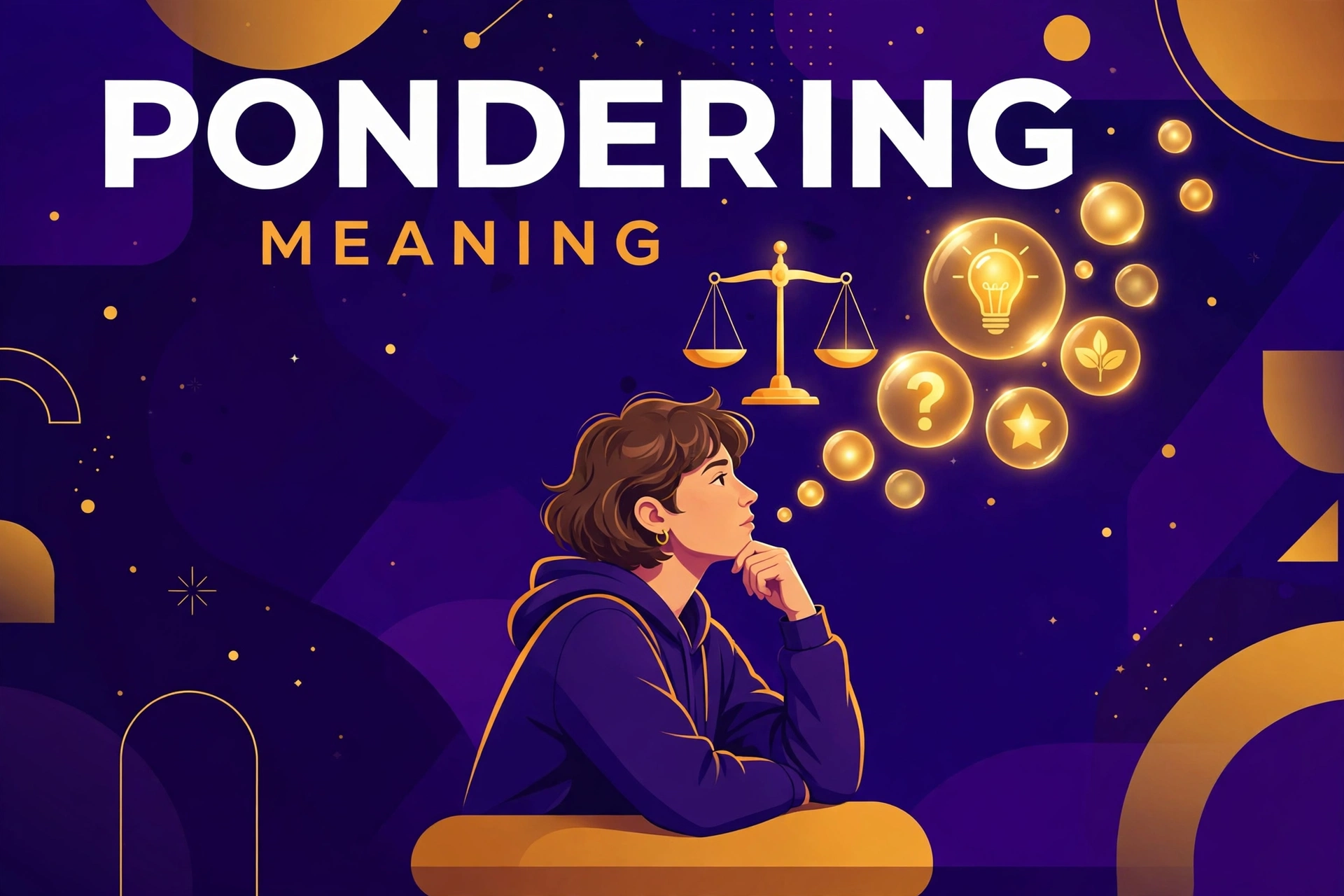
Three things in those definitions do the real work. First, carefully: pondering is deliberate, not casual. Second, for a noticeable length of time: pondering takes a while, or at least it is understood to. Third, weighing: the verb keeps its old sense of judging the worth of something, like weighing goods on a scale.
How to Pronounce “Pondering”: UK and US
The pronunciation follows the verb ponder with -ing added, and the two standards differ in the first vowel:
- UK: ponder /ˈpɒn.dər/, so pondering /ˈpɒn.dər.ɪŋ/ — PON-der-ing, with the short “o” of British hot.
- US: ponder /ˈpɑːn.dɚ/, so pondering /ˈpɑːn.dɚ.ɪŋ/ — PAHN-der-ing, with the broad “a” of American father.
The stress is always on the first syllable: PON-der-ing. A common slip is to stress the middle syllable — pon-DER-ing — which no dictionary records.
“Pondering” Is a Verb Form, Not a Separate Word
This is the point the article has to make plainly, because it shapes everything else. “Pondering” has no meaning apart from ponder. It is the present participle, and like all present participles it does several jobs:
- Continuous tenses: “She is pondering her next move.” “They were pondering the offer all week.”
- Participial phrases: “Pondering the map, he chose the northern route.” “After pondering them a bit, we might conclude they contradict one another.” (Cambridge’s own example sentences use the word exactly this way.)
- Gerund (a verb acting as a noun): “Pondering the offer took all week.”
- Adjective use: like many participles, pondering can modify a noun, though this is uncommon — you will occasionally meet “a pondering look”, meaning a thoughtful expression. No major dictionary gives it its own entry, so do not lean on it.
The noun ponder is a separate, colloquial development: “to have a ponder” means to have a period of deep thought, as in “Let me have a ponder and get back to you.” Wiktionary records this use as colloquial, and it is genuinely current in British English, though informal. The related noun for a person is ponderer — “one that ponders”, in Merriam-Webster’s words.
How to Use “Pondering”: The Patterns
Ponder is flexible about what follows it, and the patterns are where most mistakes happen:
| Pattern | Example |
|---|---|
| ponder + object | “He pondered his next move.” “She pondered the events of the day.” |
| ponder + question word | “He pondered what might have happened if he hadn’t gone home.” (Cambridge) |
| ponder on / over / upon + object | “She pondered on the situation.” “He pondered over the decision for days.” |
| ponder (alone) | “She pondered for a while, then came to a decision.” (WordReference) |
Two notes on those patterns. First, ponder over and ponder upon are the prepositions the dictionaries record; ponder about does appear in real usage, but it is less standard, and careful writers avoid it. Second, ponder takes a direct object without a preposition most of the time — “ponder the question”, not “ponder about the question”.
The Weighing Metaphor: Where “Ponder” Comes From
The etymology explains the meaning better than any definition. Ponder comes from Middle English ponderen, from Old French ponderer, “to weigh, poise”, and directly from Latin ponderare, “to weigh, ponder, consider, reflect” — literally “to weigh”, from pondus, “weight”. The mental meaning, “to judge a matter in the mind, weighing it carefully”, is recorded from the late fourteenth century.
The weighing root is still visible all over English. Pondus gives us pound (the unit of weight), ponderous (heavy, and so slow and dull), and imponderable (something that cannot be weighed — and so cannot be measured or evaluated), and, through the related Latin verb pendere, “to hang”, the whole family of pendant, pending, pension, and poise. When you say you are pondering something, you are saying, in the word’s own history, that you are holding it in the balance.
Pondering vs Consider, Contemplate, Meditate, Muse, and Ruminate
English has a whole shelf of verbs for serious thinking, and the dictionaries draw the lines between them with care. Cambridge’s own language blog groups ponder, meditate, muse, and ruminate together as formal words meaning “think seriously about a subject for a long time” — and then shows how they differ:
| Word | How it differs from ponder |
|---|---|
| Consider | The neutral, everyday choice. Considering can be quick; pondering is understood to take time. |
| Contemplate | Longer and more visual or imaginative; you contemplate a view, a future, or an idea as a whole. |
| Meditate | Deep, focused thought, often with a spiritual or disciplined practice behind it. |
| Muse | Dreamy, idle, drifting thought; musing is pondering without the pressure of a decision. |
| Ruminate | Thinking something over repeatedly, often anxiously; rumination goes round in circles where pondering moves towards a judgement. |
| Reflect | Looking back at what has already happened; pondering looks forward to what to do. |
Merriam-Webster makes the same point in one sentence: “ponder implies a careful weighing of a problem or, often, prolonged inconclusive thinking about a matter.” Pondering does not promise an answer. A person can ponder for days and still not decide — and the word is honest about that. It describes the weighing, not the verdict.
Pondering in Sentences: Examples
- “She sat back for a minute to ponder her next move in the game.” (Cambridge)
- “He pondered what might have happened if he hadn’t gone home.” (Cambridge)
- “The team pondered their chances of success.” (Merriam-Webster)
- “After pondering the offer for a week, she turned it down.”
- “He spent the walk home pondering whether to take the job abroad.”
- “Mary kept all these things, and pondered them in her heart.” (Luke 2:19 — the most famous use of the word in English, from the King James Bible.)
That last example deserves a note. The verse about Mary pondering things in her heart is probably the single most quoted sentence containing the word, and it fixes the word’s tone in English: quiet, inward, unhurried. Pondering is not thinking aloud, not arguing, not brainstorming. It is thinking in private, at length.
Common Mistakes and Confusions
“Pondering about” instead of “pondering”
The most frequent error with this word is adding a preposition it does not need. Ponder takes its object directly: “ponder the question”, “ponder her next move”. If you want a preposition, the standard ones are over, on, and upon — “ponder over the decision”. “Ponder about” appears in informal use, but it is the least standard of the patterns, and careful writing avoids it.
Pondering vs wondering
The two verbs sound alike and both involve not knowing something, but they describe different states. Wondering is curiosity: “I wonder what time it is.” Pondering is careful evaluation: “I am pondering whether to accept.” You wonder about facts; you ponder decisions. A person wondering is waiting for information; a person pondering already has the information and is weighing it.
Treating pondering as worrying
Pondering is not worrying, though the two can overlap. Worry is anxious and often unproductive; pondering is deliberate and evaluative. “She pondered the diagnosis” sounds measured and thoughtful, while “she worried about the diagnosis” sounds frightened. If anxiety is what you mean, say so; do not dress it up as pondering.
Using “pondering” as a fancy synonym for “thinking”
Ponder is formal and C2 level in Cambridge’s grading, which means it belongs to advanced, careful English. Using it for ordinary, quick thinking — “I pondered what to have for lunch” — sounds inflated, even comic. The word earns its place when the thinking is genuinely careful and prolonged: a decision, a problem, a question of some weight. For everything else, think or consider is the honest choice.
Frequently Asked Questions
What does pondering mean?
Thinking carefully about something, especially for a noticeable length of time — weighing it in the mind before deciding. “Pondering” is the -ing form of the verb ponder; it has no separate dictionary definition of its own.
Is pondering a word on its own?
Yes, but only as a form of ponder. Cambridge’s entry for “pondering” simply says “present participle of ponder” and sends you to the verb for the meaning. It works as a continuous tense (“she is pondering”), a gerund (“pondering took all week”), and in participial phrases (“pondering the map, he chose the northern route”).
What is the difference between pondering and thinking?
Pondering is a specific kind of thinking: careful, unhurried, and evaluative — weighing a matter in the mind, usually before a decision. Thinking is the general word and covers everything from idle daydreams to instant reactions. Pondering is also formal, while thinking is neutral.
How do you use pondering in a sentence?
As a continuous verb: “She is pondering her next move.” As a gerund: “Pondering the offer took all week.” In a participial phrase: “Pondering the map, he chose the northern route.” Remember that ponder usually takes its object directly — “ponder the question”, not “ponder about the question”.
What does “pondering” mean in the Bible?
In Luke 2:19, “Mary kept all these things, and pondered them in her heart” — she held the events quietly in her mind and thought deeply about their meaning. It is the word’s most famous use, and it captures its tone exactly: inward, unhurried, reflective thought.
Takeaway
Pondering is careful, unhurried thinking — weighing a matter in the mind, in the word’s own Latin image, like goods on a scale. It is the -ing form of the formal verb ponder, pronounced PON-der-ing, and it earns its place only when the thinking is genuinely deliberate: a decision, a problem, a question with weight. Use it for the slow work of judgement, not for everyday thought.
Sources: Cambridge Dictionary (pondering; ponder); Oxford Advanced Learner’s Dictionary (ponder); Merriam-Webster (ponder); Collins English Dictionary (ponder); Cambridge Dictionary blog, “Pondering, musing, and brooding (The language of thinking)”. Etymology per Merriam-Webster and the Oxford English Dictionary via Etymonline.