Intentionality Meaning: Definition, Examples and How to Use It
Intentionality Meaning: Definition, Examples and How to Use It
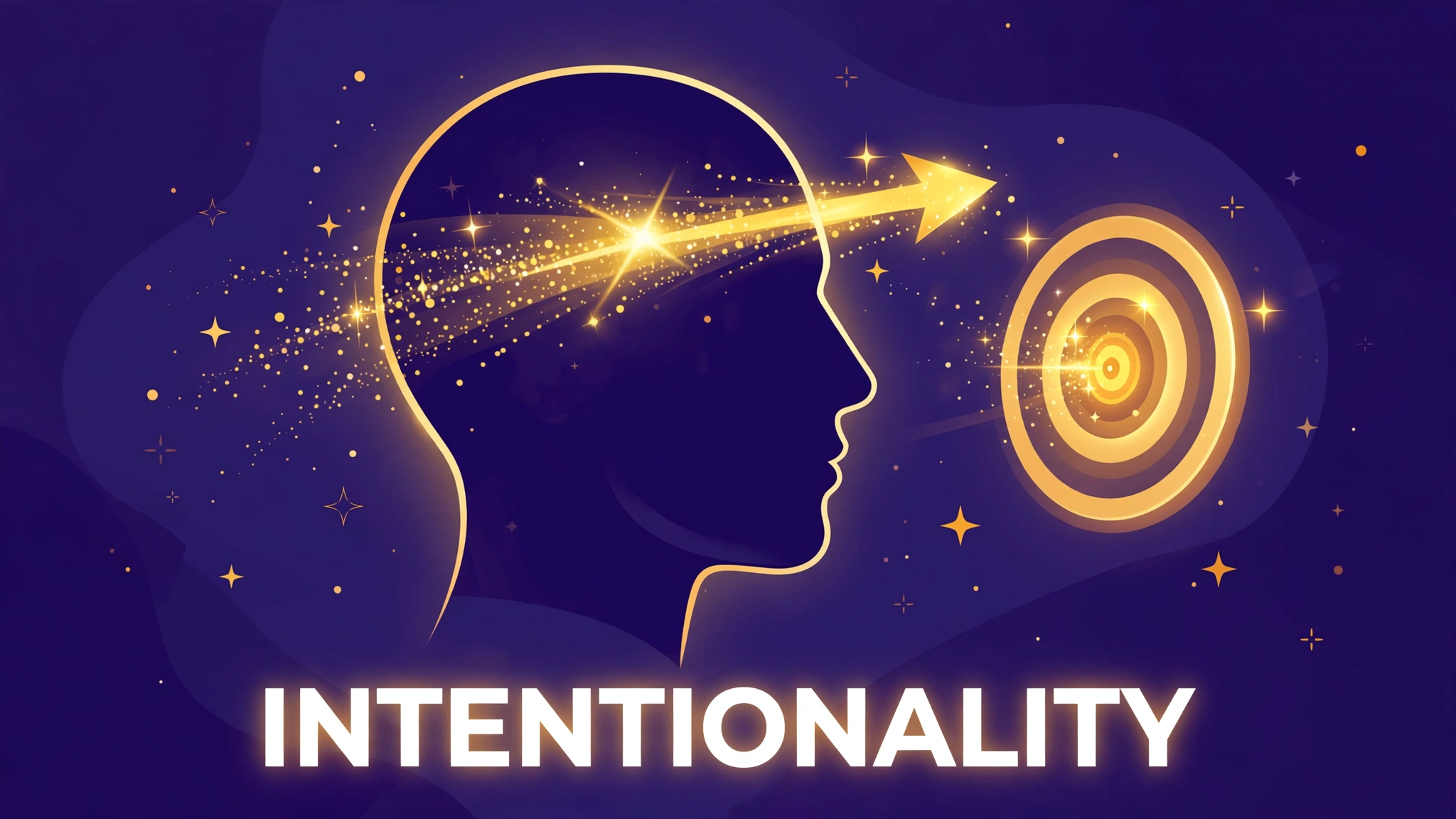
Some words live quiet lives in everyday speech and dramatic ones in the lecture hall. Intentionality is one of them. In ordinary conversation it means doing things on purpose — acting with deliberation rather than drifting. In philosophy it names something much deeper: the strange power of the mind to be about things, to point at the world the way an arrow points at a target. Both senses share one root idea — directedness — and that shared root is the key to using this long word well.
What the Dictionaries Say
The general dictionaries treat intentionality briefly, because much of its life is lived in philosophy. Collins lists it as a derived noun from intentional — (ɪnˈtɛnʃənəl), “done with intention or on purpose; intended: an intentional insult,” “of or relating to intention or purpose” — with the derived forms intentionality (inˌtentionˈality) and intentionally. Merriam-Webster gives the etymology as Medieval Latin intentionalitat-, intentionalitas, from intentionalis (“intentional”) + Latin -itat-, -itas (“-ity”), with the adjective intentional first known around 1677.
Dictionary-style definitions of the noun itself give two numbered senses: 1. “The state of having or being formed by an intention” — the everyday sense; 2. Philosophy. “The property of being about or directed toward a subject, as inherent in conscious states, beliefs, or creations of the mind, such as sentences or books” — the technical sense.
The Stanford Encyclopedia of Philosophy, the standard reference for the technical sense, opens its entry this way: “Intentionality is the power of minds to be about, to represent, or to stand for, things, properties and states of affairs. The word itself, which is of medieval Scholastic origin, was rehabilitated by the philosopher Franz Brentano towards the end of the nineteenth century.” And it adds a warning worth heeding: “in its philosophical usage, the meaning of the word ‘intentionality’ should not be confused with the ordinary meaning of the word ‘intention.'”
One honest note: Cambridge Dictionary does not yet carry a headword entry for intentionality — its own pages say the word “is not in the Cambridge Dictionary yet,” while showing corpus examples. Merriam-Webster and Collins do cover it: the word is still migrating from academic and business writing into general use.
How to Pronounce Intentionality (UK and US)
The pronunciation is the same in both varieties:
- UK: /ɪnˌtenʃəˈnælɪti/ — “in-ten-shuh-NAL-i-tee”
- US: /ɪnˌtenʃəˈnælɪti/ — “in-ten-shuh-NAL-i-tee”
Collins gives the derived noun as (inˌtentionˈality), and Cambridge’s entry for the related adverb intentionally — UK /ɪnˈten.ʃən.əl.i/, US /ɪnˈten.ʃən.əl.i/ — confirms the stress pattern. The main stress falls on NAL, with a secondary stress on TEN. Six syllables: in-ten-tion-al-i-ty. The common error is stressing “ten” hardest (“in-TEN-tion-AL-i-ty” with equal weight, or “in-ten-shun-AL-ity” with a hard “shun”) — keep the strongest beat on NAL and let the rest flow lightly.
Where the Word Comes From
Intentionality is a medieval word wearing modern clothes. The term was coined by the Scholastics — the philosophers of the Middle Ages — and derives from the Latin verb intendo, meaning “to point (at),” “to aim (at),” or “to extend (toward).” Through intendere came intentio, “a stretching out” or “a directing of attention.” The core image has never changed: a mind stretched toward something, like an archer’s arm extended toward a target.
The word then did something unusual: it nearly died, and was brought back to life. The concept faded in early modern philosophy, but in 1874 the Austrian philosopher and psychologist Franz Brentano revived it in his Psychology from an Empirical Standpoint. Brentano made a bold claim — sometimes called the Brentano thesis — that intentionality is the mark of the mental: all and only mental phenomena exhibit it. Your belief is about something; your fear is of something; your hope is for something. No purely physical thing — a stone, a puddle, a circuit — is “about” anything in this sense. Philosophers have argued about Brentano’s claim ever since, and the term got a second revival in the 1960s and 1970s through analytic philosophers such as Chisholm, Sellars, and Quine.
Meanwhile, outside philosophy, the word took a simpler path: intentional (first recorded 1520–30, from intention + -al, per Collins) plus -ity gives “the quality of being intentional” — deliberateness, purposefulness. That is the sense now spreading through business writing, self-improvement literature, and design: “intentional living,” “intentional leadership,” “intentional design.”
The Two Senses: Everyday and Philosophical
1. Everyday: deliberateness
This is the sense most readers need. Intentionality here means acting with purpose and awareness rather than on autopilot:
- She brought real intentionality to her morning routine — every habit had a reason.
- The architect designed the courtyard with intentionality; every sightline was planned.
- Living with intentionality means spending money on what you actually value.
Synonyms in this register: purposefulness, deliberateness, mindfulness, conscientiousness. This is the sense behind fashionable phrases like “intentional living” (a lifestyle of conscious, value-aligned choices) and “intentional communities” (groups formed around shared purposes).
2. Philosophy: aboutness
This is the technical sense, and it is worth grasping because it is genuinely fascinating. Philosophers use intentionality to name the mind’s directedness: mental states are always of or about something. You don’t just believe — you believe that it will rain. You don’t just want — you want a coffee. Even when the object doesn’t exist (you can search for lost keys that turn out never to have existed, or fear a monster under the bed), the directedness is real. Philosophers call this feature “aboutness,” and puzzles about it — how can a thought be about something that isn’t there? — sit at the heart of the philosophy of mind.
You will also meet the phrase “the intentional stance,” from the philosopher Daniel Dennett: a way of predicting behaviour by treating something as if it had beliefs and desires — we take the intentional stance toward people, pets, and sometimes even thermostats.
Intentionality vs Intention vs Intent
The word family is easy to tangle:
- Intention — the plan or aim itself, the thing in mind. “My intention was to help.” Countable: you can have intentions.
- Intent — much the same as intention, but more formal and often legal (“assault with intent”). Also an adjective meaning determined: “intent on winning.”
- Intentional — the adjective: done on purpose. “An intentional foul.” Its opposite is unintentional.
- Intentionally — the adverb: “She did it intentionally.”
- Intentionality — the abstract noun: the quality of being intentional (everyday sense) or the property of directedness (philosophy sense). Uncountable: you wouldn’t say “three intentionalities” outside a philosophy seminar.
The practical rule: if you mean the plan, write intention; if you mean the quality of acting deliberately, write intentionality; if you mean the philosophical property of aboutness, write intentionality and expect some readers to need the concept explained.
Correct vs Incorrect Usage
- Correct: He approached the negotiations with great intentionality. (deliberateness, purpose)
- Correct: Brentano argued that intentionality distinguishes mental from physical phenomena. (philosophy sense)
- Correct: Intentionality is the power of minds to be about things. (SEP’s definition)
- Incorrect: His intentionality was to finish by Friday. — The plan itself is the intention: “His intention was to finish by Friday.”
- Incorrect: She showed intentionality by accident. — A contradiction: intentionality is precisely the opposite of accident. Say “she succeeded by accident” or “she acted with intentionality.”
A register note: intentionality is formal in both senses. In casual writing, “she did it on purpose” or “he was deliberate about it” usually serves better. The word earns its length in essays, philosophy, business strategy, and design writing — places where naming the abstract quality matters.
Common Mistakes Learners Make
Using it as a fancy synonym for “intention.” This is the most common error, and it empties the word of meaning. “My intentionality is to travel” should be “my intention is to travel” or “my plan is to travel.” Reserve intentionality for the quality — the deliberateness with which something is done.
Assuming the philosophy sense in everyday contexts. If a lifestyle blogger writes about “intentionality,” she means living deliberately — not Brentano’s thesis about mental representation. Match the sense to the context; don’t import the lecture hall into the living room.
Spelling it “intensionality.” Careful: intensionality (with an s) is a different word, from logic and linguistics, related to “intension” (meaning as opposed to reference). Intentionality (with a t) is the word you want here. The pair is a classic trap.
Misplacing the stress. It is in-ten-shuh-NAL-i-tee, not IN-ten-tion-AL-i-ty with the weight on “ten.” Six syllables, main beat on NAL.
Frequently Asked Questions
What is the simple meaning of “intentionality”?
In plain language: the quality of doing things on purpose, with awareness and direction, rather than accidentally or on autopilot. “She decorated the room with intentionality — every object meant something.” In philosophy it has a technical meaning: the mind’s capacity for its states to be about things.
What is the difference between “intentionality” and “intention”?
Intention is the specific plan or aim you have in mind (“my intention was to call”). Intentionality is the abstract quality of acting with purpose (“she leads with intentionality”) — or, in philosophy, the property of mental states being directed at objects. One is the plan; the other is the purposefulness (or the aboutness).
Who invented the concept of intentionality?
The term was coined by medieval Scholastic philosophers, from Latin intendere (“to stretch toward, aim at”). It was revived for modern philosophy by Franz Brentano in his 1874 Psychology from an Empirical Standpoint, where he proposed it as the defining mark of the mental — the feature that separates minds from mere physical things.
Is “intentionality” the same as “intensionality”?
No — and this is a genuine trap. Intentionality (with a t) is about purpose and, in philosophy, aboutness. Intensionality (with an s) belongs to logic and linguistics, concerning intension (the content or meaning of a term) as opposed to extension (the things it refers to). Different roots, different fields.
How do you use “intentionality” in a sentence?
Everyday: “The team won through preparation and intentionality, not luck.” Business/design: “Good design requires intentionality at every step.” Philosophy: “Intentionality — the aboutness of mental states — remains a central puzzle in the philosophy of mind.”
Takeaway
Intentionality is a word with a split personality and a single soul. In everyday use it names deliberateness — the quality of acting with purpose, pronounced /ɪnˌtenʃəˈnælɪti/ with the stress on NAL. In philosophy it names something more mysterious: the mind’s power to point beyond itself, to be about the world — a concept coined by medieval Scholastics from Latin intendere, “to stretch toward,” and revived by Brentano in 1874. Keep it distinct from intention (the plan) and intensionality (the logician’s word), use it where its formality is earned, and you will have one precise term for both the deliberate life and the directed mind.