Cabal Meaning: Definition, Examples and How to Use It
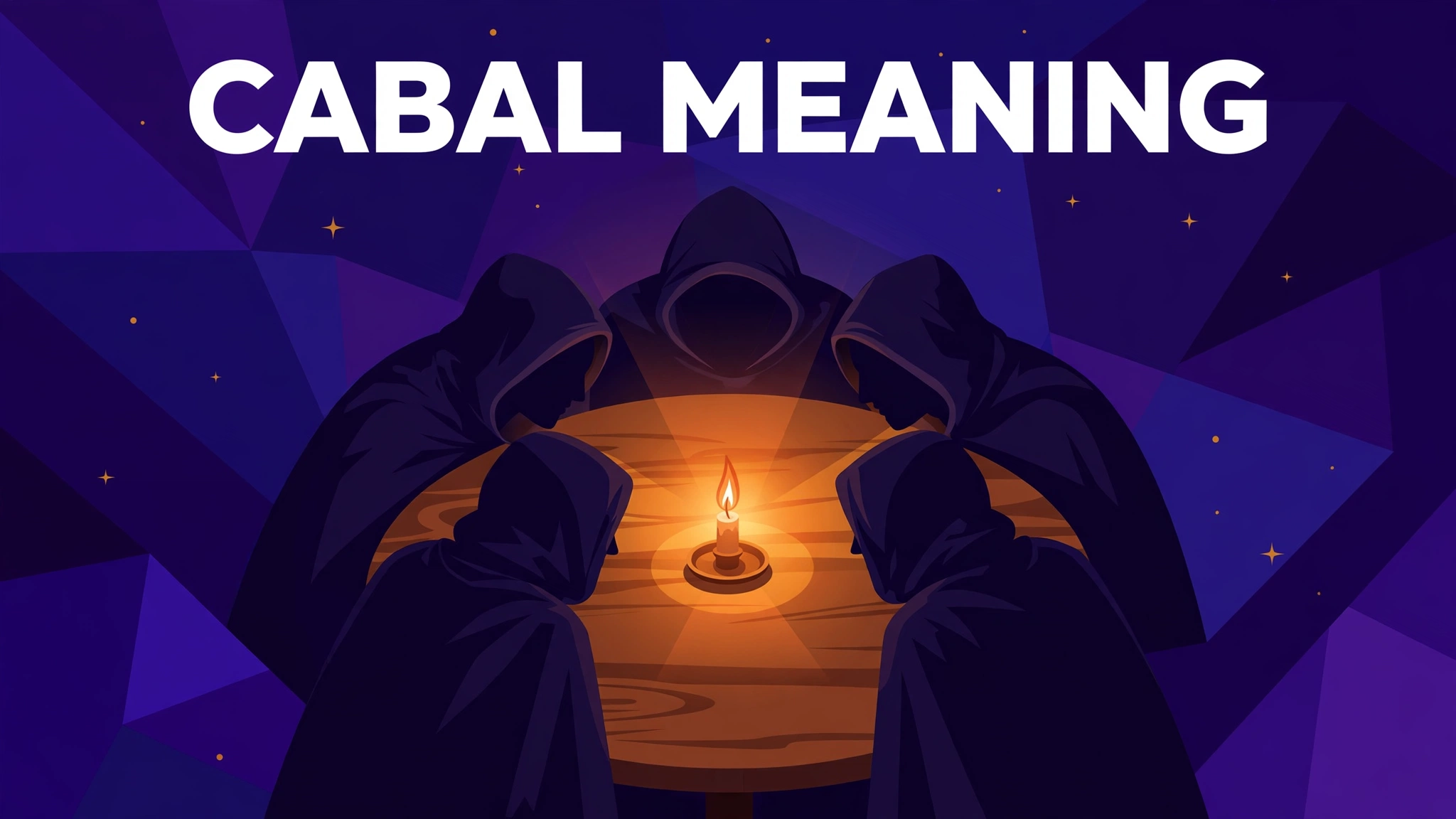
Cabal means a small group of people who plan secretly to take action, especially political action — Cambridge Dictionary’s definition, marked disapproving. It can also mean the secret plotting itself, and it works as a verb meaning to plot or conspire. The word carries a charge: to call a group a cabal is to accuse it of scheming behind closed doors. This article gives the dictionary definition, the British and American pronunciations, the word’s real history (including the famous Charles II coincidence that is not its origin), how it differs from conspiracy, junta, and clique, and how to use it responsibly.
Quick Answer
Cabal (UK /kəˈbæl/, US /kəˈbɑːl/) is a noun meaning a small group of people who plan secretly to take action, especially political action (Cambridge, marked disapproving). Collins defines it as “a small group of intriguers, especially one formed for political purposes,” and also records the second noun sense — the secret plot itself (“a secret plot, especially a political one”) — plus the verb to cabal, meaning to plot or conspire.
What does “cabal” mean? The dictionary definition
The references agree closely, and Cambridge’s entry captures the modern core:
- The group: “a small group of people who plan secretly to take action, especially political action” (Cambridge, disapproving). Collins COBUILD: “If you refer to a group of politicians or other people as a cabal, you are criticizing them because they meet and decide things secretly” — also marked disapproval. Webster’s New World: “a small group of persons joined in a secret, often political, intrigue; junta.”
- The plotting: “a secret plot, especially a political one; conspiracy; intrigue” (Collins); “the intrigues of such a group; plot” (Webster’s New World). So “a cabal formed against the minister” (the people) and “the cabal to remove the minister” (the scheme) are both correct.
- The verb: to cabal — “to form a cabal; conspire; plot” (Collins), an intransitive verb: “The senators caballed against their leader.”
Two things to notice. First, the word is almost always political in flavour — Merriam-Webster’s synonym note says cabal “typically applies to political intrigue involving persons of some eminence,” as in “a cabal among powerful senators.” Second, it is inherently critical: both Cambridge and Collins mark it disapproving. Nobody proudly calls their own committee a cabal.
Pronunciation
Two syllables, stress on the second:
- UK: /kəˈbæl/ — “kuh-BAL”
- US: /kəˈbɑːl/ — “kuh-BAHL” (Cambridge’s US rendering; Collins gives /kəbæl/ for both varieties, and Webster’s New World records both kəˈbɑl and kəˈbæl)
The first syllable is the reduced “kuh” of about. The stress must fall on -bal — “KAY-bul” is wrong, and the word is unrelated to cable despite the visual resemblance.
Where does “cabal” come from? The real story and the famous coincidence
The genuine history, as the dictionaries record it: cabal entered English in the 17th century from the French cabale, from the Medieval Latin cabbala — the Latin name for the Kabbalah, the tradition of Jewish mysticism, from the Hebrew qabbālāh, meaning “received lore” or “tradition.” Because mystical teaching was secret teaching, the word picked up the sense of “secret doctrine,” then “secret intrigue,” then the group doing the intriguing. The Random House dictionary dates the word’s appearance to 1610–20.
Now the famous coincidence. In the reign of England’s Charles II, five ministers governed together from about 1667 to 1673: Clifford, Arlington, Buckingham, Ashley, and Lauderdale. Their initials — C, A, B, A, L — can be rearranged to spell CABAL, and the group became known as the Cabal Ministry. It is a wonderful story, and it is often repeated as the origin of the word — but the dictionaries are explicit that it isn’t. Collins’s word-origin note says it directly: “by a coincidence, the initials of Charles II’s ministers can be arranged to form this word.” The word was already in English decades before that ministry existed; the coincidence may have popularised it, but it did not create it.
This is worth stating carefully because the folk etymology is everywhere — even some older reference works present the ministers as the source. The evidence against it is the dating: a word recorded in the 1610s cannot have been coined from a ministry of the late 1660s. Treat the C-A-B-A-L story as what it is: a genuine historical curiosity, not an etymology.
Cabal vs conspiracy vs junta vs clique
Four words for secretive groups, four different centres of gravity:
| Word | What it means | Example |
|---|---|---|
| Cabal | A small group plotting secretly, usually for political ends; disapproving | “A cabal of ministers plotted the king’s downfall.” |
| Conspiracy | The secret plan itself (and by extension the planners); often criminal | “A conspiracy to rig the election.” |
| Junta | A group that rules, especially a military one after a coup — power already taken | “The military junta seized power in 1973.” |
| Clique | An exclusive social group; not necessarily secret or political | “She never fit in with the popular clique.” |
Merriam-Webster’s synonym note sharpens the cabal/conspiracy line: conspiracy “implies a secret agreement among several people usually involving treason or great treachery,” while cabal “typically applies to political intrigue involving persons of some eminence.” A useful shorthand: a conspiracy is the plot; a cabal is the plotters — though cabal can name the plot too.
How to use “cabal” in sentences
Historical and neutral examples (the safest ground for this word):
- “Charles II’s Cabal Ministry — Clifford, Arlington, Buckingham, Ashley, and Lauderdale — governed England from 1667 to 1673.”
- “Historians debate how much power the real cabal of advisers wielded behind the throne.”
- “He was chosen by a cabal of fellow senators.” (Collins’s example)
- “The novel centres on a secretive cabal manipulating events from the shadows.”
The verb:
- “The ministers caballed to force the policy through.”
- “Rival factions had been caballing for months before the vote.”
A usage caution that matters. Because the dictionaries mark cabal as disapproving, applying it to real, living people is an accusation — it asserts secret scheming as fact. In journalism and commentary it should be used with evidence, attribution (“critics described the group as a cabal”), or not at all. For historical subjects and fiction, no such caution applies. When in doubt about a contemporary target, faction, inner circle, or interest group say “influential group” without the charge of conspiracy.
Common mistakes
Claiming the word comes from Charles II’s ministers. The initials coincidence is real and delightful, but the word predates the ministry by decades — Collins calls it a coincidence explicitly, and the 1610–20 dating confirms it. Don’t repeat the folk etymology as fact.
Confusing “cabal” with “cable.” They look alike and sound nothing alike: cabal is “kuh-BAL,” cable is “KAY-bul.” They are unrelated words.
Spelling the verb forms. Collins records caballed, caballing (doubled l, the British pattern). American usage also accepts cabaled, cabaling with a single l. Pick the pattern that matches your variety and be consistent.
Using it as a compliment. There is no admiring use of cabal in the dictionaries — it is marked disapproving throughout. If you mean an impressive team, that word is not this one.
FAQs
Is a cabal always political?
Usually, but not exclusively. The dictionaries’ core sense is political intrigue, and Merriam-Webster specifies “persons of some eminence” — but Collins also records “a secret or exclusive set of people; clique,” so non-political uses exist. The political sense is the default; anything else needs context.
Is “cabal” always negative?
Effectively yes. Both Cambridge and Collins mark it disapproving. Calling a group a cabal says they scheme in secret — that is never praise in these entries.
What was the Cabal Ministry?
The group of five ministers — Clifford, Arlington, Buckingham, Ashley, and Lauderdale — who dominated Charles II’s government from about 1667 to 1673. Their initials spell C-A-B-A-L, a coincidence that gave the ministry its nickname and helped popularise the word, without being its origin.
What’s the difference between a cabal and a conspiracy theory?
A cabal (if real) is an actual secretive group; a conspiracy theory is an unproven belief that such a group is secretly pulling strings. Confusing the two is how the word gets misused — asserting a cabal exists is a factual claim that needs evidence.
Can “cabal” be a verb?
Yes — “to form a cabal; conspire; plot” (Collins). It is intransitive and formal: “The aides caballed against the chief of staff.”
The takeaway
Cabal names secret political scheming and the small group doing it — a word that accuses by definition, which is why the dictionaries mark it disapproving. Its real history runs from the Hebrew qabbālāh (“received lore”) through French cabale into 17th-century English; the Charles II ministers’ initials are a coincidence, not an origin, however often the story is told the other way. Use it freely for history and fiction, carefully for the living — and when the evidence isn’t there, faction or inner circle will say “powerful group” without crying conspiracy.