Wishbone Meaning: Definition, Origin and Examples
Wishbone Meaning: Definition, Origin and Examples
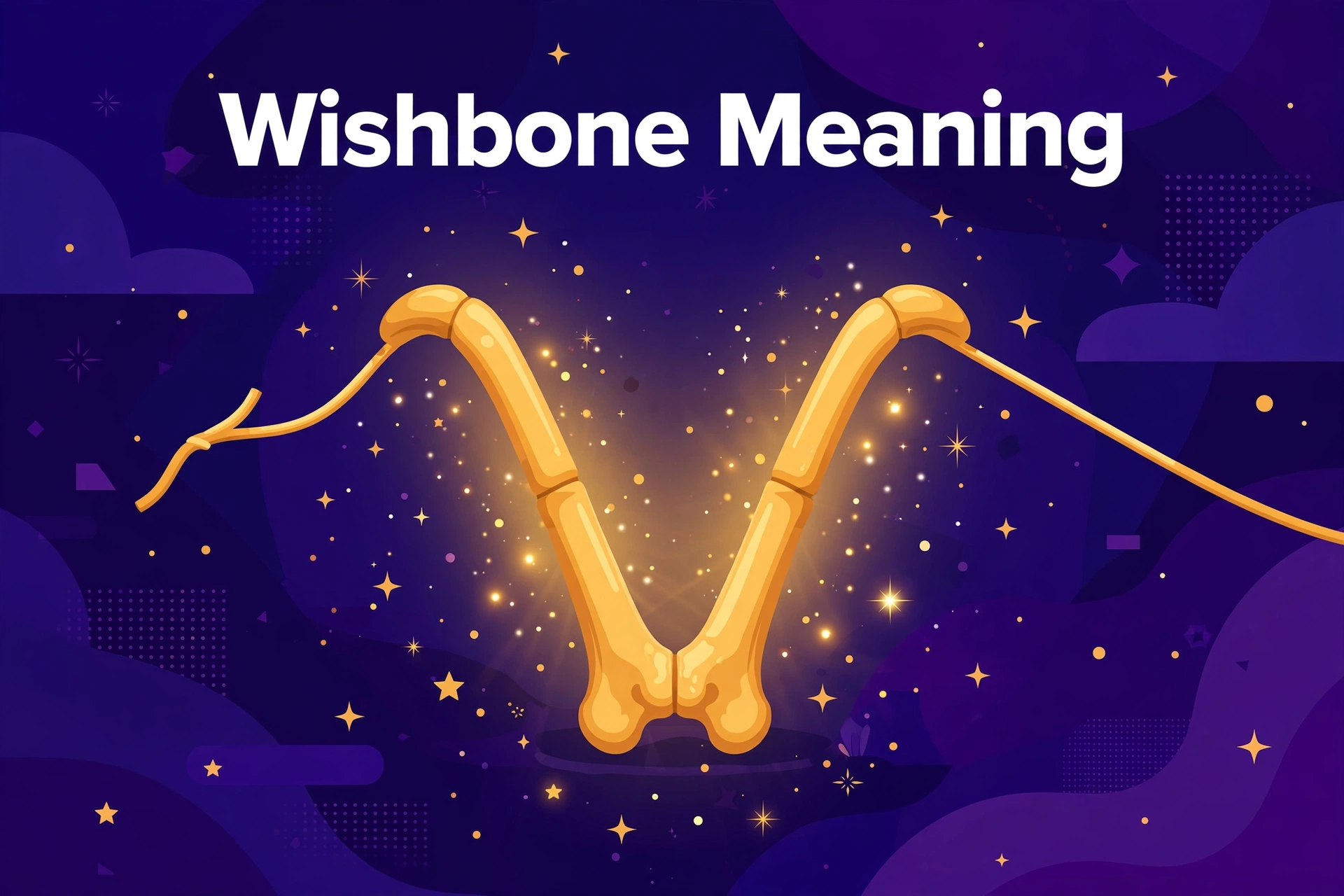
Wishbone names one of the most familiar bones in the kitchen: the V-shaped forked bone you find at the front of a roast chicken or turkey. It is also the centre of a small ritual — two people pull it apart, and whoever gets the longer piece gets a wish — and, in American football, the name of an offensive formation. One word, three worlds: anatomy, superstition, and sport.
This article covers what a wishbone actually is (the bone has a proper scientific name), how the wish-pulling custom works, why the word’s origin date is genuinely disputed between dictionaries, and the football sense that borrowed the shape.
What the wishbone actually is
Anatomically, the wishbone is the furcula — the forked bone lying in front of a bird’s breastbone (sternum), made chiefly of the two clavicles (collarbones) fused together at their lower ends. In a roast chicken or turkey it sits just above the breast, and carvers usually remove it before slicing. It acts as a spring in the bird’s skeleton, flexing as the wings beat.
It is not unique to poultry: most birds have one, and fossil finds have turned up furculae in some dinosaurs too — a reminder that the bone is far older than the superstition attached to it. Other names for it include merrythought (an older English word for the same bone), wishing bone, and lucky bone.
- Lift up the chicken’s neck to expose the wishbone before carving.
- The skeleton was nearly complete, wishbone included.
The wish-pulling ritual: how it works
The custom that gave the bone its name is simple and widely known across the English-speaking world:
- After the roast, the wishbone is removed and set aside to dry — a fresh bone bends; a dried one snaps cleanly.
- Two people each hook a little finger around one end of the V and each silently makes a wish.
- They pull until the bone breaks. Whoever is left holding the longer piece is supposed to have their wish granted.
Two honest caveats belong here. First, the “longer piece wins” rule is the standard version, but dictionaries record a variant: in some traditions the shorter piece wins. If your family plays it the other way, you are not wrong — you are just regional. Second, it is a superstition, and Merriam-Webster’s etymology says so outright: the word comes “from the superstition that when two persons pull it apart the one getting the longer fragment will have a wish granted.” Fun at the dinner table; not a life strategy.
Why the origin date is disputed
Here is a small honesty lesson in dictionary work. Ask three reputable dictionaries when wishbone entered English and you get three answers:
- Merriam-Webster: first known use 1847.
- Dictionary.com: 1850–55, an Americanism — wish + bone.
- Collins (British entry): 17th century, “from the custom of two people breaking apart the bone after eating.”
These are not quite contradicting each other: Collins appears to date the naming idea (the custom is old), while Merriam-Webster dates the printed word (the compound is 19th-century American). What is safe to say: wishbone is a 19th-century American compound of wish + bone, named for a much older bone-breaking custom. Anyone who gives you a single confident century for it is smoothing over a real disagreement.
The football sense: the wishbone formation
In American football, the wishbone (or wishbone formation) is an offensive formation — a variation of the T formation — in which the fullback lines up directly behind the quarterback and the two halfbacks line up farther back, to the left and right. Seen from above, the three backs form a Y — the shape of the bone.
It was the defining offence of 1970s college football, built for the running game, and it takes the name purely from the shape. If you hear “they ran the wishbone all afternoon,” nobody is talking about poultry.
Figurative and extended uses
Beyond anatomy and football, the bone’s distinctive V-shape has lent its name to a few technical things:
- Double-wishbone suspension — a car suspension design using two wishbone-shaped arms; standard in performance cars.
- Wishbone boom — in sailing, a curved spar (also called a wishbone rig) that holds a sail’s clew.
- “Wishbone” as a luck symbol — the shape appears on charms, jewellery, and Thanksgiving decorations as shorthand for “make a wish.”
These are all shape-metaphors. None of them involves an actual bone or an actual wish.
The bone also enjoys a lively afterlife in popular culture. In the United States the wishbone pull is a fixture of the Thanksgiving table, and the dried bone — sometimes painted gold or silver — turns up as a lucky charm on necklaces and keyrings. Novelty “wishbone” kits, moulded in plastic so every guest gets a pull, are sold each November. The ritual has outgrown the roast: what matters now is the gesture of wishing together, not the anatomy.
Common mistakes with wishbone
- Writing it as two words. The standard form is one word: wishbone, not “wish bone.” (The scientific name furcula is a separate word entirely.)
- Trying the ritual with a fresh bone. Practical rather than linguistic, but worth saying: the custom requires a dried bone. A fresh wishbone bends instead of snapping.
- Assuming the longer piece always wins. As noted, some traditions award the wish to the shorter piece. Agree the rules before you pull.
- Confusing furcula with “funny bone.” The furcula is the bird’s fused collarbones; the human “funny bone” is the ulnar nerve at the elbow. Unrelated.
- Over-literalising the football term. The wishbone formation is named for the shape, not the ritual — there is no wishing involved in the backfield.
Examples of wishbone in sentences
- The children fought over who got to pull the wishbone.
- She held the longer piece of the wishbone and wished for snow.
- A wishbone — the furcula — braces the bird’s shoulders during flight.
- The coach scrapped the passing game and went back to the wishbone.
- The car’s double-wishbone suspension handled the corners beautifully.
- He wore a tiny gold wishbone on a chain, for luck.
FAQs
What bone is the wishbone?
The furcula: the forked bone in front of a bird’s breastbone, formed by the two collarbones (clavicles) fused at their lower ends. It sits above the breast in chickens, turkeys, and most other birds.
Why is it called a wishbone?
Because of the custom of two people pulling a dried one apart, with the holder of the longer piece granted a wish. The word is a 19th-century American compound of wish + bone — though the custom itself is older, which is why dictionaries differ on the date.
Who gets the wish — the longer or the shorter piece?
Usually the longer piece. But some traditions reverse it, awarding the wish to the shorter piece — dictionaries record both. Settle it before you pull, not after.
Is wishbone one word or two?
One word: wishbone (plural wishbones). “Wish bone” as two words is non-standard.
What is the wishbone formation in football?
An American-football offensive formation: the fullback directly behind the quarterback, with two halfbacks split behind and to each side — a Y-shape like the bone. A run-heavy formation associated especially with 1970s college football.
The takeaway
Wishbone (US /ˈwɪʃˌboʊn/, UK /ˈwɪʃˌbəʊn/) is the V-shaped furcula bone in birds, the centre of the wish-pulling ritual, and — by shape — an American-football formation. Write it as one word, dry the bone before you pull it, and remember the word itself is 19th-century American even though the custom is older.