Different Ways to Say Hi: 100+ Friendly, Cute and Flirty Greetings
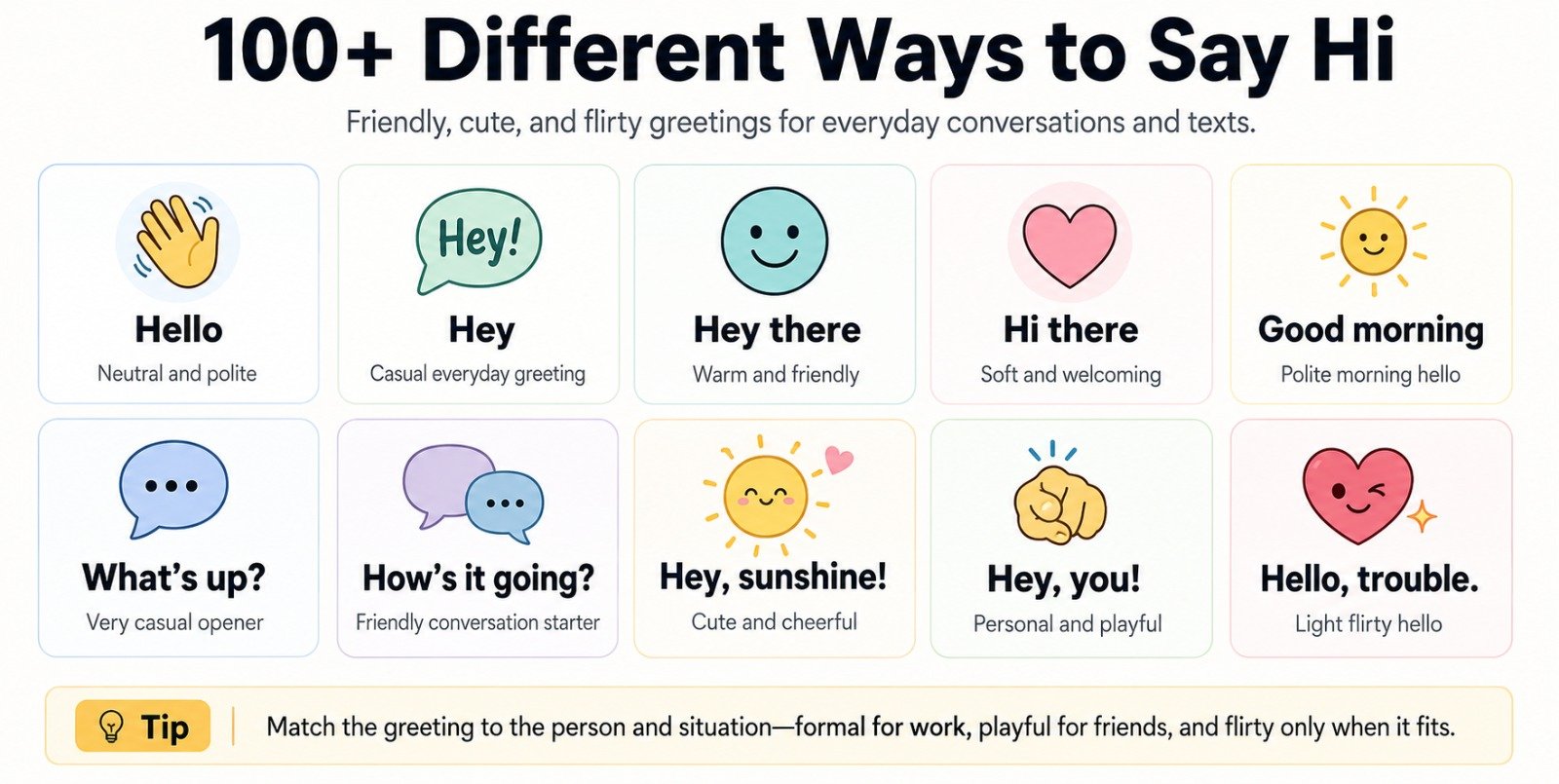
“Hi” is simple, friendly, and useful in almost any casual situation, but it isn’t your only option. There are plenty of different ways to say hi, from relaxed greetings like “Hey there” to warmer expressions such as “Good to see you” and playful texts like “Hey, you!” The best choice depends on who you’re talking to, how well you know them, and the tone you want to create.
Different Ways to Say Hi at a Glance
Some greetings are neutral enough for almost anyone, while others make more sense with friends, coworkers, partners, or people you already know.
| Expression | Tone | Best Used For |
|---|---|---|
| Hello | Neutral | Almost any situation |
| Hey | Casual | Friends, coworkers, texts |
| Hey there | Friendly | Casual conversations |
| Hi there | Warm, casual | Friendly introductions |
| Good morning | Polite | Morning greetings |
| Good afternoon | Polite | Daytime greetings |
| Good evening | Polite | Evening greetings |
| How’s it going? | Casual | Friends and familiar coworkers |
| What’s up? | Very casual | Friends and peers |
| Good to see you | Warm | Someone you already know |
| How have you been? | Friendly | Someone you haven’t seen recently |
| Long time no see | Informal | Reconnecting with someone |
| Hiya | Informal | Friendly casual conversation |
| Howdy | Casual/playful | Informal situations |
| Yo | Very informal | Close friends |
| Greetings | Formal or playful | Written or humorous contexts |
The key difference is not simply the wording. “Hello” and “Hey” can both open a conversation, but they do not create exactly the same impression. “Hello” is more neutral, while “Hey” feels noticeably more relaxed.
Also Check | 25+ Ways to Say Hi in Different Languages Around the World
Casual and Friendly Ways to Say Hi
When you know the other person or the situation is relaxed, you can move beyond a plain “hi” without sounding unnatural.
Hey!
“Hey” is one of the easiest alternatives to “hi.” It sounds friendly and informal and works especially well with friends, classmates, familiar coworkers, and people you message regularly.
Example: “Hey! How was your weekend?”
Hey there!
Adding “there” makes the greeting feel slightly warmer and more conversational.
Example: “Hey there! Good to see you again.”
It works well in person and in messages, although it may feel too relaxed for a formal business introduction.
Hi there!
“Hi there” is friendly without being especially playful or intimate. It can be useful when greeting someone you don’t know particularly well.
Example: “Hi there! Can I help you with something?”
How’s it going?
This greeting does more than acknowledge the person. It also invites them to respond.
Example: “Hey, Maya. How’s it going?”
It is natural in casual English but generally less suitable for very formal situations.
What’s up?
“What’s up?” is highly informal and commonly functions as both a greeting and a question about what someone is doing.
Example: “What’s up? Haven’t seen you all week.”
A short response such as “Not much” is perfectly natural, so the person does not necessarily need to give a detailed account of what is happening.
How are things?
This is friendly and slightly broader than “How are you?”
Example: “Hi, Ben! How are things?”
It is especially useful when catching up with someone you already know.
What’s new?
Use “What’s new?” when you are genuinely open to hearing what has happened in someone’s life recently.
Example: “Hey! What’s new with you?”
Good to see you!
This works best when greeting someone you have met before.
Example: “Good to see you! It’s been a while.”
It would sound odd as a substitute for “hi” in a first-ever text to a stranger because the phrase assumes some form of meeting or prior familiarity.
Morning!
“Morning!” is a shortened, casual version of “Good morning.”
Example: “Morning! Ready for the meeting?”
It is common among coworkers, friends, housemates, and other people you see regularly.
Hiya!
“Hiya” is a cheerful informal greeting. It is particularly familiar in British conversational English, though speakers elsewhere may use it too.
Example: “Hiya! How have you been?”
Howdy!
“Howdy” has strong associations with American English, particularly the southern and western United States, but it is also used jokingly or playfully elsewhere.
Example: “Howdy! What brings you here?”
Because of its distinctive character, it may sound deliberately playful outside contexts where it is normally used.
Other Ways to Say Hi When You Already Know Someone
Sometimes the most natural greeting does not contain “hi” or “hello” at all.
Try:
- Good to see you!
- Nice to see you again!
- How have you been?
- How are things?
- What have you been up to?
- What’s new?
- Look who it is!
- There you are!
- Long time no see!
- How’s everything?
- How’s life?
- How are you doing?
- How goes it?
- What’s happening?
- What’s going on?
Long time no see!
This familiar expression works when you have not spoken to or seen someone for a while.
Example: “Long time no see! How have you been?”
It would make little sense if you spoke to the person yesterday.
What have you been up to?
This is another good option for reconnecting because it naturally encourages conversation.
Example: “Hey! What have you been up to lately?”
Look who it is!
This greeting is more playful and depends heavily on tone.
Example: “Look who it is! I haven’t seen you in ages.”
Use it with someone who will understand the friendliness behind it. With a stranger or in a serious professional setting, it can sound too familiar.
Cute Ways to Say Hi
A cute greeting adds warmth or affection. These expressions work best with people you already have a friendly, affectionate, or romantic relationship with.
Here are some natural ideas:
- Hey, sunshine!
- Hello, lovely!
- Hey, cutie!
- Hi, beautiful!
- Hey, you!
- Hi, sweetie!
- Morning, sleepyhead!
- Hey, superstar!
- Hello, favorite human!
- Well, hello there!
- Hey, stranger!
- Hi, lovely!
- Hello, you!
- Hey, bright eyes!
- Look who’s here!
Hey, Sunshine!
This is warm, cheerful, and affectionate.
Example: “Hey, sunshine! Hope your day’s going well.”
It suits partners, close friends, or someone with whom you already have an affectionate tone. Saying it to an unfamiliar coworker could feel overly personal.
Hey, You!
“Hey, you!” is simple but often feels more personal than plain “hi.”
Example: “Hey, you! How’s your day going?”
Its meaning depends heavily on the relationship and tone. Between close friends or partners it can sound sweet; delivered sharply, it could sound like you are trying to get someone’s attention.
Morning, Sleepyhead!
This playful greeting is best reserved for someone you know well.
Example: “Morning, sleepyhead! Finally awake?”
It would normally be too familiar for a new acquaintance.
Hello, Favorite Human!
This is deliberately playful and affectionate rather than a standard everyday greeting.
Example: “Hello, favorite human! What are you doing later?”
Use it when the relationship already supports that kind of warmth.
Cute Ways to Say Hi in a Text Message
Texting gives you more freedom to make a greeting playful, personal, or expressive. You can also use a question or conversation starter instead of opening with a traditional greeting.
Try these:
- Heyyy 😊
- Hey, you!
- Hello, sunshine ☀️
- Morning, sleepyhead!
- Hi, favorite human.
- Hey, stranger!
- Guess who was thinking about you?
- Look who just popped into my head.
- Just dropping by to say hey.
- Hi! Randomly thought of you.
- Hey! How’s your day treating you?
- Hello from my side of the screen.
- Guess who decided to text you?
- Well, well, well… look who it is.
- Hey! What are you up to?
Repeated letters, emojis, and playful punctuation can change the tone significantly. For example, “Hey” is neutral-casual, while “Heyyy 😊” may come across as more enthusiastic, affectionate, or even slightly flirty depending on the relationship.
Use those signals carefully. A playful texting style that feels natural with a close friend may not suit a professional contact.
Ways to Say Hi Without Actually Saying “Hi”
You do not always need a greeting word to begin a conversation. Sometimes opening with a genuine question or observation feels more natural.
Quick question…
This is useful when you have a specific reason for messaging.
Example: “Quick question—are you free this afternoon?”
How’s your day going?
This opens the conversation while showing interest.
Example: “How’s your day going? Surviving Monday?”
You crossed my mind.
This is warmer and more personal, so relationship matters.
Example: “You crossed my mind, so I thought I’d check in.”
Tell me something good.
This is upbeat and conversational.
Example: “Tell me something good. How’s your week been?”
Guess what?
“Guess what?” immediately creates curiosity.
Example: “Guess what? I finally tried that café you recommended.”
What are you up to?
This is a natural way to start a casual conversation with someone you already know.
Example: “What are you up to this evening?”
These are not literal synonyms for “hi.” They perform the same conversation-opening function, but they also add a question, emotion, or reason for contacting someone.
Flirty Ways to Say Hi
A flirty greeting usually works best when there is already mutual interest or a playful relationship. The goal is to sound light and confident rather than overly intense.
Ideas include:
- Hey, good looking!
- Hello, trouble.
- Hey, stranger 😉
- Well, hello there.
- Hey, you. Miss me?
- Hi, favorite distraction.
- Hey, sunshine.
- Hi, handsome!
- Hey, beautiful!
- Guess who was thinking about you?
- Look who just crossed my mind.
- Hi. I needed an excuse to talk to you.
- Hey! Were you waiting for me to text?
- You’re distracting me again.
- I was wondering when we were going to talk again.
Hello, Trouble.
This is teasing rather than literally describing someone as troublesome.
Example: “Hello, trouble. What are you up to tonight?”
It works only when playful teasing already feels comfortable between you.
Hi, Favorite Distraction.
This makes your interest obvious without being especially serious.
Example: “Hi, favorite distraction. How’s your evening going?”
It is too personal for someone with whom you do not have that kind of relationship.
Guess Who Was Thinking About You?
This skips the greeting and leads with interest.
Example: “Guess who was thinking about you? How was your day?”
Because it clearly signals affection or attraction, use it when that message is intentional.
Hey, Stranger 😉
“Hey, stranger” can be friendly or flirty depending on context, especially when paired with a playful emoji.
Example: “Hey, stranger 😉 Where have you been?”
It is particularly natural when you have not messaged each other for a while.
Professional and Polite Alternatives to Hi
Not every situation calls for something cute or casual. With clients, managers, new colleagues, or unfamiliar people, simpler greetings are usually safer.
Good options include:
- Hello
- Good morning
- Good afternoon
- Good evening
- Nice to meet you
- It’s good to meet you
- Good to see you again
- Hello, [Name]
- Good morning, [Name]
Example: “Good morning, Daniel. Thanks for sending the report.”
Example: “Hello, Priya. I wanted to follow up about Thursday’s meeting.”
“Hey” is common in many relaxed workplaces, but company culture and your relationship with the recipient matter. If you are unsure, “Hello” or a time-based greeting is generally a more neutral choice.
Greetings That Are Not Interchangeable
Although all these expressions can begin conversations, they should not be treated as direct replacements in every situation.
“What’s up?” is far more casual than “Good afternoon.”
“Long time no see” assumes you have not interacted recently.
“Nice to meet you” belongs primarily to first meetings, while “Good to see you again” assumes prior contact.
“Hey, sunshine!” carries affection that plain “Hello” does not.
“Yo” may sound perfectly natural between close friends but inappropriate in a formal introduction.
“Greetings” is grammatically correct, but in everyday speech it can sound deliberately formal, theatrical, or humorous.
The best alternative therefore depends less on finding a synonym and more on choosing the greeting that matches the relationship and moment.
How to Choose the Right Way to Say Hi
Before choosing a greeting, think about three things.
Consider Your Relationship
With a stranger or new professional contact, choose something neutral:
- Hello
- Good morning
- Good afternoon
With friends, you have much more flexibility:
- Hey!
- What’s up?
- Hiya!
- How’s it going?
With someone you are close to, warmer greetings may work naturally:
- Hey, sunshine!
- Morning, sleepyhead!
- Hey, you!
Match the Level of Formality
If the situation is professional or unfamiliar, avoid greetings that depend on slang or teasing.
“Good morning” is a safer introduction at a formal meeting than “Yo” or “What’s up?”
Think About What You Want to Happen Next
If you simply want to acknowledge someone, “Hey” may be enough.
If you want to start a conversation, use something that invites a response:
- How have you been?
- What’s new?
- How’s your day going?
- What have you been up to?
That small change can make the greeting feel less automatic and more genuinely interested.
Frequently Asked Questions
What are some different ways to say hi?
Common alternatives include hello, hey, hey there, hi there, good morning, how’s it going, what’s up, hiya, howdy, good to see you, and how have you been? The right option depends on how formal the situation is and how well you know the other person.
What can I say instead of hi in a text?
You can use “Hey, you!”, “What are you up to?”, “How’s your day going?”, “Hey, stranger!”, or even a conversation starter such as “Quick question…” A text does not always need a traditional greeting.
How do you say hi in a cute way?
Try warm greetings such as “Hey, sunshine!”, “Hello, lovely!”, “Morning, sleepyhead!”, “Hey, cutie!”, or “Hi, favorite human.” Cute greetings are most natural with people you already know well.
How can I say hi in a flirty way?
Light options include “Hello, trouble,” “Hey, good looking,” “Hey, you. Miss me?” or “Guess who was thinking about you?” A flirty greeting should suit the existing relationship and should not make the other person uncomfortable.
What is a professional way to say hi?
“Hello,” “Good morning,” “Good afternoon,” and “Good evening” are reliable professional greetings. When writing to someone, adding their name can make the opening feel more polished: “Good morning, Alex.”
Is “hey” rude?
“Hey” is not inherently rude. It is a common casual greeting among friends, peers, and coworkers in informal environments. However, it may sound too casual in highly formal communication or when addressing someone for the first time.
How can I start a conversation without saying hi?
Open with a natural question or observation, such as “How’s your day going?”, “What are you up to?”, “Quick question…”, “Guess what?” or “You crossed my mind.” These expressions begin the interaction while immediately giving the other person something to respond to.
Choosing a Greeting That Feels Natural
The best greeting is the one that fits the person, setting, and tone. A friendly “Hey there” may be perfect for a coworker you know well, while “Good morning” is safer in a formal setting and “Hey, sunshine!” adds affection when you are talking to someone close. Paying attention to those small differences makes your communication sound more natural, and Clarifyra is designed to help you recognize which wording feels right for each situation.
Also Read | 100 Funny Ways to Say Hello: Silly, Weird and Playful Greetings