Sari or Saree: Which Is Correct?
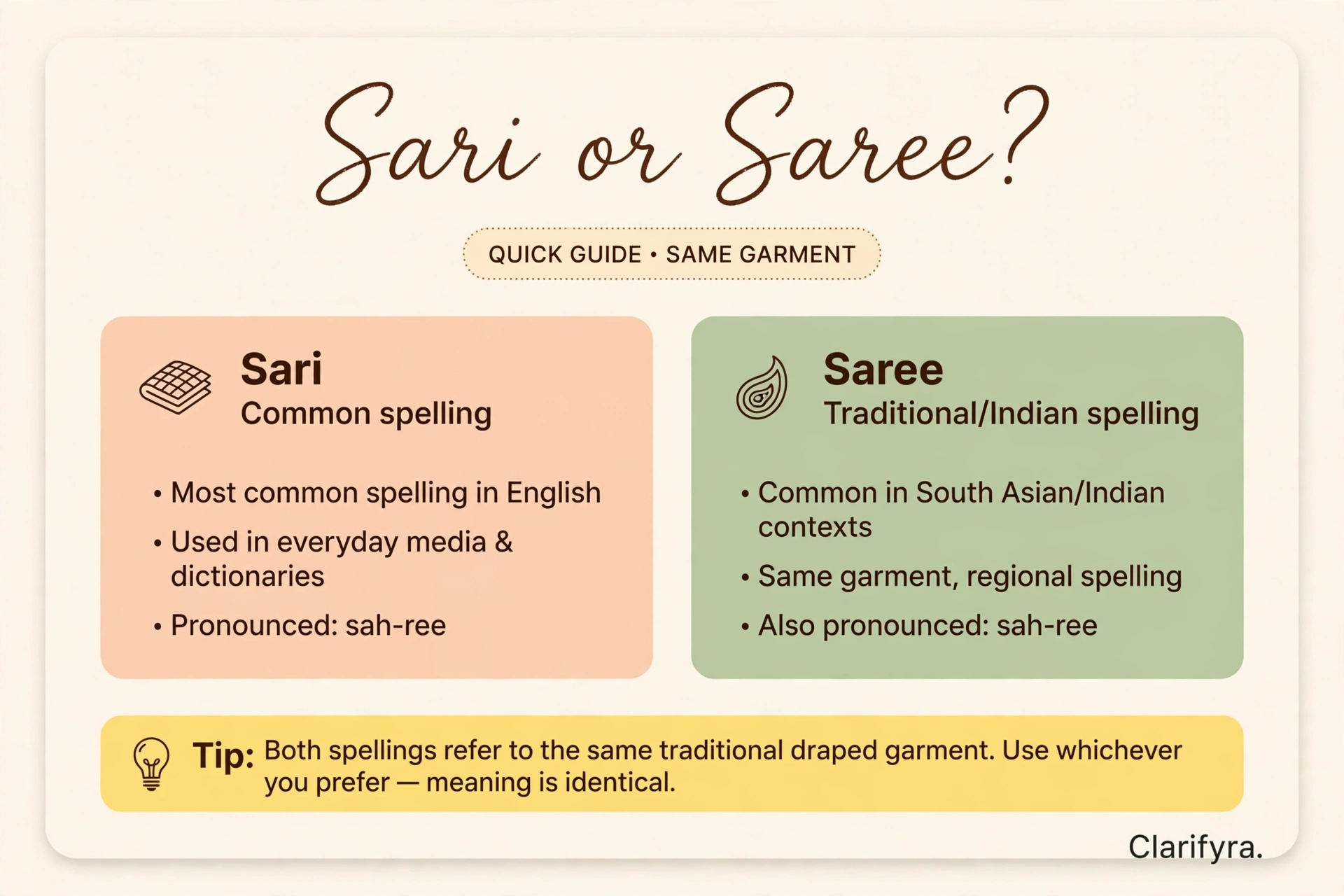
Sari and saree are two spellings of the same word for the same garment — the long length of cloth draped around the body and worn by women across South Asia. Neither is a misspelling, and neither names a different outfit. Sari is the spelling most international dictionaries put first and the one most common in global English. Saree is fully standard too, and is especially frequent in South Asian English — in Indian newspapers, shops, and everyday writing, where it often feels like the local, natural choice. They are even pronounced the same: /ˈsɑːri/. Choose by audience and house style, then stay consistent.
Quick Answer
Sari and saree both correctly name the draped South Asian garment, and both are pronounced /ˈsɑːri/ (“SAH-ree”). Cambridge Learner’s enters the word as “sari (also saree)”; Collins British English gives “sari or saree,” plural saris or sarees. International and dictionary-default English leans to sari; South Asian English uses saree very widely, particularly in retail and Indian media. There is no difference in meaning, formality, or correctness — only in spelling habit. Pick one, apply it throughout your document, and pluralise it as saris or sarees to match.
One Garment, Two Spellings in the Dictionaries
Every major dictionary checked treats the pair as free variants of a single noun. Cambridge Learner’s Dictionary enters “sari (also saree)” with UK and US pronunciation /ˈsɑːri/. Collins is even-handed in both its varieties: the British entry reads “sari or saree (ˈsɑːrɪ), plural -ris or -rees,” and the American entry lists sari with “Also: saree.” Oxford Learner’s enters the garment under sari alone — “a long piece of cloth that is wrapped around the body to make a long dress, worn by women in South Asia,” from Hindi sāṛī — while Merriam-Webster defines sari as “a garment of southern Asian women that consists of several yards of lightweight cloth draped so that one end forms a skirt and the other a head or shoulder covering.”
That headword choice is worth reading correctly. When a dictionary writes “sari (also saree),” it is not demoting saree to an error — “also” is the standard label for an accepted variant. Collins’ British “or” makes the equality explicit. No dictionary checked marks saree as non-standard, regional-only in a restrictive sense, archaic, or incorrect, and none marks sari that way either. Writers who “correct” one spelling to the other are usually enforcing a house style or a regional preference, not fixing a mistake — a distinction worth keeping when you edit other people’s work.
Pronunciation seals the identity. Oxford gives /ˈsɑːri/ for both its British and American transcriptions of sari, Cambridge gives /ˈsɑːri/, and Collins gives /ˈsɑːrɪ/ to /sɑri/ across its entries — in every case the two spellings share one pronunciation. The spelling difference is purely graphic.
Where the Spellings Come From
Both forms transliterate the same source. Merriam-Webster gives the etymology as “Hindi & Urdu sāṛī, from Sanskrit śāṭī, strip of cloth,” with first known use in English in 1785. Collins dates the borrowing to the 18th century on the same path — Hindi sārī from Sanskrit śāṭī — and Oxford says “late 18th cent.: from Hindi sāṛī.” The retroflex ṛ and the long final vowel of the Hindi word don’t map neatly onto English spelling conventions, so early writers improvised: some settled on the compact sari, others on the phonetically suggestive saree, whose double e signals the long “ee” sound to an English eye, much as in settee or divorcee (words shaped by similar spelling habits, though different languages).
Geography then sorted the variants. Outside South Asia, publishing standardised largely on sari — the shorter form dominates international news and dictionary headwords. Inside South Asia, saree remains the more visible spelling in commerce and Indian media. Both are understood everywhere.
What the word names has stayed constant through all this spelling drift: an unstitched length of woven fabric — dictionaries say “several yards” of lightweight cloth — draped so that one end wraps the waist to form a skirt-like lower garment while the other end crosses the torso and rests over the shoulder or head, typically worn with a fitted blouse (a choli) and a petticoat beneath. Fabrics and draping styles vary enormously; the spelling does not track that variation.
Choosing in Practice: Plurals, Compounds, and Style
| Feature | Sari | Saree |
|---|---|---|
| Meaning | Identical — the draped South Asian garment | |
| Pronunciation | /ˈsɑːri/ (“SAH-ree”) — UK and US | |
| Plural | saris | sarees |
| Dictionary treatment | Headword in Cambridge, Oxford, Merriam-Webster; listed first by Collins | Full variant: Cambridge “(also saree)”; Collins “or saree / Also: saree” |
| Most typical habitat | International English, global news, encyclopedias, dictionaries | South Asian English, Indian media and retail, boutiques and e-commerce |
| Origin | Hindi/Urdu sāṛī ← Sanskrit śāṭī, “strip of cloth” (English from the 1780s) | |
The plural follows the singular you choose: saris if your word is sari, sarees if your word is saree. Collins sanctions both — “plural -ris or -rees” — and mixing them (“she owns six saris and two sarees,” intending the same garment) looks like a distinction without a difference. Compound and attributive uses behave the same way: sari blouse / saree blouse, sari drape / saree drape, silk sari / silk saree. Pick the base form your document uses and build everything from it.
For writers choosing a house form, the practical guidance is audience-based. Writing for a general international readership, a textbook, or a publication whose style guide follows the major dictionaries, sari is the lower-friction default — it is the headword form in Cambridge, Oxford, and Merriam-Webster. Writing for a South Asian readership, a fashion retailer, or any context where saree is the word on the shop sign and the price tag, matching that local spelling respects your readers’ own usage — Collins records it without restriction, and Indian English is a fully standard variety. Quoting a source, keep its spelling inside the quotation, whatever your house form is.
Correct vs. Incorrect
- ✓ “She wore a red silk sari to the ceremony.” (international/dictionary style)
- ✓ “She wore a red silk saree to the ceremony.” (South Asian English style — equally correct)
- ✓ “The shop sells handloom saris from Bengal.” (plural to match sari)
- ✓ “The shop sells handloom sarees from Bengal.” (plural to match saree)
- ✗ “She bought three sari for the wedding.” → ✓ “…three saris…” or “…three sarees…” (the plural needs its ending)
- ✗ “His mother wore a sari, and her sister chose a saree,” (intending one garment type, mixed spellings) → ✓ Choose one spelling for the whole text.
- ✗ “Sarree / saari / sarie” → ✓ sari or saree. (These doubled-letter guesses are not recorded variants.)
- ✗ “She wore a sari dress made of two pieces stitched together.” — misleading: the defining garment is one unstitched length of cloth, per every definition checked. (Describe stitched outfits in their own terms.)
The pattern to notice: there is no ✗ pair where one of our two spellings corrects the other. The genuine errors around this word are plural slips, mixed-spelling inconsistency, and invented spellings — not the choice between sari and saree itself.
Common Mistakes
1. “Correcting” saree to sari (or the reverse) as if one were wrong. The dictionaries are unambiguous that both are standard: Cambridge “(also saree),” Collins “or saree.” If your style guide mandates one form, enforce it as a style rule and say so; presenting it as a spelling error misinforms writers and readers alike.
2. Mixing spellings in one document. A catalogue that lists “silk sarees” on one page and “cotton saris” on the next, with no difference intended, reads as unedited. Global find-and-replace to your chosen form — including plurals, compounds, captions, and alt text — before you publish.
3. Pronouncing them differently. There is no “sah-REE” versus “SAH-ree” distinction. Oxford, Cambridge, and Collins give one pronunciation, /ˈsɑːri/, for the word in both its spellings, in British and American English alike. The -ee is a spelling device, not a stress instruction.
4. Inventing doubled-letter spellings. Sarree, saari, and sarrie appear in the wild, especially in hastily built online shops, but no dictionary checked records them. The recorded variant set is exactly two: sari and saree. (Older texts occasionally show other transliterations, but they are historical curiosities, not modern options.)
5. Assuming a meaning difference that isn’t there. Occasionally a writer supposes saree is the formal/wedding garment and sari the everyday one, or that one is Indian and the other Pakistani or Bangladeshi. The definitions give no support to any such split: one garment, one meaning, two spellings. Formality, region, and fabric are expressed by adjectives and context — a bridal Banarasi saree, a simple cotton sari — not by the spelling choice.
Frequently Asked Questions
Which spelling do dictionaries recommend?
They don’t rank them as right and wrong; they choose a headword and list the other as a variant. Cambridge Learner’s, Oxford Learner’s, and Merriam-Webster enter the word under sari (Cambridge adding “also saree”), while Collins presents the two side by side: “sari or saree.” If a single default is needed for international writing, sari — the majority headword choice — is the usual pick, but saree is never an error.
Is “saree” Indian English only?
It is most characteristic of South Asian English, where it thrives in media and retail, but it is not confined there and no dictionary checked labels it with a regional restriction. Collins’ British entry offers “sari or saree” without qualification. The fairest description is: sari is the international default, saree is the form South Asian English often prefers — both understood everywhere.
How do you pronounce “saree”?
Exactly like sari: /ˈsɑːri/, “SAH-ree,” with the stress on the first syllable. Oxford, Cambridge, and Collins all give this single pronunciation covering both spellings, in British and American English. Don’t let the double e pull the stress to the end.
What is the plural — “saris,” “sarees,” or something else?
Match your singular: saris with sari, sarees with saree — Collins: “plural -ris or -rees.” There is no irregular plural and no apostrophe (“sari’s” is possessive only). Within one text, keep singular and plural from the same spelling family.
The Takeaway
Sari and saree are two standard spellings — and one pronunciation, /ˈsɑːri/ — for the same unstitched, draped garment of South Asia, from Hindi sāṛī and Sanskrit śāṭī, “strip of cloth.” International English and most dictionary headwords favour sari; South Asian English, especially in Indian media and commerce, very often uses saree. No dictionary checked calls either form wrong. Decide by audience, pluralise consistently (saris / sarees), never mix the two in one document — and save the word “misspelling” for the forms that genuinely aren’t recorded, like sarree.