Scarred or Scared: What’s the Difference?
Writing “she was scarred by the experience” when you mean she was frightened by it changes the sentence more than a typo should: one spelling reports a lasting mark, the other reports a moment of fear. Scarred carries the double r because it comes from scar — the mark left after skin heals — and it means marked, damaged, or lastingly affected. Scared carries a single r in its base because it comes from scare — to frighten — and it means afraid. The two words differ by one letter, sound completely different, and swap constantly in hasty typing because the fear phrase “scared for life” is so familiar.
Quick Answer
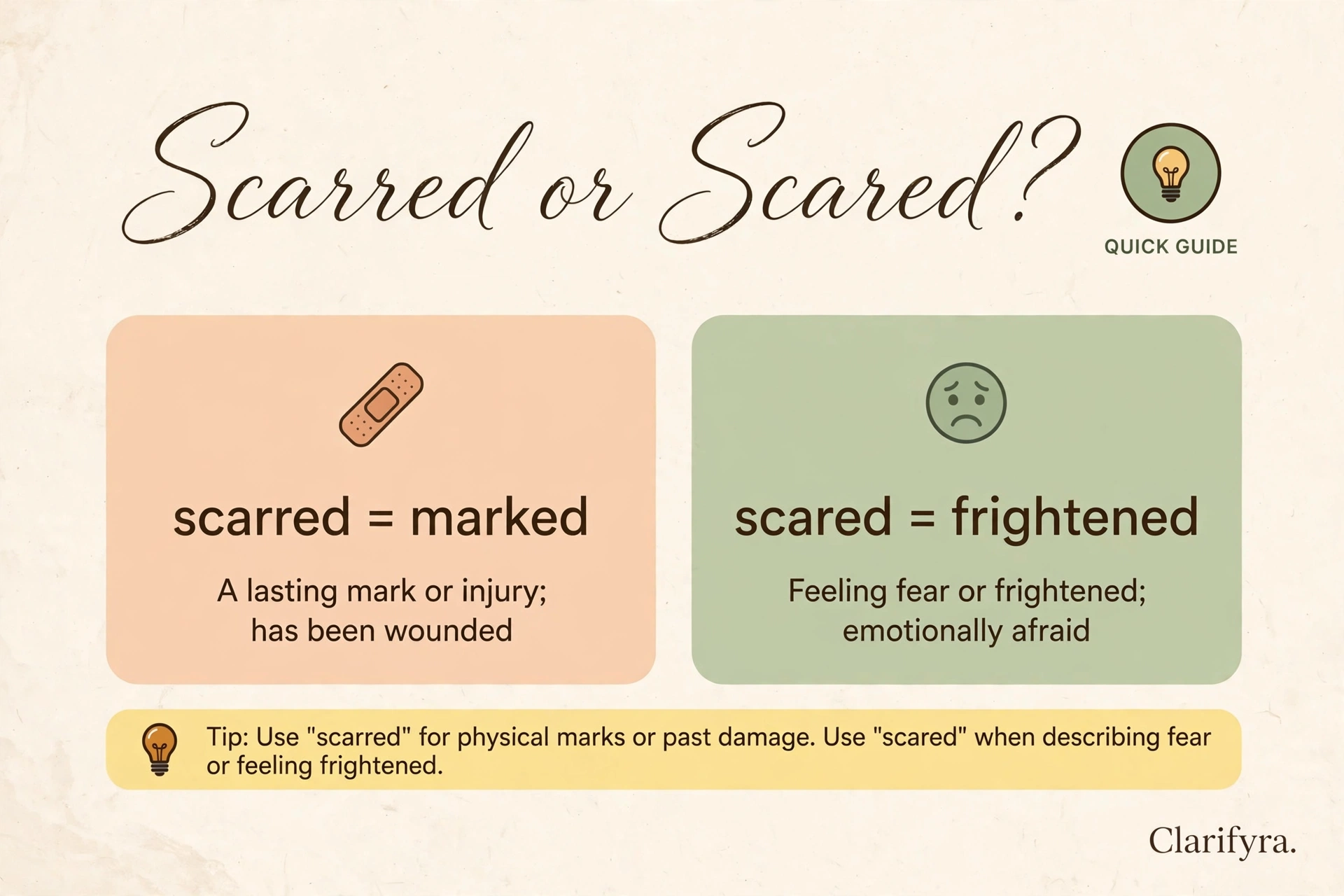
Scarred (with double r, from scar) means marked by a scar or lastingly damaged: “His face was scarred by acne”; “battle-scarred soldiers.” Pronounced “skard” — UK /skɑːd/, US /skɑːrd/, rhyming with card. Scared (single r in the base, from scare) means frightened: “I’m scared of spiders”; “too scared to move.” Pronounced “skaird” — UK /skeəd/, US /skerd/, rhyming with cared. If it still hurts to look at, it’s scarred; if the knees are shaking, it’s scared.
Scarred: The Mark That Stays
A scar is the mark tissue leaves behind after a wound closes, and scarred is built directly from it: scar + -ed, with the final consonant doubled because the base word ends in a single vowel plus a single consonant — the same doubling you see in barred, starred, and marred. Cambridge’s definition runs “(of skin) having a scar (= a mark left after an injury has healed), or several scars, on it,” and Merriam-Webster condenses it to “having or marked by a scar or many scars.”
Collins English Dictionary gives the core physical sense as “(of a surface) marked with scars,” illustrated by “the arena was scarred by deep muddy ruts” and “scarred wooden table tops.” That surface sense matters: scarred is not only about skin. Landscapes, furniture, and city districts can be scarred — marked by the pits, cuts, and burns that events have left in them. The figurative step is then short and well documented: “a wretched childhood that scarred his psyche” (The Free Dictionary’s example for the verb), “individuals who were scarred by addiction,” “a scarred landscape recovering slowly after a wildfire.”
The combining form is where scarred does its most recognizable modern work. Collins’ COBUILD entry explains that -scarred attaches to nouns like bullet and fire to mark physical damage — “a bullet-scarred bus,” “a lightning-scarred tree” — and to nouns like battle and drug to mark permanent effect on the mind: “battle-scarred soldiers,” “a war-scarred orphan.” Note the hyphen in these compounds and the permanence in both branches: whether the damage is to a surface or to a psyche, scarred claims the mark remains.
Pronunciation follows the base: scarred rhymes with card — Collins British skɑːd, American skɑrd. No standard variety pronounces it like scared.
As grammar, scarred is the past tense and participle of to scar (“The accident scarred her arm”) and a free-standing adjective (“his scarred face”). The thread is constant: something happened, and its trace is still visible — which is why emotional uses (“scarred by the experience”) claim the experience is over but not gone.
Scared: The Feeling of Fear
Scared comes from a different family altogether. The verb scare — Cambridge gives the verb’s pronunciation UK /skeər/, US /sker/ — means to frighten, and its past participle scared doubles as the ordinary adjective for the state fear produces. Collins COBUILD defines it plainly: “If you are scared of someone or something, you are frightened of them,” with the companion sense “nervous and worried because you think something unpleasant might happen.”
The Collins example sentences map the adjective’s whole grammar: “I’m certainly not scared of him”; “I was too scared to move”; “Why are you so scared?”; “I was scared that I might be sick”; “He was scared of letting us down.” Three frames carry nearly all real usage: scared of + noun or -ing (“scared of spiders,” “scared of being rejected”), scared to + infinitive (“too scared to answer the phone,” “scared to come and ask for help”), and scared that + clause (“scared that people were going to take pictures of me”). British usage adds the intensified idioms the dictionaries record — scared stiff, scared out of one’s wits, “shaking like a leaf” territory — all of them amped-up fear, none of them marks on skin.
Pronunciation separates the twins cleanly. Scared rhymes with cared: Collins prints British (skeəʳd) for the adjective and (skɛərd) for American English; Oxford-derived sources give UK /skɛːd/. The vowel is the SQUARE vowel — the one in hair, as Cambridge’s phonetic breakdown of scare shows with its /eə/ “as in hair” component — not the START vowel of scar. A British speaker saying “skaad” means the scar word; “skeuhd” (the non-rhotic UK rendering of /skeəd/) means the fear word. American speakers keep both rs: “skard” versus “skerd.” The pair is a true minimal pair in both accents.
The Two Words at a Glance
| Feature | Scarred | Scared |
|---|---|---|
| Base word | scar (a healed mark) | scare (to frighten) |
| Spelling logic | scar doubles its r before -ed: scarred | scare drops its e before -ed: scared |
| Meaning | Marked by scars; lastingly damaged | Frightened; afraid; worried |
| Pronunciation | UK /skɑːd/; US /skɑːrd/ — rhymes with card | UK /skeəd/ (also /skɛːd/); US /skerd/ — rhymes with cared |
| Typical partners | scarred face/skin/landscape, battle-scarred, scarred by | scared of, scared to, scared that, scared stiff |
| Time profile | Permanent or long-lasting mark | A feeling, usually of the moment |
| Memory hook | Scarred has the extra r — and a scar is a reminder that stays | Scared has one r — like the single shake of fear |
Psychological scarred is a metaphor built on the physical word, and dictionaries document it without apology: “scarred by addiction,” “scarred his psyche.” What is not correct is scared doing that work (“scared by his childhood”) or scarred for passing fright (“scarred by the noise”). Marks can be emotional; momentary fear does not leave a scarred.
Correct vs. Incorrect
- ✓ “His face was scarred from years of teenage acne.” (Collins example — lasting marks)
- ✗ “His face was scared from years of teenage acne.” → ✓ “scarred” (acne leaves marks, not fear)
- ✓ “I’m certainly not scared of him.” (Collins — fear)
- ✗ “I’m certainly not scarred of him.” → ✓ “scared of him” (the of frame belongs to fear)
- ✓ “She was too scared to move.” (fear of the moment)
- ✓ “The accident left her permanently scarred.” (lasting physical mark)
- ✓ “He was scared for his life.” (he feared he would die — correct and different)
- ✓ “He was scarred for life.” (the mark will never fully fade)
- ✗ “He was scared for life after the accident.” → ✓ “scarred for life” (permanence is the idiom’s whole point)
- ✓ “…battle-scarred soldiers.” (Collins — psychological permanence)
- ✓ “A scarred pine table stood in the middle of the floor.” (surface marked)
- ✗ “The children were scarred by the thunder.” → ✓ “scared by the thunder” (startled, not marked)
Common Mistakes
1. “Scared for life.” The single most frequent swap. Lifelong consequences — physical marks or durable psychological effects — are scarred for life. Unless the sentence literally means someone spent their whole life being afraid, which almost no writer intends, the double r is required.
2. Dropping an r under time pressure. Because scared is the more frequent word in everyday text, fingers produce it automatically mid-sentence: “a scared landscape,” “emotionally scared.” Read the sentence back with the rhyme test — say card or cared aloud — and the error announces itself.
3. Using scarred for startle. “I was scarred when the door slammed” overclaims: a slammed door frightens; it does not mark. Keep scarred for consequences that outlast the event, or the word’s force drains away for every reader who checks.
4. Missing the hyphen in compounds. Attributive compounds take the hyphen in the style the dictionaries print: battle-scarred soldiers, a bullet-scarred bus, a war-scarred orphan. “Battlescarred” and “battle scarred veterans” (attributive, unhyphenated) both jar; hyphenate before the noun, and leave it open after a linking verb (“the soldiers were battle scarred” is acceptable in many house styles).
5. Confusing scaring and scarring. The present participles reproduce the same doubling logic: scaring (frightening, one r) versus scarring (marking, two). “The horror film is scaring the children” and “The burn is scarring badly” are a minimal pair of their own, and autocorrect will happily give you the wrong one.
6. Assuming the psychological sense needs quotation marks or apology. It does not. Cambridge, Collins, and Merriam-Webster all carry the marked/lasting senses without a “figurative” stigma in modern entries, and corpus examples (“scarred by addiction,” “scarred his psyche”) are unmarked prose. Use it straight — just reserve it for effects you are genuinely claiming are lasting.
Frequently Asked Questions
Is it “scarred for life” or “scared for life”?
Scarred for life. The idiom claims a permanent mark, physical or psychological, and permanence is the scar word’s territory. “Scared for life” would mean frightened for one’s whole life and is a misspelling in the idiom’s normal use.
How do you pronounce scarred and scared?
They rhyme with different words. Scarred rhymes with card: Collins gives British /skɑːd/ and American /skɑːrd/. Scared rhymes with cared: Collins gives British (skeəʳd) and American (skɛərd); Cambridge’s breakdown of scare shows UK /skeər/, US /sker/. The vowel — START in scarred, SQUARE in scared — is the whole audible difference.
Why does scarred have two rs when scared has one?
Ordinary spelling rules. Scar ends in a short vowel plus one consonant, so the consonant doubles before -ed (like barred, starred) to keep the vowel short: scarred. Scare ends in silent e, which drops before -ed (like cared, dared): scared, keeping the single r of its base.
Can scarred be used for emotional damage?
Yes — that use is dictionary-documented, not slang: “a wretched childhood that scarred his psyche,” “battle-scarred soldiers,” “scarred by addiction.” The requirement is permanence: the emotional effect must be presented as lasting. For fear that passes, use scared.
Is “scared of” or “scared by” correct?
Both, for different jobs. Scared of names the feared thing: “scared of spiders,” “scared of letting us down” (Collins). Scared by names the fright’s cause in a passive-like frame: “children scared by the thunderstorm.” Neither frame accepts scarred in the fear sense; scarred by, by contrast, introduces the damaging agent: “scarred by acne,” “scarred by deep muddy ruts.”
The Takeaway
Scarred — double r, from scar, pronounced like card (UK /skɑːd/; US /skɑːrd/) — means marked by a scar or lastingly damaged, on skin, on surfaces, or in the mind: “his scarred face,” “battle-scarred soldiers,” “scarred for life.” Scared — single r, from scare, pronounced like cared (UK /skeəd/; US /skerd/) — means frightened: “scared of spiders,” “too scared to move,” “scared stiff.” Let permanence arbitrate: if the mark outlives the moment, write scarred; if only the fear is real, write scared.