Analyses or Analysis: What’s the Difference?
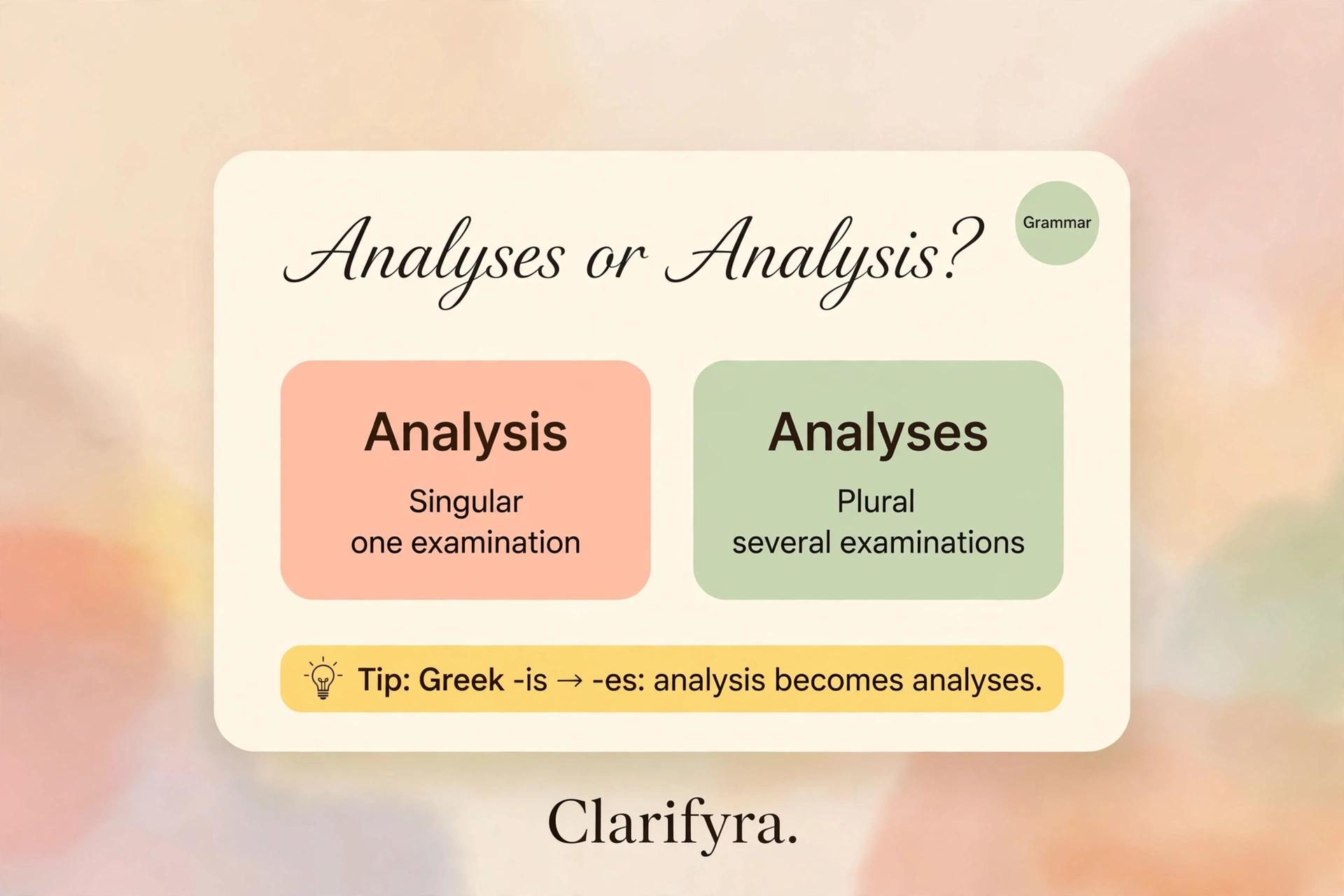
Analysis is the singular noun — one detailed examination (“an analysis of the data”). Analyses is its plural — more than one (“two analyses of the data”). They’re pronounced differently too: analysis ends in /-sɪs/ (“uh-NAL-uh-siss”), while analyses ends in /-siːz/ (“uh-NAL-uh-seez”). And there’s a twist: in British English, analyses is also the third-person singular of the verb analyse (“she analyses the data”).
Quick Answer
Analysis (singular, /əˈnæləsɪs/) = one examination: “a careful analysis.” Analyses (plural, /əˈnæləˌsiːz/) = more than one: “several analyses.” Collins lists analysis as the headword with “Word forms: plural analyses,” and gives analyses its own entry: “plural noun. See analysis.” This is the Greek -is → -es plural pattern (crisis/crises, thesis/theses, hypothesis/hypotheses). Bonus wrinkle: in British English the verb is analyse, so analyses is also “she analyses the data” — in American English the verb is analyze, giving “she analyzes the data.”
Analysis: The Singular
Analysis is a singular countable noun meaning a detailed examination of something — breaking a complex whole into parts to understand it. Collins’s British entry gives the pronunciation (əˈnælɪsɪs) and the American entry (əˈnæləsɪs); either way, it’s “uh-NAL-uh-siss” with a hissing s at the end.
Use it when you mean one: “the report contains a thorough analysis of sales figures,” “blood analysis,” “in the final analysis” (that last one is an idiom meaning “when everything is considered”). As a mass noun it can also mean the activity in general: “the job involves a lot of data analysis.”
The word’s history explains its odd plural. Collins dates it to the 16th century, from New Latin, from Greek analusis — literally “a dissolving” or “a loosening up” — from analuein (ana-, “up,” + luein, “to loosen”). Greek loanwords brought their Greek plurals with them, which is why analysis doesn’t pluralize the English way.
Analyses: The Plural
Analyses is the plural of analysis — two or more examinations. Collins gives it its own headword entry (“plural noun. See analysis“) with the pronunciation (ənælɪsiːz) in British English and (əˈnæləˌsiz) in American English: “uh-NAL-uh-seez,” with a buzzing z sound at the end.
That pronunciation shift is the whole trick of the Greek -is → -es family: the singular ends in a voiceless /sɪs/, the plural in a voiced /siːz/. It’s the same pattern across the family:
| Singular (/-sɪs/) | Plural (/-siːz/) |
|---|---|
| analysis | analyses |
| crisis | crises |
| thesis | theses |
| diagnosis | diagnoses |
| hypothesis | hypotheses |
| parenthesis | parentheses |
| basis | bases |
Note the spelling change is -is → -es (analysis → analyses), not -is → -ies. The most common misspelling in this family is writing “analysies” — that form doesn’t exist. Swap the i for an e and keep the final s: analyses.
The Verb Wrinkle: “She Analyses the Data”
Here’s the complication that makes this pair more interesting than a simple singular/plural question. In British English, the verb is spelled analyse — and its third-person singular present tense is analyses: “she analyses the results every quarter.” So in British writing, analyses does double duty: plural noun (“the analyses are complete”) and verb form (“she analyses data”).
In American English, the verb is analyze, so the third-person form is analyzes with a z: “she analyzes the results.” An American reader seeing “she analyses the data” may read it as a plural noun used wrongly — another reason to match your spelling to your audience.
Context almost always disambiguates: “the analyses show” (plural noun, before a verb) versus “she analyses the figures” (verb, after a subject). But in a headline or a fragment — “Analyses complete” — the British reader sees a noun and the American reader may stumble. When in doubt, recast: “the analysis is complete” or “her analysis is complete.”
Correct vs. Incorrect
- ✓ “The committee published its analysis of the results.” (one examination)
- ✓ “The committee published three separate analyses.” (plural)
- ✗ “The committee published three separate analysis.” → ✓ “…three separate analyses.”
- ✗ “The committee published its analyses of the results.” → ✓ “…its analysis…” (one committee, one examination)
- ✗ “Several analysies were conducted.” → ✓ “Several analyses were conducted.” (no such word as “analysies”)
- ✓ “She analyses the data weekly.” (UK verb) / ✓ “She analyzes the data weekly.” (US verb)
- ✗ “She analysis the data weekly.” → ✓ “She analyses…” (UK) or “she analyzes…” (US)
Possessives: Analysis’s, Analysis’, Analyses’
Possessives follow the standard rules once the singular/plural is settled. The singular possessive is analysis’s (“the analysis’s conclusion”) — or analysis’ in house styles that drop the s after an s-ending singular. The plural possessive is analyses’: “the analyses’ findings were consistent.” Get the base form right first; the apostrophe then falls into place.
Analysis in Idioms and Compounds
Analysis also lives in fixed phrases where the singular/plural question never arises — useful to recognize so you don’t “correct” them:
- In the final analysis — “when everything has been considered”: always singular, always with the.
- Analysis paralysis — overthinking to the point of inaction: singular, uncountable.
- Psychoanalysis — the Freudian therapeutic method; its practitioner is a psychoanalyst, and a single session’s write-up would be “an analysis” only in the general sense.
- Data analysis / systems analysis — the field or activity, used as a mass noun: “she works in data analysis.” No plural needed because you’re naming the discipline, not counting examinations.
The related agent noun is analyst (“a financial analyst,” “systems analyst“) — and note its spelling keeps the y: analy-st, from the same Greek root. If you can keep analysis/analyst/analytic straight as one word family, the plural analyses stops feeling like an exception and starts feeling like the family rule.
Common Mistakes
1. Using “analysis” as a plural. The single most common error: “we ran several analysis on the samples.” One examination is an analysis; several are analyses. If there’s a number or “several”/”multiple” in front of it, you almost certainly want analyses.
2. Writing “analysies.” The -ies plural rule (city/cities, study/studies) doesn’t apply to Greek -is words. Analysies is never correct — the plural is analyses, swapping i for e.
3. Mixing up the verb: “she analysis the data.” Analysis is never a verb. The verb is analyse (UK) or analyze (US); the third-person form is analyses (UK) or analyzes (US).
4. Pronouncing the plural like the singular. “Uh-NAL-uh-siss” for both is a common spoken slip. The plural buzzes: “uh-NAL-uh-seez.” Getting the /s/ → /z/ shift right marks you as someone who knows the word.
5. Confusing this pair with other irregular plurals. Analysis/analyses follows the Greek -is → -es rule — the same family as crisis/crises and thesis/theses. It’s a different pattern from Latin -ix → -ices words like matrix/matrices or index/indices; don’t mix the families.
Frequently Asked Questions
Is “analyses” singular or plural?
Plural — it’s the plural of the noun analysis. The one exception: in British English, analyses is also the third-person singular of the verb analyse (“she analyses”). In American English that verb form is analyzes.
How do you pronounce “analyses”?
/əˈnæləˌsiːz/ — “uh-NAL-uh-seez,” with a long ee and a buzzing z at the end. Collins gives (ənælɪsiːz) for British and (əˈnæləˌsiz) for American English; both end in the z sound. The singular analysis ends in a hissing “siss.”
Can “analysis” ever be plural?
No. Analysis is always singular as a count noun (“an analysis,” “the analysis”). When it looks plural — “data analysis,” “systems analysis” — it’s being used as a mass/attributive noun for the activity, not as a plural of examinations.
What’s the difference between “analyse” and “analyze”?
Just regional spelling of the verb: analyse is British, analyze is American. The noun analysis and its plural analyses are spelled identically in both varieties — only the verb (and its third-person form, analyses vs. analyzes) differs.
Why isn’t the plural “analysises”?
Because analysis is a Greek loanword that kept its Greek plural: -is becomes -es (like crisis/crises). Adding an English -es on top (“analysises”) doubles the plural marking — it’s never standard.
The Takeaway
Analysis is one examination (“an analysis”); analyses is more than one (“several analyses”), pronounced with a buzzing -seez ending. Remember the Greek -is → -es pattern — never “analysies,” never “analysises” — and watch for the British verb form: “she analyses the data” (UK) versus “she analyzes the data” (US). Singular or plural first; everything else follows.