Suit or Suite: What’s the Difference?
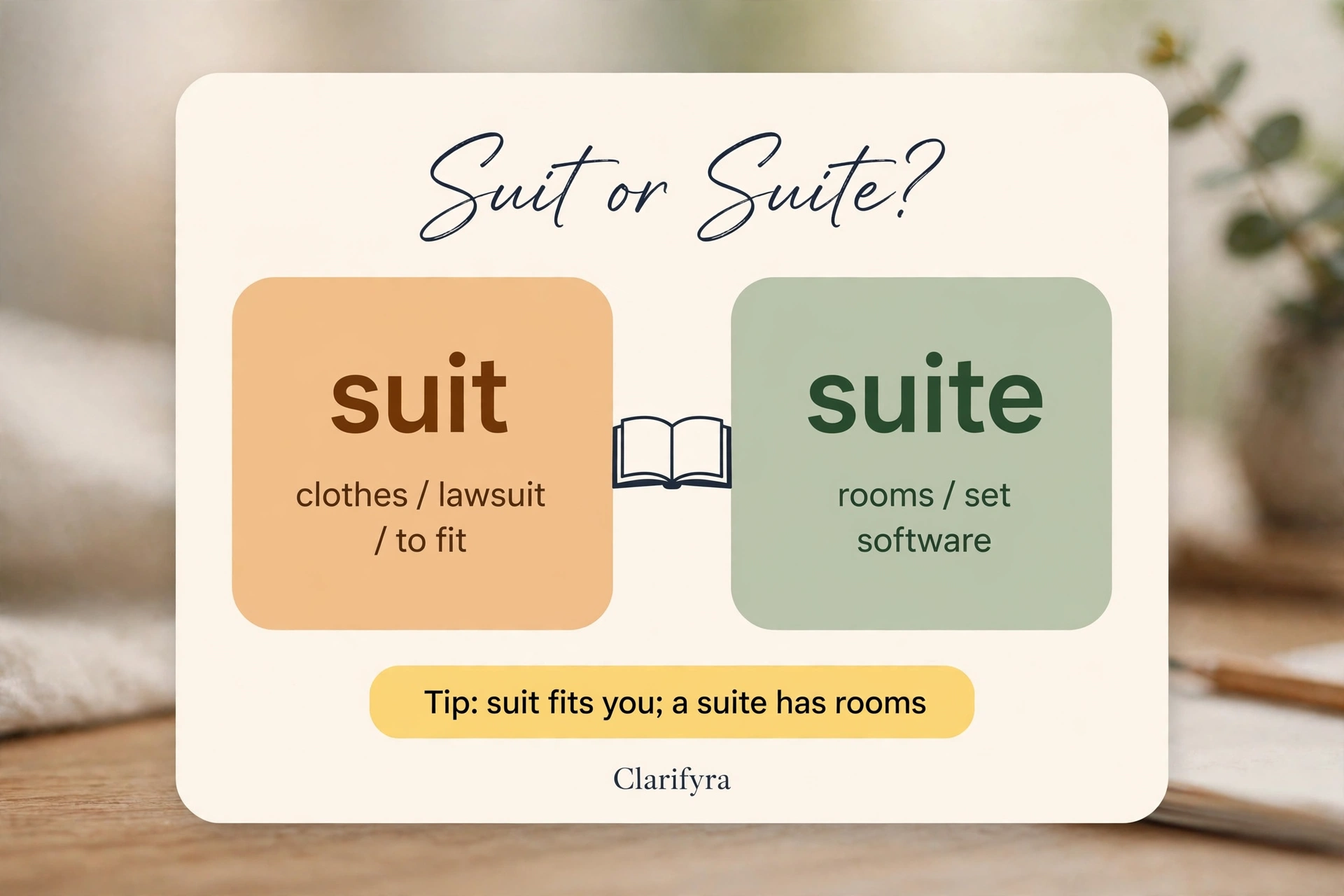
Suit is what you wear to a wedding; suite is where you sleep the night before it. One letter and one w apart, they’re a classic pair of near-homophones — and people swap them constantly: “bridal suit,” “office suit,” “follow suite.” Here’s the short version: suit (/suːt/ in British English, /sut/ in American English) is a set of clothes worn together — and also a lawsuit, a card suit, and a verb meaning “to be convenient or appropriate.” Suite (/swiːt/ UK, /swit/ US) is a noun only: a connected set of rooms (a hotel suite), a set of matched furniture (a three-piece suite), a multi-movement piece of music, or a set of programs designed to work together (a software suite).
Quick Answer
Suit is both noun and verb: a set of clothes worn together, one of the four card suits, or a lawsuit (“file suit”); to suit means to be convenient or appropriate (“Would Monday suit you?”). Suite is a noun only — a set of things designed to be used together: a connected set of rooms (“the honeymoon suite”), matched furniture (“a three-piece suite,” mainly UK), a piece of music in several movements, or a set of programs sold as one unit (“an office suite”). They share an ancestor — Old French suite, from Latin sequi, “to follow” — but they are different words with different jobs.
What “Suit” Means: The One You Wear (and File)
Suit works as noun and verb — and the noun’s senses only make sense together once you know the history.
As a noun, suit is a set — or a case. The primary sense is a set of clothes designed to be worn together: jacket with matching trousers or skirt (the three-piece adds a waistcoat), plus purpose-built outfits like a diving suit or spacesuit. The same “matched set” idea gives the card sense: one of the four suits — hearts, diamonds, clubs, spades (Collins, Oxford). Then comes the legal sense, from the word’s oldest meaning: a claim or complaint made in court (Oxford), with collocations like file suit, a divorce suit, and the compound lawsuit. Slang adds one more: the suits — executives or managers, “usually a term of mild derision” (Webster’s New World).
As a verb, to suit means to fit the circumstances. Collins: if something suits you, “it is convenient for you or is the best thing for you in the circumstances” (“Would Monday suit you?”); if clothes suit you, they make you look attractive. Oxford’s idioms add two everyday phrases built on the noun: be somebody’s strong suit — a subject somebody knows a lot about — and, humorously, in your birthday suit — not wearing any clothes.
Oxford gives /suːt/ for British English and /sut/ for American English (Collins’s American entry agrees). Forms are regular: suits, suited, suiting.
What “Suite” Means: The Set That Goes Together
Suite is a noun only in the dictionaries checked here — none of them lists a verb to suite — and every sense means a set of things designed to be used together:
- A connected set of rooms. Cambridge: “a set of connected rooms, especially in a hotel” — the honeymoon suite, the presidential suite, a suite of offices. Merriam-Webster extends it to medicine: “a group of rooms in a medical facility dedicated to a specified function or specialty” — a surgical suite. (The French borrowing en suite — a bathroom joined directly onto a bedroom — belongs to this sense.)
- Matched furniture — Cambridge marks this one “mainly UK”: “I’ve ordered a new three-piece suite for the living-room” — a sofa with matching armchairs (Collins). Note the trap: a three-piece suit is clothing; a three-piece suite is furniture.
- A piece of music in several movements — “an instrumental composition in several movements less closely connected than a sonata” (Collins); the older baroque sense is a series of dances in the same key. Bach’s cello suites are the textbook example.
- A set of programs designed to work together — “usually sold as a single unit” (Merriam-Webster): an office suite, a security suite.
- A retinue — “the personal staff accompanying a ruler, diplomat, or dignitary on official business” (Merriam-Webster): the oldest sense in English, and the closest to the word’s origin.
The plural is regular: suites.
Suit vs Suite at a Glance
| Word | Part of speech | Pronunciation | Core meanings | Example |
|---|---|---|---|---|
| suit | noun and verb | UK /suːt/; US /sut/ | set of clothes; card suit; lawsuit; to suit = be convenient or appropriate | “He wore a grey suit to the interview”; “Would Monday suit you?” |
| suite | noun only | UK /swiːt/; US /swit/ | set of rooms; matched furniture; multi-movement music; software collection; retinue | “They booked the honeymoon suite”; “an office suite” |
Pronunciation: Near-Homophones, Not Identical
Oxford gives /suːt/ and /sut/ for suit (BrE/AmE); Cambridge gives /swiːt/ and /swit/ for suite (UK/US), and Collins agrees. The difference is the /w/: suite starts with a sw- glide, suit does not — so suite is pronounced “sweet,” and suite and sweet are true homophones (both /swiːt/), while suit only rhymes with them loosely.
There is exactly one verified exception. Merriam-Webster records that sense 2d of suite — the matched-furniture sense — is “also ˈsüt”: some American speakers pronounce three-piece suite (furniture) to rhyme with suit. Every other sense stays “sweet”-sounding in every dictionary.
The Same Ancestor: Why They Look Alike
The resemblance is not a coincidence: suit and suite are the same word borrowed twice. Collins dates suit to the 13th century, “from Old French sieute, set of things, from sivre to follow.” Oxford traces it through Middle English and Anglo-Norman French siwte to Latin sequi “follow,” noting the early senses “attendance at a court” and “legal process,” with the clothing, card, and other “set” senses deriving from an earlier “set of things to be used together.” Merriam-Webster’s chain runs from Middle English sute, seute (“pursuit, retinue, set, legal action”) through Anglo-French siute, suite to Vulgar Latin *sequita, from sequere, “to follow” — first known use, 14th century.
Suite is the same French word coming back around. Collins dates it to the 17th century — “from French, from Old French sieute; see suit” — and Merriam-Webster agrees (“French, from Old French siute, suite,” first known use 1579). The shared “follow” root is why both still mean “a set”: a suit of clothes is a set that goes together, a card suit a set that runs together, a suite of rooms a set you move through in sequence — and the retinue sense is literally a following.
Correct vs Incorrect
The working test: can you wear it, file it, or play it? Then it’s suit. Is it a set of things used together — rooms, furniture, music, programs? Then it’s suite.
- ✗ “They booked the bridal suit.” → ✓ “They booked the bridal suite.” (A set of hotel rooms — Merriam-Webster’s example is “We stayed in the hotel’s honeymoon suite.”)
- ✗ “The other airlines will follow suite.” → ✓ “The other airlines will follow suit.” (The idiom comes from card-playing and is always spelled with suit — see below.)
- ✗ “She bought a three-piece suit for the lounge.” → ✓ “She bought a three-piece suite for the lounge.” (Matched furniture — mainly UK. A three-piece suit is clothing: jacket, trousers, waistcoat.)
- ✓ “He filed suit against the company.” (Lawsuit — the legal sense, no clothing involved.)
- ✓ “Long hair suits her; short meetings suit me.” (The verb — be flattering, be convenient.)
Common Mistakes
1. Writing “bridal suit” or “honeymoon suit.” The classic hotel-booking error. The set of rooms is the bridal suite / honeymoon suite — always with the i. A “bridal suit” would be something the bride wears.
2. Writing “follow suite.” The idiom follow suit uses the card-suit spelling — Merriam-Webster: (1) “to play a card of the same suit as the card led,” (2) “to follow an example set” (first known use 1643); Cambridge and Oxford agree. So “one airline cut fares and the others followed suit” — never suite.
3. Writing “software suit” or “office suit.” A collection of programs is a suite (Merriam-Webster: “designed to work together and usually sold as a single unit”; Cambridge’s COMPUTER sense). “Office suite” is the programs; the people using them wear suits.
4. Pronouncing “suite” as “suit” in every context. The dictionaries keep them apart by the /w/ — UK /swiːt/ vs /suːt/, US /swit/ vs /sut/. The only sanctioned overlap is Merriam-Webster’s American furniture-sense variant (ˈsüt). Everywhere else, “suite” sounds like “sweet.”
5. Assuming “suite” is just a fancier spelling of “suit.” It isn’t — it’s a separate 17th-century borrowing, it’s noun-only in the dictionaries checked here, and none of them records a verb to suite. You can suit yourself (do as you please); you cannot suite yourself.
6. Guessing at “en suite” from sound. It’s en suite — the bathroom joined onto a bedroom — with the i intact. Writing “en suit” turns a bathroom into an outfit.
Frequently Asked Questions
Is it “follow suit” or “follow suite”?
Follow suit — always the clothing spelling. It comes from card games: playing a card of the same suit as the card led (Merriam-Webster sense 1), extended figuratively to “follow an example set” (“when one airline lowers its fares, the others usually follow suit”). Merriam-Webster dates its first known use to 1643.
Can “suit” be a verb?
Yes — and suite cannot. Collins: if something suits you, “it is convenient for you or is the best thing for you in the circumstances” (“Would Monday suit you?”); if clothes suit you, they make you look attractive. The dictionaries checked here list suite as a noun only, so “the arrangement suites me” is an error — it’s “suits me.”
What’s the difference between a “three-piece suit” and a “three-piece suite”?
One you wear, one you sit on. A three-piece suit is clothing: jacket, trousers, and waistcoat in the same fabric. A three-piece suite — mainly UK usage, per Cambridge — is furniture: typically a sofa and two matching armchairs. Both are standard in their own domain — which is exactly why they get swapped.
Is “suite” ever pronounced like “suit”?
Almost never — the /w/ is the consistent difference (UK /swiːt/ vs /suːt/; US /swit/ vs /sut/, per Cambridge, Oxford, and Collins). The one verified exception is Merriam-Webster’s note that the matched-furniture sense of suite is “also ˈsüt” — some American speakers say “three-piece suite” to rhyme with “suit.” No other sense carries that variant.
What are the plurals?
Regular: suits (clothes, lawsuits, card suits) and suites (hotel, furniture, software). The verb suit inflects suits, suiting, suited (Collins).
The Takeaway
Suit is the wearable, fileable, playable one: a set of clothes, a lawsuit, a card suit — and the verb to suit, meaning to be convenient or becoming. Suite is the set that goes together: rooms, matched furniture, movements of music, programs, a retinue — noun only, pronounced “sweet.” They’re the same Old French word (sieute/siute, from Latin sequi, “to follow”) borrowed four centuries apart, which is why both still mean “a set.” When in doubt, ask whether you could put it on: if yes, it’s a suit — the wedding outfit, not the room you sleep in after it.