Syphon or Siphon: Which Spelling Is Correct?
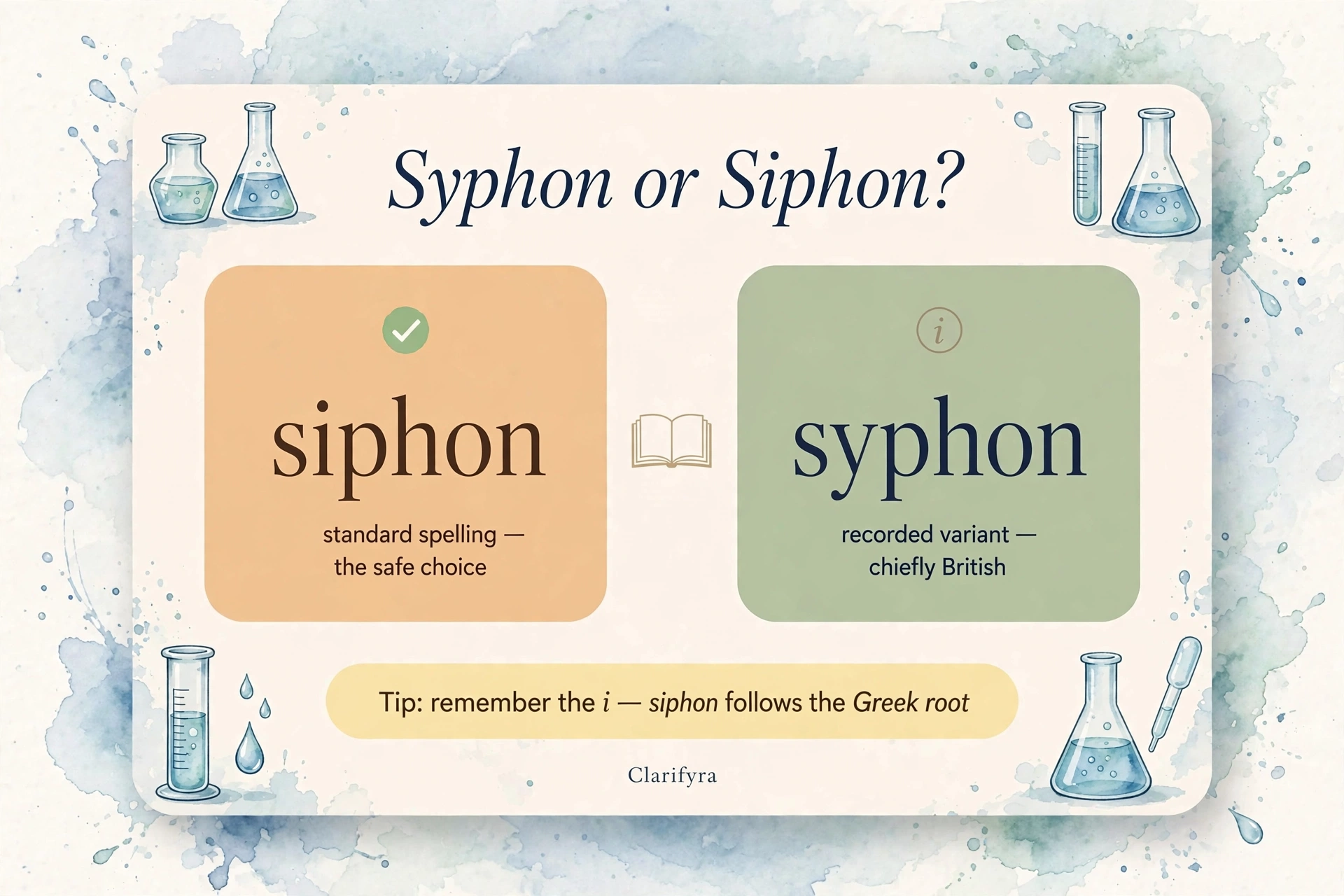
Both syphon and siphon turn up in English writing, and they point at the same thing — the bent tube that draws liquid up and over into a lower container. The short answer: siphon, with an i, is the standard spelling in every major dictionary. Syphon, with a y, is not a mistake invented by careless spellers — it is a genuine, dictionary-recorded variant — but it is the secondary spelling, and using it where readers expect siphon can make your writing look uncertain.
Quick Answer
Siphon is the standard spelling, noun and verb: a tube that draws liquid from one container down into another, or the act of drawing something off through such a tube — liquid, or, figuratively, money. Syphon is a recorded variant spelling with identical meaning and pronunciation (/ˈsaɪfən/): Collins lists it as a British English variant, and Merriam-Webster calls it a “less common spelling.” If you want one spelling that is right in every situation, use siphon.
What “siphon” means
As a noun, a siphon is a tube placed with one end in a vessel of liquid and the other end outside the vessel below that level, so that liquid pressure forces the liquid through the tube and out by gravity. Oxford Learner’s Dictionaries defines it plainly as “a tube that is used to move liquid from one container down into another, lower container.” The word also names the familiar carbonated-water dispenser (the soda siphon) and, in zoology, any of several tubular organs in aquatic animals through which fluid passes.
As a verb, siphon means to draw liquid through such a tube, often with off: “I siphoned the gasoline out of the car into a can,” or “The waste liquid needs to be siphoned off” (both Oxford examples). It also has a well-established figurative sense, marked informal by Oxford: to remove money or resources and redirect them, usually dishonestly. Collins gives the flavour of it: “He had siphoned thousands of pounds a week from the failing business.” The verb’s forms are siphons, siphoning, siphoned.
What “syphon” actually is — the honest dictionary answer
The y-spelling is a variant, not a misspelling, and the four leading dictionaries are remarkably consistent about its status. Here is what each one actually says, checked before this article was written:
| Dictionary | How it records “syphon” |
|---|---|
| Cambridge | Gives syphon its own entry: the noun is defined as “a siphon” and the verb redirects to siphon. Pronunciation is identical to siphon (/ˈsaɪfən/, UK and US). |
| Oxford Learner’s | Lists siphon “(also syphon)” and syphon “(also siphon)” — each entry cross-refers to the other, with no regional label and the same pronunciation (/ˈsaɪfn/). |
| Collins | Lists syphon under “British English” as “a variant spelling of siphon.” |
| Merriam-Webster | Lists syphon as a “less common spelling of siphon.” |
The honest summary: no dictionary surveyed here calls syphon wrong, but all four headword siphon and treat the y-form as the junior partner. Collins is the only one of the four to pin a regional label on it, marking it as British English. That is worth stating plainly, because it corrects two lazy claims you will find online: that “syphon is not a word” (it is — all four dictionaries list it) and that “syphon is the British spelling” as if the two were equal regional alternatives (no dictionary presents them that way; siphon is the primary spelling on both sides of the Atlantic).
One genuine exception deserves mention. In its entry for the soda-siphon bottle — the pressurised bottle that dispenses aerated water — Merriam-Webster notes the spelling is “usually syphon.” So the y-form still has a traditional home in that one sense, a leftover of older usage that never fully converted to the i-form.
Why both spellings exist
The word’s root is Greek siphōn, meaning “pipe” — spelt with an iota, so the i-form is the one that follows the Greek most faithfully. Oxford traces it into English in late Middle English “from French, or via Latin from Greek siphōn ‘pipe’,” with the verb arriving in the mid-19th century; Merriam-Webster’s etymology runs French siphon ← Latin siphon-/sipho ← Greek siphōn, and dates the noun’s first known English use to 1659. Collins likewise gives a 17th-century origin from Latin sīphō and Greek siphōn.
How the y crept in is a murkier story, and the dictionaries do not tell it — they record the variant without narrating its birth. What can be said safely is that English has a long habit of y/i doublets in words of Greek origin, and that the y-form of this word became established enough in British writing to be enshrined as a variant in British dictionaries. Encyclopaedia Britannica’s current article hedges in exactly the way the evidence supports: “Siphon, also spelled syphon.” The i-form is the root-faithful, dictionary-headworded, internationally standard spelling; the y-form is the historically established British variant.
Which spelling should you use?
Use siphon. It is never wrong: it is the headword in Cambridge, Oxford, Collins, and Merriam-Webster, and it is accepted without comment in British, American, and international English. Syphon is defensible in British writing — you will still meet it in plumbing contexts and older texts — but it is always the marked, less-expected choice, and to some readers (especially American ones) it simply looks like a typo. In exams, academic writing, and professional documents, siphon is the safest choice.
The one place where the y earns its keep is the vintage soda-siphon bottle, where Merriam-Webster records syphon as the usual spelling. Everywhere else, pick the i and be done with it.
Correct and incorrect
- ✓ “He siphoned petrol from the tank into a can.”
- ✓ “Millions of pounds were siphoned off into private accounts.”
- ✓ “The plumber replaced the siphon in the cistern.”
- ✗ “He syphoned petrol from the tank.” — A recorded variant, but siphoned is the spelling every dictionary prefers; in formal writing, the y here reads as an error.
- ✗ “She bought a siphone for the bar.” — The e-ending spellings siphone and syphone are simply misspellings; neither spelling is listed in the dictionaries checked here (Cambridge, Oxford Learner’s, Merriam-Webster, Collins).
Note the inflection rule: whichever vowel you choose, keep it consistent through the verb’s forms — siphoning / siphoned with an i, or syphoning / syphoned with a y (both verb forms are recorded by Oxford). Mixing them (“siphon” the noun, “syphoned” the verb) looks like a slip even where the y-variant is accepted.
Common mistakes
1. Insisting “syphon” is always wrong. It overstates the case. Correcting a British writer’s syphon to siphon is good style advice; calling it an outright error misdescribes what the dictionaries say.
2. Mixing the two spellings in one document. Pick the i-form and stick to it. Alternating between siphon and syphon reads as inconsistency even in writing where the variant would be tolerated.
3. Carrying the y into related technical terms. The related technical terms (siphonage, siphonal, siphonic, and siphonophore) are listed with i in the dictionaries checked here.
4. Pronouncing them differently. Both spellings are /ˈsaɪfən/ (“SY-fuhn”) in British and American English alike — Cambridge and Oxford give identical pronunciations for the two forms. There is no “sy-phon” with a different vowel.
Related words
| Word | What it means | Spelling note |
|---|---|---|
| siphonage | The action or process of siphoning. | Listed with i in the dictionaries checked here. |
| siphonal / siphonic | Adjectives meaning “relating to or acting like a siphon.” | Listed with i in the dictionaries checked here. |
| siphonophore | A colonial marine animal such as the Portuguese man-of-war; from Greek siphōnophoros, “tube-bearing.” | Listed with i in the dictionaries checked here (Merriam-Webster, Collins). |
| soda siphon | The pressurised bottle for aerated water. | Merriam-Webster notes this sense is “usually syphon” — the y’s last stronghold. |
Frequently asked questions
Is “syphon” a word?
Yes. It appears as a listed entry or cross-referenced variant in Cambridge, Oxford Learner’s, Collins, and Merriam-Webster. What it is not is the standard word: every one of those dictionaries headwords siphon and presents syphon as the less common or variant spelling.
Why do both spellings exist?
The word comes from Greek siphōn (“pipe”), via Latin and French, entering English in the 1600s. The i-form follows the Greek root; the y-form is an established British variant that the dictionaries record without fully explaining. Both have been in circulation for centuries — the variant is old, not a modern typo.
Is “syphon” British and “siphon” American?
Not exactly. Of the four dictionaries checked, only Collins labels syphon a “British English” variant spelling; siphon is the primary, headworded spelling in British and American dictionaries alike. Describing them as equal regional alternatives (like colour/color) overstates the y-form’s standing — think of it as a recognised variant that you are most likely to meet in British writing, not as Britain’s official spelling.
Does the spelling change the meaning?
No. Syphon and siphon mean exactly the same thing in every sense — the tube, the verb, and the figurative “siphon off” sense. The difference is purely one of spelling convention.
How do you pronounce “syphon” and “siphon”?
Identically: /ˈsaɪfən/ (“SY-fuhn”), with the same pronunciation in British and American English. Cambridge and Oxford give the same transcription for both spellings, so the y-vs-i choice is invisible in speech.
Which spelling should I use in exams or formal writing?
Siphon. It is the headword spelling in all four major dictionaries and is accepted without question everywhere. Syphon risks being marked as an error by anyone who does not know its variant status.
Takeaway
Siphon is the standard spelling — noun, verb, and all its derivatives — and it is correct in every variety of English. Syphon is a real word with real dictionary entries, a recognised (chiefly British) variant, but it is never the safer choice. Remember the i: the spelling that follows the Greek root is the one every dictionary puts first.