Cancel or Cancelled: Which Is Correct?
If you’re torn between cancel and cancelled, the reassurance is that both are real words — they’re just different forms of the same verb. Cancel is the base form: the one you use with to, after modal verbs like will and can, and for the present tense. Cancelled is the past tense and past participle — but only in British English. In American English, those forms are spelled canceled, with one l. The error people actually make isn’t picking the wrong one of these two spellings; it’s using the past form where the base form belongs, or mixing British and American spellings in the same piece of writing.
Quick Answer
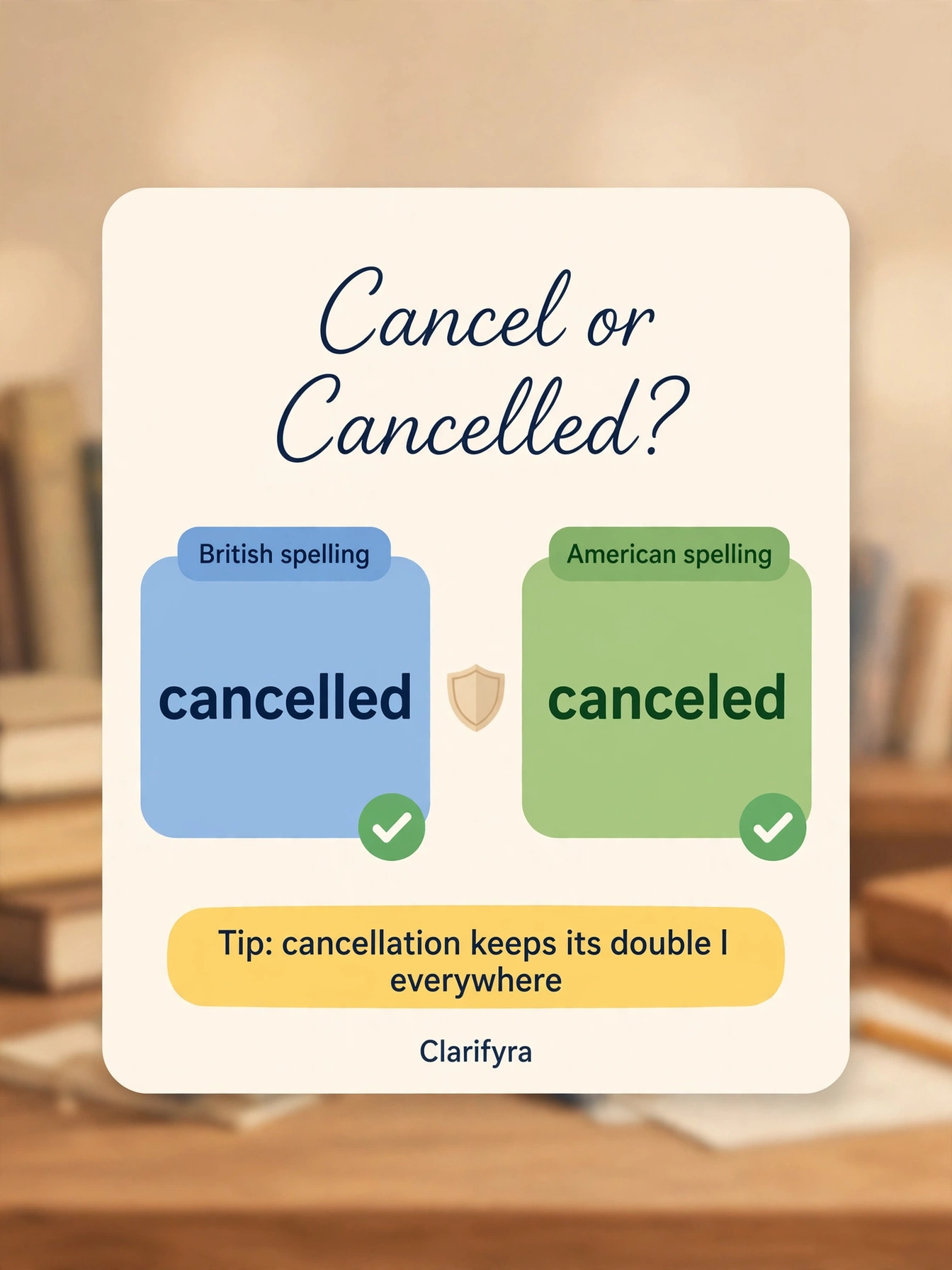
Cancel is the base form of the verb (“I will cancel“); cancelled is the past tense and past participle in British English, canceled in American English. Oxford Learner’s lists the past as cancelled with US canceled alongside it; Merriam-Webster says canceled and canceling are typical in the United States, cancelled and cancelling everywhere else. The third person is cancels in both varieties, and the noun cancellation keeps its double l everywhere.
Cancel and Cancelled Are Different Verb Forms
The first thing to settle is that this pair is not a spelling choice at all — it’s grammar. Cancel is the form you use when the verb is unfinished or general: after to (“they decided to cancel the event”), after modal verbs (“you can cancel anytime,” “we should cancel the booking”), in the imperative (“cancel my subscription”), and for the present tense with I/you/we/they (“I cancel subscriptions I don’t use”). Cancelled is what you use when the action is finished or describes a completed state: the simple past (“she cancelled her appointment yesterday”) and the past participle (“the meeting has been cancelled,” “a cancelled check” — Merriam-Webster’s example uses the American spelling, “a canceled check”).
This is where most mistakes come from: writers who are unsure whether a sentence needs the base form or the past reach for cancelled by default. The test is simple: can you substitute another regular verb and hear whether the sentence wants the plain form or the past? “I will cancelled the order” fails the same way “I will booked the order” fails — the modal verb demands the base form, so it’s “I will cancel the order.”
The Full Set of Forms, Side by Side
Once the base-form versus past-form question is settled, the remaining question is transatlantic: one l or two? The dictionaries divide along regional lines, and the pattern is consistent:
| Form | British English | American English | Example |
|---|---|---|---|
| Base verb | cancel | cancel | “You can cancel at any time.” (same) |
| 3rd-person singular | cancels | cancels | “She cancels every plan.” (same) |
| Present participle | cancelling | canceling | “They are cancelling/canceling orders.” |
| Past tense | cancelled | canceled | “We cancelled/canceled the trip.” |
| Past participle | cancelled | canceled | “The flight has been cancelled/canceled.” |
| Noun | cancellation | cancellation | “No cancellation fee.” (same) |
Three things stand out in that table. First, the regional split affects only the -ed and -ing forms — the base form and the third-person singular are identical everywhere, so “cancels” never takes a double l. Second, British English is the variety that doubles the l, American English the one that doesn’t: it’s the same pattern as travelled/traveled and fuelled/fueled. Third, the noun cancellation keeps its double l in every variety, which is a handy anchor: if you’re unsure about the verb forms, the noun is spelled the same wherever your readers live.
What the Dictionaries Actually Say
- Oxford Learner’s (British-leaning): past simple cancelled, past participle cancelled, with the explicit note “(US English) past simple canceled“; -ing form cancelling, “(US English) -ing form canceling.” It defines the core senses as calling off an arranged event (“The wedding was cancelled at the last minute”), ending an agreement (“to cancel a contract/policy/subscription”), and — in a newer, disapproving sense — withdrawing from someone socially or professionally online.
- Merriam-Webster (American): states flatly that “the forms canceled and canceling are typical in the United States, while cancelled and cancelling are more prevalent everywhere else.” Its usage note on “Is it cancelled or canceled?” adds that “cancellation is the usual spelling everywhere, though cancelation is also sometimes used.” It also records the social-media sense — “to withdraw one’s support for (someone…), publicly and especially on social media” — with examples spelled “canceled,” reflecting the term’s American origin.
- Collins: gives the derived forms as “cancelable or esp Brit cancellable” (adjective) and “canceler or esp Brit canceller” (noun) — confirming that the l-doubling split runs through the whole word family, not just the verb’s past tense.
No reference treats either spelling as a misspelling, a colloquialism, or a lesser variant. They are parallel standards. The one thing all the references agree on is consistency: within a single document, pick the British or American set and stay with it.
Why British English Doubles the L
The one-l/two-l split isn’t random and it isn’t unique to “cancel.” British spelling doubles the final consonant of many words ending in an unstressed syllable before vowel endings like -ed and -ing — hence cancelled, travelling, fuelled — while American spelling generally leaves the single consonant alone: canceled, traveling, fueled. This is a spelling convention, not a pronunciation difference.
Correct vs. Incorrect
✓ “Please cancel my membership.” — base form after the implied you; correct everywhere.
✓ “The airline cancelled our flight.” — past tense, British spelling; correct for British audiences.
✓ “The airline canceled our flight.” — past tense, American spelling; correct for American audiences.
✓ “She is cancelling the venue.” (BrE) / “She is canceling the venue.” (AmE) — -ing forms match their variety.
✓ “He cancels his subscription every January.” — third-person singular, one l, both varieties.
✗ “I will cancelled the order.” → “I will cancel the order.” — modal verbs take the base form, never the past.
✗ “The meeting is cancel.” → “The meeting is cancelled/canceled.” — the passive needs the past participle, not the base form.
✗ “They cancelled the show, and now they’re canceling the tour.” → pick one variety: “cancelled … cancelling” or “canceled … canceling.”
✗ “She cancells too easily.” → “She cancels too easily.” — the double l never appears before -s.
Common Mistakes
1. Using the past form after a modal or “to.” ✗ “You can cancelled anytime.” → ✓ “You can cancel anytime.” Modals (will, can, must, should, would) and to always take the base form. This is the error most worth checking for with this pair — worth checking every time.
2. Using the base form in the passive. ✗ “Our booking was cancel.” → ✓ “Our booking was cancelled (BrE) / canceled (AmE).” Passive constructions need the past participle.
3. Writing “cancells” with a double l. ✗ “He cancells at the last minute.” → ✓ “He cancels at the last minute.” Writers who have internalized the British doubling over-apply it to the third-person singular, where no dictionary licenses it.
4. Mixing the two spelling families in one document. ✗ “The flight was cancelled; we are canceling the hotel too.” → ✓ “…cancelled … cancelling…” or “…canceled … canceling…”. The past and -ing forms must belong to the same variety.
5. Writing the noun as “cancelation” without knowing it’s the minority form. Merriam-Webster notes that cancellation is the usual spelling everywhere and cancelation only “sometimes used.” If you want the safe, standard noun, double the l.
6. “Correcting” the other variety’s spelling. Changing an American colleague’s “canceled” to “cancelled” (or the reverse) isn’t a fix — regional spellings aren’t errors. The exception is house style: if your publisher or employer specifies British or American English, follow it.
7. Assuming “cancel” and “postpone” are interchangeable. Oxford Learner’s cross-references postpone precisely because writers conflate them: cancel means the event won’t take place at all; postpone means it’s moved to a later time. “The match was cancelled” tells the reader it’s off; “the match was postponed” tells them to wait for a new date.
The Wider Word Family
The l-doubling split runs through the whole family, and the dictionaries map it form by form:
- Cancellation (noun): the standard spelling everywhere; cancelation exists but is the less usual form (Merriam-Webster).
- Cancellable / cancelable (adjective, “able to be cancelled”): Merriam-Webster gives cancellable first and notes it is “also but less commonly spelled cancelable“; Collins lists “cancelable or esp Brit cancellable.” So both exist, with the doubled form the more common choice.
- Canceller / canceler (noun, “one who cancels”): Collins lists “canceler or esp Brit canceller.”
- “Cancel culture”: the social-media sense (“to be canceled”) originated in American usage, so the single-l spelling is the one you’ll normally see in that phrase — Merriam-Webster’s own examples for the sense use “canceled.”
The spelling difference is purely visual — no accent pronounces the extra l separately. Oxford Learner’s gives the pronunciation as /ˈkænsl/ (“KAN-sl”) for both varieties.
Frequently Asked Questions
Is it “cancelled” or “canceled”?
Both are correct — they’re regional spellings of the same past tense and past participle. Cancelled is the British spelling; canceled is the American spelling. Use whichever your audience expects and don’t mix them.
Is “cancelled” wrong in American English?
It’s the non-standard choice there: American readers, spellcheckers, and style guides expect canceled. Merriam-Webster describes cancelled/cancelling as “more prevalent everywhere else” — i.e., outside the United States.
What is the past tense of “cancel”?
Cancelled in British English, canceled in American English. The past participle is spelled the same as the past tense in each variety (“has been cancelled / has been canceled”).
Is it “cancelling” or “canceling”?
Cancelling (BrE), canceling (AmE) — the same one-l/two-l split as the past tense. Match it to whichever past-tense spelling you’re using.
How do you spell the noun — “cancellation” or “cancelation”?
Cancellation, with a double l, is the usual spelling in every variety, per Merriam-Webster; cancelation is only sometimes used. When in doubt, double the l.
Is “I will cancelled” correct?
No. After will (and can, must, should, would, and to) you need the base form: “I will cancel.” The past form after a modal is always an error, in both varieties.
Is “the meeting is cancel” correct?
No — that’s the opposite error: the passive needs the past participle, so “the meeting is cancelled” (BrE) or “the meeting is canceled” (AmE).
Is it “cancels” or “cancells”?
Cancels — one l — in both British and American English. The double l appears only before vowel endings (-ed, -ing); the third-person singular takes -s and keeps the base spelling.
How is “cancelled” pronounced?
/ˈkænsl/ — “KAN-sld,” effectively one syllable. The spelling differs by country; the pronunciation doesn’t.
The Takeaway
Cancel is the base form, used after to, after modals, and in the present tense; cancelled is the British past tense and past participle, with canceled as the American equivalent. The one real rule is a two-part check: first, does the sentence need the base form or the past form? Then, which variety’s spelling am I writing in? Get those two answers right and every form — cancels, cancelling/canceling, cancellation — falls into place. And the noun cancellation, spelled identically everywhere, is always a safe harbor when the verb forms feel uncertain.