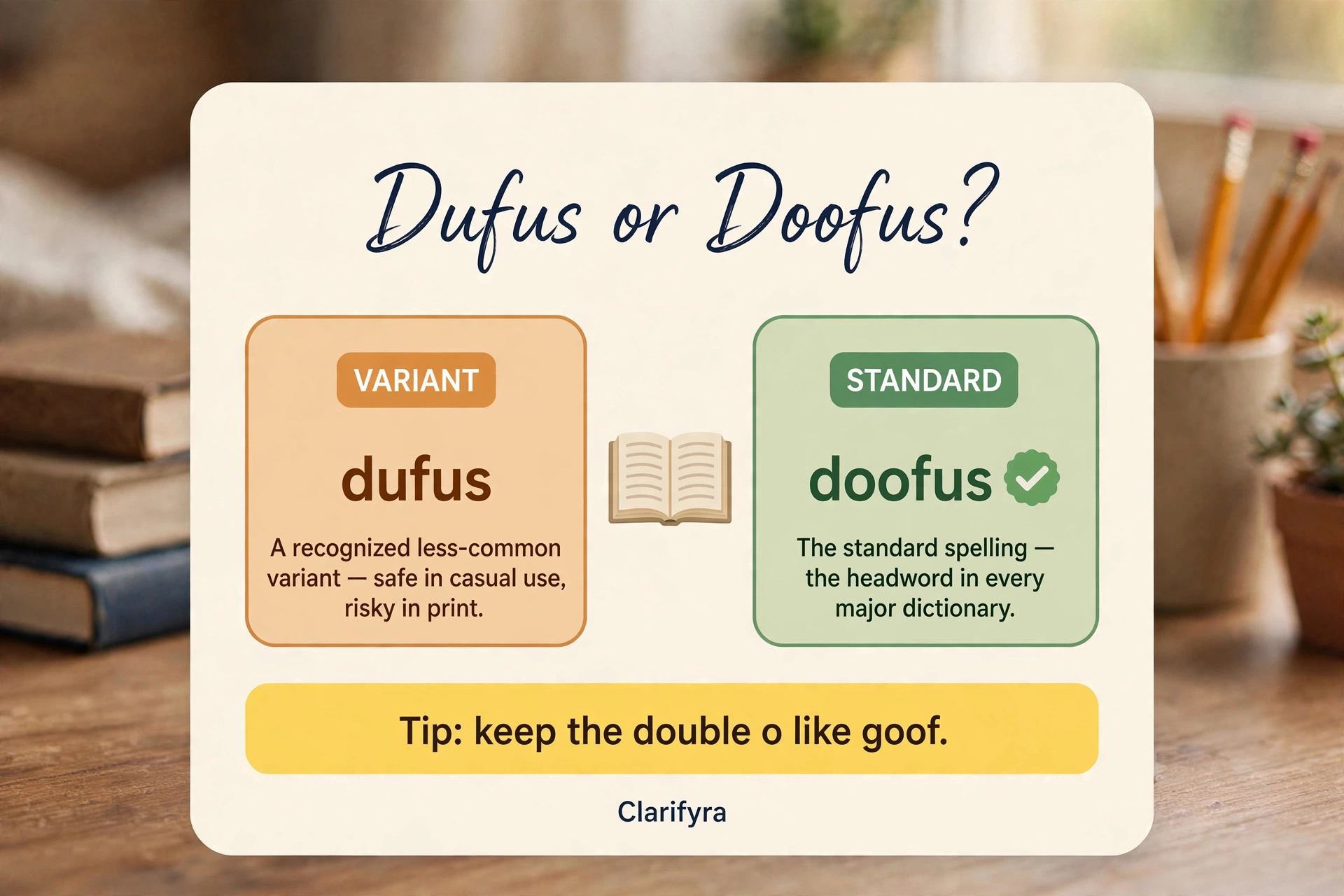
Dufus or Doofus: Which Is Correct?
Doofus is the correct, standard spelling — it is the headword in Merriam-Webster, Oxford Learner’s Dictionaries, Cambridge, and Collins. Dufus is not simply wrong, though: Merriam-Webster lists it as a less-common variant, and one of Collins’s American sources lists it as an accepted alternate spelling. In casual writing it will pass; in anything published or formal, use doofus.
Quick Answer
Doofus is the standard spelling in every major dictionary — Merriam-Webster, Oxford Learner’s, Cambridge, and Collins all list it as the headword. Dufus is a recognized less-common variant (Merriam-Webster says so outright), so it isn’t a pure misspelling, but it is the spelling more likely to look like an error. Both mean a stupid or foolish person. The plural is doofuses.
Why the Confusion Exists
Say “doofus” out loud and you hear doo-fuss. Nothing in the sound tells you whether the first syllable needs one o or two, and “dufus” looks like a perfectly reasonable way to spell what you hear. That is how most of the confusion happens: writers spell by ear, and by ear the two versions are nearly identical.
It is the same mechanism behind other sound-spelling mismatches. Just as “Febuary” happens to “February” because the first r disappears in speech, “dufus” happens to “doofus” because the written double o collapses into a single vowel sound when spoken. The ear can’t settle a spelling question; only the dictionaries can.
There is also genuine disagreement baked into the record. This isn’t a case where every dictionary agrees and the internet disagrees — one of the dictionaries consulted for this article explicitly tolerates the single-o spelling. So the right question isn’t really “which is a word and which isn’t?” but “which is the standard, and how acceptable is the other?”
What the Dictionaries Actually Say
I checked the entry for “doofus” in all four references and looked for a standalone entry for “dufus” in each. Here is what each one actually records:
| Dictionary | Headword & meaning | What it says about “dufus” |
|---|---|---|
| Merriam-Webster | doofus — slang, “a stupid, incompetent, or foolish person.” Variant line: “or less commonly dufus.” Etymology: “perhaps alteration of goof“; first known use 1960. Has a dedicated doofuses entry for the plural. | Listed as a variant spelling, not the headword. |
| Oxford Learner’s Dictionaries | doofus /ˈduːfəs/ — “(North American English, informal) a stupid person.” Word origin: “1960s: perhaps an alteration of goofus, ‘a foolish person’, or from Scots doof ‘dolt’.” (The American dictionary gives US pronunciation /ˈdufəs/.) | No entry for “dufus” found. |
| Collins | doofus — British entry: /ˈduːfəs/, “informal, mainly US.” American entries: (ˈdufəs), US slang, “a stupid, foolish, or inept person”; and (ˈduːfəs), slang, “a foolish or inept person,” marked “Also: dufus,” plural “-fuses.” Origin given as “[1960–65, Amer.; prob. alter. of earlier goofus in same sense; cf. goof].” | One US source lists “dufus” as an alternate; Collins also hosts a standalone “dufus” page under American English drawing on the same US sources. |
| Cambridge | doofus — marked “US informal,” pronunciation /ˈduːfəs/ (found in Cambridge’s dictionary at dictionary.cambridge.org). | No entry for “dufus” found. |
Three patterns stand out. First, doofus is the undisputed headword — every dictionary leads with it. Second, the single-o spelling has real, if limited, dictionary recognition: Merriam-Webster calls it a “less commonly” used variant, and Collins’s American source says “Also: dufus.” Third, nobody marks this word as formal or neutral: every dictionary that gives a register label calls it slang or informal.
So is “dufus” a misspelling?
Not exactly — and this is worth stating carefully. A pure misspelling has no dictionary standing at all. “Dufus” has some: Merriam-Webster prints it in the entry as a variant, and Collins’s US source accepts it as an alternate. The honest description is that dufus is a less-common variant spelling, and doofus is the standard spelling. The pattern is the same one behind inclose vs. enclose, where the dictionaries record the shorter form as a less-common variant of the standard headword.
That said, variant status is not the same as equal status. Outside Merriam-Webster and one Collins US source, “dufus” gets no entry anywhere I checked. Most readers, editors, and teachers will read it as a mistake. Use doofus unless you have a specific reason not to.
How to Say It: UK vs. US
The pronunciations split slightly by side of the Atlantic:
- UK: /ˈduːfəs/ — DOO-fuss, with a long “oo” (Oxford Learner’s, Collins British entry).
- US: /ˈdufəs/ — DOO-fuss, with a slightly shorter “oo” (Oxford Advanced American Dictionary, Merriam-Webster’s ˈdü-fəs, Collins’s Webster’s New World entry). One of Collins’s other US sources gives /ˈduːfəs/, so both are heard in America.
Neither pronunciation settles the spelling — which is precisely why the single-o version keeps appearing.
The Verdict
| Spelling | Status | When to use it |
|---|---|---|
| doofus | Standard headword spelling in all four dictionaries | Always — formal, published, and casual writing alike |
| dufus | Recognized less-common variant (Merriam-Webster; Collins US source) | Tolerable in casual writing, but reads as an error to most readers — avoid in anything edited or formal |
Common Mistakes
-
Writing “dufus” in published or professional writing.
✗ “The report’s author is a total dufus.” (in a published article)
✓ “The report’s author is a total doofus.” (still slang — and still an insult — but at least spelled the standard way)
Better still: in formal writing, drop the slang entirely and say fool, bungler, or whatever you actually mean. Every dictionary labels this word slang or informal. -
Pluralizing it as “doofus’s” or “doofi.”
✗ “A room full of doofus’s.”
✗ “A room full of doofi.”
✓ “A room full of doofuses.”
Merriam-Webster gives “doofuses” its own entry as the plural of doofus, and Collins’s US source lists the word forms as plural “-fuses.” The -i ending belongs to Latin plurals, and this word has no Latin in it. -
Doubling the wrong letter: “duffus,” “dooffus,” “doofuss.”
✗ “You duffus.”
✓ “You doofus.”
The standard spelling is d-o-o-f-u-s: double o, single f, single s. If you remember nothing else, remember the double o — it is the one letter the standard spelling has that the variant lacks. -
Capitalizing it mid-sentence.
✗ “He’s a real Doofus.”
✓ “He’s a real doofus.”
It is a common noun, not a name or title, so it takes a capital only at the start of a sentence. -
Using it where a milder word would do.
Doofus means a stupid or foolish person — calling someone one is calling them stupid. It is mild as insults go (dictionaries mark it slang/informal, not vulgar), and it is often used affectionately about friends, but aimed at a stranger or a colleague it still lands as a jab. “Stop being such a doofus” to a friend is teasing; in a performance review it is unprofessional.
Memory Tricks
- Think of goof. Merriam-Webster and Collins both trace doofus to an alteration of goof or goofus — and goof has a double o. Keep the double o in doofus the way you’d keep it in its cousin.
- “A doofus drops an o.” The single-o “dufus” is the spelling a doofus would write — the o fell out along the way. If you want to look like you know better, keep both.
- Plural rhyme: doofus → doofuses, just like bus → buses and octopus → octopuses. Words ending in a hiss (-s) add -es, never an apostrophe.
Frequently Asked Questions
Is “dufus” a real word?
In the everyday sense, yes — people use it and are understood. In the dictionary sense, it is a recognized less-common variant rather than a headword: Merriam-Webster prints “variants or less commonly dufus” in the doofus entry, and Collins’s American source lists “Also: dufus.” Oxford Learner’s and Cambridge give it no entry at all. So it is not a pure invention, but it is the weaker spelling by every measure that matters.
What is the plural of “doofus”?
Doofuses. Merriam-Webster has a dedicated entry for doofuses (“plural of doofus“), and Collins’s US source lists the word forms as plural “-fuses.” Don’t use an apostrophe (doofus’s), and don’t reach for a Latin-style doofi.
Is “doofus” a bad word?
It is slang and informal — every dictionary that gives a register label says so — but none of the four marks it vulgar or offensive. It is a mild, sometimes affectionate insult along the lines of goofball or knucklehead. Still, it literally means “a stupid person,” so aim it with care: teasing a friend is one thing, using it about a colleague or in print is another.
Is “doofus” mainly an American word?
Mostly, yes. Oxford Learner’s labels it “(North American English, informal),” and Collins’s British entry calls it “informal, mainly US.” British readers will understand it — American sitcoms and films have done the exporting — but it still reads as an Americanism. There is no British-specific spelling alternative; it is doofus on both sides of the Atlantic.
Where did “doofus” come from?
The honest answer is that nobody knows for certain. Merriam-Webster says “perhaps alteration of goof” with first known use in 1960; Oxford Learner’s offers “perhaps an alteration of goofus, ‘a foolish person’, or from Scots doof ‘dolt'”; Collins’s British entry says flatly “of uncertain origin.” The cautious scholarly position — and the only one the dictionaries support — is that it is an American coinage of the early 1960s, probably reshaped from goof/goofus, with the details uncertain.
Final Takeaway
Doofus is the standard spelling — the headword in Merriam-Webster, Oxford Learner’s, Cambridge, and Collins, meaning a stupid or foolish person (slang, informal, mainly American). Dufus survives as a less-common variant recognized by Merriam-Webster and one Collins US source, so it isn’t fabricated, but it will look like a misspelling to most readers. Keep the double o, make the plural doofuses, and keep the word itself where slang belongs: out of formal writing.