Conversing or Conversating: Which Is Correct?
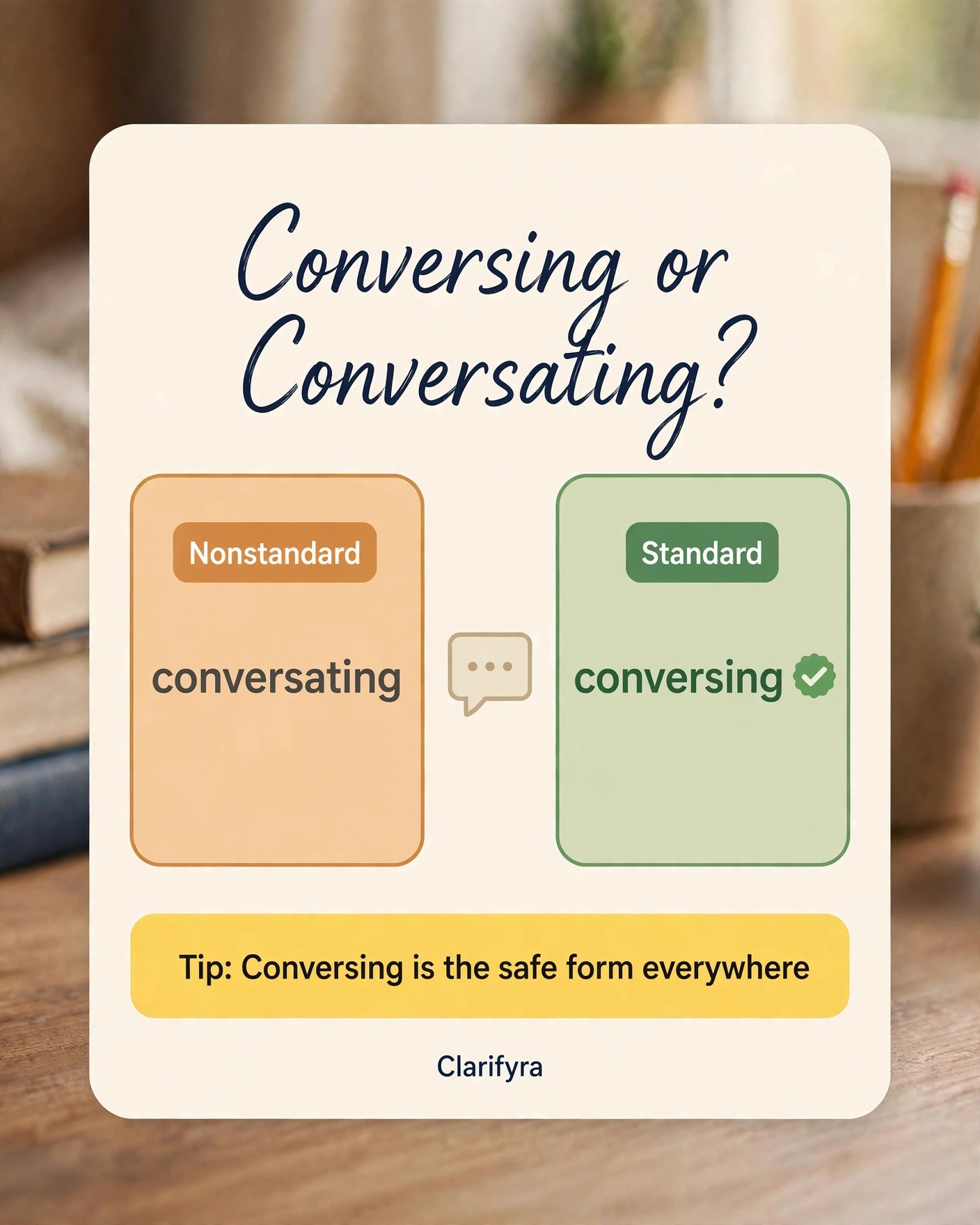
The correct word is conversing — the present participle of the verb converse (“to talk”). Conversating is nonstandard: it appears in no major dictionary as an entry of its own (Cambridge, Oxford Learner’s, Merriam-Webster, and Collins all list conversing under converse and give conversate no headword at all), and style guides universally mark it as slang or error. It survives in casual speech, comedy, and song lyrics — which is precisely why it keeps tempting writers who have heard it far more often than they’ve seen it corrected.
Quick Answer
Conversing is the standard present participle of converse (“They were conversing quietly”). Conversating is nonstandard slang — a back-formation from “conversation” that no major dictionary lists as standard; use conversing in all edited writing. The verb it would come from, conversate, is itself marked nonstandard or slang wherever it appears. Pronunciation: conversing /kənˈvɜːsɪŋ/ (UK), /kənˈvɝːsɪŋ/ (US) — stress on the second syllable, “-verse” as in “universe.”
What the Dictionaries Actually Say
The lexicographic record is unusually blunt:
- Cambridge: lists converse (verb) — “to have a conversation” — with the inflected forms “conversing, conversed.” No “conversate,” no “conversating.”
- Oxford Learner’s Dictionaries: converse /kənˈvɜːs/ — “to talk to somebody; to have a conversation with somebody,” with the grammar note “(not used in the progressive tenses)” on one subsense — and forms “converses, conversing, conversed.” No “conversate.”
- Merriam-Webster: converse — “to exchange thoughts and opinions in spoken or written words” — with the inflections “conversed; conversing.” The entry for “conversate,” where dictionaries mention it at all, is marked slang or nonstandard.
- Collins: converse — “to talk; to engage in conversation” — forms “converses, conversing, conversed.” No “conversate” headword.
The pattern: every dictionary’s verb entry generates conversing mechanically from converse + -ing, and none of them needs a separate entry for “conversating” because the verb it would belong to — “conversate” — isn’t standard English in the first place.
Where “Conversating” Comes From: The Back-Formation Story
Conversating is a back-formation — a word built backwards from a longer word by stripping what looks like a suffix. Speakers took the noun conversation, removed what felt like an ending, and produced the “verb” conversate — then added -ing to get “conversating.” The logic feels airtight (“conversation” → “conversate,” the way “donation” → “donate”), which is why the form keeps being reinvented by new generations of speakers.
The problem: English already had a verb for this job — converse, in use since the 14th century (via Old French converser, from Latin conversārī, “to associate with, keep company”). The back-formation filled no gap; it duplicated an existing word while breaking the historical pattern. Back-formations that fill genuine gaps survive (“donate” from “donation” stuck because English had no verb there); back-formations that duplicate existing verbs mostly don’t — or survive only as slang, which is exactly where “conversate/conversating” lives.
It’s worth noting the family resemblance: English is full of back-formations, and the legitimate ones are invisible precisely because they won. Donate (from donation), enthuse (from enthusiasm), liaise (from liaison) — all back-formations, all standard now. “Conversate” is the one that knocked on a door that was already open.
Why It Persists: Speech, Comedy, and Song
If “conversating” is nonstandard, why does everyone seem to know it? Because it’s everywhere in unscripted language:
- Casual speech. In conversation (the irony is free), “we were conversating” feels more symmetrical with “conversation” than “we were conversing” does — the longer form sounds like it should be the verb of the longer noun. Speakers reach for the pattern, not the history.
- Comedy. The word is a reliable laugh line precisely because audiences recognize it as wrong — comedians deploy “conversating” the way they deploy malapropisms generally, as a character note. The joke depends on the audience knowing the right word.
- Music. Hip-hop and R&B lyrics use “conversating” freely — where it scans better than “conversing” and where nonstandard grammar is part of the register’s authenticity. Nobody corrects a lyric; but a lyric isn’t a style guide either.
The takeaway: frequency in speech and song is not evidence of standardness. “Conversating” is common the way “ain’t” is common — widely understood, widely used in some registers, and still marked nonstandard in edited prose.
Pronunciation: UK and US
The standard form is pronounced with the stress on the second syllable — “con-VERSE-ing,” with “-verse” as in “universe”:
- UK: /kənˈvɜːsɪŋ/ — “kuhn-VUR-sing.”
- US: /kənˈvɝːsɪŋ/ — “kuhn-VUR-sing” (rhotic r).
The nonstandard “conversating” would be stressed on the first syllable of its invented root — “CON-ver-say-ting” — which is itself a tell: standard English verbs in this family stress “-verse” (conVERSE, reVERSE, diVERSE), and the back-formation’s stress pattern breaks the family’s rhythm.
Correct vs Incorrect: The Forms Compared
| Form | Verdict | Why |
|---|---|---|
| conversing | ✓ Standard | The regular -ing form of converse, listed in all four dictionaries |
| conversed | ✓ Standard | The regular past tense: “They conversed late into the night” |
| converse (verb) | ✓ Standard | “to have a conversation”; in use since the 14th century |
| conversating | ✗ Nonstandard | Back-formation from “conversation”; no standard dictionary entry |
| conversate | ✗ Nonstandard | The invented verb behind “conversating”; marked slang/nonstandard |
| conversated | ✗ Nonstandard | The past tense of the nonstandard verb — doubly marked |
Common Mistakes
1. Using “conversating” in edited writing. ✗ “The managers were conversating by the coffee machine.” → ✓ “The managers were conversing by the coffee machine.” In emails, essays, reports, and articles, “conversating” reads as an error.
2. Assuming the longer word is the “real” verb. ✗ “The verb form of ‘conversation’ is ‘conversate.'” → ✓ “The verb is converse; ‘conversation’ is its noun.” The noun is longer than the verb here — English doesn’t promise symmetry.
3. “Correcting” converse to conversate. ✗ “They were converse-ing? That doesn’t sound right.” It is right — conversing is the regular -ing form. Trust the morphology, not the ear.
4. Using “conversating” in formal speech. Presentations, interviews, and ceremonies run on the standard register: ✗ “We were conversating with the client.” → ✓ “We were conversing with the client.” Save the slang for the group chat.
Is “Conversating” Ever Okay?
Yes — in the registers where nonstandard English is the point. In casual speech among friends, in dialogue written to sound like real people talking, in comedy that leans on the malapropism, in song lyrics where it scans: “conversating” is doing deliberate stylistic work, and policing it there would be pedantry. The rule isn’t “never say it” — it’s “know what it signals.” In edited prose it signals error; in a group chat it signals ease. Match the word to the room.
Frequently Asked Questions
Is “conversating” a word?
It’s a nonstandard word — widely used in casual speech, comedy, and music, but with no entry as standard English in Cambridge, Oxford Learner’s, Merriam-Webster, or Collins. In edited writing, use conversing.
What’s the verb form of “conversation”?
Converse — “to have a conversation.” Its present participle is conversing (“They were conversing quietly”). “Conversate” is a nonstandard back-formation, not the verb you’re looking for.
Why do so many people say “conversating”?
Because it’s a natural back-formation: speakers strip “conversation” down to what feels like a verb stem, the way “donation” genuinely gives “donate.” The logic is sound — it just duplicates converse, a verb English has had since the 1300s.
Is “conversate” in the dictionary?
Not as standard English. Where dictionaries mention it at all, it’s marked slang or nonstandard. Cambridge, Oxford Learner’s, and Collins give it no headword; the standard verb entry is converse.
How do you pronounce “conversing”?
UK /kənˈvɜːsɪŋ/, US /kənˈvɝːsɪŋ/ — “kuhn-VUR-sing,” stress on the second syllable, “-verse” as in “universe.”
Final Takeaway
Conversing is the word — the regular, dictionary-listed present participle of converse, correct in every register from text messages to dissertations. Conversating is the back-formation that knocked on an open door: vivid in speech, useful in a lyric, and wrong in edited prose. Know what each signals, match the word to the room, and when in doubt, converse.