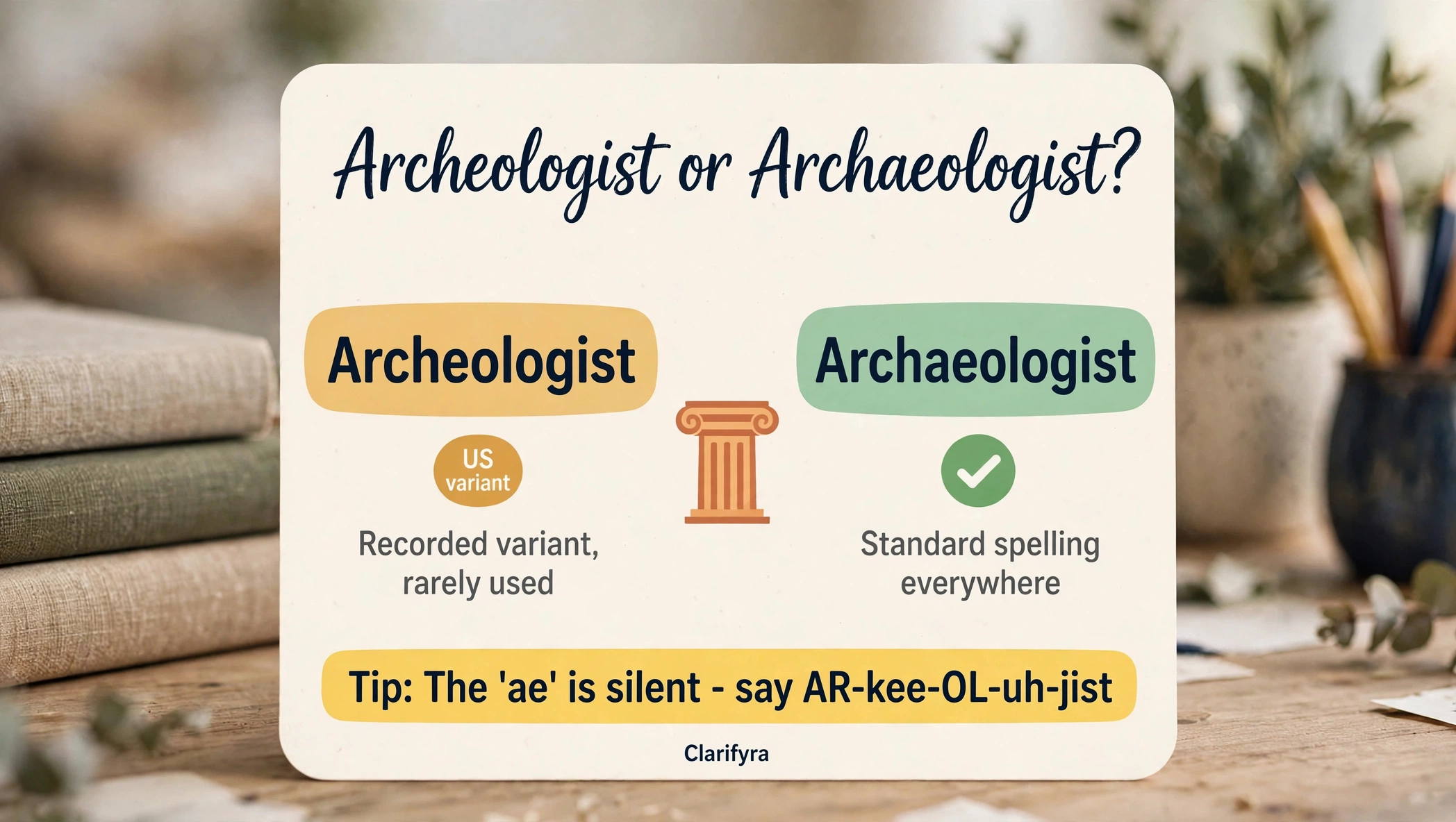
Archeologist or Archaeologist: Which Is Correct?
If you’re choosing between archeologist and archaeologist, the practical answer is simple: write archaeologist. It is the standard spelling in British and American English alike — the one used by dictionaries’ headword entries, universities, museums, and the profession itself. But here’s the twist that makes this pair interesting: archeologist isn’t a typo. Major dictionaries record it as a genuine, chiefly American variant of the same word. It’s real, it’s listed, and it’s still the wrong choice in most writing — because a dictionary recording a variant is not the same as recommending it.
Quick Answer
Archaeologist is the standard spelling everywhere — use it in all writing. Archeologist is recorded in Collins, Cambridge, Oxford, and Merriam-Webster as a less common, chiefly American variant: it exists in the dictionaries, but the profession and every style guide use the “ae.” When in doubt, archaeologist is never wrong. Pronunciation is identical either way: UK /ˌɑː.kiˈɒl.ə.dʒɪst/, US /ˌɑːr.kiˈɑː.lə.dʒɪst/ — the “ae” pair makes a single vowel sound.
What the Dictionaries Actually Say
This is where precision matters, because the confident claim “archeologist isn’t a word” turns out to be wrong — and so is the claim that “both spellings are equally fine.” Here’s what the major references actually record:
- Collins English Dictionary: headword archaeology — “also archeology“; derived forms listed as archaeologist or archeologist. Collins’s English–Spanish dictionary goes further, marking the split geographically: “archeologist (especially US) or archaeologist (British).”
- Cambridge Dictionary: “archaeologist (US also archeologist)” — with UK pronunciation /ˌɑː.kiˈɒl.ə.dʒɪst/ and US /ˌɑːr.kiˈɑː.lə.dʒɪst/, and the definition “someone who studies the buildings, graves, tools, and other objects of people who lived in the past.”
- Oxford Learner’s Dictionaries: “archaeology (North American English also archeology)” — the variant is explicitly framed as a North American form.
- Merriam-Webster (American): gives archaeology the headword entry — “the scientific study of material remains (such as tools, pottery, jewelry, stone walls, and monuments) of past human life and activities” — with archeology indexed as its variant form.
So the picture is consistent: archaeologist is the main entry everywhere, and archeologist is a recognized variant with an American accent. Dictionaries are descriptive — they document forms people use, and labels like “US also” are the lexicographers’ way of saying the variant is real but marked. As with anual vs annual, two spellings can coexist while only one counts as the standard — and professional writing follows the standard.
Why “Archeologist” Is So Tempting
Almost nobody misspells this word out of carelessness. The temptation is built into the sound of the word. Say archaeologist out loud: “ark-ee-OL-uh-jist.” The first syllable sounds exactly like ark — as in Noah’s. And in the phonetic transcriptions, the “ae” pair produces a single vowel sound (/ɑː/): the e contributes nothing extra you can hear. So your ear reports “ark-ee-ologist,” your hand wants to write “archeologist,” and the extra a feels like a silent passenger that snuck aboard.
There’s a second force: American English has spent two centuries trimming silent letters — color for colour, favor for favour — so dropping the a from “archaeologist” can feel like the same sensible simplification. It’s a reasonable instinct that lands on the wrong spelling.
The “ae” Digraph in English
The “ae” in archaeologist is a fossil — a spelling preserved from the word’s journey through Latin and Greek. Collins traces it: 17th century, from Late Latin archaeologia, from Greek arkhaiologia, “study of what is ancient,” from arkhaios (“ancient,” itself from arkhē, “beginning”). Oxford Learner’s adds the timeline: the word entered English in the early 1600s meaning simply “ancient history,” and the modern sense — the scientific study of material remains — developed in the 19th century. The spelling kept its Greek clothing the whole way down.
English is full of these Greek and Latin “ae” fossils, and American spelling has been sanding them down for generations: encyclopaedia → encyclopedia, anaemia → anemia, oestrogen → estrogen, leukaemia → leukemia. The pattern is systematic — British English words spelled with the double vowels “ae” or “oe” are routinely spelled with a single vowel in American English. “Archeology” is what you get when that same trimming instinct is applied to “archaeology.” It’s just that, unlike the medical words, the trimmed form never fully displaced the original — even in America. (American English’s simplifying streak shows up all over the spelling system, including doubled consonants — fuelled vs fueled is another chapter of the same US/UK story.)
How deep does the “ae” go? Deep enough that the 1989 print edition of the Oxford English Dictionary didn’t use two letters at all — it printed the word with the single ligature character æ: archæology. According to the archaeology reference site ThoughtCo, the OED’s earliest recorded English occurrence of the word is 1607, in Joseph Hall’s Holy Observations, where it meant “ancient history” rather than the modern science. The ligature is gone from modern printing, but the two-letter “ae” remains — a small monument to the word’s Greek origins sitting right in the middle of it.
The Whole Family Follows the Root
Here’s something people often miss: this isn’t really a one-word question. Whatever you decide about archaeologist applies to the entire word family, because all the derived forms follow the root. Collins lists the parallel pairs together:
- archaeology or archeology (the field)
- archaeological or archeological (the adjective)
- archaeologist or archeologist (the person)
You can’t coherently write “archeologist” while keeping “archaeological” with the “ae” — the spellings are a package. So the decision rule is simple: pick the “ae” set or the “e” set, and stay inside it. Since the “ae” set is the standard, that’s the set to pick. Mixing them — “the archeologist presented her archaeological findings” — is the one outcome that’s never acceptable, because it signals you don’t have a system at all.
Pronunciation: UK and US
Whichever spelling you write, the pronunciation is the same — and the “ae” pair collapses into a single vowel sound in both varieties of English:
- UK: /ˌɑː.kiˈɒl.ə.dʒɪst/ — “ah-kee-OL-uh-jist.” Long “ah” at the start, short “o” in the stressed syllable.
- US: /ˌɑːr.kiˈɑː.lə.dʒɪst/ — “ar-kee-AH-luh-jist.” The rhotic “r” colors the first vowel, and the stressed syllable takes the broad “ah” sound.
Both stress the third syllable (“-ol-“) and reduce the “ae” to one sound — which is exactly why the spelling tempts you. The noun archaeology follows the same pattern (Oxford: UK /ˌɑːkiˈɒlədʒi/, US /ˌɑːrkiˈɑːlədʒi/); if you can say the field, you can say the profession — only the ending changes.
What Professional Archaeologists Actually Use
Here’s the decisive practical evidence: American archaeologists themselves keep the “ae.” The leading US professional body calls itself the Society for American Archaeology — with the “ae” in the name. And the Society for Historical Archaeology’s style guide is explicit: “archaeology, not archeology — the spelling archeology is acceptable only in a direct quotation or in acknowledgments, references, or biographies when capitalized as part of a title or an organizational name” (their example: the Midwest Archeological Center, which keeps its historical name).
That last detail is worth absorbing. The one place “archeology” survives in professional American use is inside proper names — organizations founded under that spelling. Everywhere else, the field’s own house style says “ae.” If you’re writing a CV, a university essay, a museum label, or anything aimed at people who work in the discipline, “archeologist” will read as a small but telling sign that you’re outside it.
Common Mistakes
1. Using “archeologist” in formal or professional writing. ✗ “She works as an archeologist at the British Museum.” → ✓ “She works as an archaeologist at the British Museum.” The variant is dictionary-recorded, but editors, academics, and the field’s own style guides expect the “ae.”
2. Confusing archaeology with paleontology. ✗ “The archeologist dug up a T. rex skeleton.” → ✓ “The paleontologist dug up a T. rex skeleton.” Cambridge defines an archaeologist as someone who studies “the buildings, graves, tools, and other objects of people who lived in the past” — people, not dinosaurs. Dinosaurs belong to paleontology.
3. Using the wrong article. ✗ “He’s a archaeologist.” → ✓ “He’s an archaeologist.” The word begins with a vowel sound (/ɑː/), so it takes “an” — same as “an architect.” (This one trips people up precisely because the silent “e” in “ae” makes the opening look consonant-heavy.)
4. Mixing the two spellings in one document. ✗ “The archeologist presented her archaeological findings.” → ✓ “The archaeologist presented her archaeological findings.” The word family is a package — pick one spelling set and stay inside it.
5. Trusting your spellchecker to settle it. Many spellcheckers accept “archeologist” without a red underline — because it’s in the dictionary, not because it’s recommended. A spellchecker’s job is to tell you whether a form exists, not whether it’s the standard. For that, you need a dictionary’s main entry or a style guide, and both point to “archaeologist.”
How to Remember the Spelling
An archaeologist studies ancient things — and ancient starts with A. So does archaeologist. When you’re tempted to drop the “a” and write “archeologist,” remember: the “a” is the ancient part. Archaeologist digs up the ancient — keep the A where it belongs.
A second anchor: the “ae” is the Greek fingerprint. English has a whole “arch-” family — archaic, archive, architect, archangel — and archaeology is the only member that preserves the original “ae” digraph. That oddity is the point: it’s the one that wears its Greek origin on its sleeve. If the spelling looks slightly unusual, that’s because it is — it’s carrying 400 years of history in two letters.
Frequently Asked Questions
Is “archeologist” spelled right?
It’s a recorded variant, not a typo: Collins, Cambridge, Oxford Learner’s, and Merriam-Webster all list “archeologist”/”archeology” as a genuine form, marked as chiefly or North American. But “recorded” isn’t “recommended” — archaeologist is the standard spelling everywhere, including the US, and it’s the only safe choice in formal writing.
Is “archeologist” the American spelling?
It’s the American variant. Cambridge labels it “(US also archeologist)” and Oxford “(North American English also archeology).” But American dictionaries still give “archaeology” the headword, and American professional bodies — the Society for American Archaeology, the Society for Historical Archaeology’s style guide — use the “ae.” So even in the US, “archaeologist” is the standard.
How do you pronounce “archaeologist”?
UK /ˌɑː.kiˈɒl.ə.dʒɪst/ (“ah-kee-OL-uh-jist”), US /ˌɑːr.kiˈɑː.lə.dʒɪst/ (“ar-kee-AH-luh-jist”). The stress falls on the third syllable, and the “ae” pair makes a single vowel sound — there’s no separate “ee” for the “e.”
Why is there an “ae” in “archaeologist” at all?
It preserves the word’s Greek and Latin spelling. The word comes from Greek arkhaiologia (“ancient history,” from arkhaios, “ancient”), via Latin archaeologia and French archéologie, entering English in the early 1600s. The “ae” is a fossil of that journey — the 1989 print OED even used the single ligature æ, printing “archæology.”
What’s the difference between archaeology and paleontology?
Archaeology is the study of past human life through material remains — buildings, graves, tools, pottery. Paleontology is the study of ancient life through fossils, including dinosaurs. An archaeologist might excavate a Roman villa; a palaeontologist excavates a T. rex. Different sciences, different spellings, different experts.
Should I write “archeologist” on my CV or in an essay?
No — write archaeologist. Academic and professional style guides prefer the “ae” form, and the field’s own organizations use it. “Archeologist” on a CV risks reading as a spelling error to exactly the people whose opinion matters most.
Is “archæology” with the æ character correct?
Not in modern writing. The æ ligature appeared in older typesetting (including the 1989 print OED), but contemporary English uses the two-letter “ae”: “archaeology.” If you encounter “archæology” in an old book, it’s a historical rendering, not a modern alternative.
Do I write “a archaeologist” or “an archaeologist”?
“An archaeologist.” The choice of a/an depends on the following sound, and “archaeologist” begins with the vowel sound /ɑː/ — so “an” is correct, just as with “an architect” or “an honor.”
Final Takeaway
Archaeologist is the spelling for the whole English-speaking world — the dictionary headword, the professional standard, the safe choice in every register. Archeologist deserves more respect than a red underline: it’s a genuine, dictionary-recorded, chiefly American variant with a real history behind it. But “recorded” is not “recommended.” Keep the ae — the ancient “a,” the Greek fingerprint — and you’ll be right everywhere, from a school essay to a job application at the British Museum. When in doubt, archaeologist is never wrong.