Coaches or Coach’s: Which Is Correct?
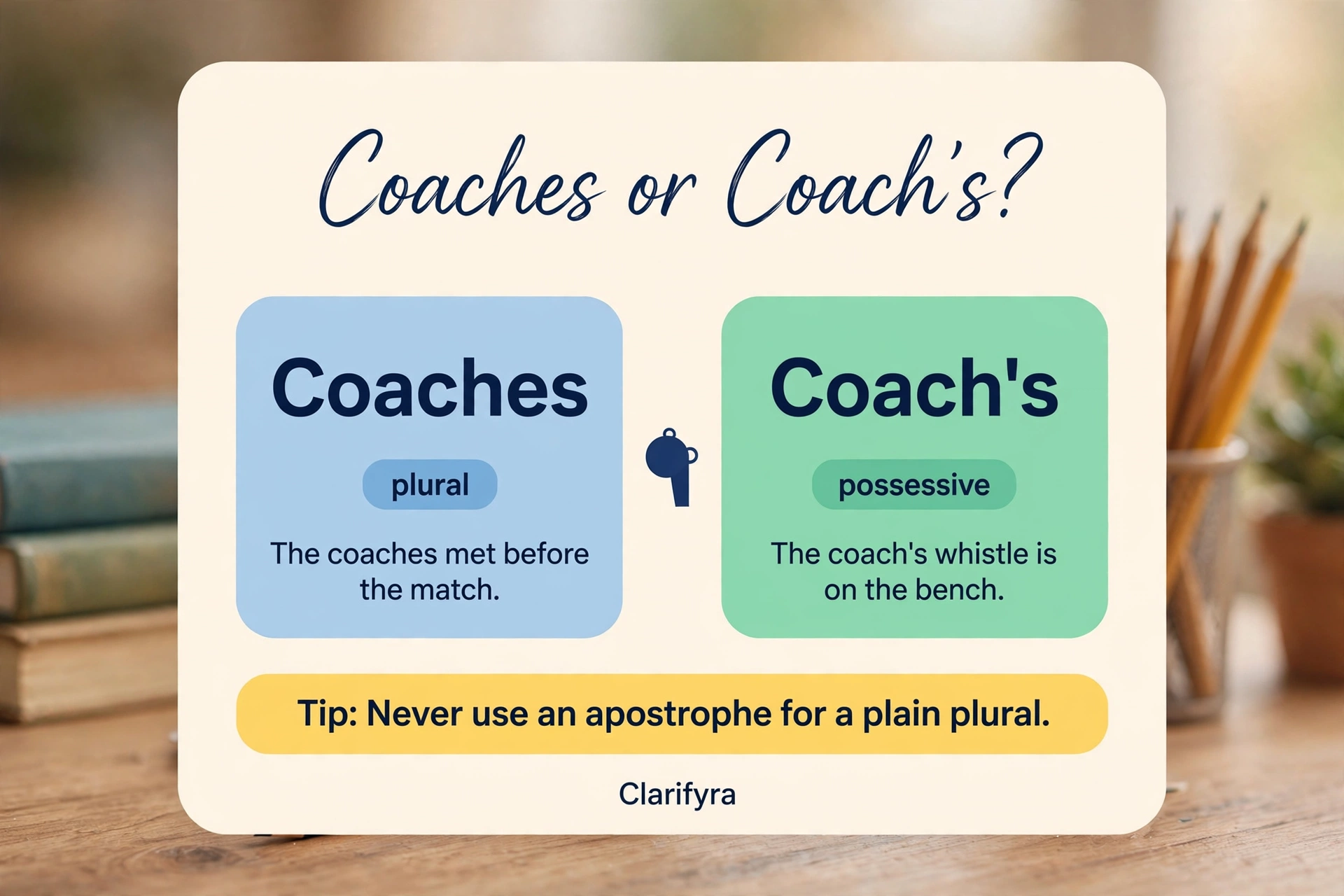
Choosing between coaches and coach’s comes down to one question: are you counting coaches, or does something belong to one? Coaches is the plural — “two coaches met after the game.” Coach’s is the singular possessive — “the coach’s whistle,” the whistle belonging to one coach. The apostrophe marks ownership; it never marks a plural. Once that rule clicks, the rest of the family falls into place — including the fourth form, coaches’, and the verb coaches (“she coaches the team”).
Quick Answer
Coaches (no apostrophe) = more than one coach, as a plural noun — “Both coaches shook hands.” It is also the verb form: “She coaches the juniors.” Coach’s = singular possessive, belonging to one coach — “the coach’s office.” Coaches’ = plural possessive, belonging to several coaches — “the coaches’ meeting.” Apostrophes never make ordinary plurals.
The Four Forms at a Glance
English gets four different jobs out of one small word, and three of them are pronounced identically. Only the sentence tells you which one you’re looking at:
| Form | What It Is | Meaning | Example |
|---|---|---|---|
| coaches | plural noun | more than one coach | “Both coaches shook hands after the match.” |
| coaches | verb, 3rd-person singular present | he/she/it trains or instructs | “She coaches the under-16s.” |
| coach’s | singular possessive | belonging to one coach | “The coach’s whistle was on the bench.” |
| coaches’ | plural possessive | belonging to several coaches | “The coaches’ meeting ran late.” |
One thing worth saying outright: in speech, the noun plural, the singular possessive, and the plural possessive all sound exactly the same. The apostrophe is a written-only signal. That is precisely why it trips people up — you can’t hear the difference, so you have to reason it out.
“Coaches” With No Apostrophe: The Plural
When you simply mean more than one coach — of football, tennis, public speaking, or the long-distance bus sense that British English uses — the plural is coaches, no apostrophe anywhere near it. Because coach ends in -ch, the plural adds -es (the same as churches, matches, and sandwiches):
“The club hired two new coaches this season.”
“All the coaches were asked to submit their plans.”
“Six coaches were parked outside the stadium.”
That last example uses the British “bus” sense of coach — but the spelling rule is identical either way. Plural means plural; the apostrophe has no role here.
“Coaches” Can Also Be a Verb
Here’s the twist that the dictionary confirms: coach is also a verb (“to train or instruct”), and its third-person singular present tense is coaches. Collins lists the forms plainly — plural and 3rd-person singular coaches, present participle coaching, past tense coached. So this spelling does double duty, exactly like halves does as both plural noun and verb:
“He coaches the women’s team.” (trains — verb)
“She coaches executives in public speaking.” (instructs — verb)
“The two coaches disagreed.” (people — plural noun)
If you’re unsure which one you’ve got, try a substitution. If you can swap in “trains” or “instructs” and the sentence still works (“she trains the juniors”), it’s the verb. If you can put “several” or “two” in front of it (“several coaches arrived”), it’s the plural noun. And the verb never takes an apostrophe — “he coach’s the team” is never right, which brings us to the rule behind everything.
“Coach’s”: When Something Belongs to One Coach
The possessive is where the apostrophe belongs. For a singular noun, possession is marked with ‘s: the whistle of the coach becomes the coach’s whistle:
“The coach’s decision surprised everyone.” (one coach made it)
“I found the coach’s notebook in the dugout.” (one coach owns it)
“The coach’s contract runs until June.” (one coach signed it)
Notice that the sentence is always really answering “whose?” — whose decision, whose notebook, whose contract. If you can rephrase with “of the coach” and the meaning holds, coach’s is the form you want.
“Coaches'”: When the Owners Are Many
For a plural possessive, the order of operations matters: make the plural first (coaches), then make it possessive. Since the plural already ends in s, you don’t add another one — you just add the apostrophe after it: coaches’.
“The coaches’ meeting ran late.” (the meeting of the coaches)
“All the coaches’ opinions were recorded.” (opinions of several coaches)
Compare the pair and watch the meaning change: “the coach’s decision” means one coach decided; “the coaches’ decision” means several coaches decided together. Precision here isn’t pedantry — it’s the difference between one person and a committee.
The Rule Behind It All: Apostrophes Never Make Ordinary Plurals
This is the general principle that settles every version of the question. An apostrophe marks possession (“the coach’s bag”) or a contraction (“it’s”), but it is not a plural marker. Writing “coach’s” when you mean “coaches” is the classic error grammarians call the greengrocer’s apostrophe — named for shop signs like “Fresh Apple‘s” and “Carrot‘s,” where the plural needed nothing but an s. The same error comes in many disguises; it’s worth seeing it untangled in nobodies vs nobodys, where the confusion runs the other way.
One honest caveat, because the rule isn’t absolute to the letter: style guides such as Oxford’s allow an apostrophe to pluralize single letters or digits for clarity — “mind your p’s and q’s,” “how many 7’s.” That’s the only commonly accepted exception, and it doesn’t touch ordinary nouns like coach. For “coaches,” the rule holds with no wiggle room: plural is always the bare s-form.
Common Mistakes
1. Writing the plural as “coach’s.” ✗ “All the coach’s were invited to dinner.” → ✓ “All the coaches were invited to dinner.” The most common error of the set — an apostrophe smuggled into a plain plural.
2. Putting an apostrophe in the verb. ✗ “He coach’s the school team.” → ✓ “He coaches the school team.” Verbs never take apostrophes for their endings; the third-person s is a verb ending, not a possession.
3. Dropping the apostrophe where possession is meant. ✗ “The coaches decision was final.” → ✓ “The coaches’ decision was final.” (If one coach: “The coach’s decision was final.”) Ask “whose?” — if there’s an answer, there’s an apostrophe.
4. Using “coach’s” for the plural possessive. ✗ “The coach’s opinions were divided.” (when you mean several coaches) → ✓ “The coaches’ opinions were divided.” Getting the number of owners wrong changes who decided.
5. Using “coaches” for the singular possessive. ✗ “Our coaches star player is injured.” → ✓ “Our coach’s star player is injured.” One coach, one apostrophe before the s.
6. Hesitating over “a coach’s decision” vs “the coaches decided.” Both are correct — they’re just different sentences. ✗ “The coach’s decided to postpone.” → ✓ “The coaches decided to postpone.” When the verb “decided” is doing the work, you need the plural noun, not a possessive.
How to Remember It
Run the two questions in order. First: how many coaches? One → start from coach. More than one → start from coaches, and stop there if it’s just a plural. Second: does something belong to them? If yes, add the apostrophe: after the s for one coach (coach’s), after the existing s for many (coaches’). Or compress it into a sentence: plural first, apostrophe second. If you make the plural before you reach for the apostrophe, the possessives write themselves.
Frequently Asked Questions
Is it “coaches” or “coach’s”?
It depends on the job the word is doing. Coaches = more than one coach (“the coaches arrived”) or the verb (“she coaches the team”). Coach’s = something belonging to one coach (“the coach’s office”). Ask “whose?” — if something belongs to the coach, you need the apostrophe.
Where does the apostrophe go for more than one coach?
After the s: coaches’. Build the plural first (coaches), then add the possessive apostrophe. Since the plural already ends in s, no extra s is added — “the coaches’ meeting,” not “the coaches’s meeting.”
Is “coach’s” ever a plural?
No. For ordinary nouns, an apostrophe never forms a plural — that’s the greengrocer’s-apostrophe error. Coaches is the only plural.
Do “coaches,” “coach’s,” and “coaches'” sound the same?
Yes — in speech they are identical. The apostrophe is visible only on the page, which is exactly why this confusion is a writing problem, not a speaking one. Only the sentence tells you which form is meant, so you have to decide by meaning, not by ear.
Is it “he coach’s” or “he coaches”?
“He coaches” — no apostrophe. Verb endings never take apostrophes, so the third-person singular verb (“she coaches,” “he coaches”) is always the bare form.
What’s the difference between “the coach’s decision” and “the coaches’ decision”?
The number of decision-makers. “The coach’s decision” = one coach decided. “The coaches’ decision” = several coaches decided. “The coaches decided” (no apostrophe) says the same thing as the plural possessive but with a verb instead.
Which is correct: “coach’s meeting” or “coaches meeting”?
Neither, as written. If the meeting belongs to one coach: “the coach’s meeting.” If it belongs to the coaching staff: “the coaches’ meeting.” A bare “coaches meeting” without an apostrophe reads as a slip where possession is clearly meant.
Is there a difference between British and American usage here?
No. The plural and possessive forms of coach are identical in both varieties. (The only BrE/AmE split is in one sense of the word — “coach” as a long-distance bus is British; Americans would say “bus” — but that doesn’t change the grammar.)
Final Takeaway
Coaches counts them or describes what one of them does; coach’s and coaches’ say who owns what. The apostrophe is a possession marker, never a plural marker — build the plural first, then place the apostrophe. Two questions in order — how many coaches, and does something belong to them — will get you the right form every time.