Empathy or Sympathy: What’s the Difference?
Empathy or sympathy are closely related words, but they describe different ways of responding to another person’s feelings or difficulties. Empathy generally involves understanding or sharing another person’s emotional experience, while sympathy involves feeling concern, sorrow, or care for someone who is going through something difficult. The distinction can become less clear because psychologists and researchers use these terms in somewhat different ways. Still, the basic difference is useful in everyday English: empathy is often described as feeling with someone, while sympathy is feeling for someone.
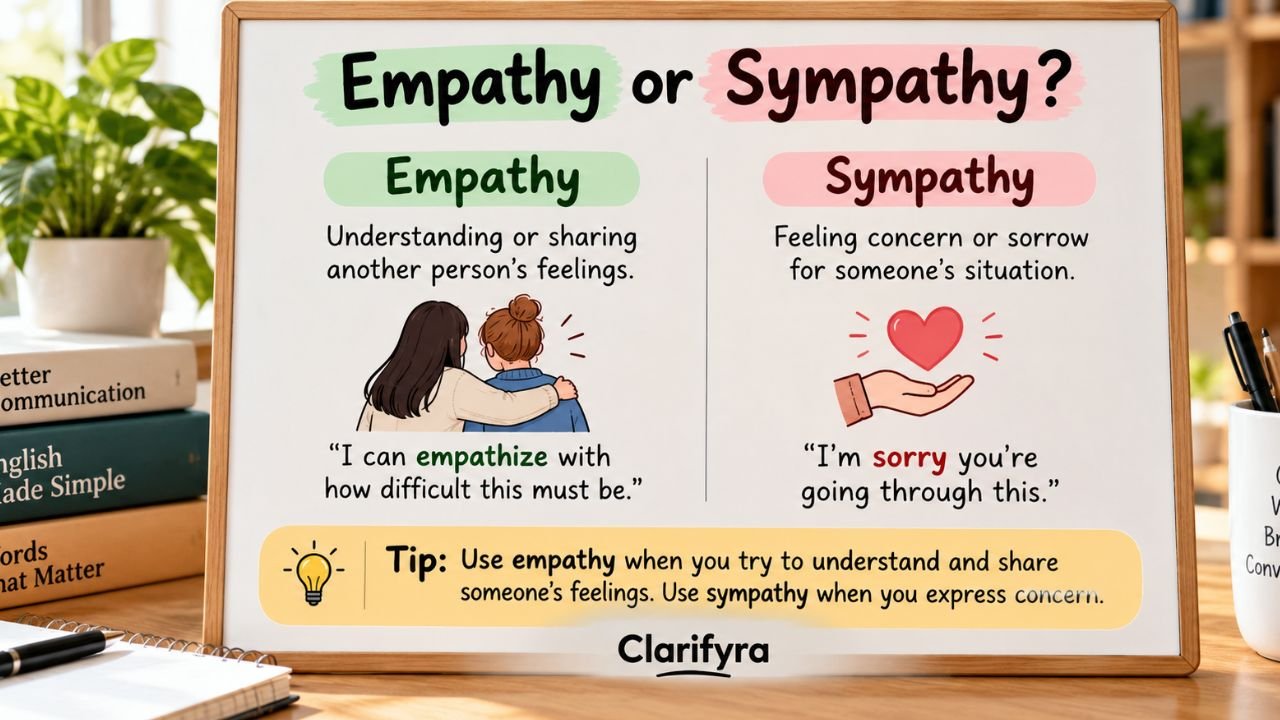
Both empathy and sympathy are correct words, but they are not exact synonyms. Empathy usually means understanding or sharing another person’s feelings or perspective, while sympathy means feeling concern or sorrow for someone’s situation. Neither is automatically “better”; the appropriate word depends on what you mean.
Empathy vs. Sympathy: The Quick Difference
The easiest way to remember the distinction is:
Empathy = feeling with someone.
Sympathy = feeling for someone.
Imagine that your friend has just lost a job.
If you say:
“I’m sorry. That must be really difficult for you.”
you are expressing sympathy.
If you try to understand what your friend is experiencing emotionally and say:
“I can imagine how disappointing and worrying this must feel after everything you put into the job.”
you are showing empathy.
This “feeling with” versus “feeling for” distinction is widely used in discussions of the two concepts, although academic literature acknowledges that the boundaries between empathy, sympathy, and compassion are not always identical across different theories.
Quick comparison
| Feature | Empathy | Sympathy |
|---|---|---|
| Basic idea | Understanding or sharing another person’s experience | Feeling concern or sorrow for another person |
| Perspective | Tries to understand the person’s point of view | Responds to the person’s situation |
| Simple description | “I understand what this may feel like.” | “I’m sorry this happened to you.” |
| Emotional relationship | May involve sharing or resonating with another’s feelings | Involves an emotion directed toward another person |
| Example | Understanding a friend’s anxiety | Feeling concerned because your friend is anxious |
| Word form | Empathetic/empathic, empathize/empathise | Sympathetic, sympathize/sympathise |
What Does “Empathy” Mean?
Empathy is the ability or process of understanding another person’s feelings, experiences, or perspective.
In everyday English, it often means trying to put yourself in another person’s position and understand what they might be experiencing.
For example:
- “She showed empathy when her colleague became upset.”
- “A good listener needs empathy.”
- “I can empathize with how frustrating that must have been.”
- “His response demonstrated genuine empathy.”
Empathy can involve more than simply feeling the same emotion. Academic discussions commonly distinguish cognitive empathy, which involves understanding another person’s feelings or perspective, from affective forms of empathy involving emotional resonance.
That means you do not necessarily have to experience exactly the same emotion as another person to understand their perspective.
Cognitive empathy
Cognitive empathy refers to recognizing and understanding another person’s emotional state or point of view.
For example:
“I understand why she feels nervous about speaking in front of the audience.”
You may not feel nervous yourself, but you understand why she does.
Emotional empathy
Emotional or affective empathy is more closely associated with actually sharing or resonating with another person’s emotional experience.
For example:
Your friend becomes excited about receiving good news, and you genuinely feel some of that excitement yourself.
The scientific literature treats empathy as a complex, multidimensional concept rather than a single, simple emotional reaction.
What Does “Sympathy” Mean?
Sympathy generally means feeling concern, sorrow, care, or support for another person because of their circumstances.
For example:
- “She expressed sympathy after his father died.”
- “I have sympathy for anyone dealing with that situation.”
- “He offered his sympathy to the family.”
- “We sympathize with everyone affected by the accident.”
Sympathy does not necessarily mean that you experience the same emotion as the other person.
You might feel concerned about someone’s difficult situation without actually feeling their sadness, fear, anger, or disappointment yourself.
One academic account describes sympathy as an emotional response focused on another person rather than necessarily sharing that person’s emotional state.
Is It Empathy or Sympathy?
The answer depends on the meaning you want to express.
Use empathy when the focus is on understanding or sharing another person’s emotional experience.
“I empathize with what you’re going through.”
Use sympathy when the focus is on concern, sorrow, or support for someone’s circumstances.
“I sympathize with you during this difficult time.”
Both sentences are grammatically correct, but they communicate slightly different ideas.
A useful test is to ask:
Am I trying to understand or share the person’s experience?
→ Empathy
Am I expressing concern or sorrow for what happened to the person?
→ Sympathy
Is Feeling Sorry for Someone Empathy or Sympathy?
Feeling sorry for someone is generally closer to sympathy.
If someone says:
“I feel sorry for Maria because she lost her home.”
the speaker is expressing sadness or concern about Maria’s circumstances. That is normally understood as sympathy.
Empathy would involve trying to understand Maria’s emotional experience:
“I can imagine how frightened and overwhelmed Maria might feel after losing her home.”
There is an important nuance, however. The distinction is not absolute in every context. Research literature uses the terms in different ways, and some definitions allow overlap between sympathy and emotional aspects of empathy.
So feeling sorry for someone is a useful example of sympathy, but it does not mean that sympathy and empathy can never occur together.
Is Compassion the Same as Empathy or Sympathy?
Compassion is related to both, but it is not simply another word for either one.
A practical distinction is:
- Empathy: understanding or sharing another person’s experience.
- Sympathy: feeling concern or sorrow for another person.
- Compassion: recognizing suffering and having a desire to relieve it.
For example:
Empathy: “I understand that you’re scared.”
Sympathy: “I’m sorry you’re going through this.”
Compassion: “I’m sorry you’re going through this. What can I do to help?”
The last example introduces an important element often associated with compassion: a motivation to relieve suffering or help. Academic sources nevertheless caution that definitions of compassion, empathy, and sympathy vary and overlap.
Therefore, it would be inaccurate to say that compassion is simply “another form of sympathy” or that it is always identical to empathy.
What Is Better: Empathy or Sympathy?
There is no universal answer that one is always better.
Empathy and sympathy serve different purposes.
Empathy can be especially useful when you want to understand another person’s perspective or emotional experience. It can help you listen without immediately judging or imposing your own interpretation.
Sympathy can be useful when you want to communicate concern or support without claiming that you know exactly how another person feels.
For example, after someone’s relative dies, saying:
“I’m so sorry for your loss.”
is a natural sympathetic response. You do not need to claim that you know exactly what the grieving person is feeling.
In other circumstances, empathic understanding may be more useful:
“It sounds like you’ve been under a lot of pressure. I can understand why you’re feeling overwhelmed.”
Research also suggests that sympathy can be closely associated with helping behavior, while empathy may contribute to helping through understanding another person’s experience and can sometimes lead to sympathy.
So instead of asking which is universally “better,” it is more useful to ask:
What response does this situation call for?
Can a Person Be Without Empathy or Sympathy?
People sometimes describe someone as a “person without empathy or sympathy” when that person appears unusually unconcerned about other people’s feelings.
However, it is important not to treat empathy or sympathy as simple on/off qualities.
A person might:
- understand another person’s feelings without sharing them emotionally;
- care about someone without feeling the same emotion;
- show empathy in some situations but not others;
- have difficulty recognizing emotions;
- respond differently depending on the relationship or circumstances.
Empathy itself has multiple dimensions, including cognitive and affective components, so someone can be relatively strong in one aspect and different in another.
For that reason, a single insensitive response does not establish that someone has no empathy or no sympathy.
It is also better not to jump from everyday behavior to a psychological diagnosis. The words lack of empathy and lack of sympathy describe an observed response; they do not, by themselves, identify the cause.
Why Don’t I Feel Empathy or Sympathy?
Not everyone experiences or expresses emotions in exactly the same way.
You might understand that someone is upset but not feel their emotion yourself. That can still involve cognitive understanding of their perspective.
For example:
“I know my friend is devastated, but I don’t personally feel devastated.”
That does not necessarily mean you are incapable of understanding your friend. You may recognize what they are experiencing without emotionally mirroring it.
Likewise, sympathy does not require you to experience exactly the same feeling. You can care about another person’s wellbeing and want to support them without experiencing their emotions yourself.
Researchers emphasize that empathy is complex and can involve cognitive, emotional, behavioral, and other dimensions.
If you are concerned about a persistent inability to connect with other people’s emotions and it is causing significant problems in your relationships or daily life, discussing the experience with a qualified mental-health professional can help you understand it in context. A lack of an immediate emotional reaction by itself, however, does not tell you what the underlying reason is.
Empathy and Sympathy in Everyday Sentences
Seeing the words in context makes the difference easier to understand.
Empathy
“I can empathize with your frustration.”
The speaker is communicating an attempt to understand the other person’s emotional experience.
“Her empathy helped her understand why the child was frightened.”
Here, empathy refers to understanding another person’s feelings.
Sympathy
“I expressed my sympathy after hearing about his loss.”
The speaker is communicating concern and sorrow.
“She felt sympathy for the family after the accident.”
The focus is on concern for the family’s difficult circumstances.
Both in one situation
A person can experience both:
“I understand how painful this must be, and I’m sorry you’re going through it.”
The first part can communicate empathic understanding, while the second expresses sympathetic concern.
This overlap is one reason the terms can be difficult to separate perfectly in ordinary conversation.
Common Mistakes With These Words
1. Treating empathy and sympathy as exact synonyms
They overlap, but they are not identical in ordinary usage.
Better: Use empathy when the emphasis is on understanding or sharing someone’s experience and sympathy when expressing concern for their situation.
2. Assuming sympathy always means pity
Sympathy can involve pity or feeling sorry for someone, but it is broader than that. It can also describe concern, support, or fellow feeling.
3. Assuming empathy means having exactly the same experience
You can understand someone’s perspective without having lived through the same circumstances.
4. Assuming someone who does not share your emotions has no empathy
Empathy can involve cognitive understanding as well as emotional resonance.
5. Treating compassion as an exact synonym
Compassion overlaps with empathy and sympathy, but many definitions emphasize a desire or motivation to alleviate suffering.
An Easy Way to Remember the Difference
Remember these two short phrases:
Empathy → “I feel with you.”
Sympathy → “I feel for you.”
Then add a third:
Compassion → “I want to help.”
These are simplified memory aids rather than complete scientific definitions, but they are useful for everyday English.
If your sentence focuses on understanding someone’s feelings, empathy is usually the better choice.
If it focuses on expressing concern about someone’s difficulty, sympathy is usually appropriate.
If it focuses on concern plus a desire to relieve suffering, compassion may be the more precise word.
FAQ
Is empathy better than sympathy?
Neither is automatically better. Empathy emphasizes understanding or sharing another person’s experience, while sympathy expresses concern or sorrow for another person. The appropriate response depends on the situation and what you want to communicate.
Is feeling sorry for someone empathy or sympathy?
Feeling sorry for someone is generally closer to sympathy because it expresses concern or sorrow about that person’s situation. Empathy more strongly emphasizes understanding or sharing the person’s emotional experience.
Can empathy and sympathy happen at the same time?
Yes. You can try to understand what someone is feeling while also feeling concern for them. The two concepts overlap, and researchers do not always define their boundaries in exactly the same way.
Is compassion empathy or sympathy?
Compassion is related to both but is not identical to either. Many definitions of compassion include awareness of suffering together with a desire or motivation to relieve it.
Why don’t I feel empathy or sympathy?
People differ in how they understand and experience emotions. You may understand another person’s feelings without emotionally sharing them, or you may care about someone without feeling the same emotion. Empathy has several dimensions, so a lack of an immediate emotional response does not by itself explain why you responded that way.
Can someone have empathy but not sympathy?
Conceptually, yes. Because the terms refer to different aspects of responding to another person, someone can understand another person’s emotional state without necessarily feeling concern or sympathy toward them. The exact relationship depends on the definitions being used.
The Bottom Line
Empathy and sympathy are both correct words, but they are used for different ideas. Empathy generally focuses on understanding or sharing another person’s emotional experience, while sympathy focuses on concern, sorrow, or support for that person. Feeling sorry for someone is usually an example of sympathy, while trying to understand what the person is experiencing is more closely associated with empathy. For a clear explanation of confusing English terms like these, Clarifyra focuses on helping readers choose words that communicate exactly what they mean.