Caddy or Caddie: Which Spelling Is Correct?
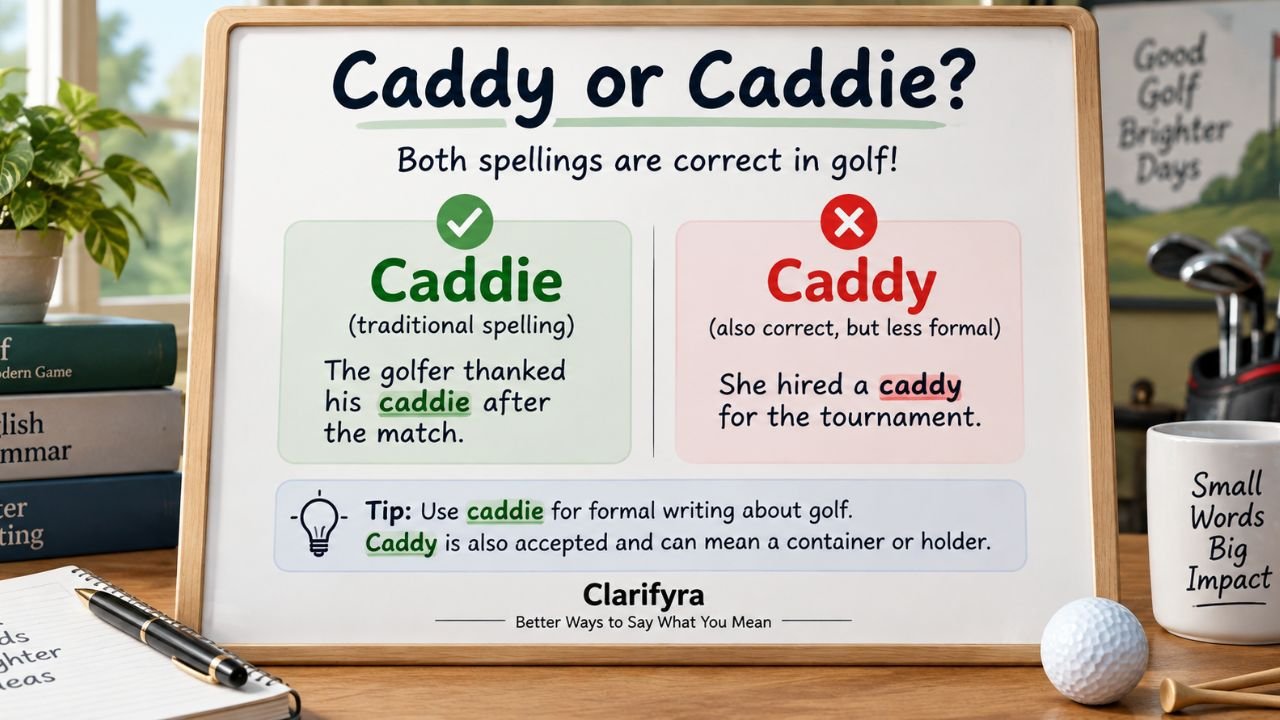
If you are writing about golf, you may wonder whether the person who carries a golfer’s clubs is a caddy or a caddie. The two spellings look almost identical and are pronounced the same, which makes the choice easy to question. The good news is that both forms are real words. However, caddie is the traditional spelling for the golf role and is the form commonly used in formal golf terminology. Caddy is also accepted in this meaning, while it has additional meanings related to containers and holders.
Caddie is the traditional and commonly preferred spelling for a person who assists a golfer. However, caddy is also an accepted variant in the golf sense. In other contexts, caddy can mean a small container or holder, such as a tea caddy or shower caddy.
Caddie or Caddy: What Is the Difference?
When referring to a person who helps a golfer, caddie and caddy can both be used. The main difference is one of spelling preference and context rather than meaning.
Caddie is especially familiar in golf writing and formal golf terminology. It is the spelling used by major golf authorities, including the USGA in its Rules of Golf.
Caddy is not simply a misspelling, though. Dictionaries recognize it as an alternative spelling of the golf term. The same spelling is also used for several types of containers.
| Feature | Caddie | Caddy |
|---|---|---|
| Golf assistant | Yes | Yes |
| Standard dictionary word | Yes | Yes |
| Traditional golf spelling | Yes | Variant |
| Container/holder meaning | No | Yes |
| Plural | Caddies | Caddies |
| Golf verb | Caddie | Caddy |
| Pronunciation | Same | Same |
So, if you are talking specifically about golf, caddie is a safe choice, particularly in formal or professional writing. But using caddy does not automatically make your sentence incorrect.
What Does “Caddie” Mean?
A caddie is a person who assists a golfer during a round. Traditionally, the job includes carrying the golfer’s clubs and equipment.
A caddie can also provide advice and other assistance permitted by the rules of golf. The role can therefore involve considerably more than simply carrying a golf bag.
For example:
- The golfer thanked his caddie after the final hole.
- Her caddie helped her choose the appropriate club.
- The professional golfer has worked with the same caddie for several seasons.
- His caddie carried the clubs throughout the round.
As a noun, caddie refers to the person. It can also be used as a verb meaning to work as a caddie.
For example:
She caddies at the local golf club on weekends.
What Does “Caddy” Mean?
Caddy has more than one meaning.
In golf, it can be an alternative spelling of caddie. Therefore, a sentence such as:
The golfer spoke with his caddy before the next hole.
can be understood as referring to the person assisting the golfer.
However, caddy also commonly refers to a small container, holder, or storage item.
Examples include:
- a tea caddy
- a shower caddy
- a desk caddy
- a sewing caddy
For example:
She kept her tea in a decorative caddy.
He bought a shower caddy for his bathroom.
This additional meaning is one reason context matters when choosing between the two spellings.
Is “Caddie” the Correct Spelling in Golf?
Yes. Caddie is a correct and well-established spelling for the golf assistant.
In fact, it is the spelling used in formal golf rules. The USGA’s Rules of Golf define a caddie as someone who helps a player during a round by carrying, transporting, or handling clubs and/or giving advice, subject to the rules.
That makes caddie an especially appropriate choice when you are writing about official golf rules, professional tournaments, or golf instruction.
However, it would be inaccurate to say that caddy is always wrong. Major English dictionaries list caddy as an alternative spelling of the golf term.
A useful rule is:
For formal golf writing, choose “caddie.” In general English, “caddy” can also be correct when it refers to a golf assistant.
Is “Caddy” Correct in Golf?
Yes.
Although caddie is the traditional golf spelling, caddy is also recognized as a variant.
For example, both of these sentences can refer to a person assisting a golfer:
Caddie:
The player discussed the course with his caddie.
Caddy:
The player discussed the course with his caddy.
The first form is generally the better choice if you want to follow formal golf terminology. The second is still a legitimate English spelling in the golf sense.
This is an important distinction because calling caddy a simple spelling mistake would give readers misleading information.
Caddy or Caddie in UK English
British English uses caddie for the golf assistant, while caddy is also recognized as a variant.
If you are writing for a British audience and want the most traditional golf spelling, caddie is a good choice.
There is another important British-English use of caddy: a container for tea.
For example:
The tea was stored in a small caddy.
So British readers may encounter both words, but the context helps determine the intended meaning.
Caddy or Caddie in Canada
Canadian English also recognizes variation between caddy and caddie.
Canadian spelling guidance generally emphasizes choosing an established dictionary authority and being consistent with the spelling you use. That is useful advice here because neither form needs to be treated as a mysterious or invented spelling.
For the golf meaning, caddie is the clearest choice when you want to follow traditional golf terminology. Caddy can also be used as the variant.
If you are writing for a Canadian audience, consistency is more important than trying to force one form into every context.
Caddy or Caddie Spelling: Which Should You Choose?
The easiest way to decide is to consider the meaning and the type of writing.
Use “caddie” when:
- You are writing about a golf professional.
- You are discussing the Rules of Golf.
- You want the traditional golf spelling.
- You are writing formal golf content.
- You want to avoid confusion with containers.
Use “caddy” when:
- You mean a container or holder.
- You are using the accepted alternative spelling for a golf assistant.
- The surrounding context makes the golf meaning obvious.
For example:
The caddie gave the player advice about the next shot.
Here, caddie clearly identifies the golf assistant.
But:
I bought a new shower caddy.
Here, caddy means a storage holder, not a person.
Caddy or Caddie Grammar and Word Forms
Both spellings can be used as nouns in the golf sense, and both can also appear as verbs.
The noun refers to the person assisting a golfer.
The verb means to work as a caddie or perform that role.
The common forms are:
| Form | Example |
|---|---|
| Base verb | I caddie for a golfer. |
| Third-person singular | She caddies at the club. |
| Past tense | He caddied during the tournament. |
| -ing form | They are caddying this weekend. |
| Plural noun | Several caddies waited near the clubhouse. |
The spelling changes slightly when endings are added.
For example, the plural of caddie is caddies, not caddies with a different pronunciation. The same plural form is used for the noun caddy.
What Is the Plural of Caddy or Caddie?
The plural of both caddy and caddie, when referring to golf assistants, is:
caddies
Examples:
Several caddies were waiting for the players.
The tournament hired additional caddies.
The spelling is therefore identical in the plural.
This is useful to remember because the two singular forms converge into the same plural spelling.
Is There an Abbreviation for Caddy or Caddie?
There is no widely established standard abbreviation that you need to use for caddie in ordinary English or golf writing.
In most cases, simply write caddie.
For example:
The player spoke with his caddie before making the shot.
There is no need to shorten the word.
If a particular tournament, organization, publication, or internal document uses its own abbreviation, follow that organization’s style guide. Otherwise, the complete word is clearer.
Why Are Caddy and Caddie Confused?
The confusion is understandable because the two words:
- have the same pronunciation,
- have almost identical spellings,
- can refer to the same person in golf,
- and share the same plural form, caddies.
The final letters are the main visual difference:
caddie → ends in -ie
caddy → ends in -y
English has many words in which an -ie ending and a -y ending can create different spellings or related forms. In this case, however, the two spellings are accepted for the golf meaning.
The bigger practical distinction is that caddy has additional meanings that caddie does not normally have.
Caddy vs. Caddie: Examples in Sentences
Here are some natural examples showing how the words work.
Golf
The golfer asked his caddie to check the yardage.
The golfer asked his caddy to check the yardage.
Both sentences use the word for the person assisting the golfer.
Container
She placed the tea leaves in a metal caddy.
Here, caddy refers to a container.
Storage holder
He keeps his bathroom supplies in a shower caddy.
Again, caddy refers to a holder rather than a golf assistant.
Verb
Marcus caddies for a professional player.
Here, the word functions as a verb.
Past tense
She caddied during several amateur tournaments.
The past tense is caddied.
Common Mistakes to Avoid
1. Calling “caddy” a misspelling
In the golf sense, caddy is an accepted variant. It is therefore too simplistic to mark it as automatically incorrect.
2. Using “caddie” for a container
A caddie normally refers to the golf role. For a tea container or storage holder, caddy is the appropriate spelling.
3. Confusing the plural
Both caddy and caddie become caddies in the plural.
One caddie → two caddies
One caddy → two caddies
4. Inventing an abbreviation
There is no need to shorten the word in ordinary writing. Caddie is already short and clear.
5. Mixing styles unnecessarily
If you are writing a formal golf article, using caddie consistently will usually make the terminology clearer. If you choose caddy as a variant, use it consistently unless the context requires a different spelling.
An Easy Way to Remember the Difference
A simple memory trick is:
Caddie = think golf.
If you are writing about the person who carries clubs and helps a golfer, caddie is the safest spelling to remember.
Caddy = think container.
A tea caddy, shower caddy, or storage caddy uses the -y spelling.
Just remember that caddy can also be used for a golf assistant, so this is a memory aid rather than an absolute rule.
Which One Should You Use?
If you are unsure, choose caddie when you mean a golf assistant.
This is particularly useful in formal writing, golf instruction, tournament coverage, and discussions of golf rules. It immediately communicates the intended meaning and matches the terminology used by major golf authorities.
Choose caddy when you mean a container or holder. If you use it for a golf assistant, it is still an accepted variant, provided the context is clear.
The most important point is that caddy and caddie are not simply a correct-versus-incorrect pair. Their relationship depends on meaning and context.
FAQs
Is “caddie” or “caddy” correct in golf?
Both are accepted for the golf assistant, but caddie is the traditional and commonly preferred spelling, especially in formal golf terminology. The USGA uses caddie in the Rules of Golf.
Is “caddy” a misspelling of “caddie”?
No. Caddy is a recognized alternative spelling for the golf meaning. It is also an independent word used for containers and holders, such as tea caddies and shower caddies.
What is the difference between a caddy and a caddie?
In golf, there may be no difference in meaning because both can refer to a person who assists a golfer. Caddie is the traditional golf spelling, while caddy is also accepted. Outside golf, caddy can mean a container or holder.
How do you spell the golf word?
The traditional spelling is caddie, spelled C-A-D-D-I-E. Caddy, spelled C-A-D-D-Y, is also accepted when referring to a golf assistant.
What is the plural of caddie?
The plural is caddies. The same plural spelling is used for caddy when it refers to a golf assistant or another countable noun that takes the regular plural.
Is “caddie” used in British English?
Yes. Caddie is well established in British English for the person who assists a golfer. Caddy is also used as a variant and has additional meanings, including a container for tea.
The Bottom Line
When referring to the person who assists a golfer, caddie is the safest and most traditional spelling to choose, especially in formal golf writing. Caddy is also a legitimate variant, so it should not automatically be treated as a spelling error. Outside golf, caddy commonly refers to a container or holder. For clear, consistent English usage, context should guide your choice. That kind of practical distinction is exactly what Clarifyra aims to make easier: choosing the right word for what you mean.