Dam or Damn: What’s the Difference?
It is easy to confuse dam and damn because they are pronounced the same in standard English, but they have completely different meanings and uses. One refers mainly to a structure that holds back water, while the other is an informal word used to express emotion, emphasis, criticism, or condemnation. The extra n in damn is silent, which is one reason the spelling can be confusing.
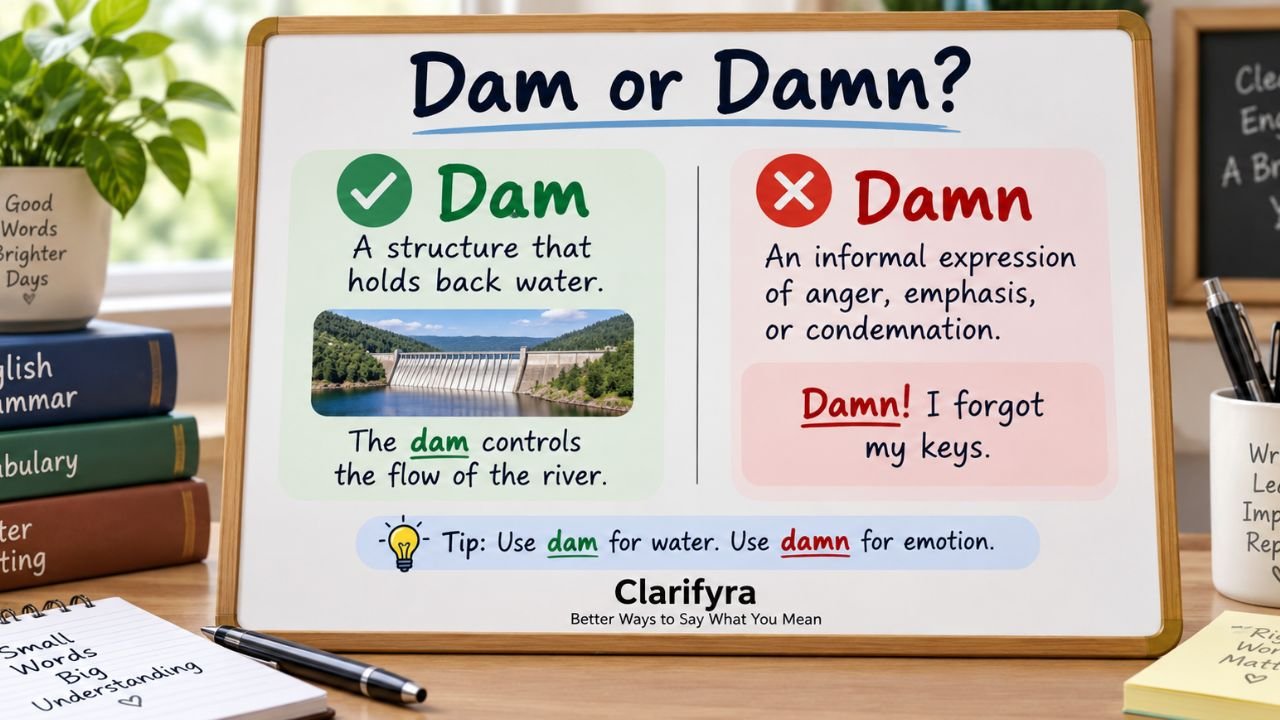
Dam and damn are both correct words, but they mean different things. Dam usually means a barrier built to hold back water, while damn is an informal expression of anger, annoyance, emphasis, or condemnation. If you mean a water barrier, use dam; if you mean the exclamation, use damn.
Dam or Damn: The Key Difference
The easiest way to distinguish these words is to look at their meanings:
| Feature | Dam | Damn |
|---|---|---|
| Main meaning | A barrier that holds back water | An informal expression or word expressing emotion, emphasis, or condemnation |
| Pronunciation | /dæm/ | /dæm/ |
| Silent letter | None | n is silent |
| Common word type | Noun, verb | Interjection, verb, adjective, adverb, noun |
| Example | The dam holds back the river. | Damn! I forgot my keys. |
| Formality | Generally neutral | Often informal and potentially offensive depending on context |
So, both spellings are real, but they cannot normally be substituted for one another.
What Does “Dam” Mean?
A dam is primarily a noun referring to a structure constructed across a river or other waterway to control, store, or restrict the flow of water.
For example:
- The dam supplies water to nearby towns.
- Workers inspected the dam after the heavy rain.
- The reservoir behind the dam is nearly full.
- The engineers designed a new dam to control flooding.
The word can also be used as a verb. To dam a river means to block or control its flow by constructing a dam.
For example:
- Engineers plan to dam the river.
- The river was dammed to create a reservoir.
The past tense and past participle are dammed, with a double m.
Another Meaning of “Dam”
There is another, less common meaning that is useful to know. In animal breeding, a dam is the female parent of an animal, especially in contexts involving horses and livestock.
For example:
The foal’s dam was a successful racehorse.
In this sense, dam has nothing to do with water.
What Does “Damn” Mean?
Damn has several uses, but it is most familiar as an informal expression of anger, annoyance, frustration, surprise, or emphasis.
For example:
- Damn! I left my phone at home.
- Damn, that was close.
- Damn! We missed the train.
It can also appear before a noun for emphasis:
- Where are those damn keys?
- That’s a damn good idea.
- This damn computer keeps freezing.
Because damn can function as an expletive or swear word, it may not be suitable for every formal or professional situation.
“Damn” as a Verb
The word can also be a verb meaning to condemn, strongly criticize, or declare something unacceptable.
For example:
- The report damned the company’s safety practices.
- The critics damned the movie for its poor writing.
This meaning is quite different from the emotional exclamation Damn!.
Why Are the Two Words Confused?
The biggest reason is pronunciation.
In standard English, dam and damn are pronounced alike:
- dam → /dæm/
- damn → /dæm/
The n in damn is silent.
That means someone hearing the word cannot always tell which spelling is intended without considering the sentence’s meaning.
Compare:
The dam was damaged by the flood.
and:
Damn! The flood damaged the road.
The words sound alike, but their meanings make the intended spelling clear.
Is It Spelled “Dam” or “Damn”?
Both spellings are correct, depending on the meaning.
Use “dam” for a water barrier
Correct:
The dam controls the flow of the river.
Incorrect for this meaning:
The damn controls the flow of the river.
Here, dam is the appropriate spelling because the sentence refers to a physical structure.
Use “damn” for the exclamation
Correct:
Damn! I forgot my wallet.
Incorrect:
Dam! I forgot my wallet.
Here, damn is the standard spelling because the speaker is expressing frustration.
So the question is not really about which spelling is universally correct. Both are correct words; the context determines which one you need.
“Dam It” or “Damn It”?
If you are expressing anger, frustration, or annoyance, the correct expression is:
Damn it!
Examples:
- Damn it! I missed my flight.
- Damn it, I forgot the appointment.
- Damn it! The computer stopped working.
Dam it has a completely different grammatical possibility. It could theoretically involve the verb dam, meaning to block something with a dam, but it does not mean the common exclamation.
For example:
They plan to dam it before the rainy season.
Here, it refers to something such as a river, and dam is being used as a verb.
Dammed vs. Damned
Another pair worth distinguishing is dammed and damned.
Dammed
Dammed is the past tense or past participle of dam.
The river was dammed to create a reservoir.
It relates to blocking or controlling water.
Damned
Damned comes from damn. It can mean condemned, severely criticized, or subjected to religious condemnation, depending on the context.
The proposal was damned by several critics.
It does not mean that a physical barrier was constructed.
A useful distinction is:
- dammed → related to a dam
- damned → related to damn
The extra n changes the word and its meaning.
Examples in Sentences
Seeing the words in different contexts makes the distinction easier.
Examples with “dam”
- The new dam will provide water during the dry season.
- The reservoir is located behind the dam.
- Engineers inspected the dam for structural damage.
- The river was dammed to generate hydroelectric power.
Examples with “damn”
- Damn! I forgot to charge my phone.
- That was a damn difficult problem.
- The critic damned the movie as poorly made.
- Where did I put those damn glasses?
Notice that the words are not interchangeable even though they sound alike.
A Simple Way to Remember the Difference
A useful memory trick is:
DAM → water
Think of a dam across a river.
DAMN → emotion
Think of damn as the word you might say when you are angry, annoyed, surprised, or emphasizing something.
You can also remember the silent n in damn: the additional letter does not change its pronunciation, but it changes the spelling and meaning.
Common Mistakes
1. Using “damn” for a water structure
Incorrect:
The damn prevents the river from flooding.
Correct:
The dam prevents the river from flooding.
2. Leaving out the “n” in the exclamation
Incorrect:
Dam! I missed the bus.
Correct:
Damn! I missed the bus.
3. Confusing “dammed” and “damned”
Incorrect:
The river was damned to create a reservoir.
Correct:
The river was dammed to create a reservoir.
4. Confusing “dam” with “damn” when speaking
Because the two words generally sound the same, pronunciation alone does not tell you which spelling to use. Think about the meaning and choose the appropriate word when writing.
Are “Dam” and “Damn” Homophones?
Yes. Dam and damn are generally considered homophones because they have the same pronunciation but different spellings and meanings.
Other familiar examples of homophones include:
- flower / flour
- right / write
- there / their
- sea / see
With dam and damn, the silent n is particularly important because it is written but not pronounced.
Is “Damn” Appropriate in Formal Writing?
Usually, you should consider your audience before using damn in formal writing.
It is widely understood, but its exclamatory use is informal and can be considered offensive by some readers. In an academic paper, formal report, professional letter, or other carefully edited document, a neutral alternative is often more appropriate.
The noun dam, by contrast, is an ordinary neutral word when referring to a water-control structure.
FAQ
Is “dam” or “damn” correct?
Both are correct words. Dam normally refers to a structure that holds back water, while damn is commonly used as an informal exclamation or as a word meaning to condemn or strongly criticize.
Is it spelled “dam” or “damn” when expressing anger?
Use damn. For example, “Damn! I forgot my keys.” The n is silent, so the word sounds like dam when spoken.
What is the difference between “dam” and “damn”?
A dam is primarily a physical barrier used to control water. Damn is an informal expression of emotion or emphasis and can also function as a verb meaning to condemn or strongly criticize.
Is “dam” a real word besides the water meaning?
Yes. In animal breeding, dam can mean the female parent of an animal, particularly in horse-related contexts. It is also used as a verb meaning to block or control water with a dam.
Why is the “n” silent in “damn”?
The spelling preserves the historical form of the word, while its modern pronunciation does not pronounce the final n. As a result, dam and damn are pronounced alike in standard English.
Is “damn it” the correct spelling?
Yes. “Damn it!” is the standard spelling when the phrase is being used as an informal expression of anger, frustration, or annoyance. “Dam it” would have a different meaning involving the verb dam.
The Bottom Line
Dam and damn are both legitimate English words, but they serve very different purposes. Use dam for a structure that holds back water, or for the related verb and animal-breeding sense. Use damn for the informal exclamation and related meanings involving condemnation or strong criticism. Although they sound alike, their spelling and meaning should never be treated as interchangeable. For more clear explanations of confusing English words, Clarifyra helps you choose the right word for what you mean.