Gardner or Gardener: Which Spelling Is Correct?
“Gardner” and “gardener” look and sound remarkably similar, so it is easy to leave out a letter when writing the word. However, they do not normally serve the same purpose. If you mean a person who grows plants or takes care of a garden, gardener is the standard spelling. Gardner is most commonly seen as a surname or proper name. Understanding this small distinction can help you avoid an easy spelling mistake in everyday and formal English.
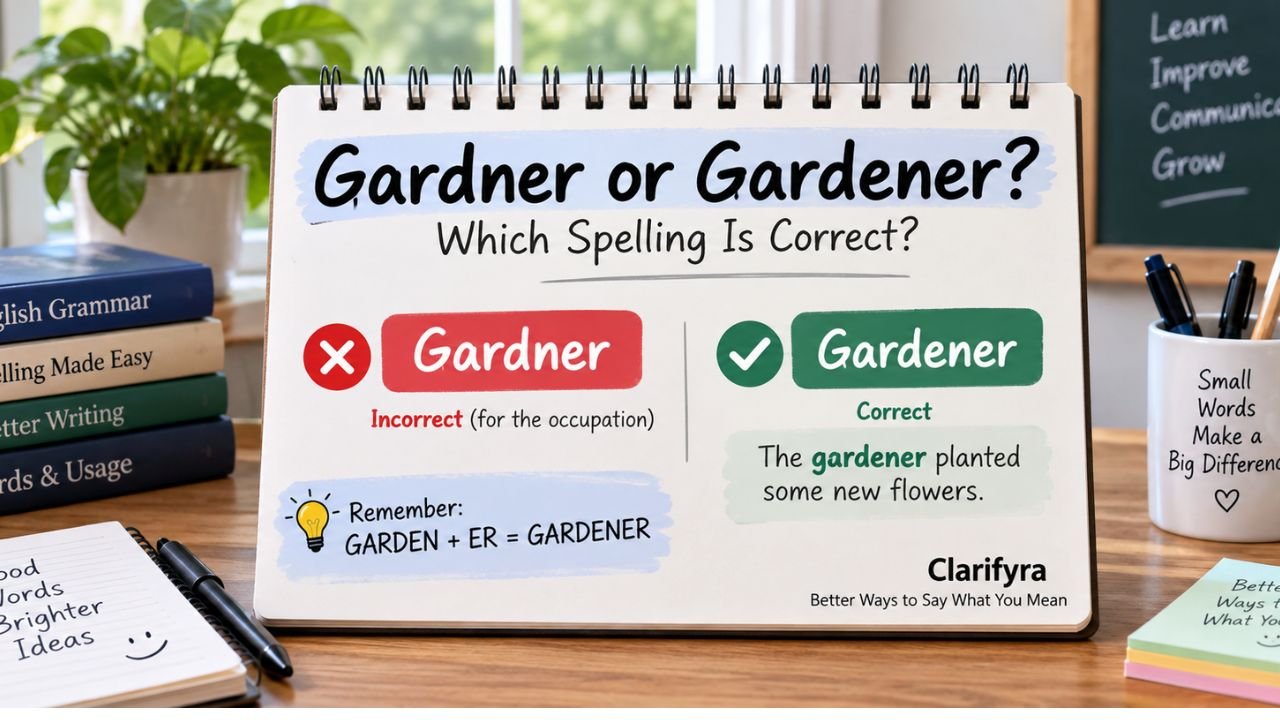
Gardener is the correct spelling when you mean a person who takes care of a garden or grows plants. Gardner is generally not the standard spelling for the occupation, but it is a legitimate surname. So, in a sentence such as “She works as a gardener,” use gardener.
Gardner or Gardener: Which Is Correct?
If you are talking about someone whose job or hobby involves caring for gardens, gardener is the correct word.
The word is formed from garden + -er, giving gardener. It is a noun referring to someone who cultivates, maintains, or works in a garden.
For example:
- The gardener planted some new roses.
- My neighbour is an experienced gardener.
- We hired a gardener to maintain the lawn.
Writing gardner in these sentences would normally be considered a spelling error.
However, Gardner is not simply a meaningless misspelling. It is an established surname, so you may correctly see it when referring to a person whose family name is Gardner.
Quick Comparison
| Feature | Gardener | Gardner |
|---|---|---|
| Standard occupation word? | Yes | No |
| Meaning | A person who tends a garden | Usually a surname |
| Common noun? | Yes | No, when used as a name |
| Proper name? | Sometimes, but uncommon | Yes |
| Example | The gardener watered the plants. | Ms Gardner called earlier. |
| Standard spelling for the occupation | Gardener | Gardner is incorrect |
The key point is simple: gardener describes the person and Gardner can be a person’s name.
What Does “Gardener” Mean?
Gardener is a noun. It describes someone who looks after plants, flowers, vegetables, lawns, trees, or other parts of a garden.
A gardener may work professionally or simply enjoy gardening as a hobby.
For example:
- The gardener trimmed the hedges this morning.
- My father has always been a keen gardener.
- The hotel employs a gardener to maintain its grounds.
- She became a gardener after studying horticulture.
The word can refer to someone doing relatively simple garden maintenance or to a professional who has extensive knowledge of plants and horticulture.
Gardener in a Sentence
Here are some natural examples:
The gardener planted tulips around the entrance.
We need a gardener to look after the large backyard.
He works as a gardener at a public park.
She is an enthusiastic gardener who grows vegetables at home.
In each case, gardener is the appropriate spelling.
What Does “Gardner” Mean?
Gardner is most commonly encountered as a surname.
For example:
- Mr Gardner is our new neighbour.
- Sarah Gardner wrote the report.
- The book was written by Lisa Gardner.
Here, Gardner is a person’s family name, so the spelling is perfectly correct.
This explains why the two forms can sometimes appear interchangeable to learners. Both gardener and Gardner exist in English, but they have different grammatical functions.
If you are describing someone’s occupation, use gardener. If Gardner is someone’s surname, retain the spelling Gardner.
Is “Gardner” a Real Word?
Yes, but context matters.
If by “word” you mean the ordinary noun for someone who works in a garden, gardner is not the standard spelling. The occupation is gardener.
If Gardner is being used as a surname, however, it is completely legitimate.
Consider these two sentences:
Correct occupation:
James is a gardener.
Correct surname:
James Gardner lives in London.
The first sentence describes James’s occupation. The second uses Gardner as his family name.
Therefore, it would be inaccurate to say that Gardner is always wrong. It is wrong when it is being used as a misspelling of the occupation gardener, but it is correct as a proper name.
Why Are the Two Spellings Confused?
The main difficulty comes from their very similar appearance and pronunciation.
When people say gardener naturally, the middle vowel can be relatively weak in ordinary speech. As a result, the word may sound closer to something like “gardner” to some listeners.
That can lead people to spell the word based on how they think it sounds.
There is also a straightforward visual reason for the mistake. Both forms begin with gard- and contain the letters -ner, making it easy to overlook the second e in gardener.
The important distinction is that the standard occupation follows the word garden:
garden + er → gardener
Correct and Incorrect Examples
Seeing the two forms in context makes the difference easier to remember.
Correct: Gardener
The gardener mowed the lawn.
Incorrect for the occupation: Gardner
The gardner mowed the lawn. ❌
Correct: Gardner as a surname
Mr Gardner lives across the street. ✅
Another correct use of gardener
We hired a gardener to take care of the flower beds.
Another correct use of Gardner
Emma Gardner published her first novel.
The capitalization in Gardner is also important when it is a surname because proper names are normally capitalized.
Gardner or Gardener in UK English
In UK English, the standard spelling for someone who looks after a garden is gardener.
For example:
The gardener is working in the back garden.
There is no special British spelling in which gardner replaces gardener for this occupation. British writers should therefore use gardener when referring to the person who maintains a garden.
The same spelling is also standard in American English:
The gardener planted flowers.
So this is not a case like colour/color or centre/center, where British and American English use different standard spellings.
If you are writing for a UK audience, use gardener. If you are writing for an American audience, use gardener as well.
An Easy Way to Remember the Spelling
A useful trick is to start with the word garden.
Think:
GARDEN + ER = GARDENER
The word already contains garden, so do not remove the second e.
You can also associate it with the action:
A gardener gardens.
The occupation word keeps the spelling of garden before adding -er.
This makes gardener easier to distinguish from Gardner, which is primarily encountered as a surname.
Common Mistakes to Avoid
1. Dropping the second “e”
The most common mistake is writing:
gardner
when the intended word is:
gardener
Remember that garden remains intact when -er is added.
2. Assuming Gardner is the British spelling
It is not. Gardener is the standard spelling in British English too.
3. Treating Gardner as universally incorrect
This goes too far. Gardner is a legitimate surname, so it can be perfectly correct when used as a person’s name.
4. Changing someone’s surname
If someone’s surname is Gardner, do not “correct” it to Gardener. Proper names retain their established spelling.
For example:
Lisa Gardner is an author.
The spelling of her surname should remain Gardner.
How to Choose the Right Form
The easiest way to decide is to ask what you are trying to say.
If you mean a person who looks after a garden, choose:
gardener ✅
If you mean a person’s surname, check whether their name is:
Gardner ✅
For example:
- He is a gardener. → occupation
- His surname is Gardner. → family name
This simple distinction resolves most cases.
FAQ
Which is correct, gardner or gardener?
Gardener is correct when referring to a person who cares for or cultivates a garden. Gardner is generally used as a surname rather than as the standard spelling of the occupation.
Is “gardner” a misspelling of gardener?
Yes, when gardner is intended to mean someone who looks after a garden, it is normally a misspelling of gardener. The standard English noun is spelled with the extra e.
Is Gardner a real word?
Gardner is a legitimate surname. It should not, however, normally be used as the common noun for someone who works in a garden.
Is gardener the correct spelling in the UK?
Yes. Gardener is the standard spelling in British English. Gardner is not an alternative British spelling for the occupation.
Why does gardener have an extra “e”?
The word is based on garden with the agent suffix -er: garden + er = gardener. Keeping the spelling of garden helps explain why the second e appears before the final r.
Can Gardner and gardener be used interchangeably?
No. They should not normally be treated as interchangeable. Gardener is the occupation noun, while Gardner is most commonly a surname.
The Bottom Line
When you mean someone who grows plants or takes care of a garden, gardener is the spelling to use. Gardner has a legitimate place in English, but primarily as a surname, so it should not replace the occupation word.
A quick memory rule is garden + er = gardener. If you are checking spelling, grammar, or other easily confused English terms, Clarifyra is designed to make those distinctions clear and practical.