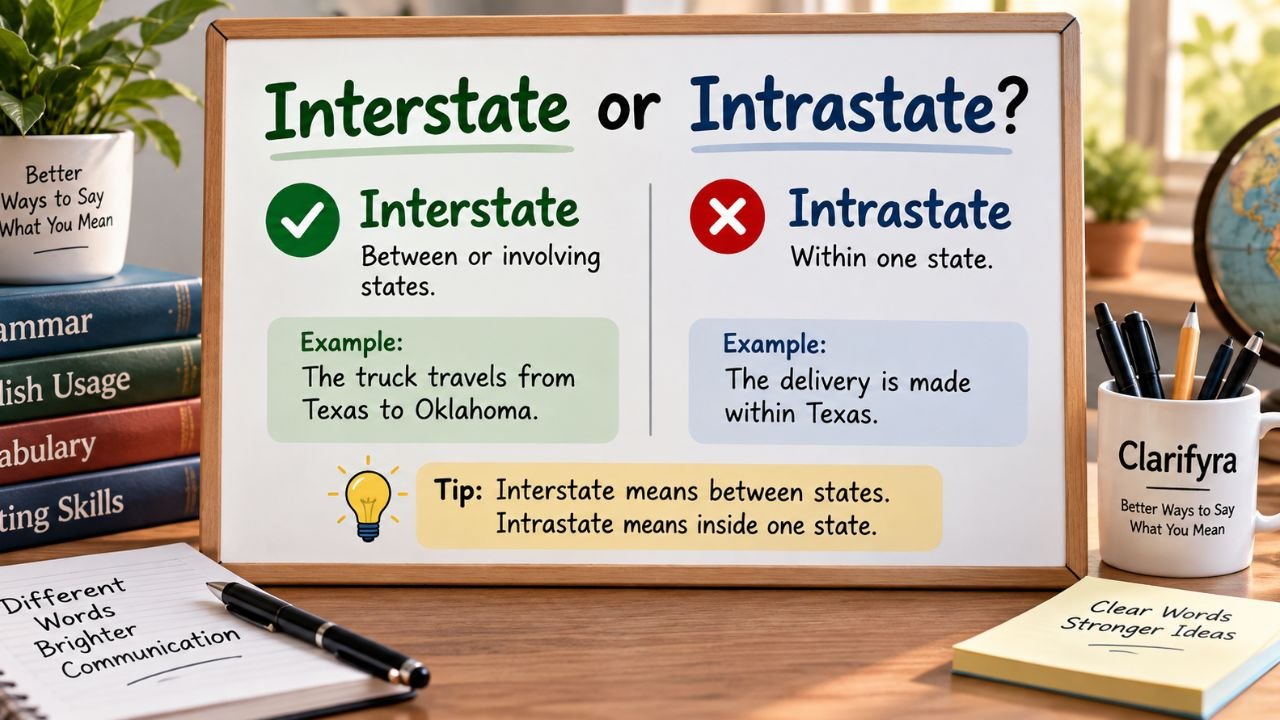
Interstate or Intrastate: What’s the Difference?
The words interstate or intrastate look almost identical, but they describe different types of activity. In U.S. transportation and trucking, the distinction can affect how a commercial motor vehicle operation is classified and how a CDL holder self-certifies. The terms also appear in Indian GST discussions, where IGST is generally associated with inter-State supplies. Understanding the context is therefore essential: the same words can be used in different regulatory systems, with different rules.
Interstate means involving more than one state or an interstate movement, while intrastate generally means activity confined to one state. For U.S. CDL purposes, interstate commerce can include certain trips that never physically cross a state line. In India, IGST is generally charged on inter-State supplies, while intra-State supplies generally involve CGST and SGST/UTGST.
Interstate vs. Intrastate: Quick Comparison
| Feature | Interstate | Intrastate |
|---|---|---|
| Basic meaning | Between or involving states | Within one state |
| Common context | Interstate commerce, trucking, trade | In-state transportation or business |
| U.S. trucking | Can involve movement connected to another state or country | Generally limited to qualifying activity within one state |
| CDL relevance | Affects CDL self-certification category | May affect state-specific CDL requirements |
| Indian GST | Generally associated with IGST | Generally associated with CGST + SGST/UTGST |
| Does the vehicle always cross a state line? | No | Generally no interstate component |
The exact legal meaning can depend on the regulation being applied. For U.S. commercial transportation, FMCSA uses a specific definition of interstate commerce rather than simply asking whether a truck crossed a state border.
What Does “Interstate” Mean?
Interstate literally means between states. In the United States, it is commonly used for transportation, trade, commerce, and other activities involving more than one state.
For example, a truck carrying goods from Texas to Oklahoma is engaged in an interstate movement.
U.S. law commonly describes interstate commerce as commerce between states, but transportation regulations can provide more detailed definitions. Under 49 CFR § 390.5, interstate commerce includes transportation between a location in one state and a location outside that state, transportation within a state that passes through another state, and certain in-state transportation that is part of a movement originating or terminating outside the state.
Examples
- A truck carries freight from California to Arizona.
- A passenger bus travels from New York to Pennsylvania.
- A shipment moves through another state on its way to its destination.
- A truck makes an in-state delivery as part of a shipment that originated outside the state.
These situations can have an interstate component even when the individual trip looks local.
What Does “Intrastate” Mean?
Intrastate means within one state.
In ordinary usage, an intrastate business or transportation activity takes place inside the boundaries of a single state. For U.S. commercial motor vehicle purposes, FMCSA describes intrastate commerce as operating within a state without meeting any of its criteria for interstate commerce.
For example, suppose a company transports goods from one city in Texas to another city in Texas, and the movement is not connected to an interstate shipment. That operation may be considered intrastate commerce.
The important qualification is that simply staying inside a state’s borders does not automatically make a transportation operation intrastate.
What Is the Difference Between Interstate and Intrastate Commerce?
The central difference is the scope and character of the commercial movement.
Interstate commerce involves transportation or trade that crosses state boundaries or has another qualifying interstate connection. Intrastate commerce remains within a state and does not meet the applicable definition of interstate commerce. FMCSA’s guidance specifically points to the origin, destination, route, and commercial movement when making this distinction.
Consider these two examples:
Example 1 — Intrastate
A carrier picks up a shipment in Dallas and delivers it to another Texas location. The shipment originated and will end in Texas, and there is no other interstate connection.
Example 2 — Interstate
A carrier picks up goods in Dallas for a shipment that originated in another state and is part of an interstate movement. Even though the particular truck trip stays within Texas, the operation can qualify as interstate commerce under the applicable rules.
This is why a driver should not determine the classification solely by looking at the route on a map.
What Is Interstate Commerce?
Interstate commerce is a broad term for trade, traffic, transportation, or commercial activity involving states or other qualifying interstate connections.
For trucking, federal regulations identify three important situations:
- Transportation between a place in one state and a place outside that state.
- Transportation between two places within one state when the route passes through another state or outside the United States.
- Transportation between two places within a state when the movement is part of trade or transportation that originated or will terminate outside that state or the United States.
The concept is broader than simply “crossing the state line.” Cornell’s Legal Information Institute also notes that interstate commerce generally concerns transactions or transportation across state borders, while U.S. constitutional commerce law can reach some intrastate activity connected to broader interstate commercial activity.
What Is Intrastate Commerce?
Intrastate commerce is commerce that remains within one state and does not qualify as interstate commerce under the relevant rules.
For a commercial driver, this could mean operating a qualifying commercial motor vehicle entirely within the driver’s state when the shipment has no interstate origin, destination, or other connection covered by the applicable definition.
However, intrastate does not mean “free from regulation.” State governments can impose their own requirements on intrastate commercial transportation, and the specific rules vary by state.
That is particularly important for CDL holders because the state issuing the license plays a role in self-certification and other requirements. FMCSA instructs CDL holders to determine the type of operation they conduct and then self-certify with their State Driver Licensing Agency.
Interstate or Intrastate CDL: Which Applies?
If you have a CDL or are applying for one, the interstate/intrastate distinction can matter because you must identify the type of commercial motor vehicle operation you expect to conduct.
FMCSA provides three basic questions for determining whether a CMV operation is interstate:
- Does the vehicle travel from one state to another state or a foreign country?
- Does the vehicle travel between two locations in one state but cross another state or foreign country during the trip?
- Are the cargo or passengers part of a trip that began or will end in another state or foreign country?
If the answer is yes to an applicable question, the operation can fall under interstate commerce.
If the CMV is operated within one state and none of the interstate conditions apply, FMCSA describes it as intrastate commerce for this purpose.
What if you operate in both?
This is an especially important point for CDL holders.
FMCSA says that if you operate in both interstate and intrastate commerce, you must choose interstate commerce when completing the relevant self-certification.
Do I Need Interstate or Intrastate Self-Certification?
The answer depends on how you use your commercial motor vehicle.
FMCSA divides CDL self-certification into four broad categories:
- Non-excepted interstate
- Excepted interstate
- Non-excepted intrastate
- Excepted intrastate
First, the driver determines whether the operation is interstate or intrastate. The driver then determines whether the operation is excepted or non-excepted.
For example, most CDL holders operating CMVs in interstate commerce fall into the non-excepted interstate category, while certain activities are specifically treated as excepted.
Intrastate drivers likewise need to consider whether their particular state requires medical certification for their operation. FMCSA notes that state rules determine the relevant requirements for excepted intrastate operations.
Because requirements can depend on the state and the type of commercial operation, a driver should check with the appropriate State Driver Licensing Agency rather than selecting a category based only on where the truck is physically located.
Does Interstate Always Mean Crossing a State Line?
No.
This is one of the most important distinctions to understand.
Imagine a truck operating entirely inside Ohio. At first glance, that looks intrastate. But if the cargo is part of a shipment that originated in another state or is destined to another state, the operation may qualify as interstate commerce.
FMCSA specifically includes certain transportation between two locations in the same state when the cargo or passengers are part of a movement that began or will end outside that state.
So the correct question is not simply:
“Did my truck cross a state line?”
A better question is:
“What is the nature and commercial movement of the transportation?”
Is IGST Interstate or Intrastate?
This question belongs to a different regulatory context: India’s Goods and Services Tax system.
IGST stands for Integrated Goods and Services Tax, and it is generally associated with inter-State supplies.
The Indian government’s GST materials explain that GST on supplies across states is generally collected as IGST, while supplies within a state generally involve CGST and SGST/UTGST.
The GST portal explains the distinction using the place of supply and the supplier’s location. Where the place of supply is different from the supplier’s state, the transaction is treated as inter-State for the relevant GST rules.
Simple GST example
Suppose a supplier is located in Maharashtra and makes a qualifying supply to a recipient where the applicable place of supply is Gujarat.
Because the relevant states differ, the supply is generally treated as inter-State, and IGST applies.
By contrast, when the supplier’s location and place of supply are in the same state, the transaction is generally intra-State and CGST plus SGST applies.
There are exceptions and special rules under India’s GST legislation, so a particular transaction should be evaluated using the applicable place-of-supply rules rather than relying on the buyer’s address alone.
Interstate and Intrastate in Different Contexts
One reason these terms can be confusing is that they appear in several legal and regulatory systems.
| Context | Interstate / Inter-State | Intrastate / Intra-State |
|---|---|---|
| U.S. transportation | Qualifying movement involving interstate commerce | Qualifying movement confined to one state |
| U.S. CDL | Interstate CMV operation | Intrastate CMV operation |
| Indian GST | Generally linked to IGST | Generally linked to CGST + SGST/UTGST |
| Basic meaning | Between or involving states | Within one state |
The terminology is similar, but the rules are not interchangeable. A U.S. truck driver dealing with a CDL should look to FMCSA and the applicable state licensing authority. Someone asking whether IGST is interstate or intrastate should look to India’s GST rules and the applicable place-of-supply provisions.
Common Mistakes to Avoid
1. Assuming interstate means physically crossing a state line
A CMV operation can qualify as interstate even when the vehicle stays inside one state, depending on the shipment’s origin, destination, or interstate connection.
2. Assuming all in-state trucking is intrastate
Location alone is not always enough. The commercial movement itself needs to be considered.
3. Assuming intrastate means no federal considerations
State requirements are important, but federal rules can also apply depending on the operation and circumstances.
4. Treating IGST and U.S. interstate commerce as the same concept
They use related terminology but belong to entirely different regulatory systems.
5. Choosing a CDL category only because you currently drive locally
Your expected commercial operation matters. FMCSA specifically instructs drivers who operate in both interstate and intrastate commerce to choose interstate commerce for the relevant self-certification.
Easy Way to Remember the Difference
A simple memory rule is:
Interstate = between states
Intrastate = inside one state
For U.S. trucking, add one important qualification:
Interstate does not always require the truck itself to cross a state border.
For Indian GST:
Inter-State supply → generally IGST
Intra-State supply → generally CGST + SGST/UTGST
FAQ
Is interstate or intrastate correct?
Both are correct words. Interstate refers to something involving or occurring between states, while intrastate generally refers to something occurring within a single state.
What is the difference between interstate and intrastate commerce?
Interstate commerce involves a qualifying movement between states or another interstate connection. Intrastate commerce is confined to one state and does not meet the applicable definition of interstate commerce.
Do I need interstate or intrastate CDL classification?
It depends on the commercial motor vehicle operation you conduct or expect to conduct. FMCSA provides specific criteria for deciding between interstate and intrastate commerce and requires CDL holders to self-certify their operating category with their state licensing agency.
Is IGST interstate or intrastate?
IGST is generally associated with inter-State supplies in India’s GST system. Intra-State supplies generally involve CGST and SGST/UTGST, subject to applicable exceptions and special rules.
Can a truck be operating interstate without crossing state lines?
Yes. Under FMCSA’s definition, an in-state trip can qualify as interstate when the cargo or passengers are part of a movement that originated or will terminate outside the state, among other qualifying circumstances.
If I operate in both interstate and intrastate commerce, which category do I choose?
For the FMCSA CDL self-certification process, a driver operating in both categories must choose interstate commerce. The driver must then determine whether the operation is excepted or non-excepted.
The Bottom Line
Interstate and intrastate are both correct terms, but they describe different types of activity. In U.S. trucking, interstate classification depends on more than whether a vehicle crosses a state border, and CDL holders must consider the nature of their commercial operation when self-certifying. In India, IGST is generally used for inter-State supplies, while intra-State supplies generally use CGST and SGST/UTGST. For more clear explanations of confusing terms and usage questions, Clarifyra helps readers understand the difference without unnecessary complexity.