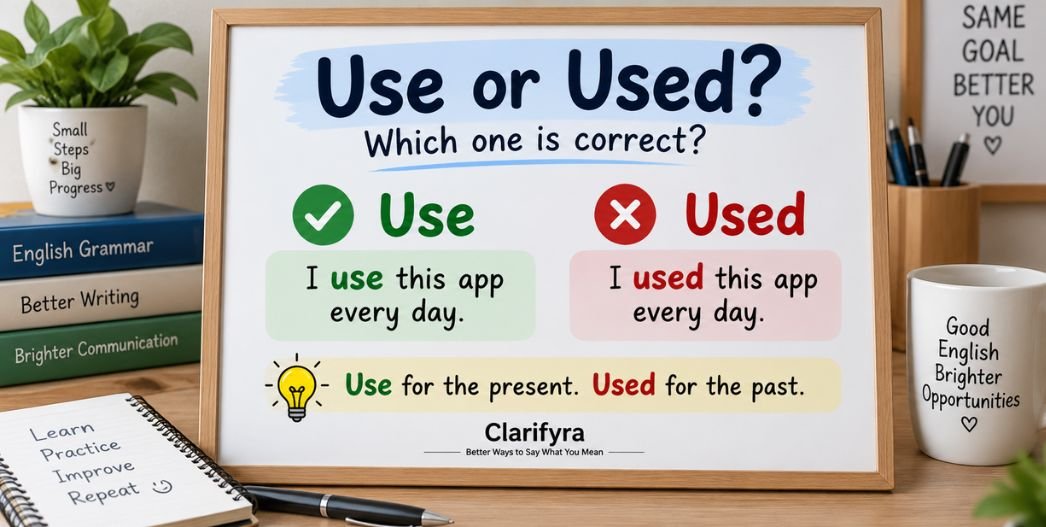
Use or Used: Which One Is Correct?
English learners often hesitate between use or used, especially when the words appear with to. The confusion becomes even greater in sentences such as “I used to use,” “Did you use to…?” and “Have you used…?” Although these forms look very similar, each follows a different grammatical pattern. The key is to look at the tense, the auxiliary verb, and what used to means in the sentence.
Use and used are both correct forms of the verb use. Use used to + base verb for a past habit or situation, but use use to after did or didn’t. For example, “I used to use this app,” but “Did you use to use this app?”
Use vs. Used: The Basic Difference
Use is the base form of the verb. It means to employ, operate, or make something serve a particular purpose.
I use this dictionary every day.
Used is the simple past and past participle of use.
I used this dictionary yesterday.
I have used this dictionary before.
The correct choice therefore depends on the grammatical structure.
| Form | Main use | Example |
|---|---|---|
| use | Base/present form | I use this computer daily. |
| uses | Present, third-person singular | She uses this computer daily. |
| used | Simple past | She used it yesterday. |
| used | Past participle | She has used it before. |
| used to | Former habit/state | She used to use it every day. |
| use to | After did/didn’t in the past-habit construction | Did she use to use it? |
So asking simply “use or used, which is correct?” does not have one answer. Both are correct, but they belong in different grammatical situations.
What Does “Use” Mean?
As a verb, use generally means to employ something for a particular purpose.
For example:
- I use a pen to write.
- We use this room for meetings.
- They use public transportation every day.
- Do you use this software at work?
It can also occur after modal verbs and other structures that require the base form:
You should use a stronger password.
We can use another example.
Did you use my computer?
Notice that did is followed by use, not used.
Present-tense forms
With ordinary present-tense statements:
I use
You use
We use
They use
But with he, she, or it, the verb becomes uses:
She uses a tablet for studying.
What Does “Used” Mean?
Used is the past form and past participle of use.
For a completed action in the past, use used:
I used your laptop yesterday.
He used the wrong key.
They used a different method last year.
After have, has, or had, use the past participle used:
I have used this program before.
She has used the same technique for years.
We had used all the available materials.
This explains why “Have you use or used?” has a straightforward answer:
✅ Have you used this program?
❌ Have you use this program?
The auxiliary have requires the past participle here.
When Should You Use “Used to”?
The construction used to + base verb describes something that was true or happened regularly in the past but is no longer true or no longer happens.
Examples:
I used to play tennis every weekend.
She used to live near the station.
We used to have a small garden.
He used to work at a bookstore.
In these examples, used to is not simply the past tense of the ordinary verb use. It is a special construction referring to a former habit or state.
“Used to have”
The expression used to have is therefore perfectly correct:
I used to have a bicycle.
She used to have long hair.
They used to have a house in the countryside.
It means that the person had something in the past, but the situation has changed.
Compare:
I have a bicycle. → This is true now.
I used to have a bicycle. → This was true in the past.
Is It “Use to” or “Used to”?
This depends on what comes before it.
In a normal affirmative statement describing a past habit, use used to:
I used to walk to school.
She used to drink coffee.
They used to live here.
However, after did or didn’t, use use to:
Did you use to walk to school?
Did she use to live here?
I didn’t use to drink coffee.
The reason is that did already marks the sentence as past tense. The main verb stays in its base form.
Compare the three forms
Affirmative:
I used to play football.
Question:
Did you use to play football?
Negative:
I didn’t use to play football.
A useful pattern is:
used to → affirmative
did + use to → question
didn’t + use to → negative
“Used to Use” Is Correct
One of the strangest-looking combinations for learners is used to use.
It is completely grammatical.
I used to use a paper dictionary.
The first used to expresses a former habit. The second use is the ordinary verb.
The sentence means that using a paper dictionary was a regular habit in the past.
Other examples include:
We used to use this road every morning.
She used to use a different computer.
They used to use handwritten notes.
In a question, however, the pattern changes:
Did you use to use this road?
And in a negative sentence:
We didn’t use to use this road.
This is why both used to use and use to use can appear correctly—but in different sentence structures.
“Used to” vs. “Be Used to”
Another important distinction is between used to + verb and be used to + noun/-ing.
Used to + base verb
This refers to a past habit or situation.
I used to wake up early.
This means waking up early was a habit in the past.
Be used to + noun or -ing form
This means be accustomed to something.
I am used to waking up early.
This means waking up early is familiar or normal for me.
Compare:
I used to work at night.
→ Working at night was my past habit.
I am used to working at night.
→ Working at night is normal for me now.
The grammar after used to is therefore important:
used to + base verb
used to work
be used to + noun/-ing
be used to working
Use or Used in a Sentence: Examples
Here are some examples showing how the forms work in real sentences.
Present action
I use this notebook every day.
Past action
I used this notebook yesterday.
Present perfect
I have used this notebook before.
Past habit
I used to use this notebook at school.
Question about a past habit
Did you use to use this notebook?
Negative past habit
I didn’t use to use this notebook.
After a modal
You should use this notebook for practice.
These examples show why there is no universal rule that says use is correct or used is correct. The surrounding grammar determines the form.
Common Mistakes to Avoid
1. Using “used” after “did”
Incorrect:
❌ Did you used to live here?
Correct:
✅ Did you use to live here?
Because did already carries the past tense.
2. Using “used” after “have” incorrectly
Incorrect:
❌ Have you use this application?
Correct:
✅ Have you used this application?
Here, used is the past participle.
3. Confusing “used to work” with “used to working”
These have different meanings.
I used to work late.
→ It was my past habit.
I am used to working late.
→ Working late is familiar to me.
4. Assuming “use to” is always wrong
It is not always wrong. It is correct after did in questions and didn’t in negative sentences referring to past habits.
Did you use to play chess?
I didn’t use to play chess.
5. Thinking “used to use” is incorrect
It may look repetitive, but it is grammatically correct.
I used to use a typewriter.
The two uses of the word belong to different grammatical roles.
An Easy Way to Remember the Difference
Use this simple three-step rule:
1. Ordinary present → use
I use it every day.
2. Ordinary past → used
I used it yesterday.
3. Past habit → used to + base verb
I used to use it every day.
Then remember one special rule:
Did/didn’t + use to
So:
Did you use to use it?
I didn’t use to use it.
And after have/has/had:
Have you used it?
This small pattern covers most situations that cause confusion.
Quick Grammar Reference
| Sentence | Correct? | Why |
|---|---|---|
| I use this app. | ✅ | Present/base form |
| I used this app yesterday. | ✅ | Simple past |
| I have used this app. | ✅ | Past participle after have |
| I used to use this app. | ✅ | Former habit |
| Did you use to use this app? | ✅ | Base form after did |
| I didn’t use to use this app. | ✅ | Base form after didn’t |
| Did you used to use this app? | ❌ | Did already marks the past |
| Have you use this app? | ❌ | Have requires the past participle |
FAQ
Is “use or used” correct?
Both use and used are correct. Use is the base form, while used is the simple past and past participle. The appropriate form depends on the tense and the grammatical structure of the sentence.
Is it “use to” or “used to”?
Use used to in affirmative statements about past habits or states: “I used to live here.” After did or didn’t, use use to: “Did you use to live here?” and “I didn’t use to live here.”
Which is correct: “have you use” or “have you used”?
The correct form is “Have you used…?” The verb used is the past participle required after have in the present perfect tense.
Is “used to have” correct?
Yes. Used to have is correct when describing something that someone possessed or experienced in the past but does not have or experience now. For example: “She used to have a dog.”
Is “used to use” grammatically correct?
Yes. In “I used to use this dictionary,” the first used to describes a former habit, while use is the main verb. The combination may look repetitive, but it is perfectly grammatical.
What is the difference between “used to” and “be used to”?
Used to + base verb describes a former habit or situation. Be used to + noun or -ing form means to be accustomed to something. For example, “I used to drive” refers to a past habit, while “I am used to driving” means driving is familiar to me.
The Bottom Line
Use and used are both correct; the right choice depends on the sentence. Use use as the base form, used for the past and past participle, and used to + base verb for former habits or situations. After did or didn’t, use use to, while have/has/had normally takes used. Once these patterns become familiar, confusing sentences such as “Did you use to use it?” become much easier to understand. For more clear explanations of tricky English choices, Clarifyra helps you find better ways to say what you mean.