Responce or Response: Which Spelling Is Correct?
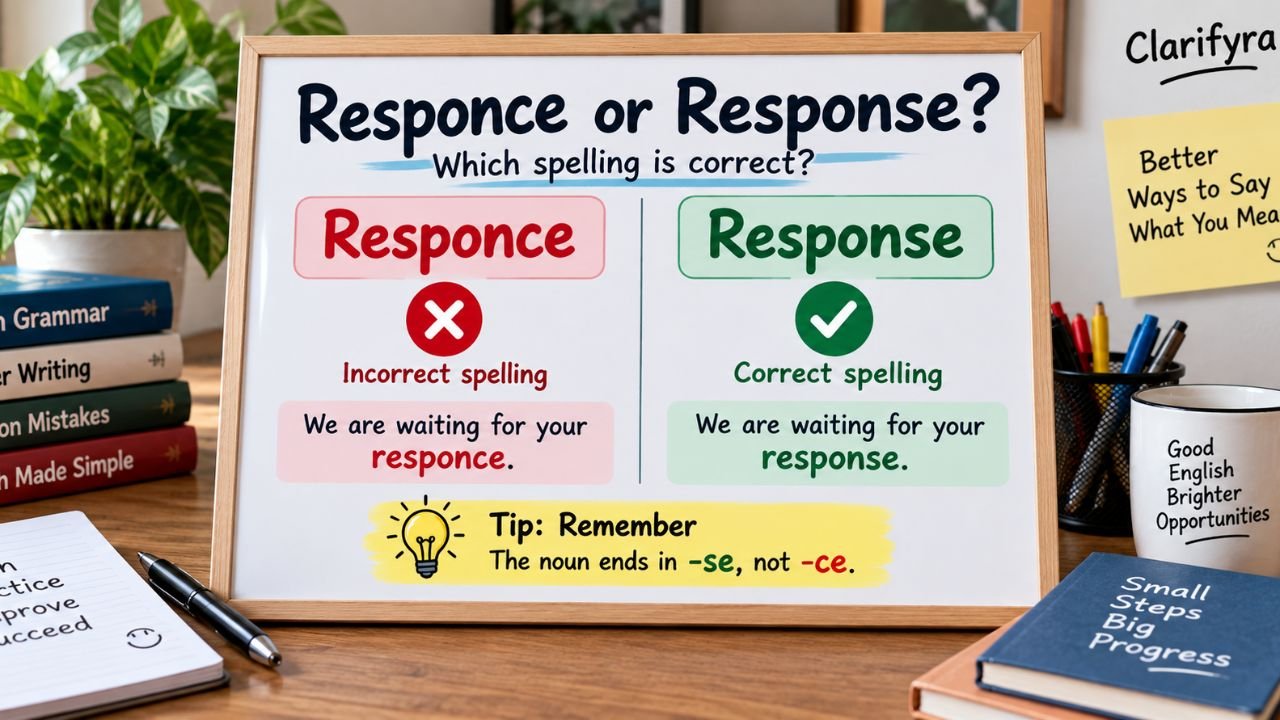
If you are unsure whether to write responce or response, there is a simple answer: response is the correct spelling. The other form is a common spelling mistake, not an alternative version used in British English. The confusion usually comes from the way the word sounds and from the similar-looking endings -ce and -se. Knowing the correct form matters in emails, essays, reports, applications, and everyday writing because response is the standard noun for an answer, reply, or reaction.
Response is the correct spelling in standard English, including UK English. Responce is a misspelling and should not be used as an alternative form. “Response” is a noun meaning an answer, reply, or reaction to something.
Response vs. Responce at a Glance
The distinction is entirely about spelling: one is the standard English word, while the other is an incorrect form.
| Feature | Response | Responce |
|---|---|---|
| Standard spelling | Yes | No |
| Meaning | Answer, reply, or reaction | No separate standard meaning |
| Part of speech | Noun | — |
| UK English | Correct | Incorrect |
| US English | Correct | Incorrect |
| Example | “Thank you for your response.” | “Thank you for your responce.” ❌ |
There is no difference in meaning because responce is not an accepted spelling of the word in standard English.
What Does “Response” Mean?
Response is a noun that describes an answer, reply, or reaction to something.
It can refer to a direct answer:
Please send your response before Friday.
Here, response means an answer or reply.
It can also describe a reaction:
The proposal received a positive response.
In this case, the word describes how people reacted to the proposal.
The meaning depends on context, but the central idea is always connected with responding to something.
Examples of Correct Usage
- I received a response to my email this morning.
- Her response was clear and professional.
- We are waiting for a response from the customer.
- The announcement received an enthusiastic response.
All four examples use the standard spelling response.
Is “Responce” a Real Word?
In standard modern English, responce is not the correct spelling of the noun meaning an answer or reaction.
It should therefore not be treated as a second word with a different definition. If you encounter it in ordinary English writing, it is best understood as a spelling error.
For example:
Incorrect:
We appreciate your responce.
Correct:
We appreciate your response.
The correction is straightforward: replace the final -ce with -se.
Is It “Responce or Response” in UK English?
If your question specifically concerns British English, the correct form is still response.
There is no British spelling responce. The standard spelling is the same in both major varieties:
- British English: response
- American English: response
Some words genuinely have different British and American spellings, such as centre/center and colour/color. This is not the case with response.
So if you are writing for readers in the UK, use response, not responce.
A UK English Example
We would be grateful for your response by the end of the week.
This sentence is standard British English, and response is spelled exactly as it would be in American English.
Why Do People Confuse These Spellings?
The error is largely understandable because English spelling does not always correspond perfectly to pronunciation.
The ending of response can make -ce seem plausible to someone spelling the word from memory. English also contains many words ending in both -ce and -se, so choosing the wrong ending can happen easily.
Another useful clue is the related verb:
respond → response
The two words share the spelling respond-:
- respond
- responded
- responding
- response
- responsive
Thinking about the verb can help you recall that the noun is response, with -se at the end.
Response and Respond: Understanding the Grammar
It is useful to distinguish the noun response from the verb respond.
Respond is a verb. It describes the action of answering or reacting.
She responded to my message quickly.
Response is a noun. It names the answer or reaction.
She sent a quick response to my message.
This relationship is particularly useful when writing because it gives you a reliable spelling pattern.
| Word | Part of speech | Example |
|---|---|---|
| respond | Verb | They responded immediately. |
| response | Noun | Their response was helpful. |
| responded | Past-tense verb | She responded yesterday. |
| responding | Present participle/gerund | He is responding now. |
| responsive | Adjective | The support team was responsive. |
Notice that response is the only form in this group that ends in -se.
Correct and Incorrect Examples
Comparing the two forms in real sentences makes the difference easy to see.
Example 1
Correct:
Thank you for your response.
Incorrect:
Thank you for your responce.
Example 2
Correct:
We have not received a response yet.
Incorrect:
We have not received a responce yet.
Example 3
Correct:
His response to the question was thoughtful.
Incorrect:
His responce to the question was thoughtful.
Example 4
Correct:
The new design received a positive response.
Incorrect:
The new design received a positive responce.
In every case, the intended word is response.
How to Remember the Correct Spelling
The easiest memory rule is:
respond → response
If you can spell respond, you can use it to remember the noun.
Think:
I respond → I give a response.
The noun ends in -se, not -ce.
Response ✅
Responce ❌
You can also mentally divide the word into:
respon + se
That final s is the part that is often accidentally replaced by c.
Common Mistakes to Avoid
Mistake 1: Treating “responce” as a UK spelling
It is not. British English uses response, just like American English.
Mistake 2: Spelling according to pronunciation
English pronunciation does not always reveal the exact spelling. If you are unsure, remember the connection respond → response rather than trying to spell the noun purely from its sound.
Mistake 3: Confusing the noun and verb
Use respond when describing an action:
The manager responded to the complaint.
Use response when naming the answer or reaction:
The manager’s response was helpful.
Mistake 4: Using the incorrect form in formal writing
A spelling error can make otherwise clear writing look less polished. In professional emails, academic work, applications, and reports, always use response.
Response vs. Reply: Is There a Difference?
Response and reply can both refer to an answer, particularly in communication.
For example:
I received a reply to my email.
and:
I received a response to my email.
Both sentences are natural.
However, response has a broader range of use. It can describe a reaction to an event, idea, proposal, situation, or statement:
The public response to the announcement was positive.
In that context, response is more naturally understood as a reaction rather than simply a written reply.
The important point for this spelling question is that neither meaning changes the spelling: the correct form remains response.
When Should You Use “Response”?
Use response when you need a noun meaning an answer, reply, or reaction.
It works naturally in both informal and formal contexts:
Email:
I am writing to follow up on your response.
Workplace:
We need a response from the supplier.
Academic writing:
The researchers recorded each participant’s response.
Everyday conversation:
I wasn’t expecting that response.
General reaction:
The announcement received a mixed response.
Its versatility makes it a useful word to recognise and spell correctly.
FAQ
Which spelling is correct: “responce” or “response”?
Response is the correct spelling. It is the standard noun used for an answer, reply, or reaction. Responce is a spelling error and should be corrected wherever it appears in standard English writing.
Is “responce” acceptable in British English?
No. Response is the standard spelling in British English. Responce is not a British spelling variant. American English also uses response, so there is no UK-versus-US spelling difference for this word.
Is “responce” an alternative spelling?
No. In standard English, responce is not an accepted alternative spelling of response. It does not have a separate meaning that distinguishes it from the correct word.
What part of speech is “response”?
Response is a noun. It can refer to an answer or reply, such as “I received a response,” or to a reaction, such as “The proposal received a positive response.”
How do you remember the spelling?
Connect the noun to the verb respond: respond → response. Remember that the noun ends with -se, giving you response, not responce.
Is “response” used in formal English?
Yes. Response is completely standard in formal and informal English. It is suitable for academic writing, professional communication, reports, letters, and everyday conversation.
The Bottom Line
When choosing between the two spellings, use response. It is the standard English noun for an answer, reply, or reaction, and it is correct in both British and American English. The spelling responce should be avoided because it is a misspelling. For more straightforward explanations of confusing English forms, Clarifyra helps make the right choice clear: Better Ways to Say What You Mean.