Wandering or Wondering: What’s the Difference?
Wandering and wondering are both correct English words, but they describe very different things. They are easy to mix up because their spelling differs by only one vowel and their pronunciation can sound similar in quick speech. In simple terms, wandering usually involves moving or drifting without a fixed direction, while wondering involves thinking, questioning, or feeling curious about something.
If you are walking around without a clear destination, you are wandering. If you are thinking about a question, you are wondering.
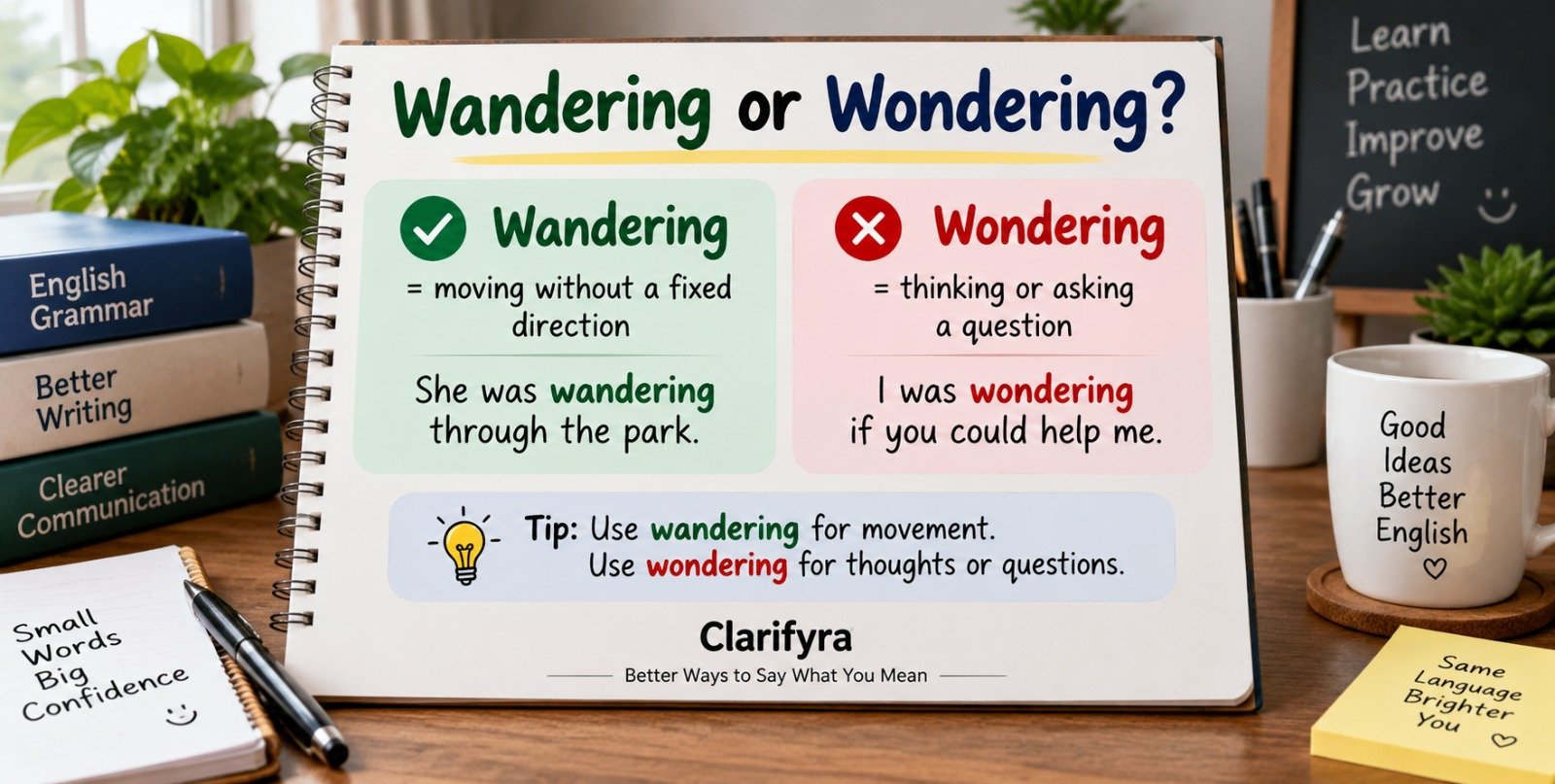
Both wandering and wondering are correct. Wandering means moving or drifting without a fixed direction, while wondering means thinking about something or wanting to know an answer. Use “I was wondering” for a question and “I was wandering” for movement.
Wandering vs. Wondering: The Key Difference
The main difference comes from the verbs wander and wonder.
Wander means to move around without a definite route or destination. It can also describe attention, thoughts, or eyes that drift from one thing to another.
Wonder means to think about something with curiosity, uncertainty, or interest.
| Feature | Wandering | Wondering |
|---|---|---|
| Base verb | Wander | Wonder |
| Main meaning | Moving or drifting | Thinking or questioning |
| Common use | Walking, attention, thoughts, eyes | Curiosity, questions, polite requests |
| Example | She was wandering through the park. | She was wondering where he went. |
A useful shortcut is:
Wandering = roaming or drifting.
Wondering = thinking or asking yourself something.
Many English learners mix up similar-looking words such as Metre or Meter: Which Spelling Is Correct?
What Is Wandering?
Wandering is the present participle of wander. It usually describes movement without a planned destination or fixed path.
For example:
- We spent the afternoon wandering around the old town.
- A dog was wandering along the road.
- She wandered from shop to shop without buying anything.
- He enjoys wandering through quiet neighborhoods.
The word does not always refer to physical movement. It can also describe attention or thoughts that drift away from the current subject.
For example:
- My mind started wandering during the lecture.
- Her thoughts wandered back to her childhood.
To Wander Meaning
The basic to wander meaning is to move, travel, or drift without a definite direction or purpose.
Someone can wander through a city, across a field, around a museum, or away from a group. In figurative usage, thoughts, attention, conversations, and even someone’s gaze can also wander.
For example:
Physical: “We wandered along the beach until sunset.”
Figurative: “His attention wandered during the presentation.”
What Is Wondering?
Wondering is the present participle of wonder. It means thinking about something because you are curious, uncertain, or interested in knowing the answer.
Examples include:
- I’m wondering what happened to Sarah.
- She was wondering whether the store was still open.
- We were wondering why the train was late.
- He sat quietly, wondering what to do next.
Wondering is also commonly used to make requests sound softer or more polite.
For example:
“I was wondering if you could help me.”
This does not mean that the speaker was walking around. It means the speaker was thinking about making the request.
“Just Wandering” or “Just Wondering”?
Both expressions can be correct, but they communicate different ideas.
Use just wondering when you are curious about something or asking a casual question.
For example:
“Just wondering, are you coming tonight?”
“I was just wondering if you received my message.”
Use just wandering when you mean moving around without a specific destination.
For example:
“What are you doing downtown?”
“I’m just wandering around and looking at the shops.”
So, if your sentence introduces a question, wondering is almost certainly the word you need.
“I Was Wandering” or “I Was Wondering”?
The easiest way to choose between I was wandering or wondering is to ask whether the sentence describes movement or thought.
Use I was wandering for movement:
“I was wandering around the neighborhood when I found a small bookstore.”
Use I was wondering for a thought or question:
“I was wondering when the bookstore closes.”
Compare these two sentences:
I was wandering through the station.
The speaker was physically moving around.
I was wondering where the station was.
The speaker was thinking about its location.
This distinction also explains why “I was just wondering if…” is the standard expression when introducing a polite question.
Mind Wandering or Wondering?
The usual expression is mind wandering, not mind wondering, when you mean that your attention has drifted away from what you are doing.
For example:
“I tried to focus on the lesson, but my mind kept wandering.”
“My mind started wandering while I was reading.”
Here, wandering suggests that your thoughts are moving away from the task at hand.
However, wondering is correct when you are consciously thinking about a specific question:
“I was wondering why I couldn’t concentrate.”
Compare:
My mind was wandering during the meeting.
Your attention was drifting.
I was wondering when the meeting would end.
You were thinking about a particular question.
Wandering or Wondering Eyes?
The established expression is usually wandering eyes.
It describes eyes or a gaze that repeatedly moves from one thing to another.
For example:
“His wandering eyes moved around the room.”
“She noticed his eyes wandering toward the doorway.”
The expression can also be used figuratively when someone keeps looking at other people, especially in a romantic context.
Wondering eyes is possible in creative writing if an author wants to suggest a curious or questioning expression, but it is not the standard phrase for a gaze that moves around.
If you mean that someone’s eyes are shifting from place to place, use wandering eyes.
Why Are Wandering and Wondering Confused?
The confusion mainly comes from their similar spelling.
Compare:
wander → wandering
wonder → wondering
Only one vowel separates the base words, but that vowel changes the meaning completely.
They may also sound somewhat similar when spoken quickly, especially to English learners. Their standard pronunciation is not identical, however.
Wonder Pronunciation
Wonder is pronounced approximately:
WUN-der
The first syllable sounds like “one” with a /w/ sound at the beginning.
Wander has a broader vowel sound and is pronounced more like:
WON-der in British English, or approximately WAHN-der in many American pronunciations.
Keeping the different vowel sounds in mind may help you separate the two words when speaking as well as writing.
Examples in Sentences
Looking at the two words side by side makes the distinction easier.
Examples with “wandering”
- We were wandering through the market when it started raining.
- The lost child was found wandering near the entrance.
- My attention kept wandering during the long presentation.
- She spent the evening wandering around the city.
- His eyes wandered toward the clock.
Examples with “wondering”
- I was wondering if you had a few minutes to talk.
- She is wondering what she should wear.
- We were wondering why the lights were still on.
- He sat by the window wondering what would happen next.
- I’m wondering whether we should leave early.
Notice that wandering involves movement or drifting, while wondering involves thought, uncertainty, or curiosity.
Correct and Incorrect Usage
Some mistakes become obvious when you replace the word with its basic meaning.
Correct: I was wondering if you could help me.
Incorrect: I was wandering if you could help me.
The sentence introduces a question, so wondering is correct.
Correct: We were wandering around the park.
Incorrect: We were wondering around the park.
Here, the people are moving around, so wandering is correct.
Correct: My mind kept wandering during class.
Incorrect: My mind kept wondering during class.
If the meaning is that attention was drifting, use wandering.
However:
Correct: I kept wondering why the teacher was late.
Here, the speaker is thinking about a specific question, so wondering is the right choice.
An Easy Way to Remember the Difference
Use this simple association:
Wander = walk or roam.
Wonder = question or think.
If you could replace the word with roaming or drifting, choose wandering.
“She was wandering around town.”
“She was roaming around town.”
If you could replace it with thinking about or asking yourself, choose wondering.
“She was wondering why he left.”
“She was thinking about why he left.”
This quick replacement test works in most everyday sentences.
Common Mistakes to Avoid
One common error is writing “I was wandering if…” when introducing a question. The correct expression is “I was wondering if…” because you are thinking or asking, not moving around.
Another mistake is writing “wondering around.” When someone is physically moving from place to place without a clear direction, the correct phrase is “wandering around.”
You should also distinguish between mind wandering and deliberately wondering about something. A wandering mind is drifting between thoughts, while a person who is wondering is considering a particular question.
Final Verdict: Which Word Should You Use?
Use wandering when someone or something is moving, roaming, or drifting without a fixed direction. Use wondering when someone is thinking, questioning, or feeling curious.
If you remember wander = roam and wonder = think, the distinction becomes simple. That clear difference is exactly the kind of practical English usage Clarifyra aims to make easier to understand.
Frequently Asked Questions
Is it “I was just wandering” or “I was just wondering”?
Both can be correct. “I was just wondering” introduces a thought or question, while “I was just wandering” means you were moving around without a particular destination.
Is “wondering around” correct?
Usually no. If you mean walking or moving without a definite direction, the correct phrase is “wandering around.” For example: “We were wandering around the city.”
Is “my mind was wandering” correct?
Yes. “My mind was wandering” means your attention drifted away from what you were supposed to be focusing on. It is a standard expression.
What is the difference between wander and wonder?
Wander means to roam, move, or drift without a fixed direction. Wonder means to think about something with curiosity or uncertainty.
Can “wandering” describe things other than walking?
Yes. Attention, thoughts, conversations, eyes, and even a person’s mind can be described as wandering when they drift from one subject or direction to another.
What does “I was wondering” mean?
“I was wondering” usually means “I was thinking about” or “I wanted to ask.” It is commonly used to introduce polite questions, such as: “I was wondering if you could help me.”
You May Also Read | Liter or Litre: Which Spelling Is Correct?