Compair vs Compare: Which Is Correct?
If you are choosing between compair vs compare, the correct spelling is compare. The word compair is usually a spelling mistake when someone means “to examine two or more things to see how they are similar or different.” The error is easy to understand because compare is pronounced with a final sound similar to “pair.” However, pronunciation does not change its spelling. There is also a different word, compere, that can mean a host or master of ceremonies, which sometimes adds to the confusion.
Compare is the correct spelling when you mean to examine similarities or differences. Compair is not the standard spelling of this verb and should be avoided in normal English writing. Do not confuse either form with compere, a separate British English word meaning a host or master of ceremonies.
Compair or Compare: Which Is Correct?
Compare is the standard English word.
It is mainly used as a verb meaning to examine two or more people, objects, ideas, or situations in order to identify similarities, differences, or relative qualities. Cambridge Dictionary describes compare as examining things to see how they differ, and it can also be used when suggesting that one thing is similar to another.
Compair, by contrast, should not be used as an alternative spelling of compare in standard English.
Here is the distinction at a glance:
| Feature | Compare | Compair |
|---|---|---|
| Standard English spelling | Yes | No, in this meaning |
| Main use | Examine similarities or differences | Usually a misspelling |
| Part of speech | Mainly a verb | Not the standard verb |
| Past tense | Compared | — |
| -ing form | Comparing | — |
| Example | Compare the two prices. | Avoid: Compair the two prices. |
You May Also Read | Arised or Arose: Which Is Correct? Meaning and Examples
What Does “Compare” Mean?
Compare means to look at two or more things together and consider how they are similar, different, better, worse, larger, smaller, cheaper, or otherwise related.
For example:
- We should compare the two offers before making a decision.
- She compared the new phone with her old one.
- The teacher asked the students to compare the two poems.
- It is difficult to compare the players because they have different roles.
The word can also be used when saying that one person or thing resembles another.
For example:
- Critics often compare the singer to famous performers from the past.
- He compared the shape of the cloud to a giant bird.
Cambridge also records the noun use of compare in the expression beyond compare, meaning exceptionally good or unequalled.
What Does “Compair” Mean?
If by compair you mean the verb for examining two things, it does not have a separate standard meaning. In that context, it is simply a misspelling of compare.
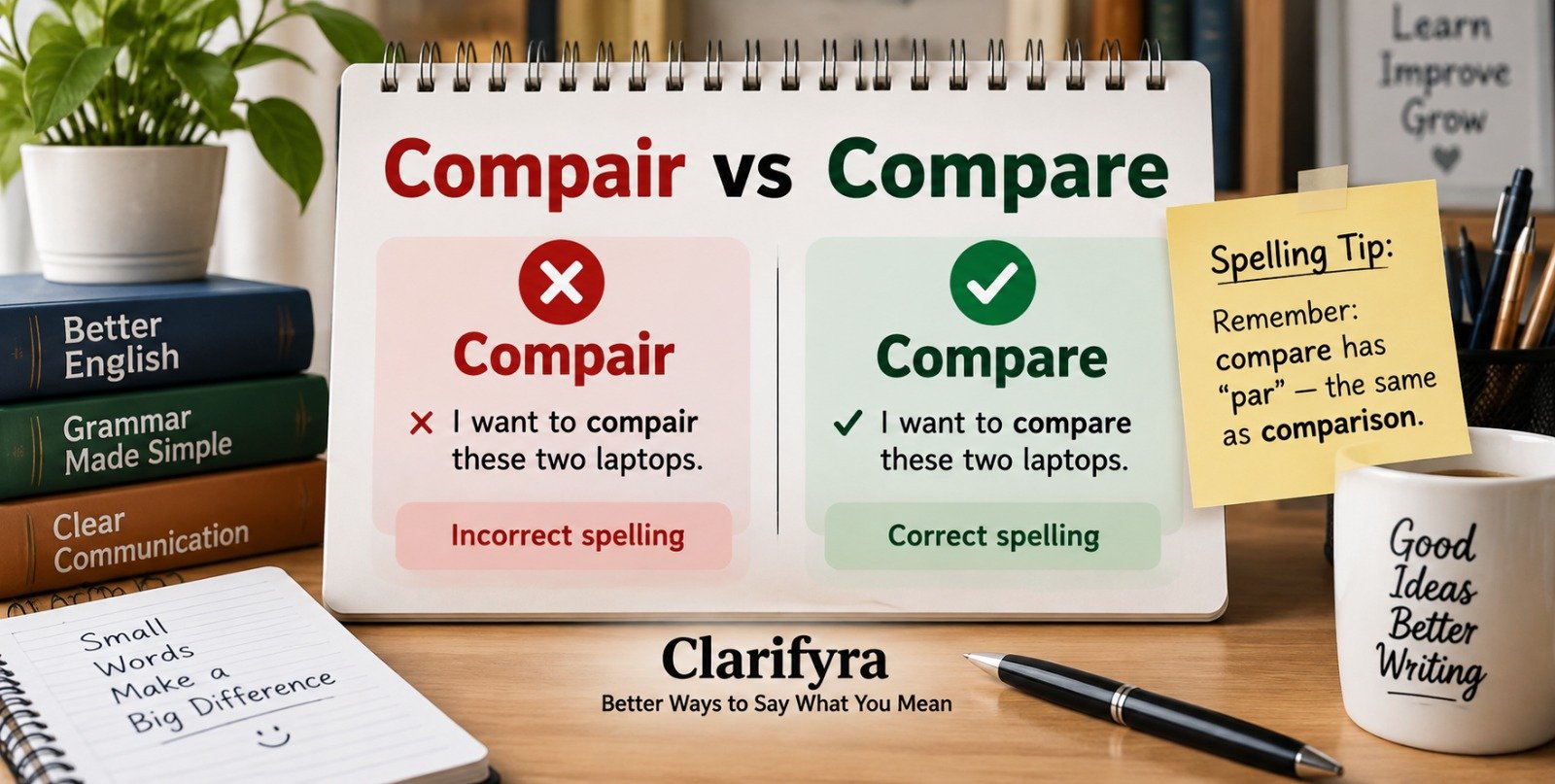
Incorrect:
I want to compair these two laptops.
Correct:
I want to compare these two laptops.
It is important not to invent a different grammatical meaning for compair. For ordinary writing, schoolwork, emails, reports, and professional communication, use compare.
You may sometimes encounter CompAir as part of a proper name or brand. That does not make compair an accepted alternative spelling of the English verb.
Why Is “Compair” Such an Easy Misspelling?
The main reason is pronunciation.
The final syllable of compare sounds similar to the English word pair. Cambridge gives the pronunciation as approximately:
- UK: /kəmˈpeə(r)/
- US: /kəmˈper/
A simple pronunciation guide is:
compare = kuhm-PAIR
Because the stressed syllable sounds like “pair,” it is easy to assume that the word should be written compair. The spelling, however, is compare.
A useful reminder is to connect it with comparison:
- compare
- comparison
Both words contain par, not pair.
Compare Grammar and Word Forms
Grammatically, compare is most commonly used as a verb.
Its regular forms are:
| Grammar Form | Correct Form |
|---|---|
| Base form | compare |
| Third-person singular | compares |
| Past tense | compared |
| Past participle | compared |
| Present participle | comparing |
Examples:
Present:
I compare prices before buying anything expensive.
Third-person singular:
She compares several options before choosing one.
Past:
We compared both plans yesterday.
Present continuous:
They are comparing hotel prices now.
A frequent spelling mistake is carrying compair into other forms.
Incorrect: compaired
Correct: compared
Incorrect: compairing
Correct: comparing
Compare To or Compare With?
Both compare to and compare with appear in standard modern English.
For example:
- This year’s sales were compared with last year’s figures.
- The new model is inexpensive compared to the premium version.
Cambridge gives examples using both compared to and compared with.
A traditional style distinction sometimes recommends compare with when directly examining similarities and differences, while compare to may be used when likening one thing to another. In real modern usage, however, the two expressions often overlap.
So you do not usually need to treat one as universally correct and the other as wrong.
Compair vs Compare Examples
Seeing the spelling in context can make the difference easier to remember.
Correct: Please compare the prices before placing the order.
Incorrect: Please compair the prices before placing the order.
Correct: I compared several insurance plans.
Incorrect: I compaired several insurance plans.
Correct: She is comparing the two documents.
Incorrect: She is compairing the two documents.
Correct: How does this laptop compare with the previous model?
Incorrect: How does this laptop compair with the previous model?
Correct: The article compares city life with country life.
Incorrect: The article compairs city life with country life.
The same spelling rule applies regardless of whether you are discussing prices, people, products, ideas, statistics, or experiences.
Synonyms for Compare
The best compare synonym depends on what you are trying to express.
Useful alternatives include:
- contrast
- evaluate
- examine
- assess
- analyze
- review
- match
- measure
- relate
- weigh
These words are not perfect replacements in every sentence.
For example:
Compare the two proposals.
could sometimes become:
Evaluate the two proposals.
However, evaluate emphasizes judging their quality, while compare focuses more broadly on examining them alongside each other.
Similarly, contrast usually puts more emphasis on differences.
For example:
- Compare the two paintings to identify similarities and differences.
- Contrast the two paintings to explain how they differ.
Does “Compare” Mean Host?
No. Compare does not normally mean “host.”
The word you may be thinking of is compere or compère.
In British English, a compere is a person who introduces performers or participants in a television, radio, stage, or live show. It can also be used as a verb meaning to act as that host. Cambridge lists the US equivalent as emcee.
For example:
- The compere introduced the next comedian.
- She was invited to compere the awards ceremony.
This gives us three different spellings to keep separate:
compare — examine similarities or differences
compere — host or master of ceremonies
compair — normally an incorrect spelling of compare
Common Mistakes to Avoid
One common mistake is spelling the word according to how it sounds:
Incorrect: compair
Correct: compare
Another is using the incorrect spelling in its past tense:
Incorrect: We compaired the results.
Correct: We compared the results.
A third mistake is confusing compare with compere.
Compare deals with similarities and differences:
Let’s compare the two designs.
Compere refers to presenting or hosting a show:
He will compere tonight’s event.
Finally, remember that pair is itself a real English word, but adding com- to pair does not produce the correct spelling of compare.
Easy Way to Remember the Spelling
The easiest memory trick is to connect compare with comparison.
Both contain the same core letters:
COMPARE → COMPARISON
You would not normally write compairison, so this relationship can help you remember that the verb is also spelled with -par-.
Another quick rule is:
You compare a pair.
The thing being examined may be a pair, but the action is compare.
Quick Compair vs Compare Quiz
Choose the correct answer for each sentence.
1. We need to ___ both estimates before choosing a contractor.
A. compair
B. compare
Answer: B. compare
2. Which spelling is correct for the verb meaning “examine similarities or differences”?
A. compair
B. compare
Answer: B. compare
3. What is the correct past tense?
A. compaired
B. compared
Answer: B. compared
4. Which word can refer to a show host in British English?
A. compare
B. compere
C. compair
Answer: B. compere
5. Complete the sentence: “She is ___ the two reports.”
A. comparing
B. compairing
Answer: A. comparing
Final Verdict: Compair or Compare?
Use compare when you mean to examine two or more things for similarities, differences, or relative qualities. Compair is not the standard spelling of that verb, even though compare sounds somewhat like “kuhm-PAIR.” Also remember that compere is a separate word referring to a host or presenter. Keeping these forms separate will make your writing clearer and more accurate—the kind of practical distinction Clarifyra is designed to explain.
Frequently Asked Questions
Is compair or compare correct?
Compare is the correct standard spelling when you mean to examine similarities or differences. Compair should not be used as an alternative spelling in normal English writing.
Is “compair” a real word?
Not as the standard verb meaning “to compare.” In that context, compair is a misspelling. Capitalized forms such as CompAir may occur as proper names or brands, but they are unrelated to the ordinary verb.
How do you pronounce compare?
It is pronounced approximately kuhm-PAIR. Cambridge gives UK /kəmˈpeə(r)/ and US /kəmˈper/. The “pair” sound at the end is one reason people may mistakenly write compair.
What part of speech is compare?
Compare is primarily a verb. Its common forms are compare, compares, compared, and comparing. It can also appear as a noun in the literary expression beyond compare.
What is the difference between compare and contrast?
Compare can involve examining both similarities and differences. Contrast usually emphasizes differences between the things being discussed.
Does compere mean compare?
No. Compere is a separate word, mainly used in British English for a person who introduces performers or hosts a show. Compare means to examine similarities, differences, or relationships between things.
You May Also Read | Math or Maths: What’s the Difference and Which Is Correct?