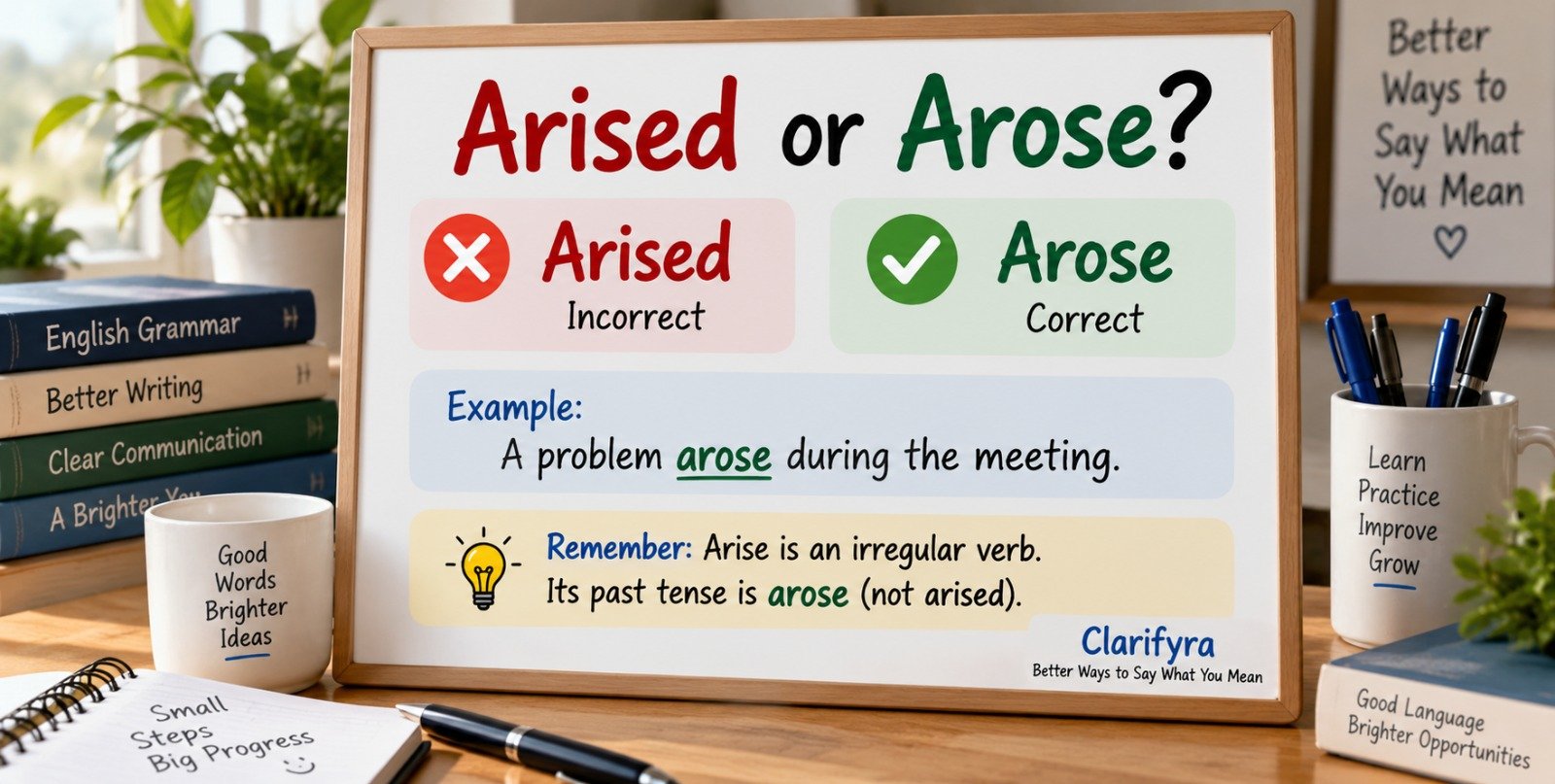
Arised or Arose: Which Is Correct? Meaning and Examples
The difference between arised and arose comes down to an irregular verb rule. It may seem logical to add -ed to arise when talking about the past, just as we say worked or started. However, arise does not follow the regular pattern. Its correct simple past form is arose, while its past participle is arisen. That means sentences such as “A problem arose yesterday” are correct, while “A problem arised yesterday” should be avoided in standard English.
Arose is the correct simple past tense of arise. Arised is a nonstandard formation and is not used as the standard past tense. The correct verb pattern is arise → arose → arisen.
Arised or Arose: Which Is Correct?
Arose is correct when you need the simple past tense of the verb arise.
Arised is not the standard past-tense form.
Here is the basic pattern:
| Verb Form | Correct Word | Example |
|---|---|---|
| Base form | arise | Problems can arise unexpectedly. |
| Simple past | arose | A problem arose yesterday. |
| Past participle | arisen | Several problems have arisen. |
The main reason for the confusion is that English has many regular verbs that form their past tense by adding -ed. Arise, however, is an irregular verb, so its form changes.
Compare:
- work → worked
- open → opened
- start → started
- arise → arose
Not:
- arise → arised
You May Also Read | Is It Vender or Vendor? – Which Spelling Is Correct?
What Does “Arise” Mean?
Before looking more closely at arose, it helps to understand the base verb arise.
Arise is a verb that commonly means to happen, develop, appear, or begin to exist.
It is often used for situations, problems, questions, opportunities, disagreements, and other things that come into existence.
Examples:
- Problems sometimes arise without warning.
- New opportunities may arise during the project.
- Please contact the manager if any questions arise.
- Difficulties can arise when instructions are unclear.
The verb can also mean to get up or rise, although this meaning often sounds more formal or literary in modern English.
For example:
- She arose early and prepared for the journey.
In everyday conversation, most speakers would probably say got up instead.
What Does “Arised” Mean?
If you are asking “What does arised mean?”, the important point is that arised is not the standard past tense of arise.
It is generally treated as an incorrect or nonstandard formation created by adding the regular past-tense ending -ed to an irregular verb.
For example:
Incorrect: A disagreement arised during the meeting.
Correct: A disagreement arose during the meeting.
There is no need to give arised a separate definition in ordinary standard English. In most situations where someone writes arised, the intended word is either arose or arisen.
Which one is needed depends on the grammar of the sentence.
What Does “Arose” Mean?
Arose is the simple past tense of arise.
It describes something that happened, appeared, emerged, developed, or began to exist in the past.
For example:
- A problem arose during the interview.
- Several concerns arose after the announcement.
- An opportunity arose to work overseas.
- A disagreement arose between the two teams.
In the sentence:
A problem arose yesterday.
Arose means that the problem developed or occurred yesterday.
So, when considering the arised or arose meaning, remember that arose is not a separate unrelated verb. It is simply the past form of arise.
Why Is “Arised” Incorrect?
The confusion happens because English verbs do not all form the past tense in the same way.
Regular verbs usually add -ed:
- walk → walked
- talk → talked
- change → changed
Irregular verbs change differently:
- begin → began
- sing → sang
- rise → rose
- arise → arose
Because arise is irregular, adding -ed produces the nonstandard form arised.
A useful comparison is rise:
rise → rose → risen
Similarly:
arise → arose → arisen
The similar pattern makes the correct forms easier to remember.
Arose vs Arisen: An Important Grammar Difference
A common mistake is fixing arised but choosing the wrong replacement.
Both arose and arisen are correct forms of arise, but they are used differently.
Use “arose” for the simple past
Use arose when describing something that happened in the past without a helping verb such as has, have, or had.
- A complication arose yesterday.
- Several questions arose during class.
- An unexpected opportunity arose last year.
Use “arisen” as the past participle
Use arisen after helping verbs such as has, have, and had.
- A new problem has arisen.
- Several concerns have arisen.
- Difficulties had arisen before the deadline.
Therefore:
Incorrect: A problem has arose.
Incorrect: A problem has arised.
Correct: A problem has arisen.
This distinction is one of the most important parts of arised or arose grammar.
Correct and Incorrect Examples in Sentences
The following examples show how the forms work naturally.
Correct examples with “arose”
- A technical issue arose during the presentation.
- A misunderstanding arose between the neighbors.
- Several questions arose after the lecture.
- An unexpected opportunity arose last month.
- Concerns arose about the project’s cost.
- A dispute arose over the final payment.
- A new challenge arose during testing.
- Difficulties arose while the team was traveling.
Incorrect examples
Incorrect: A problem arised during the meeting.
Correct: A problem arose during the meeting.
Incorrect: Several concerns arised yesterday.
Correct: Several concerns arose yesterday.
Incorrect: A new issue has arose.
Correct: A new issue has arisen.
Incorrect: Problems have arised recently.
Correct: Problems have arisen recently.
These examples also demonstrate why looking at the full sentence matters. Sometimes the correct replacement for arised is arose, while in other sentences it is arisen.
Synonyms for “Arose”
The best synonym depends on what is arising.
Common arose synonyms include:
- occurred
- happened
- emerged
- developed
- appeared
- surfaced
- originated
- came up
For example:
A problem arose during the discussion.
You could also write:
A problem occurred during the discussion.
Or:
A problem came up during the discussion.
For something becoming noticeable, emerged or surfaced may fit better:
New evidence emerged during the investigation.
Not every synonym works equally well in every sentence, so choose one that matches the intended meaning and tone.
An Easy Way to Remember the Correct Form
The simplest memory trick is to connect arise with rise.
They follow very similar patterns:
Rise → Rose → Risen
Arise → Arose → Arisen
If you already know that we say:
The sun rose yesterday.
rather than:
The sun rised yesterday.
You can use the same idea with arise:
A problem arose yesterday.
not:
A problem arised yesterday.
Another useful phrase to memorize is:
“A problem arose.”
It is short, natural, and reinforces the correct past-tense form.
Common Mistakes to Avoid
1. Adding “-ed” to arise
Incorrect: An issue arised.
Correct: An issue arose.
Because arise is irregular, the usual -ed rule does not apply.
2. Using “arose” after has, have, or had
Incorrect: Several problems have arose.
Correct: Several problems have arisen.
After has, have, or had, use arisen.
3. Using “arisen” as a simple past form
Incorrect: A problem arisen yesterday.
Correct: A problem arose yesterday.
Arisen normally requires an auxiliary verb such as has, have, or had.
4. Treating “arised” and “arose” as two words with different meanings
They are not two standard alternatives with separate definitions. Arose is the accepted simple past form; arised is normally an incorrect attempt to form that past tense.
Is “Arised” Used on Reddit or in Informal Writing?
You may occasionally encounter arised in Reddit discussions, forum posts, comments, or other informal writing. Its appearance in user-generated text does not make it the standard grammatical form.
People can easily produce arised by applying the regular -ed pattern to arise. In edited English, schoolwork, professional communication, and other contexts where standard grammar is expected, use arose for the simple past and arisen for the past participle.
Final Verdict: Arised or Arose?
Use arose when you need the simple past tense of arise. Do not use arised as its standard past form.
Keep this three-part pattern in mind:
Arise → Arose → Arisen
So you would write “A problem arose yesterday” but “A problem has arisen.” Remembering the difference between the simple past and past participle will help you choose the correct form confidently, which is exactly the kind of practical language distinction Clarifyra aims to make easier.
Frequently Asked Questions
Is it arised or arose?
Arose is the correct simple past tense of arise. Arised is a nonstandard formation and should normally be replaced with arose or arisen, depending on the sentence.
Is “arised” a real word?
It may appear occasionally in informal or nonstandard writing, but it is not the standard past-tense form of arise. In standard English, use arose for the simple past.
What is the difference between arose and arisen?
Arose is the simple past form: “A problem arose.” Arisen is the past participle and is normally used with has, have, or had: “A problem has arisen.”
Can I say “a problem has arose”?
No. After has, you need the past participle arisen. The correct sentence is: “A problem has arisen.”
What are some synonyms for arose?
Depending on the context, alternatives include occurred, happened, emerged, appeared, developed, surfaced, originated, and came up.
What is the correct verb pattern for arise?
The three main forms are arise for the base form, arose for the simple past, and arisen for the past participle: arise → arose → arisen.
You May Also Read | Agree or Agreed: Which Is Correct and When Should You Use Each?