Is It Vender or Vendor? – Which Spelling Is Correct?
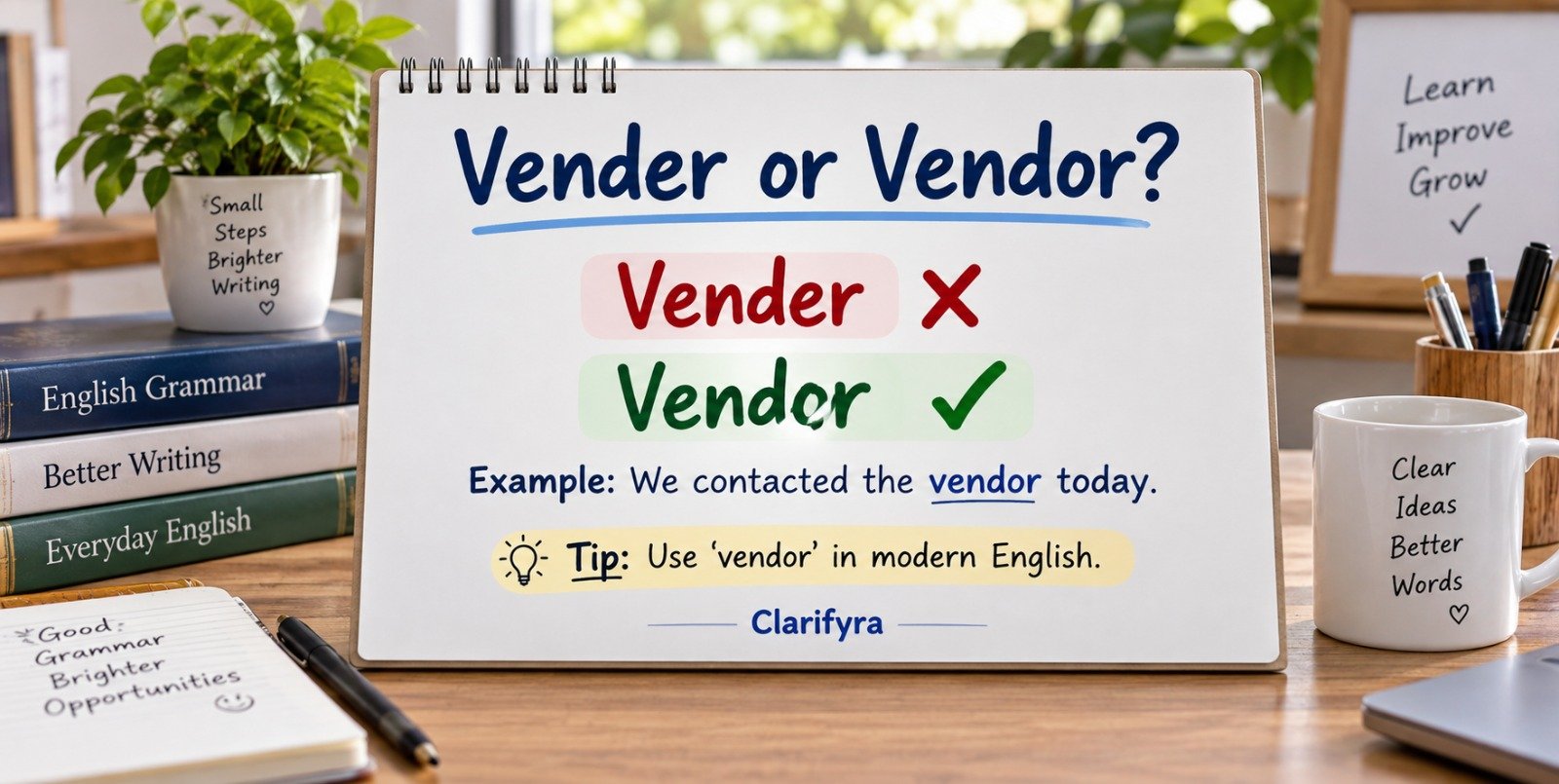
If you are unsure whether to write vender or vendor, the safest choice is usually vendor. Both spellings can be found in dictionaries, but they are not equally common in modern English. Vendor is the standard spelling used for a person or company that sells goods or services, while vender is a much less common variant. Understanding this distinction is especially useful in business writing, contracts, online marketplaces, and everyday English.
Vendor is the standard and recommended spelling in modern English. Vender is a recognized but uncommon variant with the same basic meaning, so it is usually better to use vendor in formal, professional, and everyday writing.
Vender or Vendor: Which Is Correct?
Both forms exist, but vendor is by far the more widely accepted spelling.
A vendor is a person, business, or organization that sells goods or services. You may hear the word in expressions such as:
- food vendor
- street vendor
- software vendor
- wedding vendor
- online vendor
- approved vendor
The spelling vender can also mean a seller, but it is rare. In most situations, readers will expect to see vendor, and some may even assume vender is a spelling error.
Here is the difference at a glance:
| Feature | Vendor | Vender |
|---|---|---|
| Correct word? | Yes | Yes, but uncommon |
| Meaning | A person or company that sells something | Same basic meaning |
| Modern usage | Standard | Rare variant |
| Best for formal writing? | Yes | Usually no |
| Common in business English? | Yes | Very uncommon |
| Recommended spelling | Yes | No, unless intentionally following a specific style |
You May Also Read | Wear vs Ware: Meaning, Difference, and Correct Usage
What Does “Vendor” Mean?
A vendor is a noun that refers to someone who sells goods or services.
It can describe an individual seller:
The street vendor sells fresh fruit near the station.
It can also describe a company:
We selected a new software vendor for the project.
In business English, vendor is often used for companies that supply products or services to other companies.
For example:
The restaurant works with several local food vendors.
Our IT vendor provides technical support and cloud services.
The word can also appear in property and legal contexts, where a vendor may refer to the person selling property.
What Does “Vender” Mean?
If you are asking “What does vender mean?”, it generally has the same basic meaning as vendor: someone who sells something.
However, the important difference is usage.
Vender is a recognized alternative spelling, but it is much less common than vendor. Because of that, it may appear unusual or outdated to modern readers.
Consider these two sentences:
Standard: The vendor delivered the equipment on Monday.
Uncommon: The vender delivered the equipment on Monday.
The second sentence can be understood, but the first is much more natural in contemporary English.
Is “Vender” a Word?
Yes, vender is a word, although it is rare.
This distinction matters because it would be inaccurate to say that vender is always a misspelling. Some dictionaries recognize it as an alternative spelling of vendor.
Still, dictionary recognition does not mean both spellings are equally common.
In modern professional and everyday English, vendor is normally the better choice.
That means if you are writing an email, contract, article, report, product listing, or business document, write:
vendor
rather than:
vender
Why Are “Vender” and “Vendor” Confused?
The confusion mainly comes from their spelling and pronunciation.
The verb vend means “to sell.” Because English often forms nouns for people by adding -er, someone might logically assume that a person who vends something should be a vender.
That spelling does exist.
However, English convention established vendor as the dominant noun form. This means the most familiar spelling does not follow the pattern people may initially expect.
Compare:
teach → teacher
sell → seller
vend → vendor
The unusual -or ending helps explain why some writers naturally type vender.
How to Spell Vender or Vendor
For standard English, remember this spelling:
V-E-N-D-O-R
A useful memory trick is to connect vendor with other professional nouns ending in -or, such as:
advisor
contractor
operator
You can also remember the phrase:
A vendor sells.
If you are dealing with a business, supplier, marketplace seller, or service provider, vendor will almost always be the spelling you need.
Vender or Vendor Examples
Seeing the word in realistic sentences can make the distinction easier.
Correct and Natural
The food vendor opened a stall near the entrance.
Our company is looking for a new equipment vendor.
Each vendor must submit an invoice before Friday.
The software vendor released a security update.
Several local vendors participated in the weekend market.
We contacted the vendor to request a refund.
Grammatically Possible but Uncommon
The food vender opened a stall near the entrance.
Although vender can be recognized as a word, using vendor is clearer and more conventional.
Vendor Synonyms
The best vendor synonym depends on the context.
Seller
A broad and simple alternative.
The seller agreed to lower the price.
Supplier
Common when a business provides goods or materials to another company.
We changed our packaging supplier last year.
Merchant
Often used for someone involved in commercial trade.
The merchant sold imported fabrics.
Retailer
A business that sells directly to consumers.
The retailer offers free delivery on large orders.
Dealer
Often used for someone who buys and sells specific types of products.
The car dealer offered a warranty.
Provider
Useful when the company mainly supplies a service.
We switched to a different internet service provider.
These words overlap with vendor, but they are not always interchangeable. For example, a supplier may provide products to businesses, while a retailer generally sells directly to consumers.
Vendor Pronunciation
The pronunciation of vendor is straightforward.
In American English, it is commonly pronounced approximately:
VEN-der
In British English, the final sound may be softer, closer to:
VEN-duh
The stress falls on the first syllable:
VEN-dor
Because vendor and vender would normally sound very similar in speech, pronunciation does not provide a reliable clue about which spelling to use.
Vendor in American, British, and Canadian English
Unlike spelling pairs such as color/colour, vendor is not primarily an American-versus-British spelling issue.
American English
Vendor is the standard spelling.
Example:
The company approved three new vendors.
British English
Vendor is also widely accepted and standard.
In British legal and property contexts, the word may specifically refer to someone selling property.
Canadian English
Vendor is the normal spelling in Canadian business and government usage as well.
Therefore, if you are wondering about vender or vendor in Canada, the safest choice is still vendor.
For international writing, vendor works well across American, British, and Canadian English.
What About “Vender” in The New Yorker?
Readers occasionally encounter discussions about vender or vendor in The New Yorker because the publication has historically been known for preserving distinctive editorial spelling and style preferences.
That does not make vender the normal spelling in contemporary English.
Editorial house styles sometimes retain unusual forms that are perfectly understandable but uncommon elsewhere. Unless you are specifically following a publication’s own style guide, vendor remains the practical choice for general writing.
Common Mistakes to Avoid
One common mistake is treating vender as completely meaningless. It is rare, but it is recognized as a variant.
Another mistake is assuming the difference is simply American versus British English. It is not. Vendor is standard in both varieties.
Writers may also use vender because they connect it directly with the verb vend. While that formation is logical, modern usage strongly favors vendor.
Finally, do not confuse vendor with supplier in every context. A vendor sells goods or services, while a supplier often emphasizes providing goods or materials as part of a business relationship.
Easy Rule to Remember
Use this simple rule:
If someone sells goods or services, write “vendor.”
You may occasionally see vender, but you do not need to use it in normal writing.
Think:
vendor = seller
That one association will work in nearly every ordinary context.
Final Verdict: Vender or Vendor?
Vendor is the standard spelling and the best choice in modern English. Vender exists as a rare variant, but it is unusual enough that it may look incorrect to many readers.
For professional, academic, business, and everyday writing, spell the word vendor. This keeps your writing clear, familiar, and consistent—the kind of practical distinction Clarifyra aims to make easier.
FAQs
Is it vender or vendor?
Use vendor in standard modern English. Vender is a recognized but uncommon variant, while vendor is the spelling normally used in business, general writing, and professional communication.
Is vender a spelling mistake?
Not necessarily. Vender appears as a rare alternative spelling of vendor. However, because it is uncommon, vendor is almost always the better choice.
What does vendor mean?
A vendor is a person, company, or organization that sells goods or services. Examples include a street vendor, food vendor, software vendor, or business supplier.
Is vendor American or British English?
Vendor is used in both American and British English. It is also standard in Canadian English, so there is no major regional spelling split between vendor and vender.
How do you pronounce vendor?
Vendor is pronounced approximately VEN-der in American English. In some British accents, the final r may not be strongly pronounced.
What is another word for vendor?
Common alternatives include seller, supplier, merchant, retailer, dealer, and provider. The best synonym depends on what the person or company is selling.
You May Also Read | Is It Yall or Y’all? Learn the Correct Spelling