Another Way to Say “Also”: 35+ Better Alternatives for Essays, Emails & Formal Writing
“Also” is a useful word for adding another idea, fact, or piece of information. But when it appears several times in the same paragraph, essay, or email, the writing can start to feel repetitive.
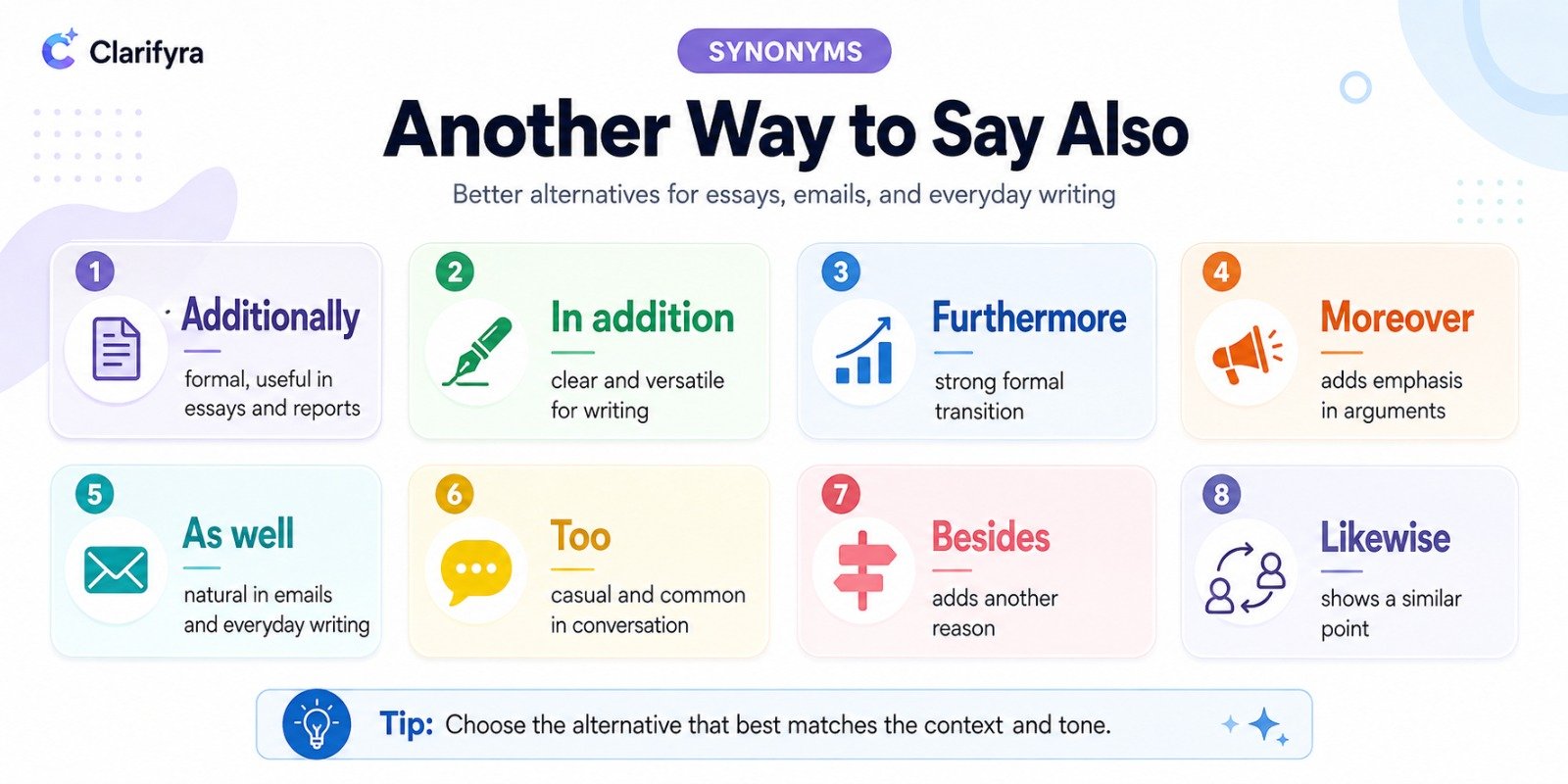
If you need another way to say also, your best choice depends on the situation. Additionally, furthermore, moreover, in addition, too, as well, besides, likewise, and what’s more can all work, but they don’t have exactly the same tone or grammatical role.
Here’s how to choose an alternative that actually fits your sentence.
Best Alternatives to “Also” at a Glance
| Alternative | Tone | Best For | Example |
|---|---|---|---|
| Additionally | Formal | Essays, reports, emails | “Additionally, the plan could reduce costs.” |
| In addition | Formal/neutral | Academic and professional writing | “In addition, we need more time.” |
| Furthermore | Formal | Essays and arguments | “Furthermore, the evidence supports this conclusion.” |
| Moreover | Formal | Strengthening an argument | “Moreover, the solution is affordable.” |
| Too | Casual/neutral | Conversation | “I’d like to come too.” |
| As well | Neutral | Conversation and emails | “I’ve attached the invoice as well.” |
| Besides | Neutral | Adding another reason | “Besides, we already have enough.” |
| Likewise | Formal/neutral | Similar ideas | “Likewise, employees need clear expectations.” |
| Similarly | Formal | Comparisons | “Similarly, smaller firms face the same problem.” |
| What’s more | Neutral | Adding emphasis | “What’s more, there’s no extra charge.” |
| Plus | Casual | Speech and informal writing | “Plus, it’s close to home.” |
| Along with | Neutral | Adding people or things | “The report came along with the invoice.” |
| As well as | Neutral/formal | Connecting related items | “She manages sales as well as marketing.” |
| On top of that | Casual | Adding emphasis | “On top of that, delivery is free.” |
| Not to mention | Conversational | Adding a notable extra point | “It’s spacious, not to mention affordable.” |
Another Way to Say “Also” in an Essay
Academic writing often needs words that connect ideas clearly. You can still use “also” in an essay, but alternatives help when you need a more specific relationship between points.
Other Ways to Say “Also” in an Essay
Good choices include:
- Additionally
- In addition
- Furthermore
- Moreover
- Likewise
- Similarly
- What is more
- Another point is
- Another factor is
- Equally important
- To add to this
The strongest option depends on what the next sentence is doing.
Additionally
Additionally introduces another relevant fact or supporting point. It is formal without sounding overly complicated.
Example:
“The program could reduce administrative costs. Additionally, it may improve communication between departments.”
It works particularly well in academic essays, reports, and analytical writing.
Furthermore
Furthermore adds information that supports or develops an existing argument.
Example:
“Public transportation can reduce traffic congestion. Furthermore, it can help lower urban pollution.”
Because it has a distinctly formal tone, it can sound unnatural in casual conversation.
Moreover
Moreover is useful when the additional point gives even more support to your argument.
Example:
“The proposed system is easier to maintain. Moreover, it requires less expensive equipment.”
It is closer to “furthermore” than to conversational alternatives such as “too.”
In Addition
In addition is one of the safest choices when you simply want to introduce another relevant point.
Example:
“Exercise supports physical health. In addition, regular activity can improve sleep quality.”
It is clear enough for general writing and formal enough for most academic work.
Likewise
Likewise is more specific. It adds something that is similar to what came before.
Example:
“Managers need clear performance goals. Likewise, employees need to understand how their work will be evaluated.”
Don’t use “likewise” when the two points have no meaningful similarity.
Similarly
Like “likewise,” similarly introduces a comparable situation rather than simply adding any new information.
Example:
“Large businesses face rising energy costs. Similarly, smaller companies are dealing with higher operating expenses.”
So although “similarly” can sometimes replace “also,” it isn’t a universal synonym.
Another Way to Say “Also” in an Email
Work emails usually sound best when they are clear and conversational. Extremely formal transitions can make a simple message feel stiff.
Other Ways to Say “Also” in an Email
Useful email alternatives include:
- Additionally
- In addition
- As well
- Along with
- I’d also like to
- One more thing
- Another point
- Further
- As a further note
For example:
Instead of:
“Also, I attached the revised contract.”
Try:
“I’ve attached the revised contract as well.”
Or:
“Additionally, I’ve attached the revised contract for your review.”
As Well
As well is especially natural when the additional information can appear toward the end of the sentence.
Example:
“I’ve included the updated schedule as well.”
It sounds professional without making the email unnecessarily formal.
Along With
Use along with when one item accompanies another.
Example:
“I’ve attached the invoice along with a copy of the project summary.”
It is useful for attachments, documents, people, and related items.
Additionally
For more formal business correspondence, additionally works well.
Example:
“Additionally, could you confirm whether the revised deadline works for your team?”
However, there’s no need to use it in every email. Sometimes “also” is already the most natural choice.
Formal Ways to Say “Also”
When you need a more formal expression, several alternatives fit reports, proposals, business documents, and academic writing.
Other Formal Ways to Say “Also”
- Additionally
- Furthermore
- Moreover
- In addition
- What is more
- Further
- Equally
- Likewise
- Another consideration is
- Another important point is
What Is More
What is more adds another noteworthy point.
Example:
“The proposal can be implemented quickly. What is more, it requires relatively little additional funding.”
It sounds more traditional than “additionally” but remains useful in formal writing.
Further
Further can introduce another point concisely.
Example:
“Further, the committee recommends reviewing the policy every six months.”
This usage is common in formal and professional contexts but can sound abrupt in everyday speech.
Another Consideration Is
Sometimes replacing a transition with a descriptive phrase makes your meaning clearer.
Example:
“Another consideration is the long-term cost of maintaining the system.”
This is particularly useful in analytical writing when you’re introducing a separate factor rather than simply adding another sentence.
Professional Ways to Say “Also”
Professional writing usually works best when it is polished but not unnecessarily complicated.
Other Professional Ways to Say “Also”
Consider:
- Additionally
- In addition
- As well
- Along with
- Furthermore
- Another consideration is
- Further
- Together with
- Coupled with
- Alongside
Together With
Together with connects related people, items, or factors.
Example:
“The sales report, together with the updated forecast, will be presented on Monday.”
It does not work as a replacement for “also” in every sentence because its grammatical structure is different.
Coupled With
Coupled with indicates that two factors operate or exist together.
Example:
“Strong demand, coupled with limited supply, has increased prices.”
That meaning is more specific than “also,” so use it when the relationship between the two things matters.
Alongside
Alongside can describe something happening or existing together with something else.
Example:
“The new system will operate alongside the existing platform during the transition.”
It is particularly useful in workplace, technical, and business writing.
Casual and Conversational Alternatives to “Also”
Formal transitions aren’t always the answer. When you’re talking with friends, texting, or writing casually, simpler expressions usually sound better.
Other Casual Ways to Say “Also”
- Too
- As well
- Plus
- Besides
- What’s more
- On top of that
- Not to mention
- Another thing
- And
Too
Too is one of the most natural alternatives in spoken English.
Example:
“I want to go too.”
Compare that with:
“I also want to go.”
Both are natural, but “too” usually appears near the end of the clause.
Plus
Plus casually introduces another advantage, reason, or fact.
Example:
“The apartment is affordable. Plus, it’s close to work.”
It is useful in conversation, texts, informal articles, and relaxed marketing copy, but usually isn’t the best choice for an academic paper.
On Top of That
Use on top of that when you want to emphasize that another fact adds to what has already been mentioned.
Example:
“The train was late, and on top of that, it started raining.”
Depending on the context, it can emphasize either something positive or negative.
Not to Mention
Not to mention introduces an additional point that strengthens what you’re saying.
Example:
“The hotel has excellent rooms, not to mention an amazing view.”
It has more emphasis than a simple “also.”
Fancy Ways to Say “Also”
Sometimes you want wording that sounds more polished or sophisticated. The key is choosing language that still feels natural.
Other Fancy Ways to Say “Also”
- Moreover
- Furthermore
- Additionally
- What is more
- Equally
- In addition
- Beyond that
- Coupled with
- Supplemented by
- Over and above
These expressions aren’t automatically better.
Consider:
Awkward:
“I bought some milk. Moreover, I bought bread.”
Natural:
“I bought some milk and bread too.”
“Moreover” is grammatically possible, but its formal tone doesn’t fit such an ordinary statement.
The best vocabulary matches the situation rather than simply sounding impressive.
Different Ways to Say “Also” Based on Meaning
“Also” can perform several jobs. Choosing an alternative is easier when you first identify what you’re actually trying to express.
Other Ways to Say “Also” When Adding Information
Use:
- Additionally
- In addition
- Too
- As well
- And
Example:
“The package includes free delivery. In addition, customers receive a two-year warranty.”
Other Ways to Say “Also” When Adding Another Reason
Use:
- Besides
- What’s more
- On top of that
- Not to mention
Example:
“We don’t need another meeting. Besides, everyone already understands the plan.”
“Besides” often carries the sense of giving another reason, so it is more specific than “also.”
Other Ways to Say “Also” When Comparing Similar Ideas
Use:
- Likewise
- Similarly
- In the same way
Example:
“Parents benefit from flexible schedules. Likewise, employees with caregiving responsibilities may find flexible hours helpful.”
Other Ways to Say “Also” When Adding a Person or Thing
Use:
- Along with
- Together with
- As well as
- Alongside
Example:
“Daniel attended the meeting along with two members of his team.”
These expressions connect nouns or ideas and may require you to restructure the original sentence.
Another Way to Say “Also Known As”
“Also known as” has a different function from ordinary “also.” It tells the reader that a person, place, object, or concept has another name.
That means alternatives such as “furthermore” and “additionally” do not work here.
Other Ways to Say “Also Known As”
Useful alternatives include:
- AKA
- Also called
- Otherwise known as
- Better known as
- Commonly known as
- Often called
- Referred to as
- Known as
- Under the name
- By the name of
AKA
AKA is an abbreviation of “also known as.” It is compact and usually more informal.
Example:
“Jonathan Smith, AKA Jonny S, will perform tonight.”
It can appear in business or informational writing too, but the full phrase may look more polished in highly formal documents.
Better Known As
Use better known as when the second name is more familiar to the audience.
Example:
“Samuel Clemens, better known as Mark Twain, was an American writer.”
The phrase adds a nuance that ordinary “also known as” does not: the second name is the more recognizable one.
Commonly Known As
Commonly known as works when an alternative name is widely used.
Example:
“Sodium chloride is commonly known as table salt.”
Referred to As
Referred to as works particularly well for terminology, labels, or descriptions.
Example:
“This stage is often referred to as the testing phase.”
It doesn’t necessarily mean that something has a second proper name. Sometimes it simply describes what people call or label it.
“Also,” “Too,” and “As Well”: What’s the Difference?
These expressions often communicate the same basic idea, but their normal sentence positions differ.
Also:
“She also handles customer support.”
Too:
“She handles customer support too.”
As well:
“She handles customer support as well.”
“Also” commonly appears before the main verb, while “too” and “as well” often feel more natural toward the end.
With the verb be, “also” normally follows the verb:
“She is also a designer.”
With an auxiliary verb, it usually follows the auxiliary:
“She has also worked in sales.”
These differences matter because replacing “also” mechanically can produce awkward sentence structure.
Not Every Alternative Is Interchangeable
This is the most important point when choosing another word for “also.”
Furthermore ≠ always also
It normally develops or strengthens an argument and sounds formal.
Similarly ≠ always also
It specifically shows similarity between ideas.
Besides ≠ always also
It often introduces another reason or consideration.
Along with ≠ always also
It usually connects nouns, people, objects, or related elements.
Not to mention ≠ always also
It gives the additional point extra emphasis.
Too ≠ always also
When “too” means “excessively,” as in “too expensive,” it has a completely different meaning.
AKA ≠ ordinary also
It replaces “also known as,” not “also” when you are simply adding information.
Thinking about the function of the sentence is more useful than choosing the first synonym you see.
When “And” Is Better Than Replacing “Also”
Writers sometimes look for a complicated synonym when the simplest solution is to restructure the sentence.
Consider:
“The software is easy to install. Additionally, it is easy to use.”
A smoother version is:
“The software is easy to install and use.”
Or:
“She manages customer support. She also oversees recruitment.”
This could become:
“She manages customer support and oversees recruitment.”
You don’t need a transition word every time you add information. Removing unnecessary connectors can make writing more direct.
How to Avoid Repeating “Also” in Writing
If “also” appears several times in a paragraph, don’t simply replace each occurrence with a different synonym.
Instead, try three approaches.
Combine Related Ideas
Instead of:
“The course teaches grammar. It also teaches vocabulary.”
Write:
“The course teaches grammar and vocabulary.”
Choose a More Precise Connector
Instead of:
“The new model is faster. It is also less expensive.”
You might write:
“The new model is faster. What’s more, it is less expensive.”
This works when you want the second benefit to receive extra emphasis.
Remove the Connector Entirely
Sometimes the relationship is already obvious.
Instead of:
“The room is spacious. Additionally, it has large windows.”
You could simply write:
“The room is spacious and has large windows.”
Good variety comes from changing sentence structure, not from cycling through increasingly elaborate synonyms.
How to Choose the Right Alternative
A quick way to decide is to consider the setting.
For an academic essay, choose additionally, in addition, furthermore, moreover, likewise, or similarly, depending on the relationship between ideas.
For a professional email, as well, additionally, in addition, along with, or even ordinary also usually works.
For formal business writing, consider furthermore, additionally, another consideration is, together with, or coupled with.
For casual conversation, stick with too, as well, plus, besides, or on top of that.
For “also known as,” choose AKA, otherwise known as, better known as, commonly known as, or referred to as according to the meaning.
The goal isn’t to find the fanciest replacement. It’s to find the expression that communicates the relationship between your ideas most accurately.
Frequently Asked Questions
What’s another way to say “also”?
Common alternatives include too, as well, additionally, in addition, furthermore, moreover, besides, and what’s more. The best option depends on your sentence and level of formality.
What is another way to say “also” in an essay?
For essays, try additionally, in addition, furthermore, moreover, likewise, or similarly. Use “likewise” and “similarly” only when the ideas are genuinely comparable.
What can I say instead of “also” in an email?
Good email alternatives include additionally, in addition, as well, along with, and one more thing. In many professional emails, “also” itself is completely appropriate.
What is a formal way to say “also”?
Additionally, furthermore, moreover, in addition, what is more, and further are formal alternatives. “Furthermore” and “moreover” work especially well when developing an argument.
What is a professional way to say “also”?
Professional choices include additionally, in addition, as well, along with, together with, and another consideration is. Choose the one that matches the grammatical structure of your sentence.
What is a fancy way to say “also”?
More sophisticated alternatives include moreover, furthermore, additionally, what is more, and equally. However, formal vocabulary can sound awkward when the situation is casual.
What is another way to say “also known as”?
You can use AKA, also called, otherwise known as, better known as, commonly known as, often called, or referred to as. They have slightly different meanings, so choose according to whether you’re giving another name, a common name, or a label.
Is “also” acceptable in formal writing?
Yes. “Also” is a standard English word and is perfectly acceptable in formal writing. You only need an alternative when another connector expresses the relationship more accurately or when repetition becomes distracting.
Can “too” replace “also”?
Often, yes. For example, “I also want one” and “I want one too” communicate essentially the same idea. However, “too” usually appears later in the sentence and can also mean “excessively,” as in “too difficult.”
Can I start a sentence with “also”?
Yes. “Also” can introduce an additional point at the beginning of a sentence. In formal writing, however, in addition, additionally, furthermore, or a rewritten sentence may sometimes create a smoother transition.
Final Thoughts
There isn’t one perfect replacement for “also.” Additionally may fit an essay, as well may sound better in an email, too may be ideal in conversation, and moreover may strengthen a formal argument. What matters most is understanding what the new information is doing in your sentence.
Choosing language by meaning and context rather than simply swapping synonyms makes writing clearer and more natural. That’s the kind of distinction Clarifyra aims to make easier, helping you find better ways to say what you mean.
You May Also Read | Another Way to Say “As a Result”: 25 Natural Alternatives for Better Writing