Dash or Hyphen: Which Is Correct?
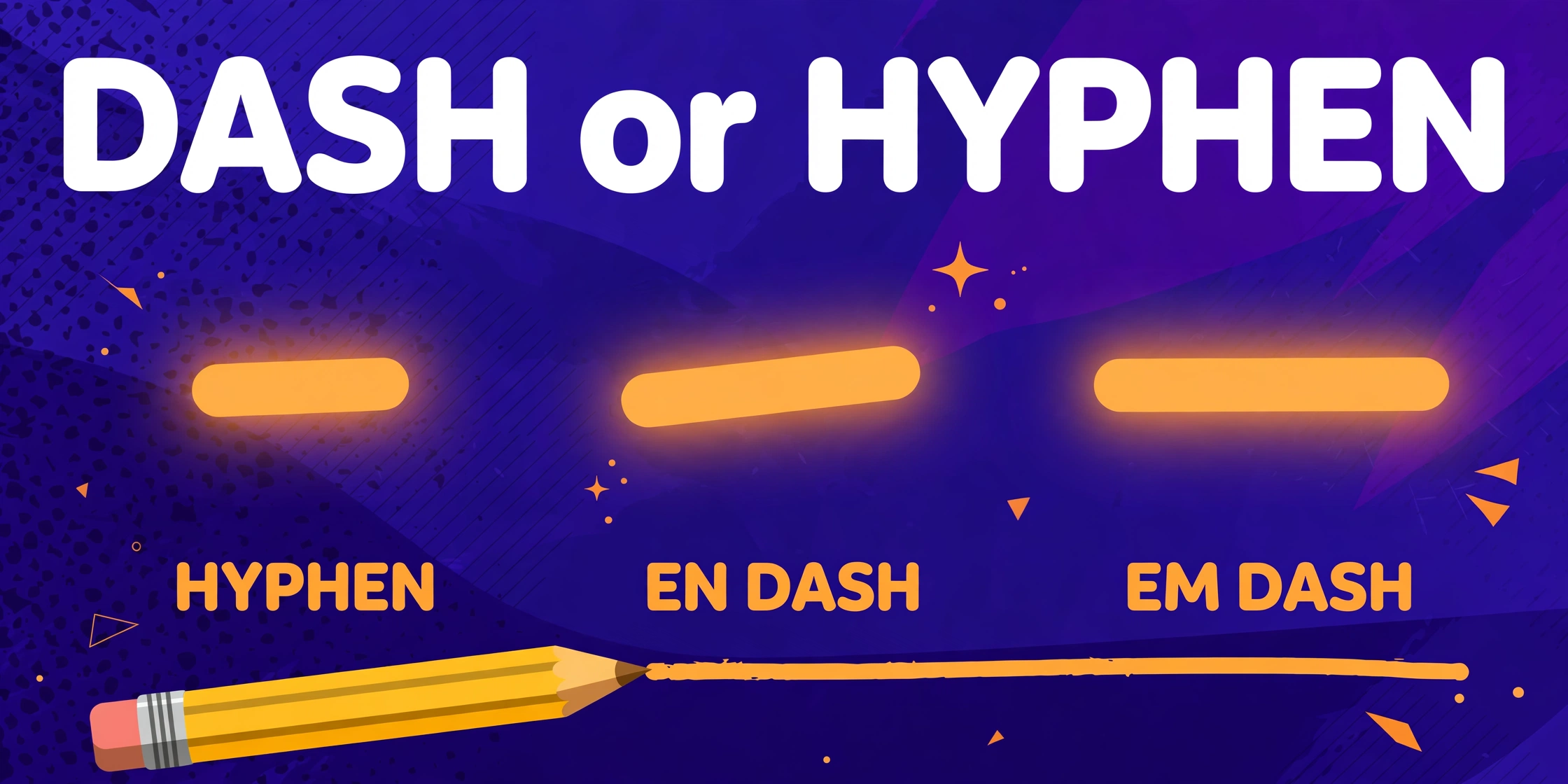
A hyphen joins things together. A dash pulls them apart — or, in the case of the en dash, stretches between them. The two marks look like the same short horizontal line at different lengths, and on most keyboards only one of them, the hyphen, has its own key. But they are different punctuation marks with different jobs. The hyphen (-) is the shortest of the three marks and it joins words. The en dash (–) is longer and it marks ranges. The em dash (—) is the longest and it marks a break in a sentence.
Quick Answer: Use a hyphen (-) to join words into compounds — well-known, twenty-seven — and to split a word at the end of a line. Use an en dash (–) for ranges and connections — pages 12–16, September–December. Use an em dash (—) for a break, an aside, or an interruption — “The plan — the one nobody had read — was approved.” Never use a hyphen where a dash belongs, or a dash where a hyphen belongs.
What the Dictionaries Say
Cambridge Dictionary defines the hyphen as a B2 noun, pronounced /ˈhaɪ.fən/: “a short stroke (-) which is used to join two parts of a word or phrase, as in co-exist; a sleeping-bag; a well-thought-out plan.” It also notes the second use: showing that a word has been split into two parts at the end of one line and the start of the next. The definition is short because the job is narrow: the hyphen joins, and it divides words, and that is all it does.
Dash is a broader word. Cambridge lists it as a B2 noun, pronounced /dæʃ/: “the symbol – used to separate parts of a sentence.” Its entries for the two named dashes are more specific. The em dash is “a long dash (= the symbol —), used especially when typing on a computer or in printing to separate parts of a sentence,” and Cambridge adds a warning that belongs in this article: “You should not use a single hyphen to represent an em dash.” The en dash is “a short dash (= the symbol –), used especially when typing on a computer or in printing to separate numbers.” Merriam-Webster’s guide fills in the detail: the em dash “can function like a comma, a colon, or parenthesis,” and the en dash “is most often used between numbers, dates, or other notations to signify ‘(up) to and including.’”
The names come from typesetting. An em dash is roughly the width of a capital M in a given typeface; an en dash is roughly the width of a capital N. The hyphen has no such pedigree: it comes from the Greek hyphen, “together” — a mark that puts two things together under one word. The etymology is the definition: the hyphen unites, and the dashes divide or extend.
The Hyphen: Joining Words Together
The hyphen’s first job is the compound word. When two or more words work together as a single idea before a noun, the hyphen binds them: a well-known author, a high-speed train, a state-of-the-art system. The rule of thumb is that the hyphen is needed when the first word modifies the second rather than the noun: in “a man-eating dog,” the hyphen tells you the dog eats men, while “a man eating dog” describes a man eating a dog.
Its second job is numbers and fractions. Compound numbers from twenty-one to ninety-nine take a hyphen — twenty-seven, forty-two — and so do fractions used as adjectives — two-thirds of the cake. Its third job is prefixes: co-exist, re-examine, anti-inflammatory, and the cases where a prefix would otherwise collide with the word it joins, as in re-cover (to cover again) against recover (to get better). And its fourth job is splitting a word at the end of a line, so that under- ends one line and standing begins the next.
The hyphen has one typographical rule that never changes: it takes no spaces around it. Well-known is correct; well ‑ known is not. This is the easiest way to tell a hyphen from a dash at a glance in edited text, because dashes are often — though not always — spaced. If the mark has spaces on both sides, it is almost certainly a dash, not a hyphen.
The Em Dash: The Break in the Sentence
The em dash is the longest of the three marks, and it does the most dramatic work. Its first job is the interruption: a sudden break in a sentence, a change of direction, a thought cut off. “I was going to say — never mind.” A pair of em dashes sets off an aside, the way commas or brackets would, but with more force: the material between them is emphasised rather than tucked away.
Its second job is the colon’s job, done with more drama: an em dash introduces a clause that explains, expands, or summarises what came before. “There was only one thing left to do — leave.” Its third job is to mark interrupted speech — “But I thought —” she began — and its fourth is attribution: an em dash precedes the name of the author or source at the end of a quoted passage.
Spacing is where the conventions split. In American style, the em dash is usually unspaced — “word—word” — while in British style, the spaced en dash is often used for the same job — “word – word.” Neither is wrong; what matters is consistency within a document. What is wrong is using a single hyphen for the job. Most word processors will convert two hyphens into an em dash automatically, and on Windows the em dash is Alt-0151 and the en dash Alt-0150; on a Mac, the em dash is Shift-Option-hyphen and the en dash is Option-hyphen.
The En Dash: Ranges and Connections
The en dash is the least loved of the three marks — Merriam-Webster says so outright — because it has no key on a standard keyboard and most writers never meet it. But its job is precise. Its first and most important use is the range: numbers, dates, and times, where it means “up to and including” or “to.” “Pages 12–16.” “September–December.” “Open 6:00 a.m.–6:00 p.m.” In each case the en dash replaces the word to, and Merriam-Webster notes that you should not use both: write “pages 12–16,” not “from pages 12–16.”
Its second use is connection: linking two things of equal weight, such as scores and directions. “The final score was 43–8.” “The London–Paris train.” Its third use is the compound adjective built on an open compound — a phrase that already contains a space. “New York–style pizza” needs an en dash, because the hyphen would attach style to York alone, while the en dash attaches it to the whole of New York. “Chicago-style pizza,” by contrast, takes a hyphen, because Chicago is a single word.
The Three Marks Side by Side
Lined up, the three marks are easy to tell apart: the hyphen is the shortest, the en dash is in the middle, and the em dash is the longest. In practice they are rarely lined up, which is why the confusion persists, so the reliable test is the job, not the length. Is it joining two words into one idea? That is a hyphen. Is it marking a range or a connection between equals? That is an en dash. Is it breaking a sentence or setting off an aside? That is an em dash.
| Mark | Length | Job | Example |
|---|---|---|---|
| Hyphen (-) | Shortest | Joins words | well-known, twenty-seven |
| En dash (–) | Middle | Ranges and connections | pages 12–16, London–Paris |
| Em dash (—) | Longest | Breaks and asides | The plan — the one nobody read — passed. |
Correct vs Incorrect
| Incorrect | Correct | Why |
|---|---|---|
| The well known author spoke first. | The well-known author spoke first. | A compound adjective before a noun needs a hyphen. |
| Pages 12-16 cover the topic. | Pages 12–16 cover the topic. | A range of numbers takes an en dash, not a hyphen. |
| The plan ‑ the one nobody read ‑ was approved. | The plan — the one nobody read — was approved. | An aside in a sentence takes em dashes, not hyphens. |
| September-December is our busy season. | September–December is our busy season. | A range of dates takes an en dash. |
| New York-style pizza is famous. | New York–style pizza is famous. | An open compound takes an en dash; a single word takes a hyphen. |
| From 9:00-5:00 the office is open. | From 9:00 to 5:00 the office is open. | With “from,” use the word “to”; the en dash replaces “to” and should not appear beside it. |
Common Mistakes to Avoid
1. Using a hyphen as an em dash
This is the most common error in the whole trio, and it happens because the hyphen is the only one of the three marks on the keyboard. “The report ‑ all forty pages of it ‑ landed on my desk” uses hyphens for a job that belongs to em dashes. The sentence is readable, but the punctuation is wrong, and in edited writing it reads as a mistake. Type two hyphens and let the word processor convert them, or insert the em dash directly.
2. Using a hyphen for a range
“Pages 12-16” and “2019-2021” are everywhere, and in informal writing nobody objects. But the correct mark for a range is the en dash, and in edited work the hyphen is a small error that a copyeditor will fix. The rule is easy to remember: a range means “to,” and the en dash is the mark that means “to.”
3. Hyphenating after the noun
A compound adjective takes a hyphen before the noun — “a well-known author” — but not after it. “The author is well known” has no hyphen, because the words are no longer working together as a single modifier. The same applies to “a high-speed train” against “the train is high speed,” and to “a state-of-the-art system” against “the system is state of the art.” The hyphen’s job is to bind words that modify together, and once they stop modifying together, the hyphen goes.
4. Mixing dash styles in one document
Unspaced em dashes, spaced en dashes, spaced em dashes — all three conventions are used by reputable publishers, and none of them is wrong on its own. What is wrong is using two of them in the same document. Choose one convention for parenthetical breaks and keep it from the first page to the last.
Frequently Asked Questions
Is a hyphen the same as a dash?
No. A hyphen (-) is the shortest of the three marks and it joins words into compounds. A dash is longer: the en dash (–) marks ranges and connections, and the em dash (—) marks a break in a sentence. They look similar but they are different marks with different jobs.
How do I type an en dash or an em dash?
On Windows, the em dash is Alt-0151 and the en dash is Alt-0150 on the numeric keypad. On a Mac, the em dash is Shift-Option-hyphen and the en dash is Option-hyphen. Most word processors also convert two hyphens (–) into an em dash automatically, and a single hyphen between numbers into an en dash.
The Takeaway
Hyphen joins: well-known, twenty-seven, co-exist. En dash ranges: 12–16, September–December, London–Paris. Em dash breaks: an aside, an interruption, an explanation introduced with a flourish. The three marks are three lengths of the same line, but they are not interchangeable, and the test is always the job: joining, ranging, or breaking.
Sources: Cambridge Dictionary (hyphen; dash; em dash; en dash); Merriam-Webster (How to Use Em Dashes, En Dashes, and Hyphens); Oxford Learner’s Dictionaries (hyphen; dash).